
Connected Ball Technology in Football Explained
This post contains affiliate links. As an Amazon Associate, we earn from qualifying purchases.
Connected ball technology in football explained in one line: a motion sensor inside the official match ball records every touch 500 times per second and sends that data to the video officials. Adidas built it with FIFA and KINEXON, and it feeds semi-automated offside and handball checks. It tells officials when the ball was touched, never why.
That last clause matters more than the spec sheet. A sensor reads motion, so it can prove the ball moved off someone’s head or hand. It can’t see an arm, a shove, or what a player meant to do.
What follows: how the chip actually works, how it moved from the centre of Al Rihla into a panel of Trionda, the four matches where it changed the call, and what the published research says about how precise it really is.
Key Takeaways
- The 2026 Trionda moved the sensor out of the centre and into one panel, with counterweights in the other panels. Al Rihla’s sat on a suspension system at the core.
- The one peer-reviewed accuracy study I found puts Kinexon ball-tracking error at 15 cm in small-sided games, which sits awkwardly next to a quoted “99.99% accurate”.
- The sensor proves a touch happened. The referee still judges whether a handball was deliberate.
- You can’t buy the chipped match ball. Adidas said the 2022 connected version wouldn’t go on retail sale, and I found no confirmation that shop-bought Trionda balls carry the chip.
- The “no perceived change” in how the ball plays comes from adidas’s own blind testing. I found no independent study of ball flight.
What Does the Sensor Inside the Ball Actually Measure?
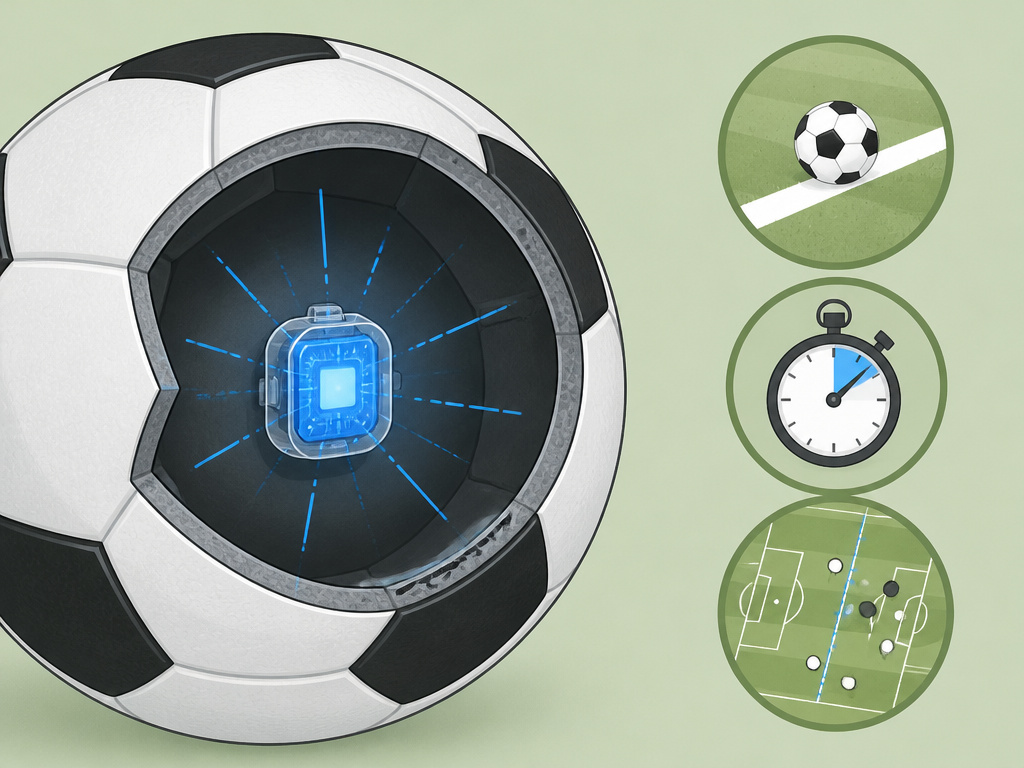
The sensor is an inertial measurement unit, or IMU: a chip that feels the ball speed up, slow down and spin. Adidas put a 500Hz version inside Al Rihla for Qatar 2022, sampling the ball’s movement 500 times per second.
An inertial measurement unit (IMU) is a motion sensor that records changes in a ball’s acceleration and rotation. In Al Rihla, a 500Hz IMU sat in a suspension system at the ball’s centre, sampling movement 500 times per second. A sudden spike in that signal marks the instant of contact, which video officials use to set the kick point.
A boot or a head striking the ball makes a sharp jolt in that signal. A ball flying freely makes a smooth one. The jolt is the touch.
The adidas Al Rihla connected ball announcement says the chip runs on a rechargeable battery charged by induction. Adidas developed it with FIFA and KINEXON, which FIFA names its Preferred Provider for Live Player and Ball Tracking. FIFA’s Johannes Holzmuller called it the culmination of three years of research and testing.
Testing ran with professional and grassroots clubs, including blind tests. Adidas says that included the FIFA Arab Cup and the FIFA Club World Cup 2021 in Abu Dhabi.
Why the Kick Point Is the Number Offside Needs
Offside is judged at the moment a teammate plays the ball. Get that moment wrong by a frame and the defensive line gets drawn in the wrong place. Before the chip, officials picked that frame from video by eye.
Honestly, this is the bit of the whole system I rate highest. The ball data alone draws no lines. Adidas says it combines with player position data and artificial intelligence, which is where football tracking data comes in, and together they feed semi-automated offside technology.
(I spent years as a right back stepping up a yard after everyone else, so I’ve got a soft spot for anything that judges the line fairly.)
The Four-Step Trip From Boot to VAR Screen
- The ball gets struck and the IMU registers a sharp change in acceleration. If the battery is flat, there’s no reading at all and the officials are back to video alone.
- Data reaches the Video Match Officials within seconds, according to adidas. Without that feed, the VAR team has to hunt for the kick frame manually, which is slower.
- The touch moment joins player positions to set the offside line. A wrong kick point here means a correct line drawn at the wrong instant.
- A human makes the call. Skip this step and you’ve handed interpretation to a chip that was never built for it.
Al Rihla to Trionda: The Sensor Moved Into a Panel
Pick up a Trionda and you’ll see red, green and blue. Those colours honour the three hosts: Canada, Mexico and the United States. The surface is textured for grip in wet or humid conditions, per adidas.
The 500Hz IMU is hidden. Adidas, in the release the Welsh FA republished, describes it as side-mounted inside one of the panels. That’s a real design break from 2022, and most explainers skip it.
| Detail | Al Rihla (2022) | Trionda (2026) |
|---|---|---|
| Sensor position | Centre, on adidas Suspension System | Side-mounted, inside one panel |
| How it stays balanced | Sensor sits at the centre | Counterweights in the other panels |
| Sensor type | 500Hz IMU | 500Hz IMU |
| Where data goes | Video Match Officials, real time | VAR system, real time |
| Charging | Rechargeable, by induction | Not stated in the release I read |
Why does placement matter so much? A ball spins around its centre of mass. Put a chip at the dead centre and the balance stays where it would be anyway. Put it in a panel, and that side gets heavier unless something on the other side cancels it out.
How Trionda Balances an Off-Centre Chip
Counterweights in the other panels do the cancelling. That works on paper. I found no published data on whether the balance holds after a season of wear or after the panels take on water.
There’s also disagreement on where the chip sits. Some 2026 explainers still describe it at the geometric centre on elastic straps. I’m going with the adidas copy, since it’s the manufacturer describing its own ball.
Easy to miss: Most “how it works” pieces describe the 2022 centre-mounted design and apply it to every ball since. Trionda’s chip lives in a panel, and the balancing job falls to counterweights.
Select iBall Takes a Third Route
The Select iBall puts its sensor in the bladder layer, balanced by counterweights around the circumference, according to the sports-engineering site engineeringsport.co.uk. So that’s three placements: centre, panel, bladder.
Between Al Rihla and Trionda, the same 500Hz system ran in Al Hilm, which debuted on 12 December 2022 in the Argentina v Croatia semi-final. Al Hilm also switched to water-based glues and inks. Oceaunz used it at the 2023 Women’s World Cup and Fussballliebe at Euro 2024, the first European Championship ball to carry it. If you follow the lineage of World Cup footballs, that’s the moment the chip stopped being a one-off.
Which other leagues use a sensor ball? I couldn’t pin that down from a primary source, so I won’t guess.
Four Calls the Ball Changed, From Qatar to Toronto
28 November 2022 is the date most fans first heard about the chip. Portugal v Uruguay. Ronaldo rose for a cross, and adidas later said there was “no external force” on the ball. The goal went to Bruno Fernandes.
| Date | Match | What the sensor showed |
|---|---|---|
| 28 Nov 2022 | Portugal v Uruguay | No Ronaldo touch; goal to Fernandes |
| 17 Jun 2024 | Belgium v Slovakia | Openda handball; Lukaku goal ruled out |
| 29 Jun 2024 | Germany v Denmark | Andersen handball; Havertz penalty, 2-0 |
| 2 Jul 2026 | Portugal v Croatia | Matanovic head touch; equaliser cancelled |
Fernandes saw it differently. “The feeling I had at the time was that Cristiano touched the ball,” he said. Two accounts, one goal.
I find the sensor more persuasive on a glancing contact like that. But it’s adidas reporting on its own product, and FIFA owns and manages the raw data, so nobody outside has published the trace. That’s worth holding onto.
Belgium v Slovakia brought the chip to broadcast. The ESPN VAR review of Lukaku goal calls it the first use of UEFA’s “snicko” heartbeat graphic. On screen it reads like a medical monitor: a flat line, then a sharp spike at the instant the ball brushed Openda’s hand.
Twelve days later, a sensor-confirmed touch on Joachim Andersen’s hand led to Kai Havertz’s penalty in a 2-0 Germany win. UEFA said the sensor timed the contact to 0.05 seconds.
Every match leaves a clue, and in the 2026 round of 32 the clue was inside the ball. In the 2026 round of 32, the sensor picked up a Matanovic head touch that video couldn’t show. That put Pasalic offside and cancelled Gvardiol’s stoppage-time equaliser. FIFA, as reported by AP, said the sensors were “capable of determining any slight contact.”
Think about that one. Video couldn’t confirm it or rule it out. The chip was the only witness.
Connected Ball Technology in Football Explained Next to Goal-Line Tech
Lumping the chipped ball in with goal-line technology muddles two different jobs. I judge every piece of officiating kit by the problem it was built to fix, and these three fix different problems:
- Goal-line technology answers one question: did the whole ball cross the line?
- The connected ball answers when the ball was touched, and whether it was touched at all.
- Semi-automated offside takes that touch moment, adds player positions and AI, and draws the line. It needs the ball data to know which instant to freeze.
Goal-line technology settles a geometry question after the fact. The chipped ball settles a timing question. Neither can tell the referee if a challenge was a foul.
I think of the offside system as joinery. The ball sensor is one well-cut piece, the camera tracking is another, and the strength comes from how they fit. A brilliant sensor bolted to sloppy tracking is a table held up by nails and optimism.
If the question is “did the ball move?”, trust the chip. If the question is “should that count?”, you’re back to a human with a whistle.
A quick note on American football’s chipped balls, since readers ask. I haven’t found a primary source I’d stake a paragraph on, so I’m leaving it out.
How Accurate Is a Ball That Feels Its Own Touches?
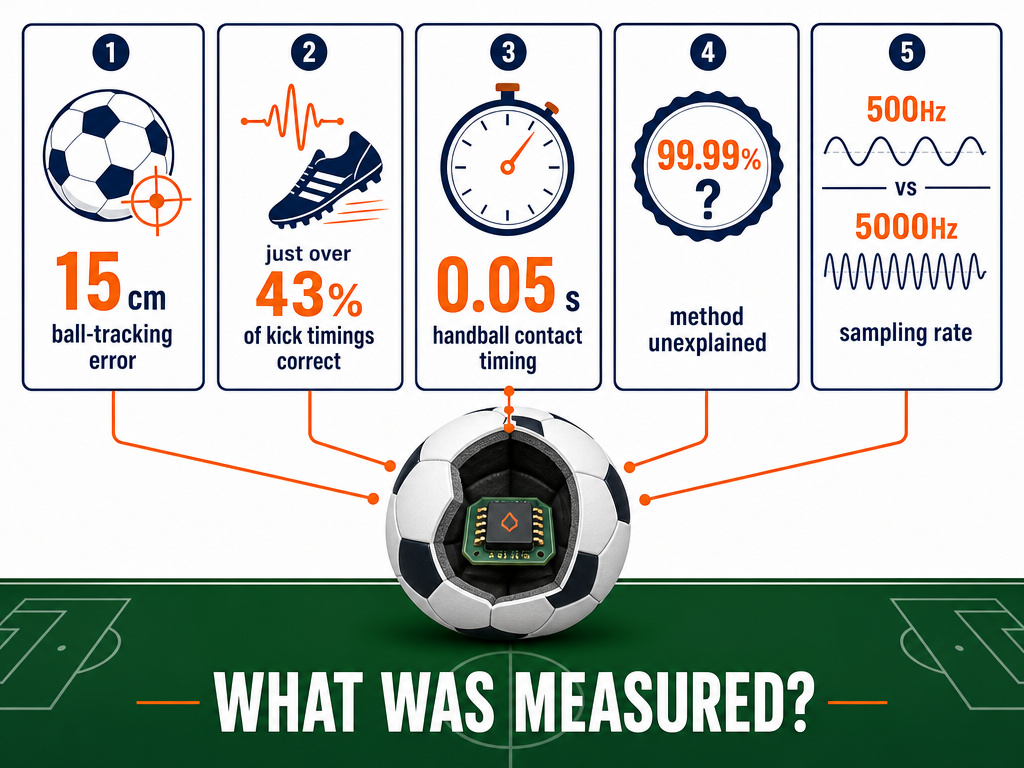
15 cm. That’s the 2D ball-tracking error a 2021 peer-reviewed validation of Kinexon tracking in Sensors found in small-sided games, measured against infrared motion capture. Impact-location error was 17 cm for shots and 21 cm for throws.
Two more details from that study stand out. Ball error was larger than player error. And the authors said sensor positioning inside the ball must be further reviewed. I could only read the summary figures, since the full text was blocked to me.
Older work points the same direction. The ISBS accelerometer kick detection study used a mechanical kicking limb for six punt kicks at six angles. Just over 43% of contact and release timings were correctly identified from the accelerometer data. The authors recommended a sensor with a higher acceleration range.
That’s a different sport and a different sensor. It still shows that timing a touch from inside a ball is hard.
| Claim | Who says it | What it measures |
|---|---|---|
| 15 cm ball-tracking error | Blauberger et al., Sensors 2021 | Ball position, Kinexon system |
| Just over 43% of timings correct | Ellens et al., ISBS 2017 | Kick timing, accelerometer |
| Contact timed to 0.05 s | UEFA, Euro 2024 | Timing of one handball touch |
| “99.99% accurate” | Georgia Tech’s Tentzeris, via AP | Ball position, method unexplained |
| 500Hz vs 5000Hz | adidas vs some 2022 outlets | Sampling rate |
The sampling-rate row deserves a word. A faster sensor takes more readings per second, so a very brief contact falls across more of them and stands out more clearly. Adidas says 500Hz. Some 2022 reports said 5000Hz. I’m going with the manufacturer.
I watch football with my eyes and a notebook, so I won’t pretend I can reconcile 15 cm with 99.99%. They measure different things. Whenever either number gets quoted at me, I ask what was measured, against what, and on which ball.
What the Chip Can’t Decide (and Shouldn’t Be Asked To)
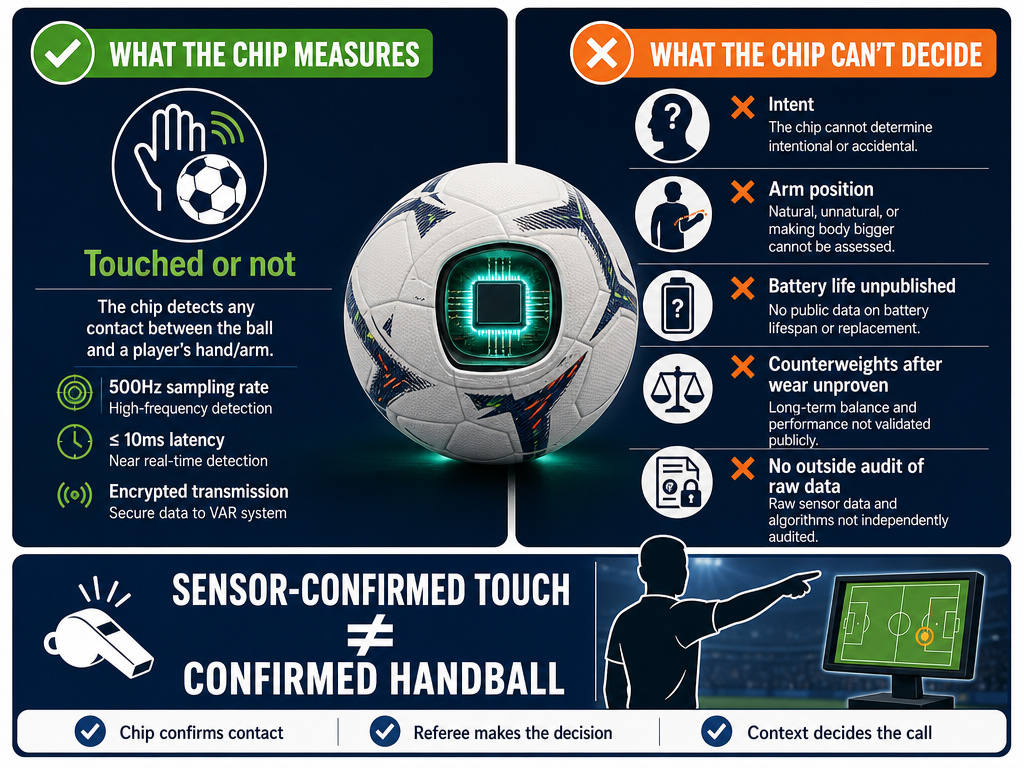
Intent is invisible to a sensor. In the Openda case, the chip confirmed contact and the referee still had to judge the handball itself.
My view on VAR hasn’t changed in years. It works on clear factual calls and struggles when asked to settle interpretation. The chipped ball is the purest factual tool football has ever had. It answers “touched or not” and stops there.
Fair enough, but plenty of coaches hate where that leads. Denmark’s Kasper Hjulmand called the Euro 2024 handball rules “ridiculous.” ESPN’s VAR review asked: “If you need ‘snicko’ to prove the handball, is it really that consequential?”
I’d side with ESPN on that question. A touch so faint it needs a sensor rarely changes what the attacker could do with the ball. That’s a rule problem, though. The chip did its job.
What the chip can’t do, based on everything I could source:
- Judge intent or arm position.
- Get checked by video on a touch the cameras can’t see, as in Toronto.
- Promise it’ll last a match. FIFA and adidas haven’t documented battery life, or charging between halves and after extra time.
- Prove that Trionda’s counterweights hold after wear and water. No published data.
- Be audited from outside, because FIFA owns the raw data.
What most people get wrong: Reading a sensor-confirmed touch as a confirmed handball. The touch is the measured fact. Whether that touch breaks the handball law is a separate judgement the referee makes afterwards.
Don’t bother waiting for the sensor to end handball rows. It can’t.
Three Groups Who Want the Data: Coaches, Broadcasters and Fans
Three groups want this data beyond the VAR room: coaches, broadcasters and fans. KINEXON’s Dr. Maximilian Schmidt said accurate live ball data “will enable a new age of football analytics and fan experience.” That’s the company’s ambition, stated at launch.
Here’s where my confidence drops. I found no source spelling out what ball data clubs or broadcasters actually receive. FIFA owned the 2022 raw data outright. I’m weaker on the analytics side anyway, so I’d rather say that plainly than invent a workflow.
What I can say: the chipped version isn’t a shop item. Adidas said the 2022 connected ball would not be commercialized or sold at retail. I found no confirmation that retail Trionda balls carry the chip.
So if you’re buying a Trionda for the back garden, buy it for the grip and the colours. For touch counts and kick data on a park pitch, smart soccer balls are their own consumer category. None of them is the FIFA system.
Frequently Asked Questions
What is connected ball technology in football?
It’s a motion sensor built into the official match ball that records the ball’s movement and reports touches to the video officials. Adidas developed it with FIFA and KINEXON. It first appeared in a World Cup ball with Al Rihla in 2022.
Can you buy a football with the connected ball sensor?
Not the official one. Adidas said the 2022 connected match ball would not be sold at retail. I found no confirmation that shop-bought Trionda balls include the chip either.
Does the sensor change how the ball flies?
Adidas says no, and its blind testing with professional and grassroots clubs found no perceived change. That’s the manufacturer’s own testing. I found no independent study of ball flight, and nothing on how Trionda’s counterweights hold up over time.
How is the sensor inside the ball charged?
The Al Rihla sensor ran on a rechargeable battery charged by induction, so no port breaks the ball’s surface. Neither FIFA nor adidas has published battery life or how the ball gets topped up between halves.
Did Cristiano Ronaldo touch the ball against Uruguay in 2022?
Adidas said its sensor detected no external force when Ronaldo went for the header, so the goal went to Bruno Fernandes. Fernandes said his feeling at the time was that Ronaldo had touched it. The raw sensor data belongs to FIFA and hasn’t been published.
Before You Go
One limit I’d put above everything else here: the best accuracy evidence available is about ball position, measured by researchers, while the calls that make headlines are about touch timing, measured by the people who sell the system. Those overlap less than the marketing suggests.
So here’s a first step for your next match. When a decision hangs on the sensor, ask which question it answered. If it’s “was the ball touched, and when?”, that’s connected ball technology in football explained at its strongest. If anyone claims it settled “was it deliberate?”, they’ve gone past what the chip can know.
I’ll admit I came to this sceptical and left more impressed with the offside side of it than the handball side.
Would you keep the sensor for offside and switch it off for handballs?
