
How Goal Line Technology Works in Football: Step-by-Step
This post contains affiliate links. As an Amazon Associate, we earn from qualifying purchases.
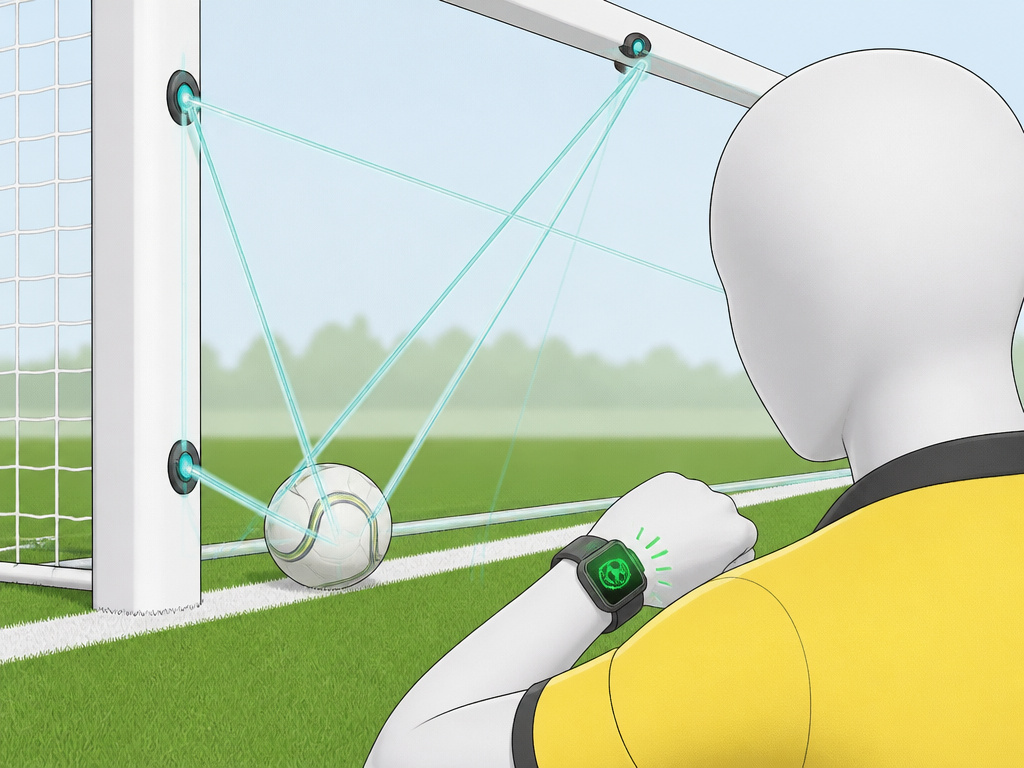
Goal line technology works in football by tracking the ball with high-speed cameras, seven per goal, or a magnetic field. Software checks whether the whole ball crossed the line and sends a signal to the referee’s watch within one second. The referee keeps the final say and can overrule it.
That signal goes to the match officials and nobody else. IFAB, the body that writes the Laws of the Game, insisted the technology must never interfere with play. So FIFA’s standard rules out stoppages completely: no pause and no screen, just a result on the referee’s wrist while the game carries on.
What follows covers the six steps of a single goal decision, the two hardware families, the accuracy figures that sources still disagree on, and the nights the system went blind.
Key Takeaways
- The test is the whole of the ball between the posts and under the crossbar. A ball that’s mostly over the line is still in play.
- FIFA certification is valid for 12 months for each stadium installation, and the system needs a retest after that.
- FIFA says the 2026 World Cup system runs on 14 high-speed cameras, and the ball’s sensor plays no part in goal decisions.
- A silent watch can mean no goal or a blinded camera system. At Villa Park in 2020, VAR didn’t step in because no signal arrived.
- Accuracy figures vary by source and year: +/-3 cm in IFAB’s 2012 manual, 1.5 cm in 2014, and a reported 4 mm for Hawk-Eye.
What Does Goal-Line Technology Actually Decide?
Law 10 sets a stricter test than most fans apply from the stands, and it sits at the heart of how goal line technology works in football. Fraunhofer IIS, the German research institute behind one of the original systems, quotes it plainly: a goal counts only when the whole of the ball passes over the goal line, between the posts and under the crossbar.
Goal-line technology is a technical system that determines whether the whole of the ball has crossed the goal line between the posts and under the crossbar. Licensed camera systems use seven cameras per goal mounted high in the stadium. The result reaches only the match officials within one second, and the referee keeps the right to overrule the system.
Whole ball. That’s the bit that fools the eye. Seen from behind the net, a ball with most of its body past the line looks like a goal. It doesn’t count until the last sliver clears the line.
The FIFA Quality Programme for goal-line technology describes the job in one line: instantly deciding whether the whole ball has crossed. That’s the only question it answers. It has nothing to say about a foul in the build-up, an offside, or a handball on the way in.
I like that narrowness. In my view, officiating technology works best when it’s given a yes-or-no question with a physical answer, and this is the cleanest example football has. VAR gets into trouble when it has to interpret something. Nobody needs to interpret whether a ball crossed a line.
FIFA’s standard also says only the match officials receive the signal, on their watches. Nobody else sees it unless the competition organiser chooses to show a replay. So the crowd finds out the old-fashioned way, by watching the referee.
How Goal Line Technology Works in Football, in 6 Steps
A shot skids off the keeper’s glove, clips the inside of the post and spins along the line. Every player on the pitch turns to look at the referee. Here’s what happens inside that second, based on FIFA’s descriptions of the licensed camera systems.
- The cameras pick up the ball as it comes into range of the goal area. Licensed systems use seven per goal, mounted as high as the stadium allows, because a low camera loses sight of the ball behind the first body in a crowded six-yard box.
- Software combines footage from every camera to fix the ball’s position. If the calibration is off, the system is measuring against the wrong line. That’s why FIFA wants calibration done with competition goals, lighting and markings in place.
- The system checks for the whole ball over the line. Anything less means no goal and no signal at all.
- A signal reaches the officials’ watches within one second. On GoalRef, encoded radio carries it to a watch that shows the result and vibrates.
- The referee decides. FIFA’s guidance says the referee can always overrule the system. Without that safeguard, a machine fault would be the final word.
- Replays come last, if they come at all. On 2 March 2013, IFAB agreed that each competition organiser decides whether goal-line replays appear on broadcasts or giant screens. FIFA recommends a 3D animation built from system data, because ordinary video can’t guarantee it shows a heavily obscured ball.
That buzz on the wrist is the whole interface. There’s no monitor to jog over to and no conversation in the earpiece. The referee feels the watch vibrate against the wrist, glances down, and points to the centre circle.
On a crowded line, I’d rather see the animation than the broadcast replay. The animation comes from the same data the referee received. The TV angle comes from wherever a camera operator happened to be standing.
Seven Cameras per Goal vs Three Copper Coils in the Ball
Seven is FIFA’s camera count per goal for currently licensed camera systems. The other family barely needs cameras, because it reads a magnetic field instead. IFAB approved one of each, Hawk-Eye and GoalRef, on 5 July 2012.
The Camera Systems: Hawk-Eye and GoalControl
Hawk-Eye is the name most fans know. It’s the same company that tracks the ball in tennis and cricket. For the Premier League launch, NBC Sports reported seven cameras at each end, mounted high on the roof, tracking the ball as it came into range.
GoalControl, a rival camera system, worked the 2014 World Cup in Brazil. FIFA’s World Cup setup now uses 14 high-speed cameras on the catwalk or under the roof, which works out to seven per goal.
One detail catches people out. FIFA’s 2022 World Cup goal-line technology page says the 2026 system ignores the sensor inside the match ball when deciding goals. That surprises anyone who has read about connected ball technology and assumed the chip makes the call.
The Magnetic Option: GoalRef and the Select iBall
GoalRef came out of the Fraunhofer Institute for Integrated Circuits IIS in Erlangen. Project spokesman Rene Dunkler kept the explanation simple: “The technology works in a similar way to that of the theft protection of a department store.” Antennae create a weak magnetic field around the goal, and thin coils inside the ball disturb that field as it nears the line.
According to ScienceNordic, the ball carries three copper coils that cover every part of it, so it registers however it crosses. The antennas sit in the goalposts and crossbar. Project head Ingmar Bretz described the system as “a bit like an invisible curtain which hangs behind the crossbar and the goal-line.”
The ball is the catch. Select built the test ball, sold as the iBall and also under the Derbystar name. Select’s chief executive Peter Knap said the challenge was a ball that could survive “even a shot from Ronaldo” and still talk to the goal.
Which Design I’d Back, and Where Sources Disagree
For a league with many grounds and several ball suppliers, I’d back a camera system like Hawk-Eye. It doesn’t depend on a special ball, and FIFA’s own World Cup setup uses cameras. GoalRef has one theoretical edge I keep coming back to. A magnetic field doesn’t need line of sight, so a pile of bodies on the line shouldn’t blind it the way bodies blinded Hawk-Eye at Villa Park.
That’s my reasoning, not a tested claim. I haven’t found a source that measured it.
The sources don’t agree on the hardware either. CORDIS describes ten antennae behind the posts and crossbar. ScienceNordic places ten plastic-coated antennas inside them. FIFA’s general description of magnetic systems mentions cables laid underground around the goal. Even the camera count varies: StadiumDB reported six for Hawk-Eye in March 2013, while FIFA and NBC Sports both say seven per goal.
Why Did Football Finally Say Yes in July 2012?
I check any football story with a suspiciously neat punchline twice. The habit started after I repeated a tidy tale that turned out to be embellished. Goal-line technology has the neatest punchline in officiating: a famous blunder, then a machine that ends blunders. So I went back to the paperwork.
The paperwork holds up, with one correction. CORDIS reports that IFAB investigated technical aids after several incorrect rulings, including England’s disallowed goal against Germany at the 2010 World Cup. Eight systems went through initial testing, against criteria set by EMPA, the Swiss Federal Laboratories for Materials Science and Technology. Two made the next phase.
I’d go easy on the line that goal-line technology exists because of one famous goal. The England-Germany incident is on the record, but CORDIS lists it as one of several wrong calls. A neat origin story tends to bury the duller truth: a long run of bad decisions that nobody could fix from the touchline.
In the second phase, EMPA’s testers put each system through lab work, field tests, training sessions and live professional matches. They evaluated several thousand goals per system. A Select representative told ScienceNordic the tests even included snow on the pitch and smoke from fireworks.
Then came a quiet debut. Both systems went to the Club World Cup in Japan in December 2012, and Inside World Football reported the technology was never called into action. The Premier League switched on its Goal Decision System in all 20 stadiums from 17 August 2013. NBC Sports reported it would have been used 31 times the season before, with three decisions reversed.
Rewind a second. Germany held out longer. On 18 October 2013, Stefan Kiessling’s header for Leverkusen at Hoffenheim went in through a hole in the side netting, and referee Felix Brych gave the goal. Hoffenheim’s Alexander Rosen remembered seeing the net bulge and feeling relieved, until a Leverkusen player started celebrating.
The DFB sports court refused a replay. By Hoffenheim’s account, the Bundesliga brought in goal-line technology about a year later.
Would the machine have stopped it? My honest read is inference, not fact. The ball never crossed the line between the posts, so a working system would have sent no goal signal. Whether Brych would have trusted a silent watch over a bulging net, nobody can say.
Brazil 2014 delivered the first World Cup goal-line technology decision. Benzema’s shot hit the post, and Honduras keeper Noel Valladares seemed to keep it out. GoalControl showed the ball had trickled over, and France went 2-0 up in the 48th minute with an own goal.
How Accurate Is It: 3 cm, 1.5 cm or 4 mm?
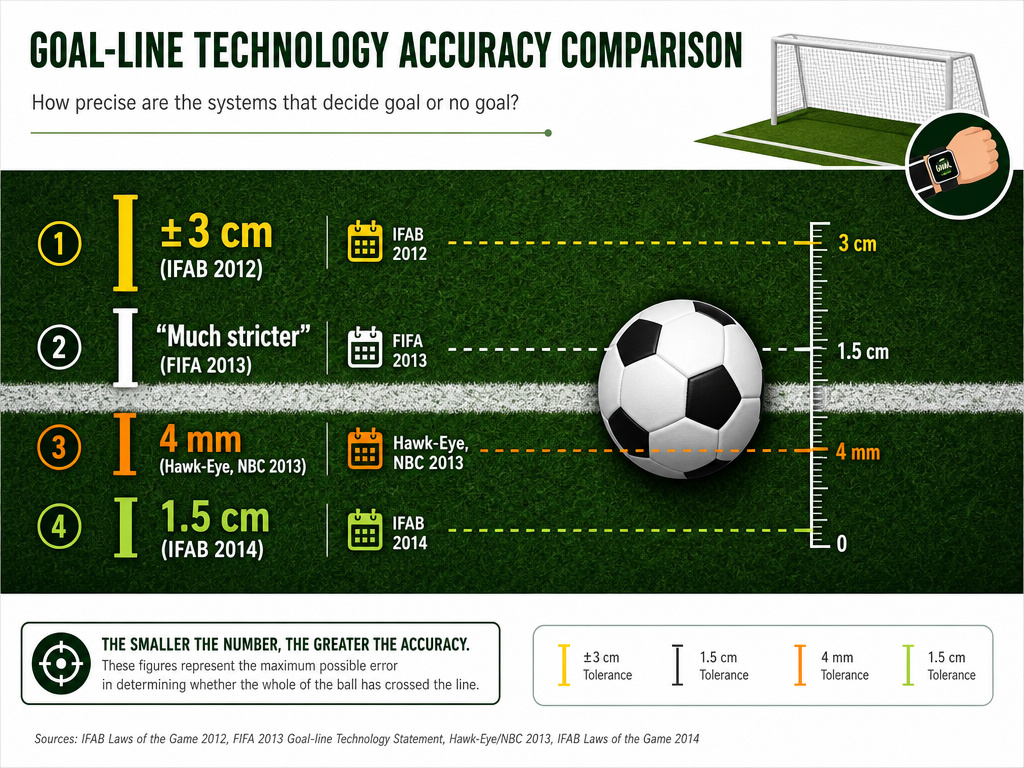
Ask how accurate goal-line technology is and you’ll get a different answer depending on which year’s paperwork the writer used. Sources from 2012 to 2014 give three different standards, plus a reported figure for Hawk-Eye.
| Source | Figure | What it refers to |
|---|---|---|
| IFAB 2012 Testing Manual | +/-3 cm | Maximum margin of error |
| FIFA spokesman, January 2013 | “Much stricter” than 3 cm | Said the 3 cm ruling no longer applied |
| NBC Sports, August 2013 | Within 4 mm | Hawk-Eye’s Premier League system |
| IFAB 2014 Testing Manual | 1.5 cm | Tightened margin of error |
Herbert Fandel, then head of refereeing at the German FA (DFB), raised doubts in January 2013. “There are doubts as to see whether the goal-line works 100%,” he said. He pointed to England’s Euro 2012 match against Ukraine, where the ball was only a few centimetres behind the line.
His logic holds. A margin of error works in both directions. When the gap you’re measuring is smaller than the tolerance, the system can call it either way and still be “within spec”.
IFAB tightened the standard to 1.5 cm in the 2014 manual. Inside World Football reported the change drew on the 2012 Club World Cup, the 2013 Confederations Cup and Premier League feedback.
I’ll be straight with you. I couldn’t get hold of FIFA’s current testing manual, and data isn’t my strongest suit. Treat 1.5 cm as the last figure I can source, not the final word.
The Certificate That Runs Out After 12 Months
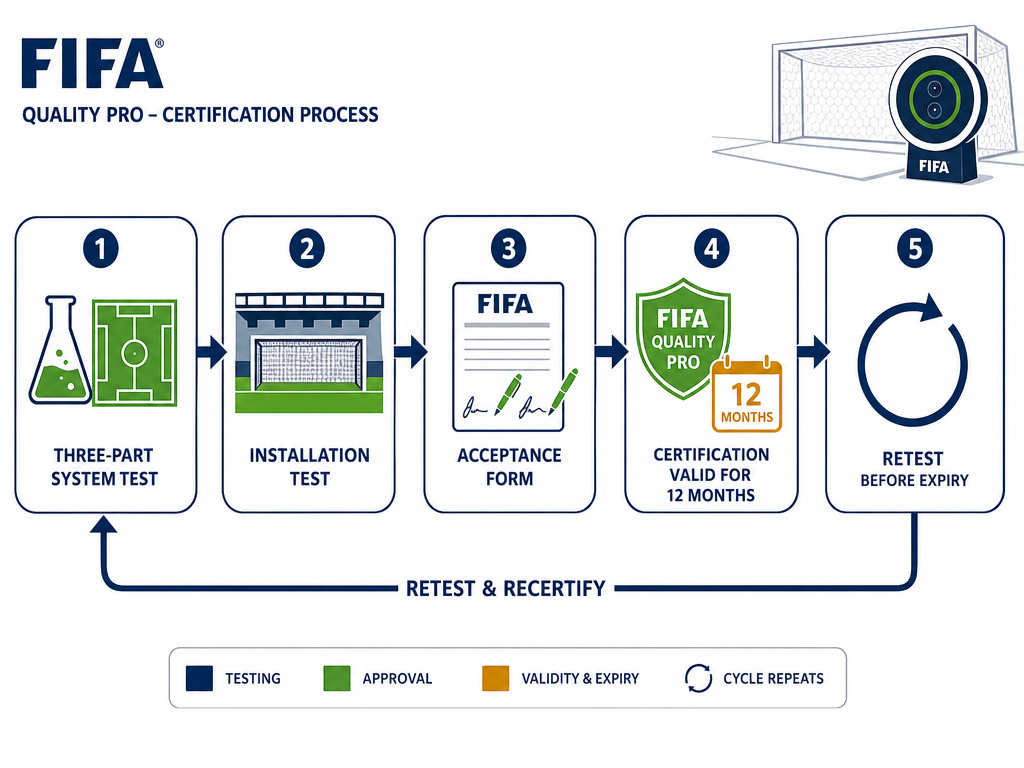
One good test result covers one stadium. Under the Laws of the Game, any goal-line system used in competitive matches must be certified under the FIFA Quality Programme. That certification belongs to each installation, not to the brand.
FIFA’s process runs in this order:
- A system test in three parts: lab tests, field tests and real game situations.
- A final installation test at the specific stadium, checking the system works and is accurate there.
- An acceptance form signed by the test institute and the competition organiser, then sent to FIFA.
- Certification. The installation can be used for official matches for 12 months.
- A retest once it expires.
Installation takes about a week, and longer at awkward venues. The provider needs the pitch, the floodlights and the technical areas, so groundstaff are part of the job from day one. At busy stadiums, FIFA wants calibration done in real match conditions, with competition goals, competition lighting and official field markings.
Think of it as joinery. A dovetail joint is strong because both halves were cut for each other. A goal-line system is calibrated the same way, against one stadium’s goals, lights and lines. Change the frame and the measurement sits on a joint it was never cut for.
Checks continue on matchday. FIFA says the referee checks the system before each match to confirm it’s switched on and correctly calibrated. Before a World Cup, independent test institutes also check every stadium.
Easy to miss: Certification covers one installation for 12 months. Once it lapses, the system can’t be used in official matches until it passes a retest, however well it worked last season.
All of this explains why you won’t see the technology on a park pitch. FIFA tells organisers to fix scope, budget and timeline before approaching providers. They also have to choose between a centrally run system and stadiums equipping themselves. The Guardian reported a hefty bill for fitting Hawk-Eye in every Premier League ground. (On my muddy Sunday mornings, our goal-line technology was whichever substitute stood nearest the post. He was never neutral.)
What Happens When the System Goes Blind?
It was a rainy evening at Villa Park on 17 June 2020, the Premier League’s first match back after lockdown. Just before half-time, Villa keeper Orjan Nyland caught a curling free kick and was bundled back over his own line by teammate Keinan Davis. Michael Oliver pointed to his watch. No signal.
TV replays appeared to show the ball over. Hawk-Eye said the keeper, a defender and the post had blocked all seven cameras covering that goal. The company called that level of occlusion unseen in over 9,000 matches and apologised. The game ended 0-0.
The VAR detail matters more than the miss. Under IFAB protocol, the video assistant referee can check goal situations. PGMOL, which runs Premier League refereeing, said that “due to the fact that the on-field match officials did not receive a signal, and the unique nature of that, the VAR did not intervene.”
Every match leaves a clue, and this one exposed a gap. FIFA’s guidance plans for a known breakdown: if GLT malfunctions, teams are told and video officials review goal-line incidents with the available cameras. That’s one of the situations where VAR can intervene. A system that’s switched on and simply sends nothing looks exactly like a correct “no goal”.
A silent watch tells the referee one of two things: no goal, or the cameras couldn’t see. The watch can’t say which.
Failures come in a few shapes:
- Silent occlusion. The cameras can’t see, no signal goes out, and nothing tells the referee why. Villa Park, 2020.
- Declared malfunction. Everyone knows it’s broken, so VAR takes over.
- Repeated faults. France’s LFP warned GoalControl in December 2017. In January 2018 it suspended goal-line technology after two more apparent malfunctions, in Amiens v PSG and Angers v Montpellier. LFP director general Didier Quillot said: “These two irregularities are unacceptable, especially as they occur just after we put GoalControl on notice.”
- A ball outside the frame. The Kiessling header never crossed the line between the posts, so the system had nothing to measure.
Ever watched a referee tap his watch and play on while the replay screams goal? You’ve just seen the gap in action.
Goal-Line Technology vs VAR vs Semi-Automated Offside
Three systems, three jobs, and fans mix them up every weekend. FIFA is explicit that the goal-line cameras cover only the two goal areas, which is why they play no part in offside calls.
| Tool | Question it answers | Uses GLT cameras? |
|---|---|---|
| Goal-line technology | Did the whole ball cross the line? | Yes, its own goal-area cameras |
| VAR | Checks goal situations under IFAB protocol | Reviews available cameras if GLT fails |
| Semi-automated offside | Was an attacker offside? | No, separate system per FIFA |
Semi-automated offside technology runs on its own equipment. Honestly, I think it’s the most underrated tool of the three. It’s goal-line technology’s closest relative: a measuring job handed to machines, instead of a judgement call handed to a review booth.
VAR is where the arguments live, because it’s asked to judge. Goal-line technology is asked to measure. That split explains most of the anger I hear at grounds about the first and how little I hear about the second.
Where this goes sideways: Judging a goal-line call from the broadcast angle. FIFA says video can’t guarantee whether a heavily obscured ball crossed, which is why it recommends the data-built animation instead.
Don’t bother arguing a tight goal-line call from a single TV replay. Wait for the animation, if the organiser shows one.
Frequently Asked Questions
Can you explain how goal-line technology works in simple terms?
Cameras or a magnetic field track the ball near the goal. Software decides whether the whole ball has crossed the line between the posts and under the crossbar. If it has, the referee’s watch gets a signal within one second, and the referee makes the final call.
How much does goal-line technology cost?
I couldn’t find a current per-stadium figure from any source I trust. FIFA tells competition organisers to set a budget before going to tender, and The Guardian described the Premier League’s install as a hefty bill. Add a retest every 12 months, and the expense explains why it stays at the top level.
What is the rule on goal-line technology?
IFAB decided on 5 July 2012 to bring goal-line technology into the Laws of the Game, with a certification procedure attached. Any system used in competitive matches must be certified under the FIFA Quality Programme. The referee checks it before each match and can always overrule it.
Is goal-line technology still used?
Yes. FIFA says the 2026 World Cup system runs on 14 high-speed cameras. Hawk-Eye said in 2020 that its system had been in operation for over 9,000 matches.
Does goal-line technology use a chip in the ball?
It depends on the system. Magnetic designs like GoalRef rely on coils inside the ball. FIFA says the camera-based 2026 World Cup system doesn’t use the ball’s sensor data to decide goals.
Before You Go
One habit worth starting at your next match: when a ball scrambles on the line and the referee plays on, don’t assume the system said no goal. Since Villa Park, I read a silent watch as “no goal, or couldn’t see”. I wait for the animation before I argue.
There’s a limit to everything above. It assumes a certified, calibrated installation in an elite competition that can pay for one and retest it every year. Away from that level, the goal-line call is back to one official’s eyes, the way it always was.
That’s how goal line technology works in football at its best: a narrow factual question, answered on a wrist inside a second. When it fails, it fails quietly.
If a magnetic ball could have seen through that Villa Park pile-up, should the big leagues have picked the curtain over the cameras?
