
What Is a Professional Foul in Football? Card Rules
This post contains affiliate links. As an Amazon Associate, we earn from qualifying purchases.
A professional foul in football is a deliberate foul that stops an opponent or a promising attack before it becomes a chance. The Laws never use that term. Law 12 punishes it as DOGSO (denying an obvious goal-scoring opportunity), a red card, or as stopping a promising attack, a yellow card.
The split between those two labels in what is a professional foul in football carries all the drama. The same shove can earn a booking or an early shower, depending on where it happens and what was at stake. Defenders run that arithmetic in a split second: a free kick and a card on one side, a clear run on goal on the other.
What follows: the sanctions by situation, a table you can screenshot, the 1980 final that started the argument, the advantage twist, and the places where rulebooks and sources disagree.
Key Takeaways
- The Laws of the Game never say “professional foul”; the sending-off offence is DOGSO, and a lesser version is called stopping a promising attack.
- A foul that denies a goal chance outside the area is a red card; inside the area it drops to a yellow when the defender tried to play the ball.
- Holding, pulling and pushing in the area stay red even though a penalty is awarded.
- If the referee plays advantage and a goal follows, the offender gets no card at all.
- Sources disagree on when the rule became law, so I’ll show you both dates rather than pick one.
What Is a Professional Foul in Football, Under the Laws?
The phrase is a nickname. IFAB’s Law 12 never prints it, and the offence it describes is DOGSO. A referee training site, Reading Refs, goes further and calls “professional foul” always a misnomer.
Law 12 sends a player off for denying an obvious goal-scoring opportunity with a foul outside the area. Inside the area, the punishment drops to a caution when the offender made an attempt to play the ball. Holding, pulling, and pushing stay red. Referees weigh distance to goal, direction of play, ball control, and defender positions.
Wikipedia puts the idea more bluntly: a professional foul definition and history page describes a deliberate foul where the punishment hurts the fouler less than the threat would have. Fair summary. The Laws then add a layer: the punishment depends on the nature of the foul and on what chance it killed.
The four things a referee weighs
What counts as an obvious goal-scoring opportunity is left to the referee’s judgement, but IFAB gives four considerations:
- Distance between the offence and the goal.
- The general direction of play.
- The likelihood of keeping or gaining control of the ball.
- The location and number of defenders and attackers.
Judgement is the key word. Two referees can see the same tackle and disagree, and that is why these decisions start arguments in every pub I know.
The “last man” myth
Fans love saying a defender “wasn’t the last man.” Reading Refs says the phrase has never been in the Laws: “Last man? Irrelevant.” Its example is a Manchester United defender sent off for fouling Gerrard. Supporters said he wasn’t last, but the nearer defender was on the far side of the area and couldn’t have reached the ball.
So count the recovering defenders if you like. The referee is asking whether a goal chance was killed, not who stood nearest.
Red Card or Yellow? The Sanction Matrix
Forum threads about this topic keep returning to one question: does it always mean a red? It doesn’t. Location, the type of offence, and whether the defender went for the ball all change the answer.
| Situation | Sanction | Why |
|---|---|---|
| DOGSO foul outside the area | Red card | Goal chance denied |
| Foul in area, attempt to play ball | Yellow card | Penalty is the punishment |
| Holding, pulling, pushing in area | Red card | No genuine challenge |
| Deliberate handball denying a goal chance | Red card | Applies wherever it occurs |
| Careless tackle stopping a promising attack | Free kick and yellow | Attack stopped, no clear goal chance |
The red card rows deal with chances killed. The yellow card rows deal with attacks interrupted. If you want the full contrast between yellow and red cards, that guide walks through it.
The handball version
Handballs follow the same logic. A deliberate handball that denies a goal or obvious chance is a red anywhere on the pitch. A non-deliberate one outside the defender’s own area is also a red. A non-deliberate handball that denies a chance and brings a penalty is a yellow.
Notice the penalty-area softening again. The punishment shrinks when a penalty kick already exists as a remedy.
Where this goes sideways: Pulling a shirt in the area and calling it a challenge. Holding, pulling and pushing stay a sending-off even when a penalty is given, so the “I was going for the ball” defence only works if the arm never grabbed.
The same shirt pull outside the area is no safer. That is an obvious red if it kills a clear chance, and it lands in the world of serious foul play only when it crosses into excessive force, which is a separate offence.
Why Would a Defender Take the Card Anyway?
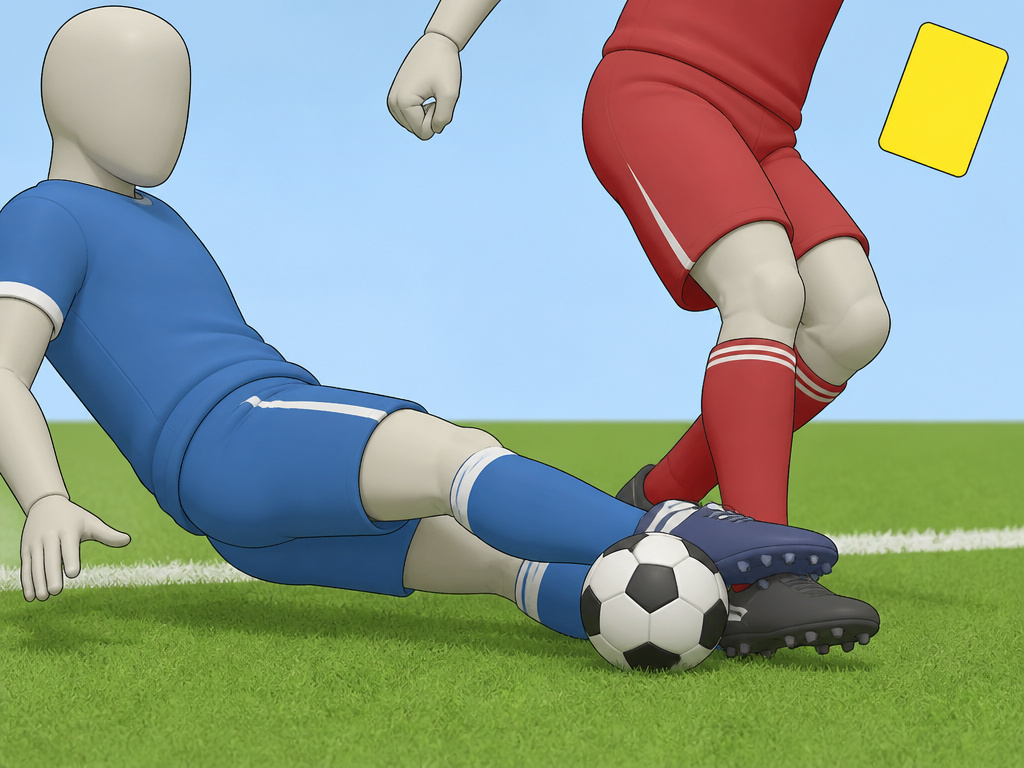
Why not just let the striker run? Because a free kick from midfield offers the attacking team a smaller chance than a one-on-one with the keeper. Wikipedia describes the same incentive: the free kick may offer a lower chance of scoring than the original position, so tactical fouling becomes rational.
I’ll say it plainly. A well-timed tactical foul is a skill, and I’d argue it’s an underappreciated one. Any defender can lunge. The hard part is picking the moment, the place, and the contact.
My view: the worst version of this is a cynical foul in a spot where the free kick is dangerous. Win time on the halfway line, not twenty yards out. The skill is stopping the move without handing over a shooting chance.
A defender’s mental checklist runs roughly like this:
- Read the runner. Spot early that the attacker is through. Wait too long and the foul happens inside the area, where holding or pulling turns it into a red.
- Choose the location. Aim to foul far from your goal. Fouling near the box gives a dangerous set piece even if the card is only yellow.
- Make it a genuine challenge. Go for the ball. A shirt tug outside the area on a clear chance is a red, while a mistimed tackle on a stopped attack may only be a booking.
- Check your card count. A defender already booked has to weigh a second caution against the damage a run on goal would do.
Better defending avoids all of it. If you want the habits that stop attackers without contact, read about defending without fouling and how the best back lines cut passing lanes early. A back line that steps up together can catch a forward offside before anybody needs to grab a shirt.
How Did the 1980 FA Cup Final Change the Rule?
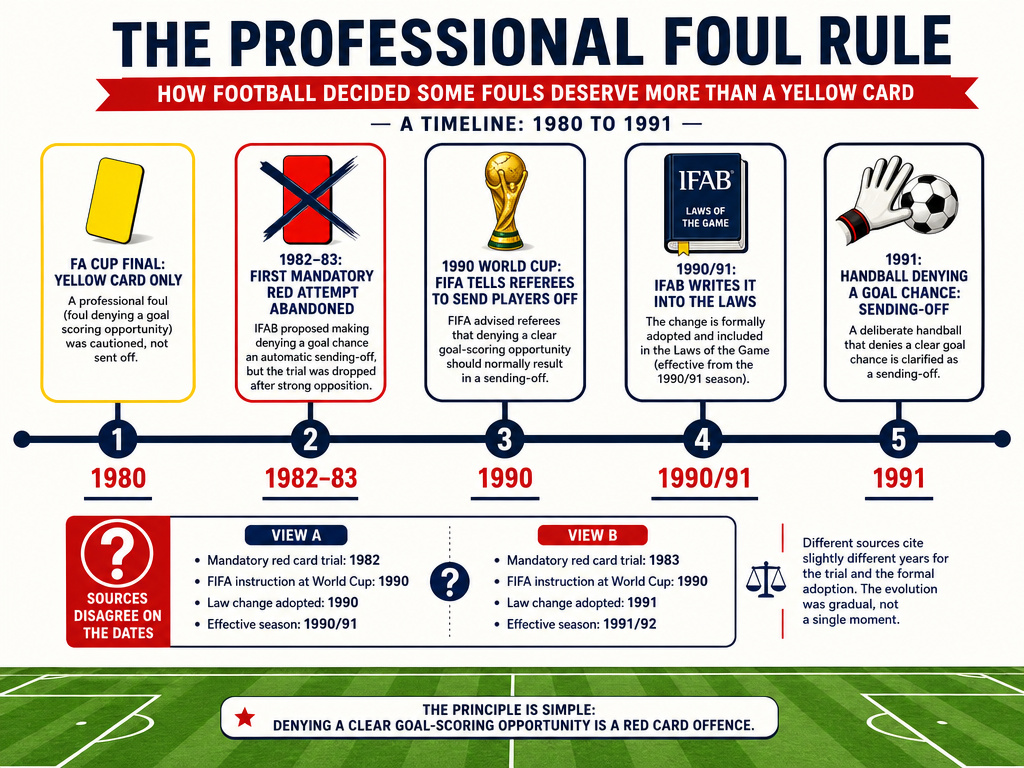
Rewind to 1980. In the FA Cup Final, Arsenal’s Willie Young deliberately fouled West Ham’s Paul Allen, who had a clear run at goal. Referee George Courtney could only issue a yellow card under the law of the day.
That moment turned a quiet tactic into a public scandal. The two sources I read tell the next chapters differently, so here they are side by side:
| Question | Reading Refs | Wikipedia |
|---|---|---|
| First attempt at a mandatory red | FA proposed it to IFAB; rejected | 1982 subcommittee recommended it; FA refereeing committee abolished it in July 1983 |
| When it became law | The year after the 1990 World Cup | IFAB fixed it into the Laws in 1990 |
| 1990 World Cup | FIFA told referees to send players off | FIFA told referees to send players off |
Both accounts agree on the 1990 World Cup instruction. They split on who killed the first attempt and on whether IFAB acted in 1990 or the following year. I can’t settle that with the sources in front of me, and I’d rather say so than guess.
One more date: in 1991, according to Wikipedia, IFAB added that a handling offence denying a goal chance should be a sending-off. That is why a goalkeeper handling outside the box can walk.
The idea exists elsewhere too. In rugby league, a professional foul earns 10 minutes in the sin bin. In rugby union, impeding a player when a try may be scored can bring a penalty try. In basketball, the same tactical thinking shows up as “Hack-a-Shaq.”
When Does Advantage Wipe the Card Out?
Sometimes the referee swallows the whistle. When advantage is played after a DOGSO offence and a goal follows, the goal stands and the offender gets no card. The logic: the attacking team kept the chance, so the offence achieved nothing.
The Laws give several worked examples:
- A defender fouls outside the area, the ball runs to another attacker, and that player scores: goal, no sanction.
- A defender deliberately handles in the area, the ball goes to an attacker who scores: goal, no sanction.
- A goalkeeper commits a DOGSO offence with a second touch on a goal kick, then the opponent scores: goal, no sanction.
- Advantage is played on a shirt pull outside the area and the shot goes over the bar: the defender is cautioned for unsporting behaviour.
That last one matters. If advantage is played and no goal comes, the offender is cautioned, not sent off. Stopping a promising attack is gentler: if the referee plays advantage or allows a quick free kick, the player isn’t cautioned for that offence.
Picture the scene. Arm out, whistle silent, the stadium holding its breath. Then either the ball hits the net and nobody cares about the foul, or it drifts over and the card appears.
Do US Rulebooks Treat It Differently?
Yes, and this trips up coaches who referee both codes.
High school: NFHS
For the 2023-24 season, the NFHS soccer rules changes 2023-24 added a new Rule 12 article and Rule 18 definitions that spell out the seven direct free kick fouls. The aim was consistency for officials interpreting misconduct. I couldn’t read the full DOGSO text, so check the NFHS PDF before relying on any wording.
College: NCAA
NISOA, the US college referees’ body, quotes NCAA rule 12.5.6 as applying to an offence punishable by a direct free kick. IFAB’s version, per the research I read, covers any free-kick offence outside the area. A commenter on the NISOA page disputes the narrower reading, so treat this as a live disagreement.
The practical effect depends on whose reading you follow: NISOA quotes NCAA 12.5.6 as limited to direct free kick offences, while a commenter on its page and IFAB’s version (per the research brief) say any free-kick offence outside the area can qualify. Not the same call you’d see in an IFAB game.
Is a professional foul the same as a cynical or tactical foul, and is it legal?
Commentators swap “professional foul”, “cynical foul” and “tactical foul” freely, and all three point at the same thing: a deliberate foul committed to break up play or stop a chance. The Laws use none of them. The offence is called DOGSO, denying a goal or obvious goal-scoring opportunity. Reading Refs calls “professional foul” a misnomer, and the Laws never mention a “last man” either.
That gap in language explains the confusion over legality. A foul is never legal, since it always gives away a free kick or penalty. Whether it also costs a card depends on the details. A careless tackle in the centre circle that stops a promising attack is a direct free kick and a yellow card for SPA. If the referee plays advantage and a goal follows, the offender gets no sanction at all. A quick free kick the referee allows can also mean no caution for SPA. So some tactical fouls end with no card, but that comes from how the referee handled the restart, not from the foul being permitted.
Frequently Asked Questions
Is a professional foul always a red card?
No. It’s a red when it denies a goal or obvious goal-scoring opportunity, and a yellow when it only stops a promising attack. Inside the penalty area it also drops to a yellow if the defender attempted to play the ball.
Is a professional foul cheating or gamesmanship?
Wikipedia describes professional fouls as usually considered gamesmanship rather than cheating. The punishments exist to deter them, but fans argue about whether the deterrent works. I lean toward calling it a calculated risk rather than a crime.
What is the “last man” rule?
There isn’t one. Reading Refs points out that the Laws make no mention of the last man. The test is whether a goal-scoring opportunity was denied, judged by distance, direction, ball control and defender positions.
What happens if a goal is scored after a professional foul?
If the referee plays advantage and a goal follows, it stands and the offender gets no sanction. If no goal comes after advantage on a DOGSO offence, the offender is cautioned for unsporting behaviour.
Do other sports have professional fouls?
Yes. Rugby league punishes it with 10 minutes in the sin bin. Rugby union can award a penalty try. Basketball has “Hack-a-Shaq,” where players deliberately foul a poor free-throw shooter.
The Bottom Line
So what is a professional foul in football? It’s a deliberate stop, punished by location, intent and consequence. Ask three questions when you watch one: where did it happen, did the defender play the ball, and was a goal chance killed? Answer those and you’ll have a solid basis for predicting the card.
Here’s your first step this week: watch one match and note every foul that stops a break. Check where on the pitch each one happens, and whether the defender picked a spot where the free kick was harmless. Skip the “last man” chatter and the card tallies. They don’t tell you who is fouling smartly.
One caveat. Everything above follows IFAB. If you referee or play under NFHS or NCAA rules, check the local rulebook before you shout at the official.
Is the tactical foul a necessary evil, or a skill the game should reward?
