
How the Group Stage Works in Football Tournaments
This post contains affiliate links. As an Amazon Associate, we earn from qualifying purchases.
Here is how the group stage works in football tournaments: teams are drawn into small groups, play every group opponent once and collect points for wins and draws. The top two advance. At the 2026 World Cup, 48 teams sat in 12 groups of four, and the eight best third-placed teams also reached a new round of 32.
That points total settles most groups on its own. When it doesn’t, EURO 2024 and the 2026 World Cup both look first at the games between the tied teams, ahead of overall goal difference. FIFA did it the other way round in 2018, and the switch changes which final-day games still matter.
What follows: the round-robin basics, the old and new World Cup formats side by side, the full tiebreak order (with Senegal’s 2018 exit as a worked example), how third-placed teams get ranked, and why the last matchday is where format design shows its teeth.
Key Takeaways
- At EURO 2024 and the 2026 World Cup, head-to-head comes first, so a team with the better overall goal difference can still finish lower.
- Fair play is a live tiebreaker. Japan went through ahead of Senegal in 2018 on four yellow cards to six.
- Third-placed teams never play each other, so their ranking skips head-to-head entirely.
- The 2026 World Cup dropped the drawing of lots; the FIFA/Coca-Cola World Ranking is now the last resort.
- Peer-reviewed research favours putting goal difference first, because it leaves fewer final-round games already decided.
How the Group Stage Works in Football Tournaments, From Draw to Table
Every group stage begins with a draw and ends with a table. Everything in between is three rounds of football and a fair bit of arithmetic.
A standard group in a major international tournament holds four teams. Each team plays the other three once, so every side is guaranteed three matches. Points from those games fill the group table, and the top two finishers advance. Formats with more groups also promote the best third-placed teams, ranked against each other across groups.
The group stage draw fixes your three opponents before anyone kicks a ball. Organisers sort teams into pots by strength and then fill each group from different pots, so the favourites can’t all pile into one corner. It makes a group of death rarer. It doesn’t stop one.
Three Matches Each, One Table
Each team plays every other side in its group once. That’s a round robin, and in a group of four it means three matches per team whatever happens.
Results feed the same points system a league uses: a win earns the most, a draw splits the reward, and a defeat earns nothing. After the third round, the teams are ranked on points. Only when two or more finish level do the tiebreakers come into play.
I’ll be honest: a final group matchday grips me more than most finals do. Four teams, two games, and a goal in one ground rewrites the table in the other.
Why Use Groups Instead of a Straight Knockout?
Groups do three jobs, and only one of them is about fairness:
- Guaranteed games. Every nation that travels gets three matches.
- Better seeding into the knockouts. A team that tops its group has earned a kinder path on paper, and at the 2026 World Cup some group winners are matched against a third-placed side rather than a runner-up.
- Drama. Plenty of it.
The groups are only one leg of how the World Cup works; qualifying sits before them and the knockout bracket sits after.
64 Matches in 29 Days Became 104: The 48-Team Switch
Qatar 2022 fitted 64 matches into 29 days with 32 teams. That was the old shape, and it had been stable for a long time.
The 48-team format adds 16 teams, four more groups and a whole extra knockout round. According to the ESPN report on 2026 World Cup format changes, the number of groups rose from eight to 12, with every group keeping four teams. The top two and the eight best third-placed teams go into a new round of 32.
| Feature | 32-team format (2018, 2022) | 48-team format (2026) |
|---|---|---|
| Groups | 8 groups of four | 12 groups of four |
| Who advances | Top two per group | Top two plus 8 best third-placed |
| First knockout round | Round of 16 | Round of 32 |
| Total matches | 64 | 104 |
| First tiebreak after points | Overall goal difference | Head-to-head results |
Twelve groups of six matches gives 72 group games out of the 104-match total. A finalist now plays eight times: three group games and five knockout rounds.
It’s a long way from the tournaments Mexico and the United States last hosted. Mexico in 1986 and the USA in 1994 each staged a World Cup with only 24 teams. Anyway, back to the groups.
The Groups of Three That Never Happened
FIFA’s earlier plan was 16 groups of three. Critics went straight for the last group game. With three teams, one side has already finished its matches, and the two teams playing last can see exactly which result suits them both.
On 14 March 2023, the FIFA Council switched to four-team groups after the three-team plan drew criticism over the risk of collusion in the last group match. I think that was the right call. Format shapes behaviour, and a governing body rarely spots the incentive before the teams do.
Four equal groups still aren’t the only option on the table. An arXiv study on imbalanced groups by Laszlo Csato and Andras Gyimesi, published in the European Journal of Operational Research, ran Monte Carlo simulations of the 48-team World Cup. Their uneven-group design cut the chance of the strongest teams playing stakeless games (matches where one side no longer cares because it’s already through or out). It also made results less predictable and needed fewer matches.
Which Tiebreaker Comes First: Head-to-Head or Goal Difference?
Goal difference first was FIFA’s rule in 2018. It isn’t the rule at the World Cup or the Euros anymore.
Stay with me, because this is where tables get strange. Under head-to-head, you build a mini-table from only the games between the tied teams. Points, goal difference and goals scored in those games come first. If two of three tied teams are still level, you rerun the same steps using only the matches between those two.
The logic holds up. Head-to-head rewards the result between the sides actually fighting for the place. Overall goal difference can be pumped up by one heavy win against the weakest team in the group, which says little about the two teams that are level.
The catch: a team with the better overall goal difference can finish below a rival it lost to. Goal difference versus head-to-head is the oldest argument in table design, and the governing bodies themselves have flipped sides.
| Step | World Cup 2018 | EURO 2024 | World Cup 2026 |
|---|---|---|---|
| First after points | Overall goal difference, then goals | Head-to-head points, goal difference, goals | Head-to-head points, goal difference, goals |
| Second | Head-to-head points, goal difference, goals | Head-to-head reapplied to teams still level | Head-to-head reapplied to teams still level |
| Third | Fair play (cards) | Overall goal difference, then goals | Overall goal difference, then goals |
| Fourth | Drawing of lots | Disciplinary points | Fair-play score |
| Last resort | None | Qualifiers ranking, or lots if Germany involved | FIFA/Coca-Cola World Ranking |
The EURO column comes straight from UEFA’s EURO 2024 group-stage explainer, which cites Article 20.01 of the regulations. I trust that column most.
The 2026 column is shakier. FIFA’s rule sits in Article 13 of its tournament regulations, but the official PDF’s article text couldn’t be checked directly, so this relies on secondary lists from Wego and hermann-baum.de. Even those wobble: hermann-baum’s text says head-to-head has “no priority” over goal difference, while its own lists put it first.
The Senegal Problem: When Yellow Cards Settle a Group
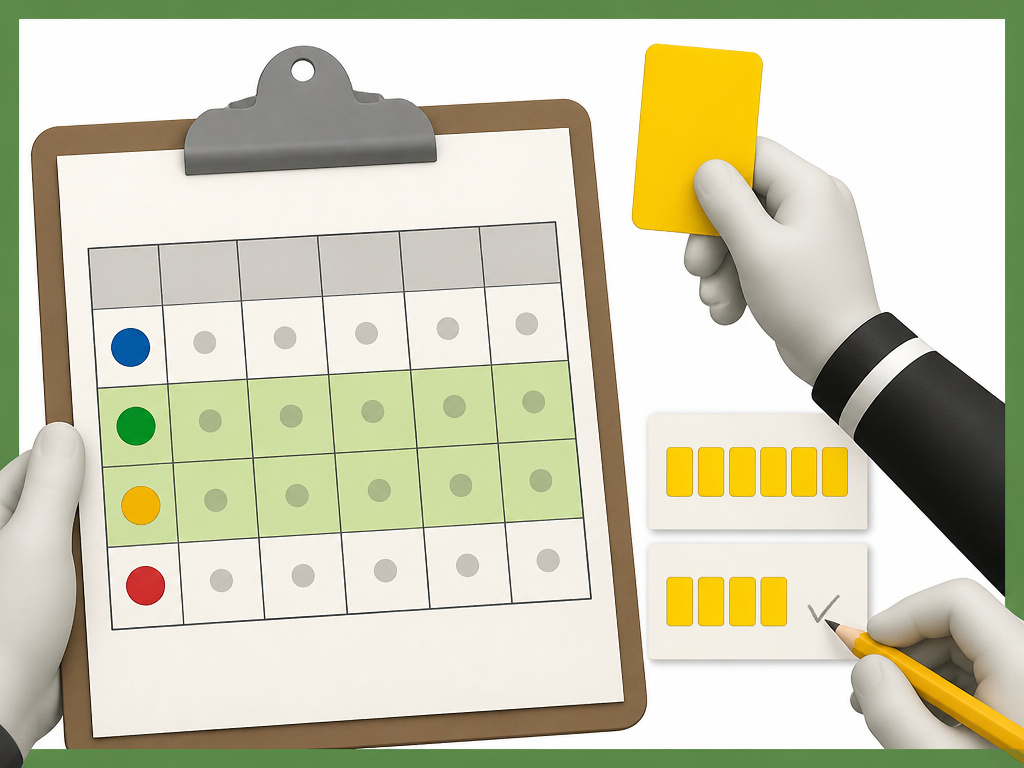
In 2018, second place in Group H came down to something neither side could score its way out of.
This is why I keep telling anyone who asks that highlights can’t follow a tournament for you. A highlights package shows the goals and hides the work that decided the match. Group H proves it. The goals were on every reel; the bookings that settled the group weren’t.
Walking Group H Through the 2018 Rules
FIFA’s 2018 procedure put overall figures first and head-to-head second. Here’s how the tie fell through each step:
- Points: four each. Level, so the table moves on. One extra draw anywhere in three games and cards never enter the story.
- Goal difference: level. Both scored four and conceded four across their group games.
- Goals scored: four apiece. Still level.
- Head-to-head: their meeting ended 2-2, so the mini-table settled nothing.
- Fair play: Japan 4 yellows, Senegal 6, with no reds on either side. Japan went through, and the count covered all three group games, not only the match between them.
Run the same numbers through the 2026 order and Japan still go through. The order only matters when the numbers split, and here they never did.
It was the first time a team had gone out of a World Cup on fair play. Senegal’s camp still accepted the result as the regulations everyone knew going in.
Sports Illustrated pushed harder in its 2018 commentary. It argued fair-play points rest on referees’ subjective calls and wondered whether that could work against African teams. It said it would rather see shots on goal or expected goals decide ties. That same tournament, no African team got out of the group stage, the first time since the round of 16 arrived in 1986.
African football is one of the gaps in my own knowledge, so I can’t judge the bias question without data I don’t have. On expected goals I’m less shy. Expected goals is a model’s estimate of how many goals a team’s chances should produce, and one match’s xG tells you very little. I wouldn’t want it sending anyone home.
I’d keep fair play in the list, right down near the bottom where it sits now. It’s the only step that measures how a team behaved rather than what it scored, and a team that knows cards count tackles with a bit more thought.
What a Card Is Worth Now
A yellow card in an opening group game lasts a moment: the referee’s arm goes up, the notebook comes out, play restarts. By the final whistle of the third match, it can be the whole tiebreak.
UEFA and FIFA price cards differently. The 2026 values below come from Wego’s secondary list rather than FIFA’s own text.
| Card | EURO 2024 (disciplinary points) | World Cup 2026 (fair-play deduction) |
|---|---|---|
| Yellow | 1 | -1 |
| Second yellow in one match | 3 | -3 |
| Direct red | 3 | -4 |
| Yellow then direct red | Not listed separately | -5 |
UEFA also counts cards shown to team officials, so a booking on the bench costs the side. At EURO 2024, Denmark took second place in Group C ahead of Slovenia on disciplinary points.
How Are the Best Third-Placed Teams Ranked?
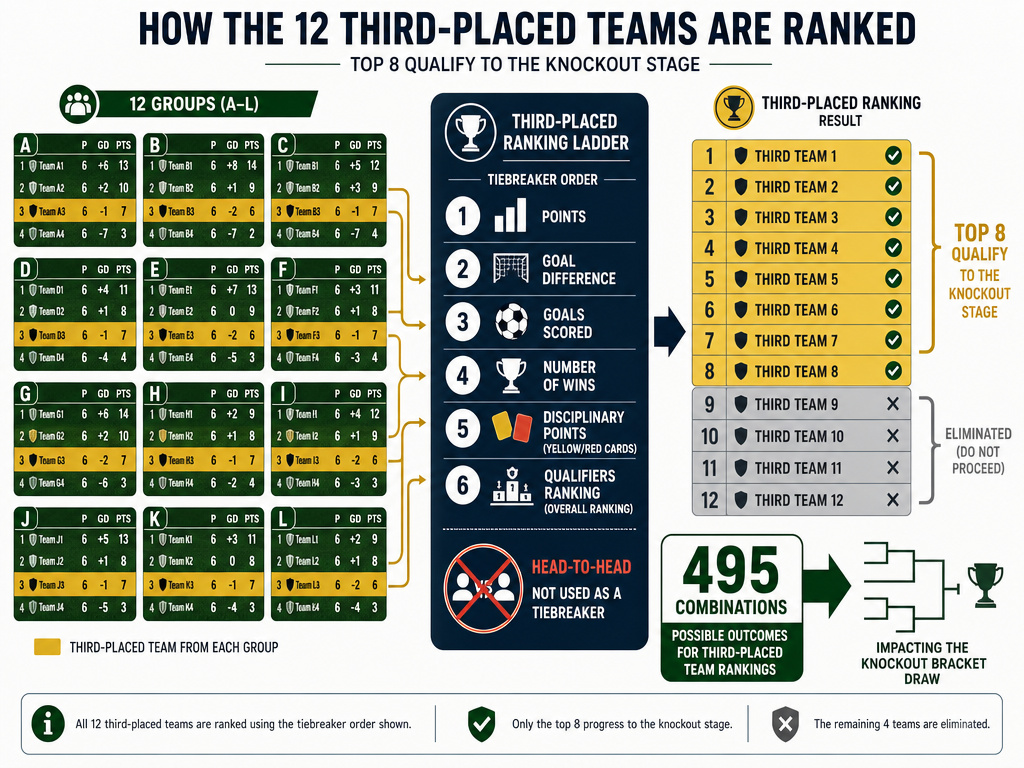
How do you rank teams that never played each other? You throw out head-to-head, because there’s nothing to compare.
At the 2026 World Cup, eight of the 12 third-placed teams go through, and hermann-baum.de notes the head-to-head steps are simply skipped for them. UEFA’s EURO 2024 version, Article 21.03, picked the four best of six third-placed teams using only their three group matches. The order ran points, goal difference, goals scored, number of wins, disciplinary points, then the European Qualifiers ranking.
Compared with ranking teams inside a group, a few things shift:
- No head-to-head. Different groups, no shared games.
- UEFA slips in number of wins as the fourth step. That rewards a team that went for victories over one that drew its way into third.
- The host exception survives. If Germany was part of the comparison, lots replaced the qualifiers ranking.
- Third place in a brutal group counts exactly the same as third in a soft one, which still strikes me as rough justice.
Then comes the bracket. With eight qualifiers from 12 groups, there are 495 possible combinations of groups they can come from. FIFA needs a 495-row table to decide which group winner meets which third-placed team. UEFA handles the same job at the Euros through Article 21.05.
That number made me laugh. It’s also the honest price of a format where the qualifiers don’t divide neatly.
What should a third-placed team aim for? I’d love to give you a safe points figure for the 48-team format. I can’t. One tournament’s worth of results is too thin to build a rule on.
Easy to miss: Goals in a seemingly dead final game still count toward the third-place ranking. A team that eases off once it thinks it’s safe can slip below a third-placed side from another group when the last results come in that day.
The 1982 Game in Gijon That Still Shapes the Last Matchday
At the 1982 World Cup, West Germany’s win over Austria in Gijon sent both teams through and knocked out Algeria. Go back to that match and watch how it played out. Algeria had played its last game the day before, so both sides walked out knowing exactly which result suited them.
Secondary accounts say simultaneous final-round kickoffs became a fixed rule from 1986. I haven’t found a FIFA document that confirms the date, so treat it as the standard story rather than settled fact.
Those shared kickoffs give a final matchday its particular sound. A stand roars for a goal nobody in it saw, because it went in at the other ground and arrived on a few hundred phones at once.
Kickoff times fixed the information problem. Tiebreak order decides how often a different problem shows up: games where one side has nothing left to play for.
The 2026 World Cup showed it early. With head-to-head first, a team can win its group with a game to spare even if it loses the last one.
The tie-breaking rules in group stages paper by Laszlo Csato, published in the European Journal of Operational Research, tested exactly this. Simulating the four 2022/23 UEFA Nations League A groups (home-and-away, four teams, 12 matches), it found that putting goal difference first cut the chance of a fixed position in the last round by at least two and usually five percentage points. Csato’s worry is plain: a team whose place is already secure might play with little enthusiasm, which hurts attendance and invites collusion.
Statistics is where my knowledge thins out, and I can’t audit a simulation like that myself. I’m taking the peer-reviewed result as published.
Picking a tiebreak order is a bit like pruning a shrub. You’re not cutting everything back. What you remove is the one branch that lets a dead rubber grow on the final matchday.
If a group can be decided before its final round, someone will play that round with nothing at stake. Every tiebreak order is a choice about how often you accept that.
The One Time a Group Game Goes to Penalties
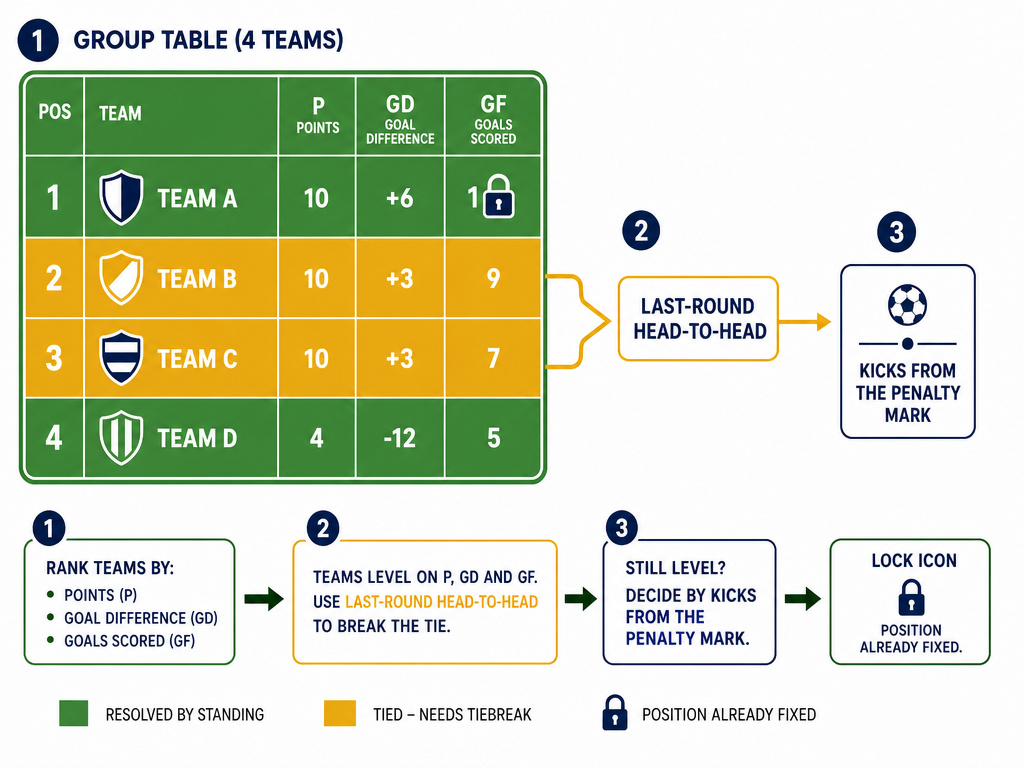
UEFA keeps a narrow exception in Article 20.02. Two teams level on points, goals scored and goals conceded meet in their last group game. If they’re still level at full time, and no other team in the group has the same points, kicks from the penalty mark decide their ranking.
The kicks themselves follow the IFAB Laws of the Game. UEFA stated the situation couldn’t apply to any group in 2024, and if more than two teams finish level, the normal criteria take over.
I’m glad it’s rare. Shoot-outs get sold as a test of character, but a ranking settled by a handful of kicks says little about three games of football.
Euros, Champions League and Your Sunday Tournament: Same Idea, Different Rules
Three things change from one competition to the next: how many teams advance, what breaks a tie, and what happens when the host is involved.
The 2024 Euro group stage used six groups, sending the top two from each plus the four best third-placed teams into the round of 16. The host exception exists because Germany, as hosts, didn’t play qualifiers. With no qualifiers ranking to fall back on, lots filled the gap.
The Champions League has gone a different way entirely, dropping classic four-team groups for a league phase with its own logic. Same goal of guaranteed games. Very different table.
Grassroots tournaments are where I’d change the most. The organiser’s real job is writing the tiebreak order down before the first ball:
- Publish the order on the entry form, not on the day.
- Pick head-to-head or goal difference first, and know the trade. Head-to-head rewards the direct result; goal difference keeps more last-round games alive, which matters when parents have driven an hour to watch.
- Skip fair play. Cards are rare at this level and refereeing varies pitch to pitch, so the step causes more arguments than it settles.
- End with a coin toss.
If you want one answer, copy UEFA’s EURO 2024 list, steps a to g, and swap the qualifiers ranking for a coin toss. It’s written down, it’s tested at the top level, and it handles a three-way tie properly. For seeing a head-to-head tie worked out, hermann-baum.de’s World Cup Excel schedule is the tool I’d point you to.
For very young players I’d go further and keep no table at all. Winning early does more damage to creative kids than losing ever does.
Where this goes sideways: Agreeing the tiebreak order after the last game. The moment two teams finish level, every coach argues for whichever rule puts them through, and the knockout round starts late because of a row instead of a fixture.
Frequently Asked Questions
How will the group stage work at the 2026 World Cup?
Forty-eight teams play in 12 groups of four, and each team plays three group games. The top two in every group plus the eight best third-placed teams reach the round of 32. Ties are broken by head-to-head results first, then overall goal difference and goals scored, then fair play, then the FIFA/Coca-Cola World Ranking.
How does the World Cup bracket work after the group stage?
The 32 qualifiers enter a straight knockout starting with the round of 32. FIFA’s regulations include a 495-row table that sets which group winners face which third-placed teams, depending on which groups those teams came from. A team that reaches the final plays eight games in total.
How many games are in a group stage?
Each team plays three games in a group of four, so every group has six matches. At the 2026 World Cup that adds up to 72 group games out of 104. The 32-team tournament in 2022 had 64 matches in total.
How many teams go through after the group stage?
At the 2026 World Cup, 32 of the 48 teams advance. EURO 2024 sent 16 teams into the round of 16: the top two from six groups plus the four best third-placed sides. The 32-team World Cups of 2018 and 2022 took the top two from each of eight groups.
Can a group stage match end in a penalty shootout?
Only in UEFA’s narrow Article 20.02 case. Two teams level on points and goals must meet in their final group game, draw again, and have no other team in the group on the same points. UEFA said the situation couldn’t arise in any group at EURO 2024.
Before You Go
That’s how the group stage works in football tournaments on paper. In practice, one line of the regulations does most of the deciding: whether head-to-head or overall goal difference comes straight after points.
Before the next tournament you follow kicks off, find that line. If head-to-head comes first, the second-round game between your team and its closest rival matters more than any other fixture, because a win there can settle the group with a match to spare.
Here’s where I’ll stick my neck out. I think FIFA picked the wrong order for 2026. Csató’s peer-reviewed simulations favour goal difference first because it keeps more final-round games alive, while UEFA at EURO 2024 and FIFA for 2026 put head-to-head first.
So, the question I always end on: what’s the last group you watched where a tiebreak, rather than a goal, decided who went home?
