
Goal Difference vs Head to Head in Football Tiebreakers
This post contains affiliate links. As an Amazon Associate, we earn from qualifying purchases.
In goal difference vs head to head in football tiebreakers, goal difference ranks level teams by goals scored minus goals conceded across every match, while head-to-head looks only at results between the tied teams. The Premier League applies goal difference first. FIFA moved head-to-head ahead of it for the 2026 World Cup.
That 2026 switch showed up in the standings before the final round of group games had even started. At the 2022 World Cup, no group winner was confirmed after two matches. This time, Reuters reported that the head-to-head rule brought early winners and losers before the final round.
What follows: the order each major competition uses, a worked example where the two rules crown different winners, the three-team trap that sent Italy home in 2004, and the research on which rule keeps final-round games honest.
Key Takeaways
- The Premier League uses goal difference before head-to-head, and head-to-head only applies at the end of the season when the title, relegation or qualification is at stake.
- The 2026 World Cup put head-to-head first, with overall goal difference dropping to fourth in Wego’s breakdown of the rules.
- When three or more teams are level, head-to-head builds a mini-league of only their games, and results against everyone else vanish.
- Simulation research by Csato found head-to-head first raises collusion risk by 11.5 to 14.8 percentage points in a Euro 2024-based model.
- Two-legged knockout ties use aggregate, then extra time, then penalties under UEFA’s Article 21. Group tiebreakers don’t apply at all.
What Is Goal Difference, and How Is It Calculated?
Take every goal a team scored, subtract every goal it let in, and you have the number. The Premier League’s rulebook defines it as “the difference between the total number of goals scored by and against a Club” in league matches that season.
Goal difference is the total number of goals a team scores minus the total conceded across every match in a competition. A team that wins 3-0 and then loses 1-0 finishes on +2. In the Premier League, goals scored becomes the next separator when two clubs share the same points and the same goal difference.
Simple arithmetic hides a design choice in the goal difference vs head to head in football tiebreakers debate. Goal difference counts every match equally, so a 5-0 win over the bottom side weighs exactly as much as a 5-0 win over your closest rival.
Fans of head-to-head hate that. I mostly don’t.
Before goal difference, English football used goal average: goals scored divided by goals conceded. Subtraction replaced division, and the standard explanation is that dividing rewarded a stingy defence far more than a busy attack. (I spent years in goal on Sunday mornings, so goal average would have flattered me. It flattered nobody else.)
The mechanism is easy to see with small numbers. Under division, cutting goals conceded from two to one doubles your ratio. Under subtraction, it moves you by exactly one goal, the same as scoring one more at the other end.
How Head-to-Head Works When Two, Three or Four Teams Are Level
Two teams finish a group on six points. One of them won the game between them 1-0, and under head-to-head that single result decides it, no matter what either side did against the rest of the group.
That’s the whole idea. Wego’s guide to the 2026 rules puts it plainly: only the games played between the tied teams count, and results against the rest of the group are set aside.
Two Teams Level
With two teams, head-to-head usually ends after one step. One side won the meeting, so it ranks higher. If the meeting was a draw, the competition moves on to its next criterion.
In the Premier League, that next step at season’s end is head-to-head away goals (Rule C.17.2), because clubs play each other twice. In a single round-robin like a World Cup group, there’s only one meeting, so a draw sends you straight to overall goal difference.
Three or More Teams Level
This is where readers get stuck. Lazada’s World Cup viewing guide explains that when three teams are tied, you exclude the fourth team and calculate points inside that smaller “round-robin league.” Then you compare goal difference and goals scored within those games only.
The sources don’t agree on every detail of the 2026 order, and I couldn’t read FIFA’s own regulations PDF to settle it. Here’s how they line up:
| Source | What it says about 2026 | Status |
|---|---|---|
| Reuters (via The Star) | Result between tied teams first, then goal difference | Wire report, June 2026 |
| Wego | H2H points, H2H goal difference, H2H goals, then overall GD | Secondary guide |
| Lazada guide | H2H goal difference and goals apply only with 3+ teams tied | Secondary guide |
| worldcupranking.com | Overall goal difference first, head-to-head after goals scored | Outdated for 2026 |
The Wego and Lazada versions produce the same answer in almost every real case. With two teams, the head-to-head goal difference from one match just mirrors the result. The split matters on paper more than on the pitch.
If three teams finish level, cross out every game involving the fourth team before you do anything else. The table you’re left with is the only one that counts.
A Six-Step Method to Settle Any Group Tie Yourself
I still work these out on paper during tight final rounds, with a biro grid on the back of whatever’s to hand. The ink smudges when the table refreshes on your phone twice in a minute and you’re redrawing it. Here’s the order I follow:
- Sort the table by points first. Skip this and you end up applying tiebreakers to teams that aren’t tied at all.
- Check which competition and which stage. The Premier League in March uses different rules from the Premier League in May, and a World Cup group uses different rules again. Use the wrong rulebook and you’ll get the order wrong with total confidence.
- List only the tied teams and pull out their mutual results. Leave a fourth team’s games in, and the mini-league is corrupted.
- Build the mini-table: points, then goal difference, then goals scored in those games.
- Check for partial separation. If the mini-league splits one team off but leaves two level, find out whether the rule restarts among the remaining two. Csato’s paper describes the UEFA Nations League applying head-to-head “in a recursive manner,” and the FIFA rule it describes as running “without recursion.” Get this wrong and you can flip second and third.
- Fall back to overall numbers. Overall goal difference, overall goals scored, then discipline and rankings.
Which Tiebreaker Comes First in Each Competition?
Any one-line answer to this question is wrong somewhere. I learned years ago that when a football story sounds too neat, it needs a second source. I’ve been caught by tidy legends that fell apart the moment I checked, and tiebreaker explainers are full of them.
Here’s the clearest case. Csato’s research papers describe FIFA’s rule as overall goal difference first, then head-to-head. For 2026, Reuters reports FIFA made the result between tied teams the first criterion. Both are right for their dates.
| Competition | First separator after points | Where head-to-head sits |
|---|---|---|
| Premier League | Goal difference, then goals scored | Season’s end only, when something is at stake |
| World Cup 2026 | Head-to-head result | First |
| UEFA Nations League 2022/23 | Head-to-head | First, then overall goal difference |
| FIFA (as described by Csato, pre-2026) | Overall goal difference | After goals scored, no recursion |
| Champions League phase | Includes opponent-based measures (Art. 18) | Not in the passages I checked |
Plenty of explainers put LaLiga and Serie A in the head-to-head camp. I haven’t verified those rulebooks for this piece, and I haven’t checked the Bundesliga at all. So they stay out of the table.
Premier League: Goal Difference, Then a Rule Most Fans Never See
During the season, the Premier League ranks clubs on points, then goal difference, then goals scored (Rules C.4 to C.6). Level on all three? Rule C.7 says the clubs share the same position, and the table lists them alphabetically.
The real story is Rule C.17, which only applies after the competition ends and only when the title, relegation or European qualification can’t otherwise be settled. Then it runs:
- Head-to-head points between the clubs concerned (C.17.1).
- Goals scored as the visiting club in those head-to-head matches (C.17.2).
- A play-off on a neutral ground, with format, timing and venue set by the Board (C.17.3). The Board decides all of that itself, which tells you how rarely anyone expects it.
C.17 wasn’t always like that. A 2017 Sports Legal piece quoted an older version that went straight to deciding matches on neutral grounds, with no head-to-head step. Squawka later reported the league confirming head-to-head records as a separator for teams level on points, goal difference and goals scored.
Where this goes sideways: Reading head-to-head into a mid-season Premier League table. Yahoo Sports explained Arsenal sitting above Chelsea on identical records through head-to-head away goals. The league’s own explainer says C.17 only applies at season’s end, and level clubs during the season are placed alphabetically.
Even the numbers in that case don’t agree. The Premier League piece gives both clubs 25 points, 26 scored and 14 conceded. Yahoo says 12 conceded. Small detail, but it’s exactly the kind of thing that makes me check twice. The full mechanics of how league tables break ties reward that habit.
FIFA vs UEFA: Who Changed, and When
Csato’s paper cites earlier work by Berker (2014), which found head-to-head records produce ‘heteronomous relative ranking’ significantly more often than goal difference. That was the old split. For 2026, FIFA crossed over.
UEFA isn’t uniform either. The 2022/23 Nations League used head-to-head first, under its Article 15. The Champions League phase can’t use head-to-head in the normal way, and the reason is structural: clubs don’t all play each other, so two tied teams often have no result between them at all.
Goal Difference vs Head to Head in Football Tiebreakers: One Group, Two Winners

Six points each, two rules, and two different group winners. Stay with me, because this is the example most explainers promise and never draw.
This is an invented four-team group. Team A beat B 1-0, beat C 1-0 and lost 1-0 to D. Team B lost to A but beat C 2-0 and D 4-0. Then C beat D 2-1.
| Team | Points / goal difference | Rank: goal difference first | Rank: head-to-head first |
|---|---|---|---|
| A | 6 pts / +1 | 2nd | 1st (beat B 1-0) |
| B | 6 pts / +5 | 1st | 2nd |
| C | 3 pts / -2 | 3rd | 3rd (beat D 2-1) |
| D | 3 pts / -4 | 4th | 4th |
Under goal difference, B tops the group thanks to that 4-0 against D. Under head-to-head, A tops it because A won the one game that mattered between them.
Which feels fairer? Honestly, it depends on which club you support. A neutral watching B dismantle D would say B earned it. A fan of A would point at the scoreboard from the meeting itself.
C and D land in the same order under both rules, because C won their meeting and has the better goal difference. Most ties look like that. The rules agree far more often than the arguments suggest.
Euro 2004 Group C: The Night Head-to-Head Goals Knocked Italy Out

The UEFA Euro 2004 Group C tiebreaker is where every serious argument about this topic ends up. Here is how the night played out.
Italy, Denmark and Sweden all finished on five points. Each beat Bulgaria and drew its other two games. Because every match among the three was a draw, head-to-head points (two each) and head-to-head goal difference (zero each) couldn’t separate them.
So head-to-head goals scored decided it. Sweden 3, Denmark 2, Italy 1. Italy went out.
Do the arithmetic and the results fall out of those totals: Italy drew 0-0 with Denmark and 1-1 with Sweden. That left Denmark and Sweden needing a draw with plenty of goals in the last game, and 2-2 did it. Italy’s win over Bulgaria counted for nothing, because Bulgaria wasn’t in the mini-league.
The result drew talk of a convenient draw that has never gone away. I’ve never seen it proven, and this is precisely the kind of neat legend I treat with care. What I can say is that the rule created the opportunity.
That opportunity has been measured. The peer-reviewed analysis of head-to-head tiebreakers by Csato, inspired by matches like this one, modelled a four-team single round-robin based on Euro 2024. The tiebreaking rule alone raised the chance of a collusion-vulnerable situation by between 11.5 and 14.8 percentage points.
The paper adds that this risk “can scarcely be mitigated by a static match schedule.” Changing who plays whom on the last day doesn’t fix it.
Why Did FIFA Switch, and Does It Make Games Better or Worse?
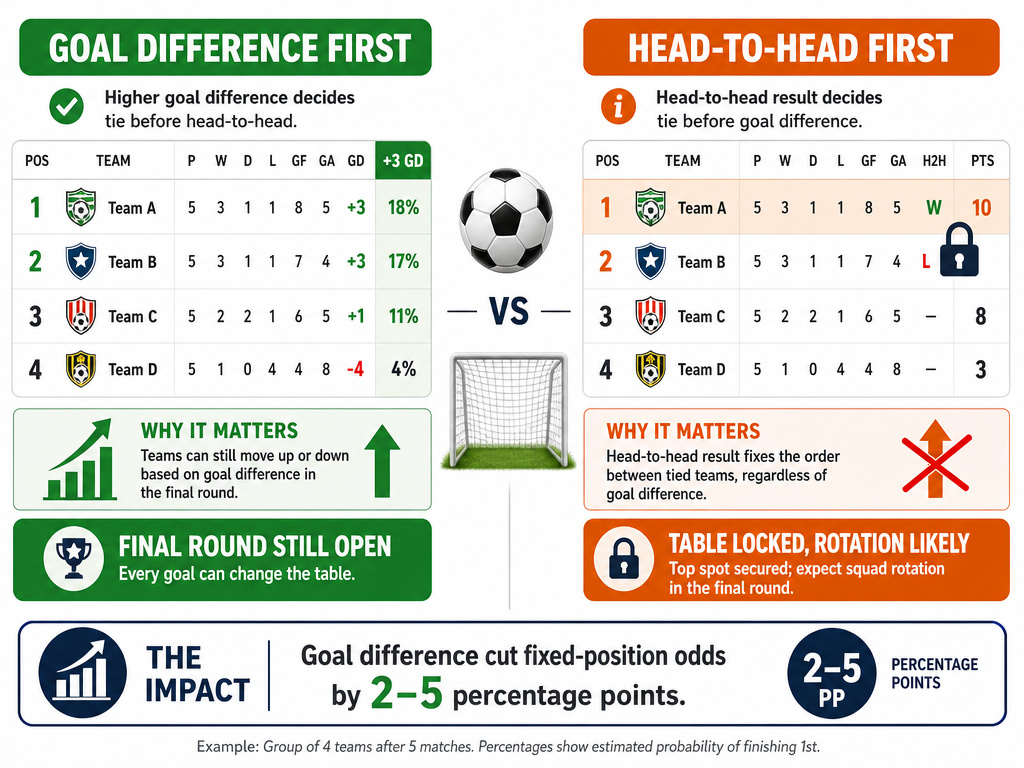
I’ll put my cards on the table: for short groups, goal difference first is the better rule. The research backs me here, and the 2026 World Cup gave us a live test.
FIFA’s reasoning made sense on paper. Korea JoongAng Daily described the idea as rewarding teams for beating direct rivals instead of piling up goals against weaker opposition. I like that instinct. It feels like football.
Then the group stage arrived. Reuters reported the changes going into the final round:
- Reuters reported that the head-to-head rule produced early winners and losers going into the final round.
- Reuters also reported that some teams were already eliminated by the head-to-head rule going into the final round.
- In 2022, under goal difference first, three teams had qualified after two games but none had clinched top spot. Brazil came within one goal of losing first place to Switzerland.
- The BBC said the new rule “lacks fairness,” according to Korea JoongAng Daily.
The mechanism is simple. Under goal difference, a team three points behind can still catch up by winning big. Under head-to-head, if you already lost to the leader, drawing level on points still leaves you second. The last game stops mattering.
That knocks on to everyone else. Korea JoongAng Daily reported that the head-to-head rule was producing rotation and an uneven playing field for Korea’s group. Same group, different opponents in practice.
There’s a gardening comparison I keep coming back to. Head-to-head prunes a group down to the branches between rivals and throws away the rest of the growth. Sometimes that gives you a cleaner shape. Sometimes you’ve just cut off the living parts.
I’d rather watch a team chase a fourth goal against a side that’s already out than watch a winner rest half its starting eleven because the table is closed. Goal difference keeps more of the group alive for longer, and that matters more to me than the elegance of rewarding the head-to-head win.
The numbers support that view. The importance of tie-breaking rules study by Csato simulated the 2022/23 Nations League A, four-team groups with 12 matches each. Giving priority to goal difference cut the chance of a fixed group position in the last round by at least two, and usually five, percentage points.
The same paper offers a concrete case. Under goal difference, Portugal could have hoped to top their Nations League group by beating Croatia. Head-to-head had already settled it.
To be fair to the other side, Csato’s paper also lays out the counter-argument properly. Goal difference can rank A above B even when B won their meeting, which feels wrong if A’s goals came against weak teams. Berker (2014) and Pakaslahti (2019) both come down on the goal difference side, but nobody serious calls the question closed.
You can hear the difference in a stadium. Under goal difference, a final round sounds like a whole stand doing sums out loud, followed by a groan when someone’s phone shows a goal elsewhere. A locked table gives you polite applause for the substitutes.
What Happens After Goal Difference and Head-to-Head?
Three things wait behind the main two: goals scored, discipline and rankings. Most fans only meet them once a decade, which is exactly why they cause panic when they show up.
- Goals scored. The Premier League’s third criterion during the season, and an overall step after head-to-head in Wego’s 2026 list.
- Team conduct or fair play. Fewer cards ranks higher. Worldcupranking.com notes Japan finished above Senegal in 2018 because they collected fewer yellow cards.
- FIFA/Coca-Cola World Ranking. The final separator in Wego’s seven-step 2026 list.
- A neutral-ground play-off in the Premier League (C.17.3). It’s only needed if head-to-head points and away goals fail.
- Alphabetical order. Only during a Premier League season, when clubs level on everything share a position.
That last one sounds like a joke, but it happened at the top of the table. The Premier League’s explainer says clubs level on points, goal difference and goals scored during the season are placed alphabetically. Brighton were listed second purely because B comes before M.
Easy to miss: Third-placed teams at the 2026 World Cup can’t use head-to-head, because they come from different groups and never played each other. Wego and Lazada both list points, overall goal difference, goals scored, conduct and ranking for them. With eight of the 12 advancing, Reuters expected goal difference to come back into play right there.
So goal difference didn’t vanish from the 2026 World Cup. It just moved to the third-place race.
Do Head-to-Head Rules Apply in Two-Legged Knockout Ties?
Ever heard someone ask who goes through on head-to-head after a 1-1 aggregate draw? The question mixes up two separate systems. Knockout ties have no group table, so neither goal difference nor head-to-head comes into it.
UEFA’s Champions League regulations spell it out. The team that scores the greater aggregate score in knockout ties goes through. Level over two legs? Article 21 adds two 15-minute periods of extra time at the end of the second leg. Still level after that, and a penalty shoot-out decides it.
Notice what’s missing from that text: there’s no away goals rule step. The only away-goals clause in this whole article sits inside the Premier League’s C.17.2, as a head-to-head separator at the end of a season. Funny where old rules survive.
The full logic of aggregate score in knockout ties shapes risk differently from a group. You aren’t protecting a goal difference across three or 38 games. You’re managing 180 minutes against one opponent, with extra time hanging over the second leg.
One opinion while we’re here. Shoot-outs get sold as a test of character, and I’ve never bought it. A shoot-out measures five or six moments of technique under pressure, plus a goalkeeper guessing right. Interesting, sure. Not a verdict on anyone’s soul.
Which leagues use goal difference and which use head-to-head?
Leagues do not agree on this, so the safest habit is to read the competition’s own rulebook before arguing about a table. The Premier League is the clearest case in the fact record. It ranks clubs by points, then goal difference, then goals scored. Head-to-head only enters through Rule C.17, and only after the season ends, when a title, relegation or qualification place cannot be settled on those first three measures. Even then it comes in two steps, head-to-head points and then head-to-head away goals, before a neutral-ground play-off.
Other leagues are free to flip that order and put the direct meetings between tied clubs first. That choice changes who gets the benefit. Goal difference rewards a club’s whole season, while head-to-head rewards winning the matches against the specific rival. When you compare two leagues, check three things: which measure comes first, whether head-to-head counts all matches or only some, and what happens if the tie survives every step.
Frequently Asked Questions
What is the difference between head-to-head and goal difference?
Goal difference subtracts goals conceded from goals scored across every match in the competition. Head-to-head ignores everything except the games between the tied teams. The first rewards a whole campaign; the second rewards beating the specific rivals you’re level with.
Does head-to-head count before goal difference?
It depends on the competition, and the answer has changed recently. At the 2026 World Cup, Reuters reports head-to-head came first. In the Premier League, goal difference and goals scored come first, and head-to-head only applies at season’s end when something is at stake.
What is the head-to-head tiebreaker rule?
When teams finish level on points, you compare only the results of matches between those teams. For three or more tied teams, you build a mini-table of their games, using points, then goal difference, then goals scored within that mini-table. Euro 2004 Group C was decided this way on head-to-head goals scored.
What is the most common tiebreaker in football?
After points, goal difference is the separator fans meet most, since it’s first in the Premier League and appears in nearly every competition’s list somewhere. The 2026 World Cup still used overall goal difference to rank third-placed teams from different groups. Head-to-head is gaining ground, though, with FIFA’s switch.
What happens if teams are level on every tiebreaker?
The final step varies by competition. Wego’s breakdown of the 2026 World Cup rules ends with the FIFA/Coca-Cola World Ranking. The Premier League’s last resort, when the title, relegation or qualification is at stake, is a play-off on a neutral ground.
The Bottom Line
If you want one answer: goal difference first is the better rule for short groups, where a single meeting carries too much weight. Whether head-to-head should rank above goal difference is disputed. Csató and the IMA JMM paper recommend goal difference first, while FIFA’s 2026 World Cup rules and the 2022/23 Nations League put head-to-head first.
The concession is real, though. The research measures competitiveness and collusion risk, and it doesn’t measure how a fan feels watching their side lose a group to a team they beat. That feeling is why FIFA switched, and it isn’t a silly reason.
One habit to start this weekend: when a table shows two teams level, check three things before you trust it. Which competition is it? Is it mid-season or the final day? Are two teams tied, or three? Those answers change the order more often than any pundit admits.
What did you notice in the 2026 group stage: did the locked-in winners make those final games feel flat, or did the third-place scramble make up for it?
