
Away Goals Rule in Football Explained: Why It Was Scrapped
This post contains affiliate links. As an Amazon Associate, we earn from qualifying purchases.
The away goals rule in football explained in one line: when a two-legged tie finished level on aggregate, the team that scored more goals away from home went through. UEFA introduced it in 1965 and scrapped it from the 2021/22 season. Level ties now go to two 15-minute periods of extra time, then penalties.
That word “away” carried a lot of tactical weight. One goal on the road changed what both managers dared to risk in the return leg. It mattered most in extra time, when a single visiting goal forced the hosts to score twice.
What follows: worked scorelines, the extra-time quirk coaches came to resent, the numbers UEFA used to justify the change, and the research suggesting the fix built a new imbalance of its own.
Key Takeaways
- “Count double” was only ever a figure of speech. The team with more away goals simply went through, and nobody added goals to the total.
- Under UEFA’s old rule, away goals still counted in extra time, so one visiting goal in extra time left the hosts needing two.
- UEFA kept away goals in one group-stage tiebreaker: away goals scored across all group matches.
- A 2023 peer-reviewed study found that extra time without away goals favours the second-leg hosts, so the replacement has a tilt of its own.
How Did the Away Goals Rule Actually Work?
The rule only woke up when a tie finished level. Add both legs together and you get the aggregate score. If that total was even, UEFA looked at who had scored more goals at the other team’s ground.
Under the away goals rule, a two-legged knockout tie level on aggregate went to the team with more goals scored at the opponent’s ground. When away goals were also equal at the end of normal time in the second leg, UEFA played extra time, followed by penalties if no goal was scored. No goals were ever added to the total.
I’ll own up to something. For years I told friends that away goals “counted double,” as if a scoreboard somewhere quietly doubled them. The Wikipedia entry on away goals rule is blunt about it: “count double” is a figure of speech, and no extra goals were ever added. The side with more away goals was just recorded as the winner.
Simple on paper.
The reasons behind it were practical and tactical. Wikipedia describes it as a quicker way to avoid replays or playoffs on neutral grounds when two teams couldn’t be split. UEFA first used it in the 1965-66 European Cup Winners’ Cup, and the stated aim was to push away teams to attack instead of parking deep.
The tactical side effect is the part I find most interesting. In a first leg, the home team had a reason to hold back, because conceding handed the visitors a goal that could decide everything later. The visitors had every reason to snatch one. Wikipedia’s phrase for the result is a nervous first leg, and anyone who sat through a cagey 0-0 in that era will recognise it.
The Away Goals Rule in Football Explained With Real Scorelines
I keep one habit when writing about football history: if a story sounds too tidy, I find a second source before I repeat it. Tidy legends have burned me before, and they fell apart the moment I checked. That habit earns its keep in this section, because one famous tie below doesn’t add up on first reading.
A Made-Up Tie, Leg by Leg
Start with a hypothetical. Team A hosts the first leg and Team B hosts the second. Here’s how the old rule settled four different pairs of results.
| First leg | Second leg | Aggregate | Old rule verdict |
|---|---|---|---|
| A 2-1 B | B 1-0 A | 2-2 | B through, 1 away goal to 0 |
| A 1-1 B | B 0-0 A | 1-1 | B through, 1 away goal to 0 |
| A 0-0 B | B 1-1 A | 1-1 | A through, 1 away goal to 0 |
| A 2-2 B | B 2-2 A | 4-4 | Away goals level, so extra time |
Row two is the one that catches newcomers. Each side scored once in total, but Team B’s goal came at Team A’s ground, so Team B won the tie on a 1-1 aggregate. Today that same pair of results sends the match to extra time.
You could hear the rule working inside the ground. An away goal in a first leg produced a flat hush from the home stands, then a roar from one small corner of the stadium where the travelling fans stood. Everyone in the place knew the arithmetic had just shifted.
Bolton, Ipswich and a Sentence That Didn’t Add Up
The 1999 First Division play-off semi-final is the classic English example. Bolton won the first leg 1-0. Ipswich won the second leg 4-3 after extra time, which levelled the tie at 4-4, and Bolton went through on away goals.
Here’s where the second-source habit kicked in. The encyclopedia text describes Ipswich losing the first leg at home and winning the second away. Read literally, Ipswich would then hold four away goals to Bolton’s one and would have gone through. The result only works if Bolton hosted the first leg and scored their three at Ipswich.
So trust the result. Treat that venue wording with care.
Before you repeat a famous away-goals result, do the arithmetic yourself. If the venues and the winner don’t line up, one of them is wrong.
The English play-offs ran a slightly different version, too: away goals came in only after extra time. They’ve since switched to penalties once extra time ends level.
Why Extra Time Turned the Away Goal Into a Weapon
Extra time was where the old rule got cruel. If a second leg finished level after 90 minutes with away goals equal, UEFA played on. The visitors spent that extra half hour still away from home, so any goal they scored counted as an away goal. That meant one visiting strike forced the hosts to score twice.
You could see the weight of it during the break before extra time. Players lay flat on the turf with socks rolled down to their ankles while physios worked on cramping calves. One side knew a single breakaway could end the night.
The Sheffield Hallam away goal research opens with a clean example, drawn from Jost (2021). Liverpool lost the first leg 1-0 in Spain, then hosted Atletico Madrid at Anfield on 11 March 2020. Liverpool scored in the first half to force extra time, and Atletico scored three times in the extra 30 minutes to win 4-2 on aggregate.
To be fair to the rule, Liverpool would have lost that tie under any system. Three goals is three goals. What the tie shows is the shape of the problem: once Atletico scored in extra time, Anfield needed two more just to stay alive.
Arsene Wenger had already made the wider complaint after Arsenal’s 2014-15 Champions League exit to Monaco. As the paper quotes him: “This rule has been created in the ’60s to encourage the teams to attack away from home. Since that football has changed. The weight of the away goal is too big today.”
I always thought the extra-time quirk was the rule’s weakest point. Asking a home side to score twice in 30 minutes, after 180 minutes of football, punished them for the luck of the draw. Wenger had a point there, whatever you think of his motives that night.
The part nobody mentions: English domestic football ran its own order of tiebreaks. The Football League Cup semi-finals, when played over two legs, applied away goals only after extra time, so the same scorelines could produce different verdicts depending on the competition.
Football has fiddled with extra time before, from the golden goal and silver goal experiments onward. In my view, every one of those tweaks changed how tired players behaved in that last half hour. Away goals were just the longest-running version.
61% to 47%: The Home-Advantage Slide Behind UEFA’s Decision
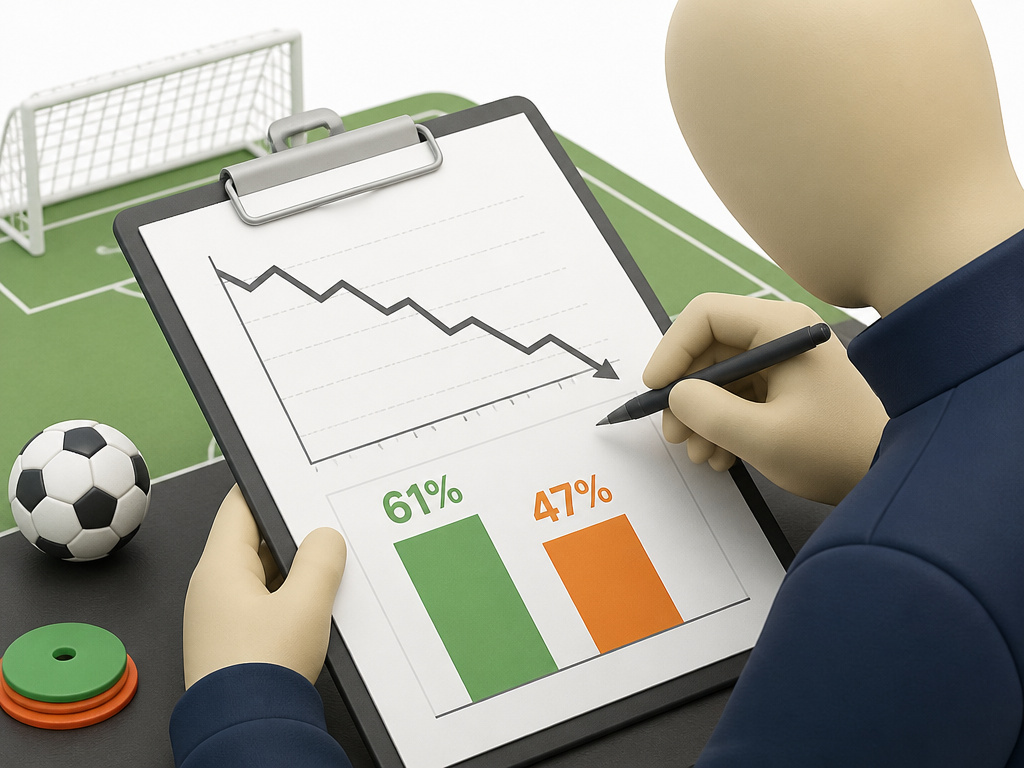
Home teams in men’s UEFA competitions won 61% of matches in the mid-1970s, according to UEFA’s announcement abolishing the away goals rule. By 2021 that figure had fallen to 47%. Away wins rose from 19% to 30% over the same stretch.
Goals told the same story. Home teams averaged 2.02 goals per match back then and 1.58 by 2021, while away teams climbed from 0.95 to 1.15. The gap that the rule was built to correct had narrowed on its own.
UEFA listed the reasons it believed home advantage was shrinking:
- Better pitch quality and standardised pitch sizes.
- Improved stadiums and higher security.
- More careful refereeing, helped lately by goal-line technology (GLT, the system that tells the referee whether the ball fully crossed the line) and VAR, the video assistant referee who reviews key incidents on a screen.
- Wider TV coverage.
- Easier, more comfortable travel.
- A packed calendar that forces squad rotation, plus changes to competition formats.
Notice what’s missing from that list. UEFA never credits the away goals rule itself for the decline, so treating the 61% to 47% slide as proof the rule worked misreads UEFA’s own document.
The women’s figure is the one I keep coming back to. Since 2009/10, the Women’s Champions League has stayed steady at 1.92 goals per game for home teams and 1.6 for away teams. No shrinking gap there, yet UEFA scrapped the rule for women’s and youth club competitions too.
I think that was the right call for consistency. It also tells you the decision rested on more than one graph. UEFA President Aleksander Ceferin admitted there was “no unanimity of views,” and said that “many coaches, fans and other football stakeholders have questioned its fairness.”
I’m no statistician, and I can’t tell you how much of that slide belongs to each factor. UEFA didn’t rank them either.
What Decides a Level Tie Now?
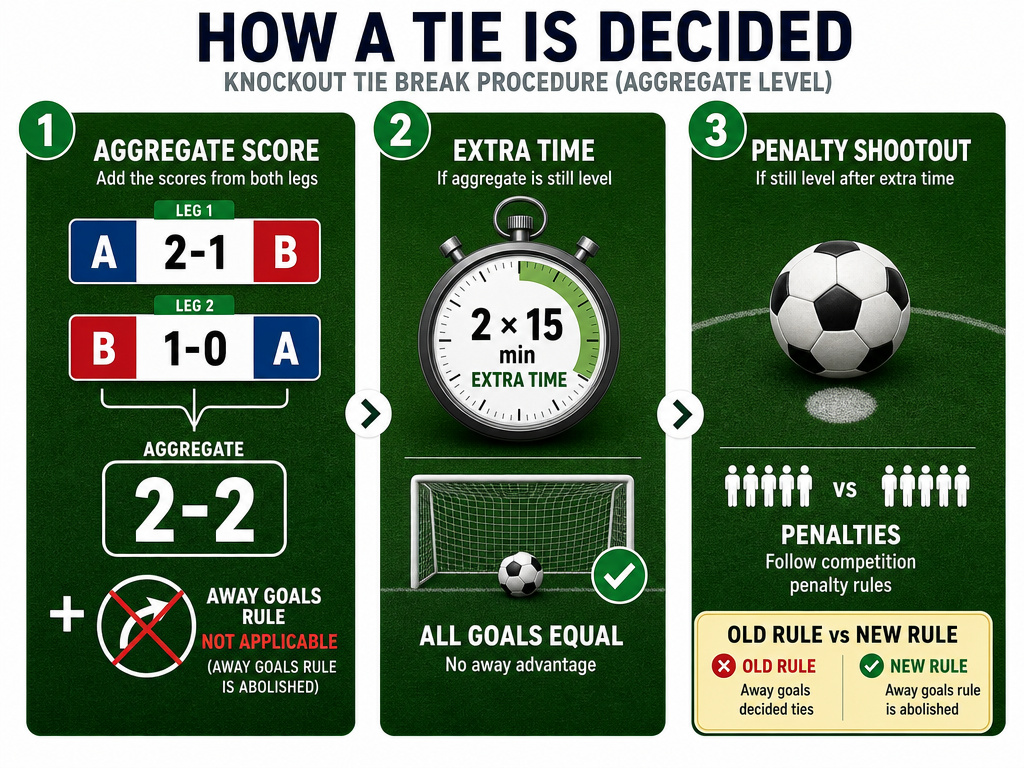
Three things happen, in this order:
- Add up both legs. The higher aggregate goes through, and where each goal was scored no longer matters. Count away goals out of old habit and you’ll name the wrong winner on a tie like A 2-1 B, B 1-0 A.
- Play two 15-minute periods of extra time at the end of the second leg if the aggregate is level. A goal in extra time is worth the same to both sides now.
- Go to penalties if the teams score the same number of goals in extra time, or none at all. Forget this step exists and you’ll think a 1-1 extra time sends someone through. It doesn’t.
UEFA’s own text spells it out: 30 minutes of extra time split into two 15-minute halves, then “kicks from the penalty mark.” The visitors’ extra-time goal lost its special weight overnight.
Easy to miss: Under the old UEFA wording, penalties came only if extra time produced no goal at all. If both sides scored once in extra time, the tie still went to the visitors, because their extra-time goal counted as an away goal.
From there the penalty shootout rules take over. I’ll say it plainly: a shootout measures nerve over a handful of kicks and tells you very little about a team’s character. (I played in goal at a modest level and dived the wrong way with real consistency, so feel free to call me biased.)
Did Scrapping Away Goals Make Two-Legged Ties Fairer?
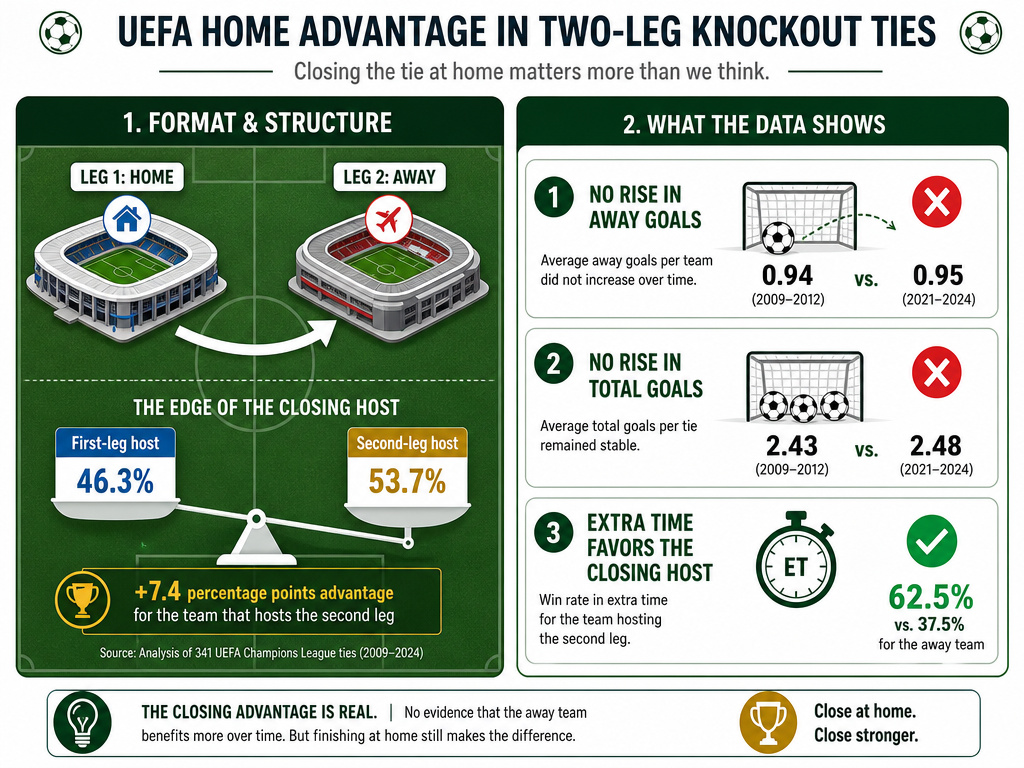
The strongest study I’ve found says the edge moved to the team hosting the second leg. That’s an awkward answer for UEFA, because fairness was the word at the centre of Ceferin’s statement.
What the Research Says
The Tilburg University away goals study by Bahamonde-Birke and Bahamonde-Birke, published in the Journal of Sport Economics in 2023, covered every major UEFA and CONMEBOL tournament across 30 years. The two confederations used the rule differently, so the authors treated that difference as a natural experiment: a real-world comparison that works a bit like a controlled test.
What they found:
- The rule seems to have failed at its original job. There was no rise in away scoring, and no rise in scoring overall.
- It helped the team that started at home, but that team still wasn’t more likely to progress than the side closing the tie at home.
- Closing at home carries a built-in edge that the rule only partly offset.
- Extra time without away goals has a determining influence in favour of the team closing the series at home.
Think of it like pruning a shrub. Cut one branch and the plant pushes its growth somewhere else. UEFA cut the away goal, and the advantage grew back on the branch marked “second-leg host.”
The Page and Page 2007 research in the Journal of Sports Sciences came at the same question from another angle. Its title, “The second leg home advantage,” tells you where the authors landed. I’ve read the published record, not re-run their numbers, so go to the paper for the size of the effect.
I can follow what these papers conclude. I can’t audit their models.
Where the Studies Pull Apart
The sources don’t line up neatly, and a fair answer shows each side.
| Question | One view (who holds it) | Other view (who holds it) |
|---|---|---|
| Did the rule raise scoring? | No rise in away or total goals (Bahamonde-Birke, 2023) | It reduced total goals (Wikipedia, secondary) |
| Who did it help? | Team starting at home, without better progression odds (Bahamonde-Birke) | Second-leg visitors, via different risk across legs (Wikipedia) |
| Is extra time now fairer? | Stakeholders questioned the old rule’s fairness (UEFA) | Extra time without away goals favours second-leg hosts (Bahamonde-Birke) |
Look closely at the middle row. The team that starts at home is the same team that visits in the second leg, so both sources point at one side. They disagree on whether that help actually changes who goes through.
That’s the part of format debates I’d like more fans to chew on. Aggregate rules decide how much risk a team will take in each leg, and you can’t change one rule without moving every incentive around it.
Where Away Goals Still Count in UEFA’s Tiebreakers
UEFA’s 2021 release left one criterion standing. When teams finish level on points in the group stage, UEFA first compares the matches between those teams, and away goals came out of that head-to-head step. If teams were still level after that, UEFA kept “higher number of away goals scored in all group matches.”
The reason UEFA gave was “to retain a maximum number of sporting criteria.” Competitions argue endlessly about goal difference versus head-to-head, and UEFA’s answer left away goals alive further down its own list.
One honest caveat. I’m describing UEFA’s 2021 wording, and competition regulations get rewritten season by season. Check the current handbook before you settle a pub argument with it.
Outside UEFA’s club competitions, the rule had a long reach. Wikipedia lists these among the places it applied:
- CAF Champions League knockout stages.
- CAF Confederation Cup knockout stages.
- Two-legged playoffs in qualifying for the FIFA World Cup or the European Championship.
- England’s Football League Cup semi-finals when played over two legs, though only after extra time had finished level.
That last entry produced one of the sharpest complaints about format change. Tottenham led Chelsea 1-0 from the first leg of a League Cup semi-final. The tie finished level at 2-2 on aggregate, and Spurs went out on penalties.
Under the older EFL Cup rules, Spurs would have forced extra time with a route through on away goals. Mauricio Pochettino put it simply: “Last season, they changed the rules and now we’re out because of penalties.”
Where this goes sideways: Assuming every two-legged competition ran the same version of the rule. English cup semi-finals counted away goals only after extra time, while UEFA counted them from the 90th minute and kept counting through extra time.
Six Dates That Trace the Rule From 1965 to 2023-24
When did the away goals rule actually die? The answer changes by continent.
| Season or year | Competition or body | What changed |
|---|---|---|
| 1965-66 | European Cup Winners’ Cup | UEFA introduces away goals |
| 2005 | Copa Libertadores, Copa Sudamericana | CONMEBOL adopts the rule |
| 2008 | CONMEBOL finals | Rule dropped for the finals |
| 2021-22 | All UEFA club competitions | Abolished from qualifying phases |
| 2022 | CONMEBOL club competitions | Abolished (Wikipedia’s dating) |
| 2023-24 | AFC club competitions | Abolished (Wikipedia’s dating) |
UEFA moved first. UEFA’s removal followed a recommendation from both the Club Competitions Committee and the Women’s Football Committee.
CONMEBOL’s president Alejandro Dominguez announced the change on 26 November 2021: “From now on, all goals in Conmebol tournaments will have the same value.” Inside World Football ran it under a headline promising immediate effect. The article underneath says CONMEBOL “didn’t specify when the rule will no longer be applicable.” Wikipedia dates the change to the 2022 season.
South American club football is the part of the game I know least well. So I’m flagging the gap between those two sources, not pretending to settle it. CONMEBOL’s finals had already moved to single matches from 2018, which took the rule out of the biggest night long before the abolition.
The AFC date also rests on Wikipedia alone. Same habit as before: I’d want a second source before staking much on it.
Frequently Asked Questions
Did away goals really count double?
No. The phrase is a figure of speech. When the aggregate was level, the team with more goals at the opponent’s ground was declared the winner, and the actual score stayed exactly as it was.
Why don’t away goals count anymore?
UEFA pointed to a long decline in home advantage in men’s competitions, linked to better pitches, easier travel, wider TV coverage and refereeing technology. Ceferin also said many coaches, fans and other stakeholders had questioned the rule’s fairness, even though views weren’t unanimous.
When did UEFA remove the away goals rule?
UEFA’s Executive Committee approved the change, following a recommendation by the Club Competitions Committee and the Women’s Football Committee. It applied from the qualifying phases of the 2021/22 season across men’s, women’s and youth club competitions.
Does the new format favour either team?
2023 study in the Journal of Sport Economics found that extra time without away goals has a determining influence in favour of the team hosting the second leg. UEFA presented the change as the fairer option, so the debate isn’t closed.
Do away goals still matter anywhere in UEFA competitions?
In UEFA’s 2021 group-stage wording, yes. Away goals left the head-to-head criteria but stayed in a later criterion that compares away goals across all group matches.
Before You Go
I’ll take a side. Scrapping the rule was right, but the extra-time quirk was the real flaw, and the home-advantage numbers were the supporting act. That’s the away goals rule in football explained with the warts left in.
The concession matters just as much. If the 2023 Tilburg findings hold up, today’s format hands a quiet edge to whoever hosts the second leg, and the draw decides who that is. Football swapped one tilt for another.
Here’s the test I’d apply to any new tiebreak idea: if it lets one side play the final 30 minutes at home with nothing extra to fear, name it for what it is. A home advantage with a new label.
Next time a level second leg goes to extra time, watch the visitors for the first five minutes of it. Do they sit deep and wait for penalties, or has the new format changed how they play that half hour?
