
Penalty Shootout Rules in Football: Key Laws Explained
This post contains affiliate links. As an Amazon Associate, we earn from qualifying purchases.
Under the penalty shootout rules in football, each team takes five kicks, alternately, each by a different player. It stops early once one side can’t be caught. If it’s level after five, sudden death follows until one team leads from the same number of kicks. Only players on (or briefly off) the field at the final whistle can kick.
That eligibility line does more work than any other part of Law 10. It decides who walks up from the centre circle, who sits out when the other side has fewer players, and who’s allowed into goal when a keeper goes down.
What follows: the two coin tosses, a round-by-round scoreboard, the March 2025 double-touch change, the card and injury rules, and the research fight over whether kicking first really helps.
Key Takeaways
- The referee makes two separate coin tosses: the first picks the goal, the second decides who kicks first.
- Teams choose their own order, and the referee is never told it.
- Since March 2025, an accidental double touch that goes in is retaken, and one that misses goes down as a miss.
- Yellow cards from the match don’t carry over into the shootout, so a second booking there isn’t a red.
- The first-kicker advantage is disputed: one study found 60.5%, a rebuttal found 53.4%, and French cup data found none.
How Does a Penalty Shootout Actually Start?
The penalty shootout rules in football say penalties start only once the match itself is over. IFAB Law 10 on determining the outcome of a match treats them as separate from the game, so in a tie with extra time they begin after its final whistle.
Law 10 sets two separate coin tosses before kicks from the penalty mark. The first toss fixes the goal for every kick, and that goal changes only for safety reasons or if the goal or playing surface becomes unusable. The winner of the second toss chooses whether to take the first or second kick. No captain’s choice of end exists.
Here’s the order things happen in:
- Numbers get levelled first. If one team finished with more players, it drops players to match and gives the referee each excluded name and number. Skip this and an excluded player has no business in the queue, which is exactly why the referee wants the names.
- The first toss picks the goal. Both teams kick at that end for the whole shootout unless safety forces a move.
- The second toss picks the order. The winner chooses first or second. That choice is the entire prize (the section on kicking first asks whether it’s worth anything).
- Everyone else heads to the centre circle. Only eligible players and match officials stay on the field. Every kicker starts from halfway, which is why the walk to the spot looks so long on television.
I’ve always liked the goal toss. Pure chance, no argument, one less thing to fight about before a ball is kicked.
Who Is Allowed to Take a Kick?
The last whistle of extra time goes. A manager is still waving at the fourth official, desperate to get a fresh penalty taker on.
Too late. Under Law 10, a substitution requested before the final whistle but not made before extra time ends can’t happen before the shootout.
Eligibility is fixed at the final whistle. Only players on the field, or temporarily off it for injury or adjusting equipment, can take kicks. The single exception is a substitute replacing a goalkeeper who can’t continue.
The part nobody mentions: A player off the pitch being treated at the final whistle is still eligible to kick. A fresh substitute warming up on the touchline isn’t, even if the coach asked for the change minutes before the end.
Evening Up the Numbers
Red cards in normal time ripple into the shootout. A team that ends with more players must cut down to the same number and tell the referee the name and number of each player left out. Those excluded players can’t kick.
It’s a quiet tactical gift, if you think about it. You get to bench your shakiest kicker.
One exception to remember: an excluded player can return as a replacement goalkeeper. More on that further down.
The Kicking Order Nobody Tells the Referee
Teams pick their own order, and the referee isn’t told it. The referee’s job is narrower: make sure nobody takes a second kick before every eligible team-mate has taken a first.
I think of a well-built order like joinery. Each kicker matters less on their own than how the five fit together: who steadies the group after a miss, who can carry the fifth kick with the tie on it. Coaches build that list around penalty taking technique as much as nerve.
Four versions of these rules get repeated in the stands and in online explainers. The Laws say otherwise:
- “The winning captain picks the end.” The first toss decides the goal, and IFAB’s own FAQ says there’s no captain’s choice.
- “The order’s locked once kicks start.” No referee has the order on record, and Law 10 lets teams change it for any later sequence of kicks.
- “A keeper can only be replaced if a sub is left.” An excluded player or an eligible team-mate can go in goal too.
- “The keeper needs a foot on the line.” Close. Law 14 says part of one foot touching, in line with, or behind it.
Five Kicks, Then Sudden Death: A Round-by-Round Scoreboard
Three rules run every shootout: five kicks each, an early stop, then sudden death. Teams kick alternately, a different player each time. If it’s level after five each, kicks carry on until one team is a goal ahead from the same number of kicks.
Here’s a made-up shootout that goes the distance:
| Round | Team A | Team B | Score |
|---|---|---|---|
| 1 | Scores | Scores | 1-1 |
| 2 | Misses | Scores | 1-2 |
| 3 | Scores | Misses | 2-2 |
| 4 | Scores | Scores | 3-3 |
| 5 | Scores | Scores | 4-4 |
| 6 | Scores | Misses | 5-4, A wins |
Round six is sudden death. Team B had the same number of kicks and fell a goal short, so it’s over.
Now the short version. Team A scores its first three, and Team B misses its first three. At 3-0, Team B has two kicks left and can reach two at most. Done after six kicks.
Count the kicks left, not the goals scored. A shootout ends the moment one side’s lead is bigger than the other side’s remaining kicks.
How Many Penalties Do You Need to Score to Win?
There’s no fixed number. You need more than the other side from the same number of kicks, or more than they can still reach.
In theory a team can win by scoring just once. Score the first kick, miss the next four, and win 1-0 if the opponents miss all five. It has to go the full five rounds, because the opponents could always draw level with one kick left.
If every eligible player has kicked and it’s still level, a new round of kicks starts. The team that kicked first in round one kicks first again, and both sides can reshuffle their order.
Deep in that second round, the kickers are the ones picked last (and as a defender of very modest gifts, I know exactly why those names come last). That’s where goalkeeper techniques for saving penalties get tested hardest.
Where the Goalkeepers Stand, and the One-Foot Rule
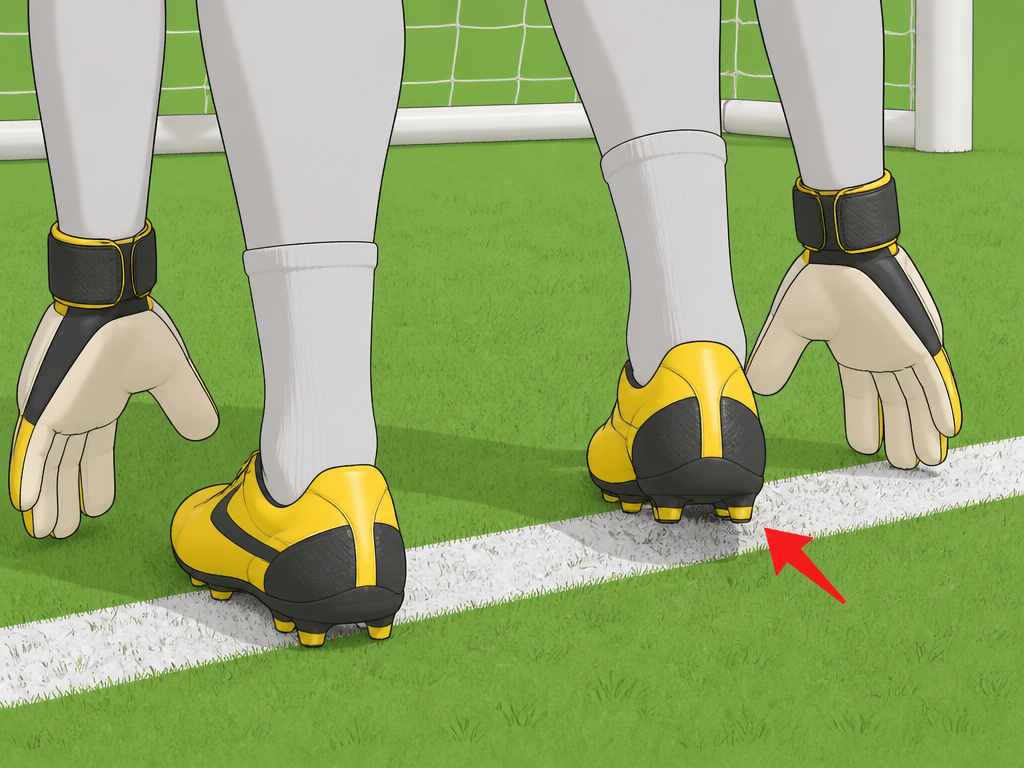
Law 14 pins the defending keeper to one requirement at the moment of the kick: at least part of one foot touching, in line with, or behind the goal line. One foot in front and one behind is legal. That’s the whole goalkeeper foot on the goal line test.
Movement is fine within limits. The keeper can wave arms, jump and slide along the line, as long as the referee doesn’t judge it disrespectful or unfair. By the late rounds the white paint between the posts is scuffed grey where keepers have bounced on it, and you can see where they’ve planted their heels.
The punishment is soft on purpose. The punishment is soft on purpose. So a keeper who prevents a goal with both feet in front gets a warning first, a retake, and a yellow card only for later offences. That’s the heart of goalkeeper encroachment in a shootout.
The other keeper has a fixed spot too. The kicking team’s goalkeeper waits on the field, outside the penalty area, where the goal line meets the penalty-area line. An eligible outfield player can swap places with their own goalkeeper at any point.
I’d tell any young keeper to stop worrying about the toe-on-the-chalk myth. The Law asks for part of one foot touching, in line with, or behind the line. Learn that wording and you’ve got more room to work with than you think.
The Alvarez Slip and the 2025 Double-Touch Change
March 2025, Champions League round of 16. Julian Alvarez of Atletico Madrid slips during the shootout against Real Madrid, and the ball brushes his standing foot as it goes in.
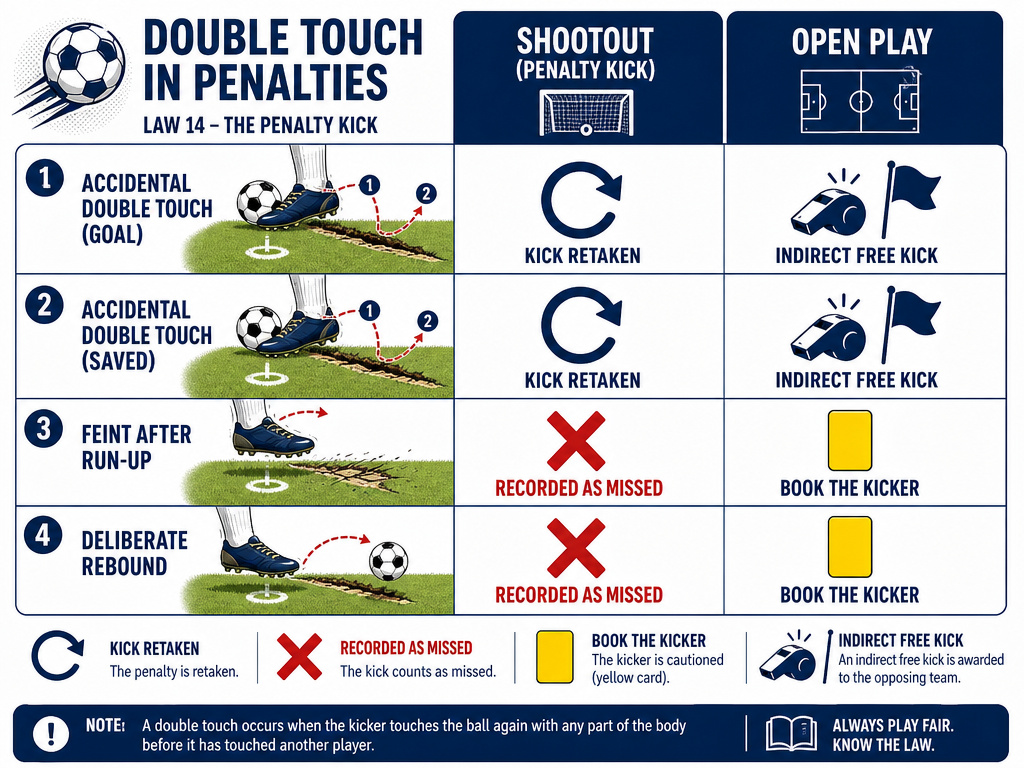
VAR ruled the goal out. UEFA said the call was correct under the laws then in force. IFAB then sent a circular: an accidental double touch that goes in is retaken, and one that misses is recorded as missed. NBC reported it applied in UEFA competitions from the next day and at the Club World Cup.
I couldn’t get hold of the circular itself, so I won’t pretend to know its exact date. What’s documented is IFAB’s admission: because Law 14 didn’t directly cover accidental double touches, “referees have understandably tended to penalize the kicker.”
A slip like that leaves a physical tell. Check for a torn strip of turf beside the spot and a standing foot that’s skidded forward under the ball.
The shootout and open-play outcomes differ, and this is where the confusion sits:
| Situation | In a shootout | In open play |
|---|---|---|
| Accidental double touch, ball goes in | Kick retaken | Kick retaken |
| Accidental double touch, keeper saves | Recorded as missed | Indirect free kick to defenders |
| Feint after finishing the run-up | Recorded as missed, kicker booked | Kicker booked, indirect free kick |
| Kicker plays the rebound on purpose | Not allowed, kick already over | Indirect free kick to defenders |
Why the difference? In open play there’s a game to restart, so the defenders get a free kick. A shootout has no open play, so the only outcome left is to record the kick as missed. If you want the wider picture of when a penalty is retaken, it follows the same logic.
The sources split on what to call this. NBC described it as a clarification of Law 14, while the Australian outlet NVI called it a law change. Given IFAB’s own admission that the Law had a gap, “clarification” looks closer to the mark to me. Same result on the pitch, either way.
Easy to miss: The retake covers accidental touches only. A kicker who smashes a rebound off the post into the net has played the ball twice on purpose, and that goal won’t count.
Feints, Shouts and Walk-Offs: What Each Offence Costs
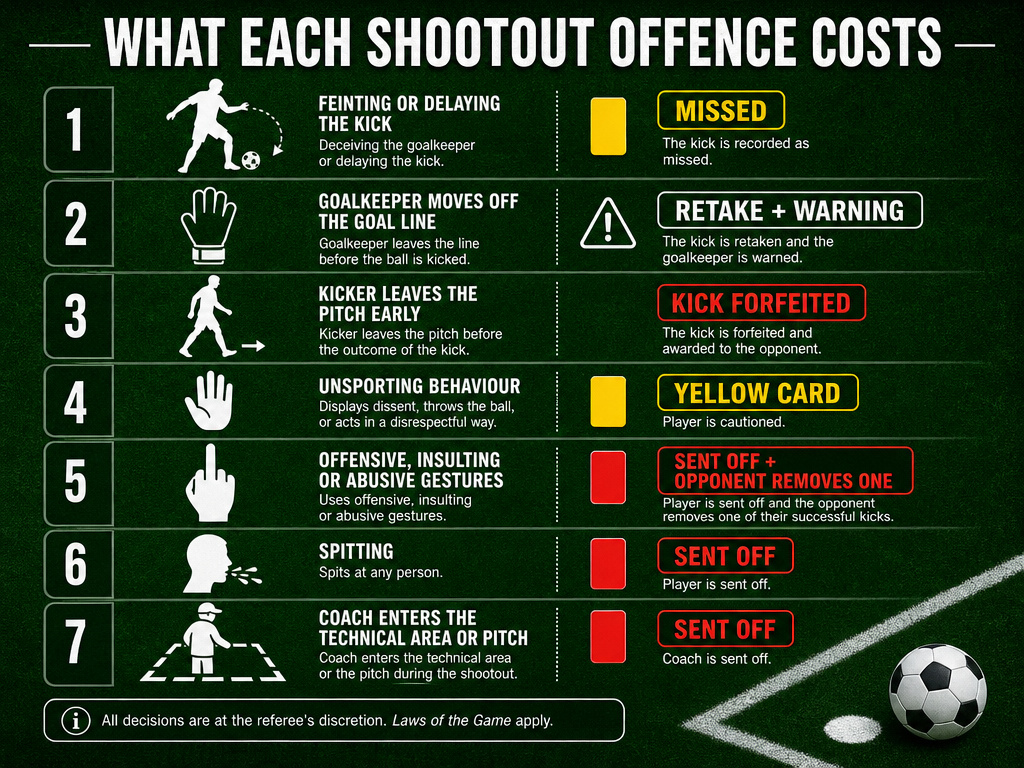
The shootout punishes kickers harder than open play does. Under normal penalty kick rules, an illegal feint brings a yellow and an indirect free kick. In a shootout the kick simply counts as a miss, plus the card.
Here’s what Law 10 says happens when things go wrong:
- Kicker feints after the run-up: recorded as missed, and a yellow card for unsporting behaviour.
- Kicker offends after the referee signals: missed, and cautioned.
- Keeper and kicker offend at the same moment: the kicker takes the hit. Missed, and booked.
- Keeper’s offence forces a retake: warned the first time, booked for any later offence.
- Player leaves the field and isn’t back in time: the shootout won’t wait, and the kick is forfeited.
- Offensive gesture at the keeper after kicking: the kick’s outcome stands, the player is sent off, and the opponents remove one player too.
- Coach storms on to confront the referee: red card, and out of the technical area entirely.
The Law draws the feint line at the end of the run-up. Hesitation on the way in is part of the art. Stopping dead over the ball is the offence.
Where this goes sideways: A kicker booked in extra time stops dead at the ball and scores. The kick goes down as missed and he picks up another yellow. He isn’t sent off, because match cautions don’t carry over.
Red Cards, Injuries and the Keeper Who Can’t Carry On
Seven is the number that doesn’t matter here. The referee must not abandon the match if a team drops below seven players during the shootout.
That rule exists because every card and injury shrinks both teams together. A player sent off during the shootout forces the opponents to withdraw one player as well. An outfield player who’s injured can’t be replaced, and the other side removes one to keep it even.
Cards from the match don’t follow anyone in. A player booked during normal or extra time who’s booked again in the shootout isn’t sent off. Both cautions get reported to the authorities instead. Honestly, I think that’s fair: the shootout is a different contest, and it gets a clean disciplinary slate.
When the Goalkeeper Can’t Continue
An injured keeper has three possible replacements under Law 10:
- A player excluded to even the numbers, who comes back in for this job only.
- A named substitute, if the team hasn’t used its maximum. Penalties aren’t part of the match, so limits on substitution opportunities don’t apply.
- An eligible team-mate already on the field, swapping places. This works even when every substitute has been used.
The replaced goalkeeper is finished. They take no further part and can’t kick. If they’d already taken a kick, the replacement waits until the next round before kicking.
A keeper sent off is different. That one must be replaced by an eligible player, not a fresh face from the bench.
The FAQ also mentions competitions that allow an extra substitute in extra time. That’s set by competition rules, not Law 10, so check your own handbook.
Does Kicking First Really Win 60% of Shootouts?
60.5%. That’s the share of shootouts won by the team kicking first in Apesteguia and Palacios-Huerta’s 2010 study in the American Economic Review, built on 2,731 kicks from 262 shootouts. They put it down to the pressure of trailing. Their working paper on psychological pressure in competitive environments lays out the method.
That theory sits close to what we know about penalty shootout pressure: kicking second means kicking to stay alive. But the number didn’t survive unchallenged.
I’m a notebook-and-eyes man, not a numbers man, so I won’t pretend to settle this. Here’s who says what:
| Source | Finding | Take on first-kick edge |
|---|---|---|
| Apesteguia & Palacios-Huerta (AER, 2010) | First team wins 60.5% of 262 shootouts | Real advantage |
| Kocher, Lenz & Sutter (comment) | First team wins 53.4% of 262 shootouts | Not significantly different from random |
| Laslier (2018) | French cup data | No advantage |
| IFAB (2017 trial reasoning) | Cited research showing about 60% | Treated it as real |
IFAB took the 60% figure seriously enough to act. On 3 March 2017 it approved trials of an ABBA order for the first 10 kicks, borrowed from tennis tiebreaks, with sudden death going back to alternating kicks. The ESPN report on IFAB shootout trials gives the AB-BA-AB-BA-AB pattern.
The first ABBA shootout came on 11 May 2017, in a Women’s U17 Euro semi-final where Germany beat Norway, as the Welsh Premier League shootout rule report records. England’s first followed at the 2017 FA Community Shield penalty shootout on 6 August 2017. Arsenal beat Chelsea 4-1 on penalties after a 1-1 draw.
Then, in November 2018, IFAB recommended dropping ABBA, mainly because the procedure was complex. It stopped being an option for competitions.
Here’s my take. IFAB accepted the advantage in 2017, then dropped the fix over complexity rather than fresh evidence. So the question was shelved, never answered.
Penalty Shootout Rules in Football at Grassroots and Cup Level
I make a point of getting to at least one small local match every season. The football is plain and honest, and it’s a reminder that the Laws on the IFAB site are the default your league builds on, not the whole story.
Before your team’s next cup tie, check the competition handbook for three things:
- Whether extra time is played at all before kicks.
- Whether an additional substitute in extra time is allowed. It changes your keeper options if one goes down during the shootout.
- Any local format tweaks to the order of kicks.
What’s new for 2026? Honestly, I can’t point you to a sourced 2026 shootout change. The latest change I can trace is the March 2025 double-touch ruling, so treat any “brand new 2026 rule” claim with care until you’ve seen it in IFAB’s own text.
One opinion for youth coaches. If you run an under-10 side, don’t hand the kicks to the same three strongest players every time. Let every eligible kid take one. The Law’s “everyone kicks before anyone kicks twice” principle works as a coaching philosophy too.
Frequently Asked Questions
What are the new penalty rules for 2026?
The most recent shootout change in the sources here is from March 2025. After the Alvarez case, IFAB ruled that an accidental double touch that goes in is retaken, while one that misses counts as missed. Check IFAB’s latest Laws page before trusting any claim of a newer change.
What happens if a player accidentally touches the ball twice in a penalty shootout?
If the ball goes in, the kick is retaken. If it doesn’t go in, the kick is recorded as missed. In open play the second case is different: the defending team gets an indirect free kick instead.
How many penalties do you need to score to win?
There’s no set number. You need more goals than the other team from the same number of kicks, or a lead they can’t reach with their remaining kicks. A team can even win 1-0 if the opponents miss all five.
Can a penalty taker kick the ball twice?
Not on purpose. A shootout kick is complete when the ball stops moving, goes out of play, or the referee stops play for an offence. The kicker can’t deliberately play it again, so a rebound off the post can’t be scored by the same player.
Do shootout goals count in the match score?
No. Law 10 treats penalties as taken after the match has ended, so they aren’t part of it. That’s why the 2017 Community Shield is recorded as a 1-1 draw with Arsenal winning 4-1 on penalties.
Before You Go
One job for this week, if you coach or play in a cup competition: open the handbook and find the line on extra-time substitutes. That single rule decides whether an injured keeper can be replaced from the bench or has to be swapped with an outfield player, and you don’t want to learn it mid-shootout.
A concession, too. Everything here follows IFAB’s text and the cases I could source, and my lens leans European. Competitions elsewhere have their own handbooks, so if your league does something different, its rules win on the day.
The first-kicker question is still open, by the way. One study says 60.5%, another says close to a coin flip, and IFAB walked away from the fix without settling it.
So, would you bring back ABBA, or is the coin toss fair enough as it is?
