
How Aggregate Scores Work in Football: Worked Examples
This post contains affiliate links. As an Amazon Associate, we earn from qualifying purchases.
How aggregate scores work in football is simple addition: each team’s goals from the first and second legs are added together, and the higher total goes through. When the totals are level, UEFA club competitions now go to extra time and then penalties, because away goals stopped counting from the 2021/22 qualifying phases.
Level totals are where the simple addition stops. Each competition writes its own tiebreak order, that order has changed over the decades, and one confederation still gives a goal on the road extra weight in 2026. Get the season or the competition wrong and you’ll misread what each team needed in the second leg.
What follows: the leg-by-leg sums with real ties as worked examples, the shootout rules from the Laws of the Game, a side-by-side of how UEFA, CONMEBOL and Concacaf break ties, and the research on whether playing the second leg at home is worth anything at all.
Key Takeaways
- Extra-time goals go into the aggregate total like any other goal. The old arguments were only about whether they counted as away goals.
- UEFA used away goals from 1965 until the 2021/22 qualifying phases; CONMEBOL dropped them from 2022, while the Concacaf Champions Cup still uses them in regulation time.
- A big first-leg win doesn’t end the tie. Dortmund won a 2012-13 semi-final first leg 4-1 and finished one goal clear.
- Penalties start after the match, so yellow cards reset for the shootout, and only players on the pitch at the final whistle can take a kick.
What Does Aggregate Score Mean in Football?
An aggregate score is the combined goal total from two matches between the same two teams. In a knockout tie, that means one home leg and one away leg, with the goals carried over from the first match into the second.
An aggregate score is the sum of goals each team scores across both legs of a two-legged tie. The first leg and second leg are played at each club’s ground in turn. The side with the higher combined total advances. Level aggregates go to the competition’s tiebreak procedure, which IFAB Law 10 limits to away goals, extra time or penalties.
The word gets used more loosely too. Commentators talk about an aggregate across a season’s league meetings, or across decades of a derby. That’s a head-to-head record, and it decides nothing.
First leg, second leg, and why the order matters
The first leg is the opening match; the second leg is the return fixture at the other club’s ground. Neither match has a winner on its own. A 2-0 first-leg result is half a scoreline.
Two-goal cushions feel different from inside the penalty area. I played in goal for years, and every two-goal lead I defended felt enormous at kick-off and tiny by the hour mark. (My record suggests the cushion was right to feel tiny.)
Order matters for a tactical reason. The team at home second walks out knowing the exact target, and that knowledge shapes every substitution after half-time.
Reading “Agg” on the scoreboard
Second-leg TV graphics add a small tag beside the live score, set in smaller type: “Agg” followed by the running total. The big numbers are tonight’s match. The small ones are the whole tie.
Results columns do the same thing in print, with “(agg)” after the second-leg score.
How Aggregate Scores Work in Football, Leg by Leg
Three numbers decide every two-legged tie: the first-leg score, the second-leg score, and the tiebreak your competition uses if those two cancel out. Here’s the order I add them in while a match is running.
- Write the first-leg score from each team’s side, not in home-away order. Skip this and you’ll credit goals to the wrong club once the venue flips.
- Add second-leg goals as they go in, and say the new aggregate out loud. Wait for full time and you spend the closing stages cheering the wrong result.
- Count extra-time goals too. They join the aggregate exactly like goals in normal time, and leaving them out makes a finished tie look level.
- Only when the totals match, check this season’s tiebreak. Use last decade’s rule and you’ll tell everyone the wrong team went through.
Common mistake: Adding scorelines column by column. Scores are written home team first, so the same club sits on the left in the first leg and on the right in the second. Add straight down the columns and you’ll hand one team’s goals to the other before half-time of the return leg.
The 2012-13 Champions League semi-finals make the cleanest worked examples I know. One tie was close; the other was finished after a single match.
| Tie | Leg scores | Aggregate | Outcome |
|---|---|---|---|
| Dortmund v Real Madrid, 2012-13 | Dortmund 4-1, then Real 2-0 | 4-3 Dortmund | Dortmund through by one goal |
| Bayern v Barcelona, 2012-13 | Bayern 4-0, then Bayern 3-0 | 7-0 Bayern | Bayern through comfortably |
| Bolton v Ipswich, 1999 play-off | Bolton 1-0, then Ipswich 4-3 aet | 4-4 | Bolton through on away goals |
| Hypothetical tie | Team A 2-1, then Team B 1-0 | 2-2 | Tiebreak needed |
Real Madrid lost 1-4 in Dortmund and needed a 3-0 home win. They fell short and went out 4-3 on aggregate.
Barcelona’s tie shows how away goals bent the sums. After the 4-0 defeat in Munich, commentators wrote them off, because one Bayern goal at the Camp Nou would have left Barcelona needing six. Bayern won the second leg 3-0 anyway.
What Happens When Two Teams Are Level on Aggregate?
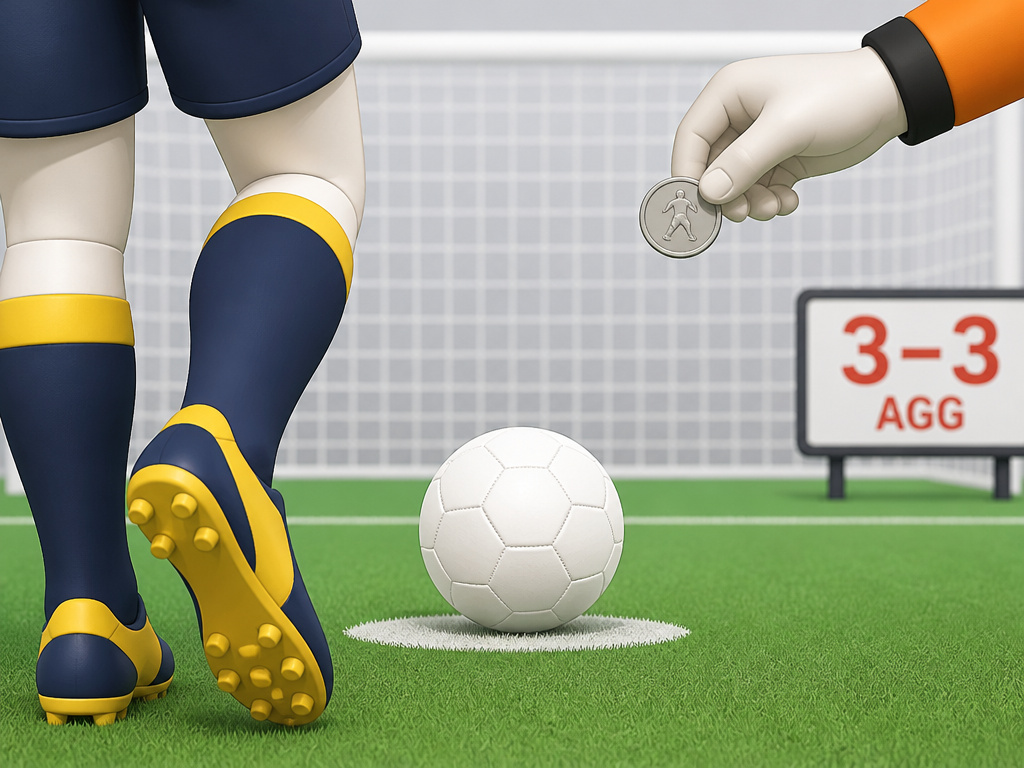
The second leg ends, the totals match, and nobody heads for the tunnel. Players sit on the grass with their socks rolled down while coaches crouch beside them with water bottles and a tactics board.
Under current UEFA rules, a level aggregate goes to extra time, and if the totals are still level after that, the tie is decided by penalties. The IFAB Law 10 rules on determining the outcome of a match allow only three methods: away goals, two equal periods of extra time of no more than 15 minutes each, or penalties.
A competition can also combine them. So away goals were always optional under the Laws.
Each competition chose them.
Do extra-time goals count toward the aggregate?
Yes. A goal in extra time goes on the total like any other. The confusion was always about away goals scored in extra time, and here the sources split three ways.
- UEFA’s 2021 announcement says the old rule was judged at the end of normal time in the second leg, with extra time played if home and away goals were equal, then penalties “if no goal was scored”.
- Wikipedia’s summary says the rules varied by competition, and that the two-legged English League Cup semi-finals applied away goals only after extra time.
- Concacaf, as reported by the Philadelphia Union, judges away goals at the end of regulation time in the 2026 Champions Cup. A tie still level then gets two 15-minute periods of extra time, then penalties.
UEFA’s wording implies any extra-time goal settled the tie, but it doesn’t spell out what happened when both sides scored. I’d love one clean answer here. The honest answer is to read the regulations for that tournament and that season.
The shootout rules that catch fans out
Law 10 treats the shootout as something that happens after the match, which explains most of its odd rules.
- Both teams take five kicks alternately, each by a different player.
- Level after five each, it goes to sudden death: kicks continue until one side has scored one more from the same number of kicks.
- It ends early once one team is out of reach.
- The referee tosses a coin twice. The first toss picks the goal; the winner of the second chooses to kick first or second.
- Only players on the pitch at the final whistle, or briefly off it for injury or equipment, can take a kick. The one exception is a substitute replacing a goalkeeper who can’t continue.
- A side with more players drops down to match the other, and the excluded players sit out.
Easy to miss: Yellow cards from the match, extra time included, don’t carry into the shootout.
I’ve never bought the idea that a shootout reveals character. It reveals a coin toss, a coach’s list, and five tired legs.
I’d pick takers by who still runs freely at the end of extra time, and ignore reputation.
The Away Goals Rule, From 61% Home Wins to 47%

Home teams won 61% of matches in UEFA’s men’s competitions in the mid-1970s, with away teams on 19%. By 2021, UEFA’s own figures put those shares at 47% and 30%. Home sides’ goals per game fell from 2.02 to 1.58, while away sides rose from 0.95 to 1.15.
Those numbers finished the rule. Under the old system, when aggregate goals were level, the team with more away goals went through. The history of the away goals rule starts with the 1965-66 Cup Winners’ Cup, and UEFA says the rule had been part of its competitions since 1965.
The logic fit its era. A goal that cost more to score was worth more. It also shaped tactics: a first-leg host that conceded at home handed the visitors a goal worth more than any of its own, so cagey first legs made sense.
An away goal in a second leg landed with a sound all of its own. A small pocket of noise erupted in one corner while the rest of the ground went quiet and did the sums.
UEFA’s announcement abolishing the away goals rule lists the factors it believes shrank home advantage:
- Better pitches and standardised sizes.
- Improved stadiums and higher security.
- Closer refereeing care, including goal-line technology and VAR (video review of key decisions).
- Wider TV coverage and more comfortable travel.
- A packed calendar forcing squad rotation, plus changes to competition formats.
UEFA was candid that the decision split opinion. Its statement admits “there was no unanimity of views”, while many coaches and fans had questioned the rule’s fairness. Women’s football told a steadier story: since 2009/10, the Women’s Champions League has held at 1.92 home goals and 1.6 away goals per game.
The 1971-72 tie a referee got wrong
Go back to the start of the tie. Sporting met Rangers in the second round of the 1971-72 Cup Winners’ Cup, and after extra time the aggregate stood at 6-6. Rangers had three away goals to Sporting’s two. The tie was over.
The referee ordered a shootout anyway. Sporting won it 3-0.
What happened next depends on which source you read. Wikipedia says Rangers appealed and won. A research summary citing the Rangers club archive says UEFA confirmed the result the next day.
I hit conflicts like this in old match records constantly. I used to quietly pick one version and move on; now I print both and say which I trust. Here, every account agrees Rangers went through and won the Cup Winners’ Cup that season, so I’m sure of the result and less sure of the paperwork.
Work through the tiebreaks in order and stop at the first one that separates the teams. Every famous aggregate mix-up skips a step.
UEFA Dropped Away Goals. Concacaf Didn’t.

Away goals are dead, according to most of the football I watch. That’s a European view, and it falls apart once you cross the Atlantic.
My knowledge of South American cup football is thinner than my European history, so I lean hard on the sources here. CONMEBOL president Alejandro Dominguez announced on 25 November 2021 that away goals would stop counting as a tiebreaker from 2022. The rule had applied in CONMEBOL competitions since 2005.
The order was different too. Per the research brief, CONMEBOL’s ties ran on points first, then goal difference, then away goals. UEFA went straight to aggregate.
Stay with me on this one. Over two matches, points-then-goal-difference always picks the same team as plain aggregate. Level on points means one win each or two draws, and goal difference across two games is the aggregate gap. I tried to break it with every scoreline I could think of and couldn’t.
| Competition | Tiebreak order | Extra-time away goals |
|---|---|---|
| UEFA clubs, 2021/22 onward | Aggregate, extra time, penalties | Not used |
| UEFA clubs, 1965 to 2021 | Aggregate, away goals, extra time, penalties | Wording unclear |
| CONMEBOL, 2005 to 2021 | Points, goal difference, away goals | Not stated in sources |
| Concacaf Champions Cup, 2026 | Aggregate, away goals, 2×15 extra time, penalties | Carry no extra value |
| English League Cup semis (two-legged era) | Aggregate, extra time, then away goals | Counted after extra time only |
England’s Football League play-offs used that after-extra-time version, which is how Bolton beat Ipswich in 1999. The two-legged playoffs now go to penalties when the aggregate is still level after extra time.
Does Hosting the Second Leg Actually Help?
Nobody has settled this one. I can read a paper’s conclusion, but I can’t audit its statistical model, so I’m reporting each study on its own terms.
A study of three European cup competitions spanning 51 years found the second-leg home team had more than a 50% probability of qualifying, even after allowing for extra time and team ability. The same paper found the effect had dropped significantly over its final decade.
The Geenens and Cuddihy second-leg study looked at Champions League and Europa League ties from 2009/10 to 2014/15. It found a slight second-leg home advantage.
A 2011 paper by Eugster, Gertheiss and Kaiser is reported to have found the effect fully explained by group-stage form and team strength. I couldn’t retrieve it, so treat that as unconfirmed.
Three studies, three shades of answer. Anyone quoting one of them as settled fact is choosing a side.
Playing the first leg like a gardener
Aggregate rules shape risk more than most tactical writing admits. A first-leg lead works like pruning: you don’t cut everything back, only the branches that would let the tie grow in the wrong direction. Fewer overlapping full-back runs, one extra midfielder screening, and a striker kept up the pitch so the shape still has a top.
The second-leg team plays a different game. It knows the exact number, so substitutions get bolder as the clock runs, and a single counter-attack concession can end the tie outright.
What aggregate rewards, and what it punishes
- It rewards consistency over two matches. One bad night doesn’t end a season.
- Each club gets a home game and its own crowd behind it.
- It punishes a heavy first-leg defeat, which turns the second leg into a formality. Barcelona in 2012-13 is the proof.
- Two matches eat calendar space.
Where Aggregate Doesn’t Apply, and the Mix-Ups It Causes
A league table runs on points, so aggregate never enters it. Each league match stands alone, and a 5-0 win earns the same three points as a 1-0.
Aggregate also stays out of these:
- Single-match finals, even in competitions that use two legs in earlier rounds.
- World Cup and European Championship knockout rounds, which settle each tie in one match.
- Head-to-head “aggregates” across a season or a rivalry. Good pub trivia, no sporting consequence.
What “total goals aggregated 6+” means on a betting slip
Bookmakers use “aggregated” to mean both teams’ goals added together. “6+” means six or more combined goals. That market is about the goal count, and it has nothing to do with who wins the tie.
Read the market rules before you trust that reading, because the slip itself rarely says whether it covers one match or both legs.
Three misreadings I hear in the stands
- A first-leg win ends the tie. Dortmund won 4-1 and finished one goal clear.
- Away goals still count in Europe. They haven’t in UEFA club football since the 2021/22 qualifying phases.
- A second-leg win means progress. Win 1-0 at home after losing 2-0 away, and you’re still out.
What are the most famous aggregate comebacks in football?
Comebacks are the ties people remember, and Liverpool against Barcelona is the one many fans name first. The sums behind any such night are simple. A side trailing after the first leg has to win the second by enough to wipe out the gap, then get past it.
The 2012–13 Champions League semi-finals show how hard that is. Real Madrid lost the first leg 1–4 to Dortmund, so they needed a 3–0 home win just to get back level. They fell short and went out 4–3 on aggregate. Barcelona had it worse, losing 0–4 at Bayern and then 0–3 at home, a 0–7 aggregate.
Level ties bring their own drama. In the 1999 First Division play-off semi-final, Ipswich lost the first leg 0–1 to Bolton and won the second 4–3 after extra time. That made it 4–4 on aggregate, and Bolton went through on away goals.
When you read about any comeback, work out the first-leg gap first, then the margin the chasing team needed.
Frequently Asked Questions
How is aggregate score calculated in football?
Add each team’s goals from the first leg to its goals from the second leg. Extra-time goals in the second leg count too. The higher total goes through, and a level total goes to the competition’s tiebreak.
What happens if two teams tie on aggregate?
In UEFA club competitions today, the tie goes to extra time and then penalties. Older UEFA rules and the 2026 Concacaf Champions Cup check away goals first. IFAB’s Law 10 allows away goals, extra time and penalties, alone or combined.
What does “total goals aggregated 6+” mean in football?
It’s a betting phrase meaning six or more goals scored by both teams combined. It concerns the goal count and has nothing to do with the tie’s winner. Check the bookmaker’s market rules to see whether it covers one match or both legs.
Do away goals still count in any competition?
Yes. Per a Concacaf preview published by the Philadelphia Union, the 2026 Concacaf Champions Cup uses away goals as its first tiebreaker at the end of regulation time. UEFA dropped them from 2021/22, and CONMEBOL followed from 2022.
Can a substitute come on just to take a penalty in a shootout?
No. Only players on the pitch, or briefly off it for injury or equipment, at the final whistle can take kicks. The one exception under Law 10 is a substitute replacing a goalkeeper who can’t continue.
Before You Go
One check before any second leg: look up that competition’s tiebreak for that season, not the one you remember. A Concacaf tie still rewards away goals in regulation time. A UEFA tie doesn’t, and a lot of confident pub arithmetic is still running on the old rule.
Once you know how aggregate scores work in football, the second leg becomes a different match to watch. You stop following the scoreboard and start following the target.
Here’s where I’ll stick my neck out. Scrapping away goals cleaned up the sums, but I’m not convinced it ended cagey first legs. Any format that splits a tie in two hands the first-leg team a reason to protect something, and coaches will keep pruning their risk accordingly.
So, the last two-legged tie you watched: did the side at home second play like it knew its number, or like it was still hoping?
