
How Football League Tables Are Calculated: Step-by-Step
This post contains affiliate links. As an Amazon Associate, we earn from qualifying purchases.
Here’s how football league tables are calculated: clubs are ranked by points (3 for a win, 1 for a draw, 0 for a loss in the Champions League phase). Level clubs are split by tiebreakers, and the order differs: goal difference first in the Premier League, head-to-head first in LaLiga and Serie A, wins first in MLS.
That last split matters more than it looks. Two clubs with identical records can finish in a different order depending on which rule their league checks first. On a final day, that gap decides titles and relegation places.
What follows: how to read every column in a table row, a worked example where three made-up clubs swap places under different rules, the tiebreaker order in four leagues, and the play-offs, coin tosses and drawn lots that settle what the numbers can’t.
Key Takeaways
- Points rank everyone first. Every tiebreaker only applies to clubs already level on points.
- The Premier League uses overall goal difference, then goals scored, and keeps head-to-head for the end of the season when a title, relegation or European place is at stake.
- In LaLiga and Serie A, results between the tied clubs come before anything else.
- MLS counts total wins first, then runs a fair-play step before any home or away split.
- Alphabetical order on a table is display only, never a tiebreaker.
What Do P, W, D, L, GF, GA, GD and Pts Mean in a Table?
Pts is the only column that ranks anyone. Every other column is either the raw record that produces the points or a tiebreaker waiting in reserve.
A football league table ranks clubs by points. P (or Pld) counts matches played, W, D and L count wins, draws and losses, GF (or F) counts goals scored, and GA (or A) counts goals conceded. GD is goal difference: goals scored minus goals conceded. Pts is the points total, and PPG means points per game.
Different sites print the same columns under different labels. Here’s how they line up.
| Column | Other labels you’ll see | What it tells you |
|---|---|---|
| P | Pld, MP | Matches played so far |
| W / D / L | Won, Drawn, Lost | The results behind the points |
| GF | F, For | Goals the club has scored |
| GA | A, Against | Goals the club has conceded |
| GD | +/- | GF minus GA |
| Pts | Points | The number that sets the order |
F and A trip up newer fans more than anything else on the page. They’re just shorter labels for goals for and goals against, handy on printed tables where every column fights for space. (I spent years in goal, so GA is still the column my eye lands on first. Old habits, and a little guilt.)
On a narrow phone screen, the GD column gets squeezed against the right edge. The plus and minus signs shrink so small that a -3 reads like a 3 at a glance, and that one missing stroke flips your whole reading of a relegation fight.
PPG appears when clubs have played different numbers of matches. It’s points divided by matches played. Halfway through a season, I trust it more than the raw Pts column for judging form.
Three Clubs on 20 Points: A Worked Example in Pencil
Three made-up clubs, ten matches each, the same 20 points. Stay with me, because this is where the rules start to bite.
| Club | W-D-L | GF-GA (GD) | Pts |
|---|---|---|---|
| Reds | 6-2-2 | 18-10 (+8) | 20 |
| Blues | 5-5-0 | 15-7 (+8) | 20 |
| Greens | 6-2-2 | 21-14 (+7) | 20 |
Work through it in this order:
- Check the points from W and D. Three per win, one per draw: Reds and Greens get 18 plus 2, Blues get 15 plus 5. Skip this and you’ll never catch a table that’s been typed wrong.
- Subtract GA from GF for each club: Reds +8, Blues +8, Greens +7. Get one sign wrong and the order flips.
- Apply the Premier League order of points, then goal difference, then goals scored. Greens drop to third on GD, and Reds edge Blues on goals scored. Final order: Reds, Blues, Greens.
- Apply the MLS order, which starts with wins. Blues have the fewest, so they drop to third, and Reds beat Greens on GD. Final order: Reds, Greens, Blues.
- For LaLiga or Serie A, stop. You need the results of the matches between these three clubs, because their head-to-head mini-table comes first. Guessing from season totals gives you the wrong answer.
Do this once by hand with a pencil. The GD column is where the rubbings-out pile up, little grey smudges where a minus sign turned into a plus.
I like this example because Blues never lost a match and still finish last of the three under MLS rules. Unbeaten, and punished for it.
Where this goes sideways: Using one league’s tiebreakers on another league’s table. Blues finish second under Premier League rules and third under MLS rules, from exactly the same record.
How Football League Tables Are Calculated in Four Different Leagues
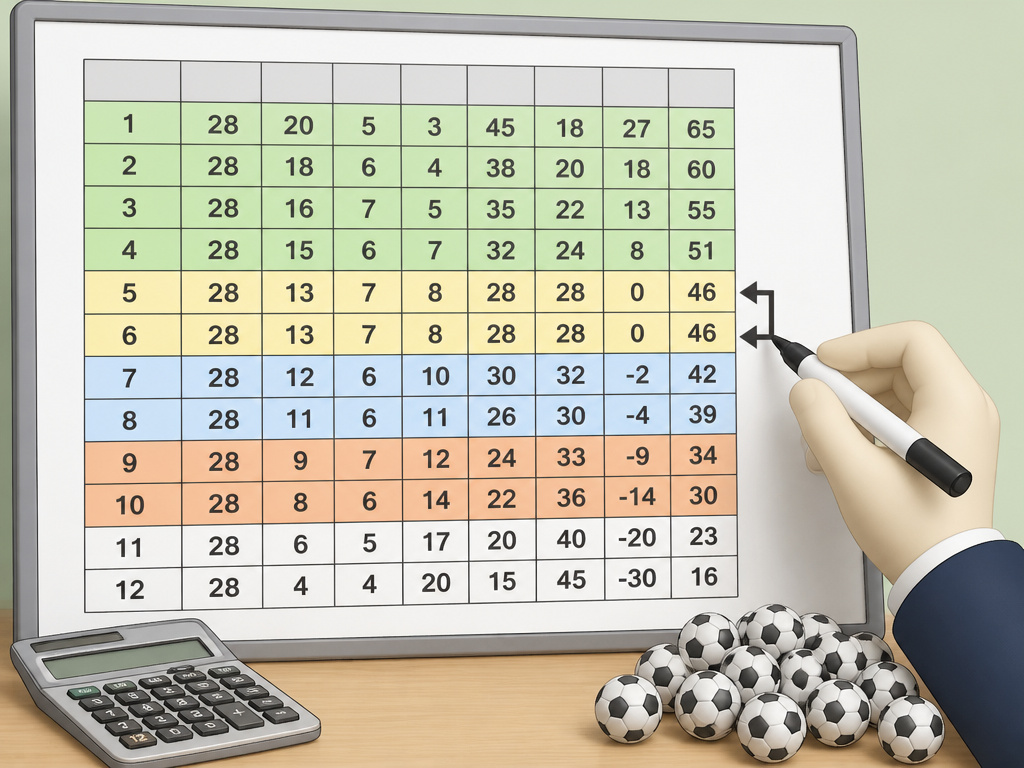
Rule C.5 of the Premier League Handbook sends clubs level on points straight to goal difference, counted across that season’s league matches. Rule C.6 then uses goals scored. Under C.7, clubs still level on all three share the position. The league lays all of this out in its Premier League explainer on Handbook rules C.4 to C.17.
The other three leagues start somewhere else entirely.
| League | First tiebreaker | Away goals used? | Last resort |
|---|---|---|---|
| Premier League | Overall goal difference | Head-to-head only, season end | Neutral-ground play-off |
| LaLiga (RFEF) | Head-to-head goal difference | No | Neutral-venue match |
| Serie A | Head-to-head points | No | Play-off, or a drawn lot |
| MLS | Total wins | Yes, after fair play | Coin toss or drawing of lots |
The goal difference tiebreaker rewards a club for every goal across the whole season. Head-to-head rewards two specific afternoons.
My verdict on goal difference vs head-to-head? For a long season where every fixture should count the same, goal difference wins. For a league that wants direct rivals to settle things between themselves, head-to-head wins, and it turns those meetings into something close to cup ties.
Head-to-head first: LaLiga and Serie A
Article 201 of the RFEF’s Reglamento General covers LaLiga ties. With two clubs level, the order runs:
- head-to-head goal difference
- overall goal difference
- goals scored
- fair play
- a neutral-venue match chosen by the RFEF
With three or more clubs level, the rulebook first builds a mini-table of points from the matches between those clubs only, as if nobody else had played. Then it runs head-to-head goal difference, overall goal difference, goals scored and fair play. There’s no away-goals step anywhere.
The article number itself is in flux. Goal’s breakdown notes it becomes Article 224 in a new edition that was still awaiting approval from the CSD, Spain’s sports council.
Serie A’s version is the classifica avulsa, a separate table of results between the tied clubs. Corriere dello Sport lists its order as head-to-head points, head-to-head goal difference, overall goal difference, goals scored, then a draw of lots.
Wins first: MLS and its fair-play step
My knowledge leans European, so for MLS I’m sticking close to the league’s own published list. The MLS 2025 regular-season tiebreakers run in nine steps across a 34-match season: total wins, goal differential, goals for, fewest disciplinary points per match, away goal differential, away goals for, home goal differential, home goals for, then a coin toss for two clubs or a drawing of lots for three or more.
Disciplinary points are scored like this:
- Second yellow or straight red: 7 points, and 7 is the most a club takes for any single incident, so a second yellow doesn’t stack on top of the first.
If clubs are still tied after one full round, MLS runs the remaining tied clubs through the whole procedure again.
I’d pick the MLS order if I were building a league from scratch. Putting wins first tells a coach that a draw is worth less than the points column suggests. That’s the kind of incentive I’d expect to change how a level game gets managed in the last ten minutes.
Why Is a Club Above Another on the Same Points Mid-Season?
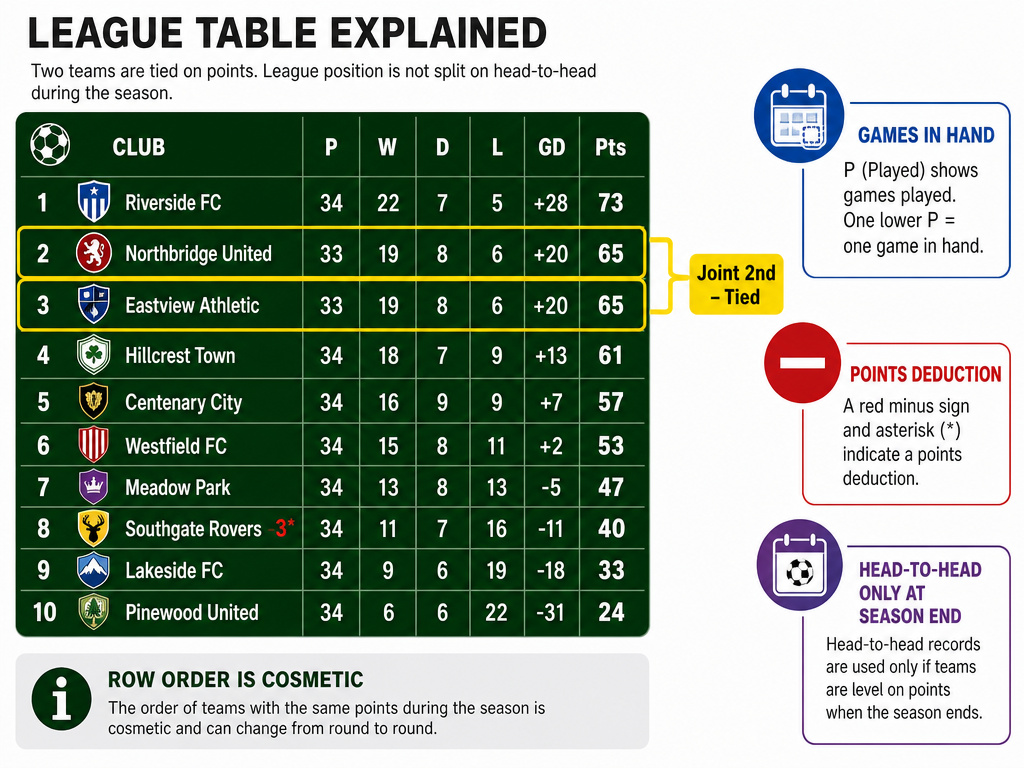
It’s a grey Monday in March. Two clubs sit on the same points, the same goal difference and the same goals scored, and one of them is printed a line higher.
Under Premier League Rule C.7, those clubs officially share the position. On the Premier League table, the league describes this as a joint place, such as joint-second. The order you see between them is cosmetic and not a tiebreaker. It’s the same trick used on opening day, when all 20 clubs sit on zero.
The head-to-head steps in Rule C.17 only kick in after the season ends. Even then, they only apply when the title, relegation or qualification for another competition is at stake. Two mid-table clubs level on everything stay level.
If two rows look identical in every column, those clubs are tied. The one printed higher hasn’t earned anything yet.
UEFA ran a similar split in the 2025-26 Champions League phase, which ran from 16 September 2025 to 28 January 2026. While it was in progress, teams were ranked on criteria 1 to 5 only, and clubs still tied shared a rank and were sorted alphabetically. Criteria 6 to 10, which include the collective points, goal difference and goals scored of a team’s league-phase opponents, only came in after the final matches.
I’m working from a summary here. The league phase tiebreaker criteria explained on Wikipedia cite UEFA, and I couldn’t get the regulation text itself. Treat the exact order with some care.
Games in hand
A club that’s played one fewer match can sit below a rival on points and still be the stronger side. That’s what “games in hand” means. Check the P column before you panic, then compare PPG.
At the end of a season, PPG means nothing. Every club has played the same number, and Pts decides.
Points deductions sit outside the arithmetic
A deduction comes straight off the Pts column. It never touches W, D or L. So a row can show a win-draw record worth more points than the club actually has. Check for a footnote or a marker next to the club’s name.
Easy to miss: A row where three times W plus D doesn’t equal Pts. That gap is a deduction, and it changes how many wins the club needs to climb.
Play-Offs, Coin Tosses and the Premier League Rule Nobody Has Used
A coin toss sounds like the worst way to finish a season. Honestly, I find it more honest than pretending one more statistic measures anything.
Premier League and LaLiga: one match on neutral ground
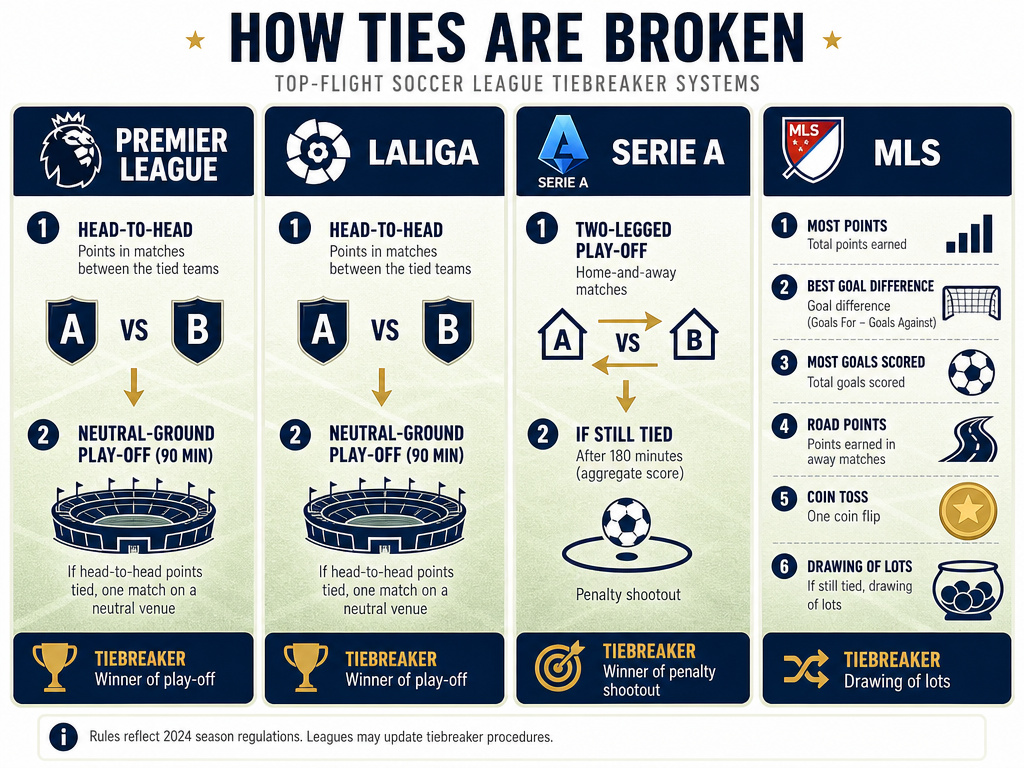
The Premier League’s end-of-season process under Rule C.17 has three steps. First come head-to-head points between the tied clubs (C.17.1). Next, goals scored as the visiting club in those head-to-head matches (C.17.2). If two clubs still can’t be separated, C.17.3 calls for a play-off on a neutral ground, with the format, timing and venue set by the Board.
It has never happened.
LaLiga’s last step is similar: a match at a neutral venue designated by the RFEF, under Article 202.
Serie A: two legs, then straight to penalties
Serie A brought back play-offs for the title and relegation a few years ago, and they never involve more than two clubs. If three or more finish level, the classifica avulsa first decides who’s 17th and 18th, and those two play off.
According to Corriere dello Sport, the relegation play-off works like this:
- Two legs, with the second at the better-placed club’s ground (decided by the classifica avulsa).
- The club with more goals across both legs stays up.
- If it’s level, the tie goes straight to penalties with no extra time.
- Away goals no longer count double.
That format nearly got a real test.
The title version hit a scheduling problem first. CBS Sports reported that if Napoli and Inter had finished 2024-25 level, a play-off final might have landed in the same week as Inter’s Champions League final in Munich on 31 May.
Here the sources split. Il Messaggero reports that the FIGC adopted a Lega Serie A proposal to cancel a two-club play-off, from the next season, whenever at least one club is playing a UEFA final. Corriere’s April 2026 rundown of the format doesn’t mention that exception. If it matters to your club, check the current regulations.
Penalties settle a tie, and that’s all they do. I don’t buy shoot-outs as a test of character, whatever the post-match interviews say.
MLS: no play-off at all
MLS skips the match entirely. After eight statistical steps, two clubs go to a coin toss and three or more go to a drawing of lots.
On a final day with a tie in the air, crowds give the game away. A low murmur travels round the stands as news arrives from another ground, then a roar, while nothing has happened on the pitch in front of them.
What Your Final Position Actually Decides
A table’s real job is sorting clubs into prize bands. Finishing one place higher can mean a different division, a different competition or a different pot of money next season.
At the bottom, promotion and relegation turn a few points into a change of league. Serie A sends three clubs down to Serie B. In England, the same logic runs all the way down the English football pyramid, and some places below the top flight are settled by promotion playoffs rather than the table alone.
At the top, the stakes are European. Domestic positions decide Champions League qualification, and the Champions League then uses its own single table. In 2025-26, its 36 teams played eight matches each, four at home and four away, and the final table split them like this:
- Top 8: a bye to the round of 16
- 9th to 24th: knockout phase play-offs
- 25th to 36th: out of European competition
Small details at the cut-off lines decide everything.
One opinion from the grassroots end of the game. I’d scrap league tables entirely for the youngest age groups. A table at that age teaches coaches to pick the big, early-developing kids and park the creative ones, and the game loses players it never sees.
From Goal Average to 3-1-0: How the Rules Got Here
Time to go back to the start. In my first year writing football history, I took a cup final score from a single source and published it. A reader corrected me within an hour. Since then, every result I print gets checked against at least two sources, and league table history is where that habit earns its keep.
Before goal difference, English football used goal average: goals scored divided by goals conceded. It rewarded tight defences more than high scorers. The sources I checked disagree, by a wide margin, on when it was dropped across different competitions, so I won’t give you a date I can’t stand behind.
Three points for a win has a similar story. It replaced an older system that paid less for a win, which made a draw relatively more valuable. Amateur and grassroots leagues still set their own values. Change the win value and the method stays the same: points first, then whatever tiebreakers the league’s own rules list.
The rules keep moving:
- Goal average gave way to goal difference.
- In 2012, MLS’s Board of Governors put goals scored first “in part to encourage attacking play”.
- By the 2025 season, MLS had total wins at the top of its list.
- Serie A brought back title and relegation play-offs, then reportedly added an exception for clubs in European finals.
The MLS switch is the clearest case. Every rule change hands coaches a new incentive. Ask what a rule makes teams do before you ask whether it’s fair.
Frequently Asked Questions
How do football league tables work?
Each result earns points, and clubs are ranked by their points total. When clubs are level, the league’s own tiebreakers set the order. The Premier League checks goal difference first, LaLiga and Serie A check head-to-head results first, and MLS checks total wins first.
How do you read a football table?
Read one row from left to right: matches played, wins, draws, losses, goals for, goals against, goal difference, points. Check that three points per win plus one per draw matches the Pts column. If it doesn’t, check for a points deduction.
What does F mean in a league table?
F stands for goals for, the goals a club has scored. It’s the same thing as GF. A, its partner, means goals against, the same as GA.
Do away goals count in league table tiebreakers?
In some leagues they do. MLS uses away goal differential and away goals for, after its fair-play step. The Premier League only counts goals scored as the visiting club in head-to-head matches, at season end. The RFEF list for LaLiga has no away-goals step at all.
Can two teams share the same position in a table?
Yes. Under Premier League Rule C.7, clubs level on points, goal difference and goals scored share the position, and the alphabetical order you see is display only. UEFA’s Champions League phase gave tied teams an equal ranking while the phase was in progress.
Before You Go
Next time you open a table, find two clubs sitting on the same points and work out which rule put one above the other. Start with the league’s first tiebreaker, not the one your own league uses. That single check teaches you more about how football league tables are calculated than any glossary.
One concession: these rules change faster than most fans notice. The RFEF article is being renumbered, MLS has rewritten its order before, and Serie A’s European-final exception sits awkwardly next to an April 2026 account that doesn’t mention it. Before a final day that matters to you, read the competition’s current rules rather than last season’s.
So here’s my question for you: what’s the last tie on a table you couldn’t explain, and which rule turned out to be doing the work?
