
How Many Teams Qualify for the Champions League?
This post contains affiliate links. As an Amazon Associate, we earn from qualifying purchases.
A total of 36 teams compete in the league phase of the UEFA Champions League, which is the main tournament stage. Of these, 29 teams qualify directly based on their domestic league finish and their country’s ranking, while the final 7 spots are earned through a multi-round qualifying playoff system that begins in early July.
That’s the basic shape of it. But the moment you start asking which teams get those 29 direct spots, or how a country earns more than four, or even how many teams qualify for the champions league, the whole thing turns into a puzzle of coefficients, performance bonuses, and titleholder clauses. It’s a system designed to reward consistency, favour the strongest leagues, and still leave a door open for a champion from a smaller nation.
What follows is a breakdown of those 36 spots, the two paths to get them, and the real-world examples, like why England and Spain have five clubs each this season, that show the rules in action.
Key Takeaways
- The Champions League phase features 36 teams, 29 direct qualifiers and 7 from qualifying playoffs.
- England and Spain each have 5 clubs in the 2026/27 league phase due to the Elite Performance Spot (EPS) reward for European performance.
- Teams that lose in the Champions League qualifying rounds drop into the Europa League or Conference League, ensuring a second chance at European football.
- The “Champions Path” of qualifying offers 5 spots for domestic champions from lower-ranked nations, while the “League Path” offers 2 spots for non-champions from stronger leagues.
- Winning the Europa League or the previous Champions League guarantees a league phase spot, even if the team finishes outside their domestic qualification places.
The New League Phase: 36 Teams, Two Kinds of Tickets
The old group stage is gone. Since the 2024/25 season, the Champions League has used a single league phase, often called the Swiss model, where all 36 qualified teams—the answer to how many teams qualify for the champions league—play eight matches against different opponents. The top 24 advance to the knockout rounds.
Those 36 tickets come in two distinct types: direct entry and playoff entry. Think of it like a concert. The 29 direct qualifiers have a backstage pass waiting at the door. The other 7 have to win a battle of the bands in the car park to get theirs.
Common mistake: Assuming the 36-team format increased the number of qualifying slots for each country. It didn’t. The expansion from 32 to 36 teams was achieved by adding more clubs from the top-ranked nations and creating the two EPS spots, not by giving every country an extra team.
The draw for this league phase happens on Thursday 27 August 2026. By then, the 29 direct qualifiers are known, and the 7 playoff winners have just punched their tickets days before.
How Many Spots Are There, and How Do You Get One?
The 36-team allocation for the 2026/27 season is broken down here. The numbers are set by UEFA’s access list, which is based on each country’s association coefficient, a five-year performance ranking of its clubs in Europe.
| Association Rank | Direct League Phase Spots | Qualifying Round Entry | | :— | :— | :— | | 1–4 (England, Italy, Spain, Germany) | 4 | None for league phase. Lower domestic finishes may enter the Europa League or Conference League. | | 5 (France) | 3 | 4th place enters the third qualifying round. | | 6 (Netherlands) | 2 | 3rd place enters the third qualifying round. | | 7–10 (Portugal, Belgium, Czechia, Türkiye) | Varies by source | League runners-up enter the third qualifying round (or second for Türkiye). | | 11–14 (Norway, Greece, Austria, Scotland) | 0 | Champions enter the play-off round. A second team enters the second qualifying round. | | 15+ (Poland and below) | 0 | Entry in the first or second qualifying round, depending on rank. |
This table shows the default. Two major rules can change it: the titleholder berths and the Elite Performance Spots (EPS).
The UEFA Champions League and UEFA Europa League titleholders are each guaranteed a league phase spot. If they’ve already qualified through their league, that spot is reallocated. For 2026/27, Paris Saint-Germain (UCL winner) and Aston Villa (UEL winner) had both done so. Their spots went to the highest-ranked champions by coefficient not yet qualified, Shakhtar Donetsk and Sporting CP, respectively.
Then there’s the EPS. The two associations whose clubs performed best collectively in the previous season’s UEFA competitions get one extra league phase spot each. For 2026/27, those associations were England and Spain. That’s why Liverpool (5th in the Premier League) and Real Betis (5th in La Liga) are in the league phase, giving each country five representatives.
Where this goes sideways: A club qualifying via EPS can create a chain reaction in their own domestic European qualification. If that EPS club had already qualified for the Europa League via their league finish, their Europa League spot is then given to the next highest-ranked domestic team that hadn’t qualified for Europe. It’s a ripple effect that reshuffles a nation’s entire European lineup.
The Two Roads Through Qualifying: Champions Path and League Path
For the 7 teams that don’t get a direct pass, the journey starts in the summer. According to Wikipedia, a total of 52 teams compete in the qualifying system, which UEFA splits into two separate lanes: the Champions Path and the League Path.
The Champions Path is for domestic league champions from countries that don’t get a direct league phase spot. According to Wikipedia, 42 teams started here in 2026/27, fighting for 5 of the 7 available playoff spots. It begins with the first qualifying round in early July.
The League Path is for non-champions from countries that get multiple qualifying slots. This is where the 4th-place team from France or the 3rd-place team from the Netherlands would start. According to BBC Sport, two spots in the league phase are available via the League Path, while Wikipedia states 10 teams competed in the League Path of qualifying.
Here’s the 2026/27 qualifying calendar, a summer grind that decides Europe’s final seven:
- First qualifying round: 7/8 & 14/15 July 2026
- Second qualifying round: 21/22 & 28/29 July 2026
- Third qualifying round: 4/5 & 11 August 2026
- Play-off round: 18/19 & 25/26 August 2026
The system is designed for a soft landing. Teams that lose in the Champions League qualifying rounds are transferred into either the Europa League or the Conference League. No team is eliminated from European football until they’ve lost a second tie.
Does 5th Place Get the Champions League? The EPS Answer
This is the question that causes the most confusion every spring. The standard answer is no, the top four from England, Spain, Italy, and Germany qualify. But the introduction of the Elite Performance Spot (EPS) has created a permanent “yes, sometimes.”
The EPS is not a gift. It’s a reward for a nation’s clubs overperforming across all three European competitions the previous season. According to UEFA’s regulations, the EPS is allocated to the club that finishes the highest in its domestic league among those that did not already qualify for the Champions League league phase.
For 2026/27, England and Spain earned the EPS. In England, the top four (Arsenal, Manchester City, Manchester United, Aston Villa) qualified directly. Liverpool, in 5th, was the highest-placed team not already in, so they got the EPS spot. The same logic applied for Real Betis in Spain.
The two associations whose clubs achieved the best collective performance in the previous UEFA club competitions are each entitled to an additional place in the league phase. This EPS is allocated to the club that finishes the relevant association’s domestic championship in the highest position of all those that do not qualify for the league phase.
. UEFA Champions League Regulations, Article 3.08
This means 5th place can be a Champions League place, but only if your country’s clubs have been exceptionally good in Europe. It turns the final weeks of the domestic season into a dual race: clubs are not just fighting for the top four, but also hoping their rivals’ European successes this year will gift them an extra spot next year.
What Happens to Teams That Lose in Qualifying?
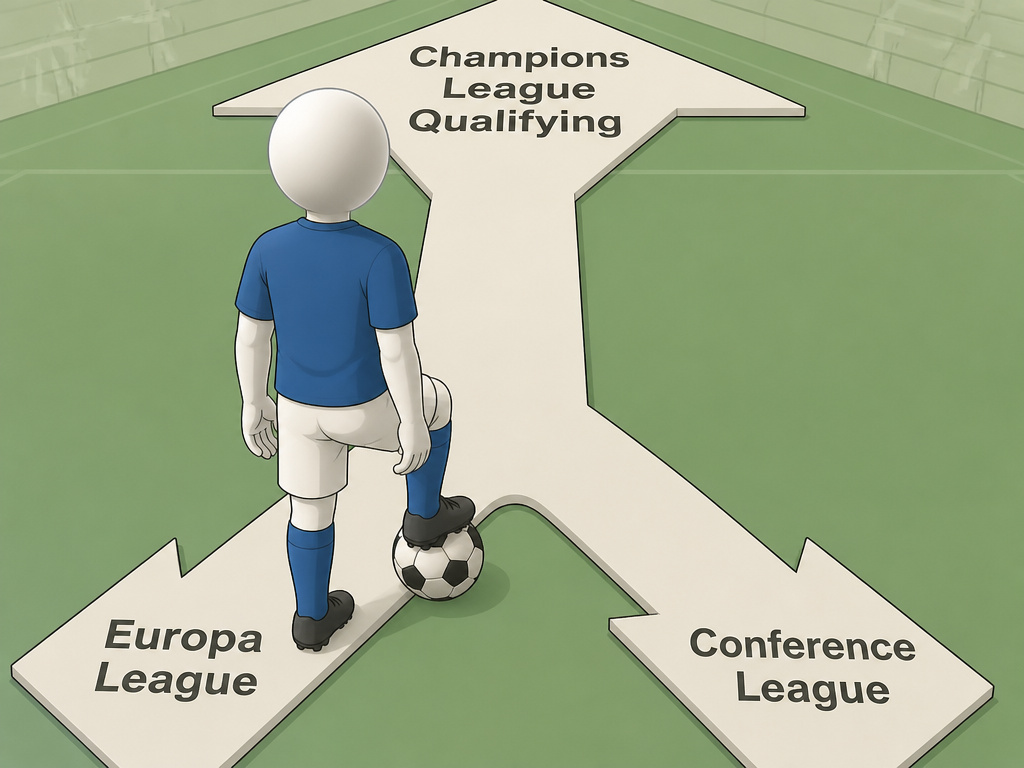
Nobody’s European dream ends in July. UEFA’s qualifying system is built with a safety net. Every team that loses in the Champions League qualifying rounds is transferred into either the Europa League or the Conference League, depending on the round they lose in.
It’s a cascading system that ensures broader participation. For example, you might be a champion from a smaller nation.
- Lose in the Champions League first qualifying round: You enter the Conference League second qualifying round.
- Lose in the Champions League second qualifying round: You enter the Europa League third qualifying round.
- Lose in the Champions League third qualifying round: You enter the Europa League play-off round.
- Lose in the Champions League play-off round: You enter the Europa League phase.
This is why you’ll see familiar names pop up in the early rounds of the Europa League in August. They’re not there by choice; they fell from the tier above. This system ensures broad participation from many national associations across the three UEFA club competitions. It spreads the wealth and the TV revenue.
The Ripple Effect: How One Qualification Changes Everything
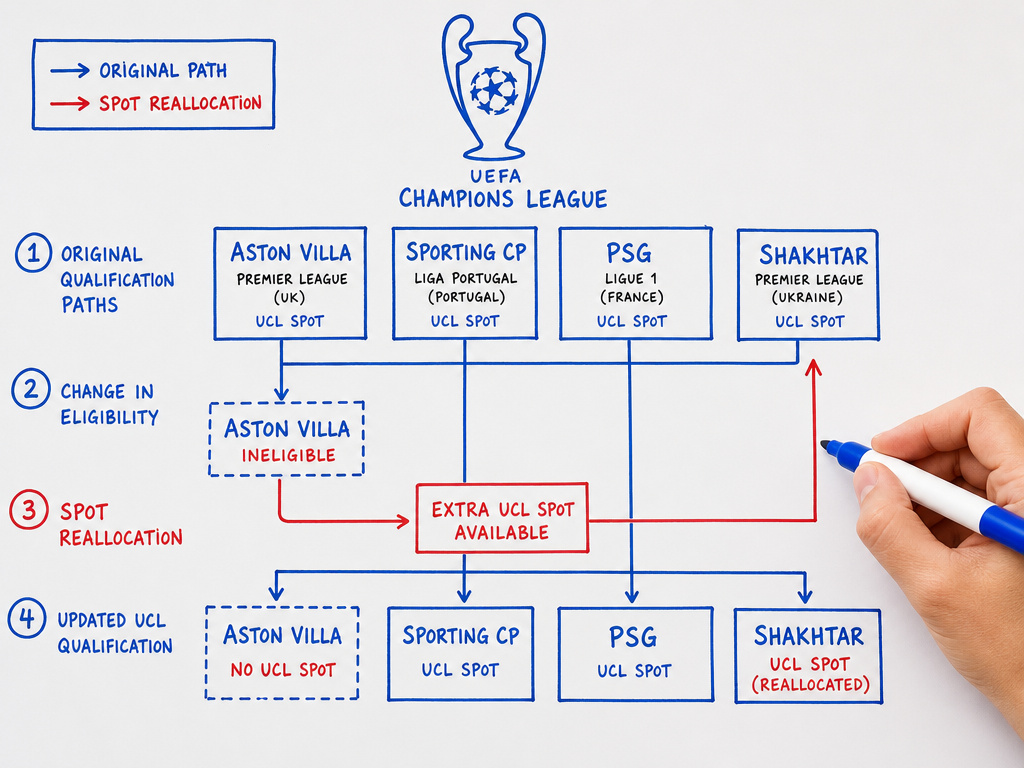
A single qualification can have domino effects across multiple competitions and countries. The 2026/27 season provides a perfect case study.
First, Aston Villa won the Europa League. That earned them a Champions League league phase spot. But they also finished in the Premier League’s top four, which already came with a Champions League ticket. You can’t take two spots, so their league-earned spot was surrendered.
According to UEFA’s complex rebalancing rules, that vacant spot went to the club with the best coefficient from the qualifying rounds that was not yet qualified. That club was Portugal’s Sporting CP. They were promoted from the third qualifying round straight into the league phase.
Meanwhile, Paris Saint-Germain won the Champions League but also won Ligue 1. Their holder’s spot was also reallocated to the highest-ranked champion by coefficient in the qualifying rounds, which was Ukraine’s Shakhtar Donetsk.
These moves can create vacancies in the qualifying rounds, triggering further adjustments. It’s a testament to how interconnected the entire Champions League qualification process truly is.
Which teams have already qualified for the 2026/27 Champions League?
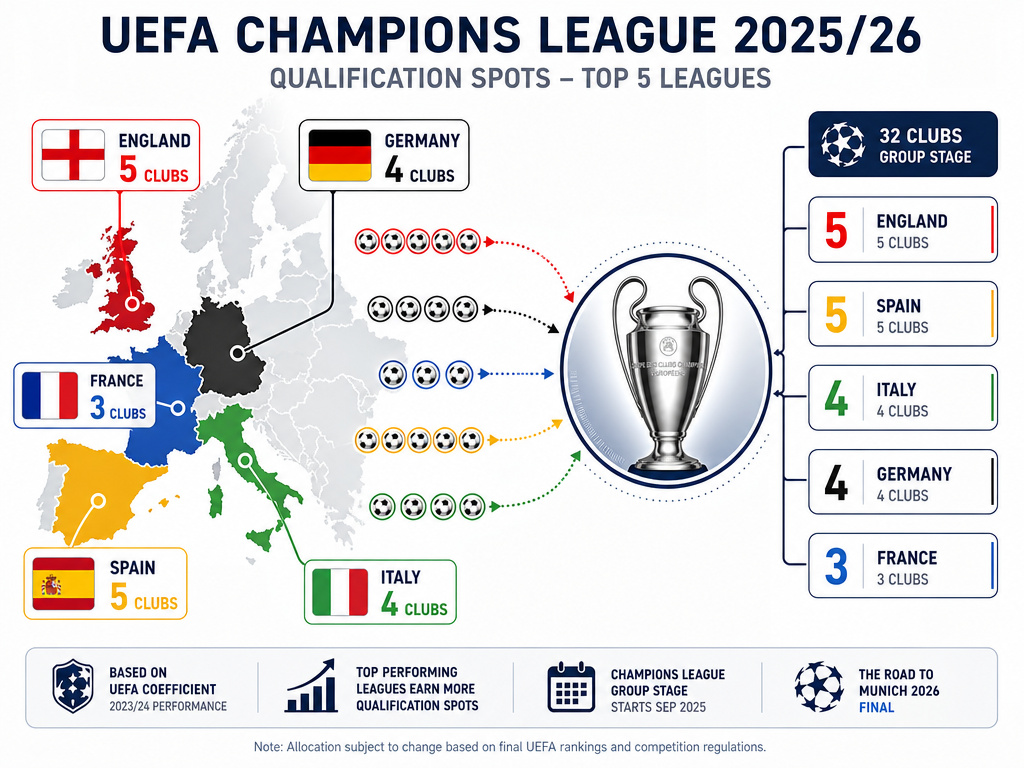
For the 2026/27 league phase, several clubs have secured direct qualification based on their domestic league finish and special allocations. England and Spain each have five clubs directly qualified, benefiting from an extra Elite Performance Spot. Italy and Germany have four direct entrants each, while France has three. Portugal’s Sporting CP qualified directly after a spot was reallocated. The champions from the top-ranked leagues, along with the UEFA Champions League and Europa League titleholders from the previous season, are also guaranteed a place. The exact final list of clubs will be confirmed once all domestic seasons conclude and any remaining titleholder spots are assigned.
What are the Champions League qualifying rounds?
Many clubs reach the league phase through a multi-round qualifying tournament. The process begins with the first qualifying round in early July, where a large number of teams enter. Winners progress to the second qualifying round later that month, and then to the third qualifying round in early August. The final hurdle is the play-off round in late August. Success here secures one of the seven available spots in the main league phase. The entire qualifying system is split into two parallel paths: the Champions Path for domestic titleholders and the League Path for non-champions from higher-ranked associations. The league phase draw is held immediately after the play-offs conclude.
Where does my country’s team start in Champions League qualifying?
A country’s UEFA ranking determines where its teams enter the competition. Champions from the top four leagues go straight to the league phase. For other nations, the entry point varies. Champions from associations ranked 11th to 14th, for example, enter the play-off qualifying round. The champions from Poland, ranked 15th, start in the second qualifying round. For non-champions, the path is different. Clubs that finish in high positions in the top leagues but don’t get a direct ticket may enter the League Path of qualifying, which has its own later entry points. The system ensures higher-ranked leagues have more direct access and safer routes for their runners-up.
Frequently Asked Questions
How Many English Teams Qualify for the Champions League 2026-27?
For the 2026/27 season, five English teams are in the league phase. The top four Premier League finishers qualify directly, and the fifth spot is awarded via the Elite Performance Spot (EPS) to the highest-placed team not already qualified.
Which Teams Are Already Qualified for the Champions League in 2026?
As of the 2026/27 season, the direct qualifiers for the league phase include the champions and high finishers from the top-ranked leagues. A full provisional list is always published by UEFA after the domestic seasons end and before the Champions League draw.
Is the Number of Qualifying Teams the Same Every Year?
The total number of teams in the league phase is now fixed at 36. However, the distribution of direct spots between countries can change annually based on the association coefficient rankings. The two Elite Performance Spots (EPS) also move each year to the two best-performing nations, so the number of clubs from England, Spain, Italy, etc., can fluctuate.
Can a Team Qualify for the Champions League by Winning the Europa League?
Yes. The winner of the UEFA Europa League is guaranteed a place in the following season’s Champions League league phase, regardless of their domestic league finish. This is how Aston Villa qualified for the 2026/27 edition.
The Bottom Line
Understanding how many teams qualify for the Champions League means understanding a dynamic system, not a static number. The 36-team league phase is the destination, but the routes there, 29 direct entries and 7 playoff winners, are governed by coefficients, performance bonuses, and titleholder privileges.
The real shift in recent years isn’t just the size, but the mechanism. The Elite Performance Spot has made the final league positions in England, Spain, Italy, and Germany more volatile, turning 5th place into a potential goldmine. And for everyone else, the grueling summer of qualifying offers a shot at glory, with the Europa League or Conference League as a consistent consolation prize.
Next time you see a club from a smaller nation in the playoff round, remember the journey. They’re not just two games from the group stage; they’re two games from joining a 36-team league that decides the best club in Europe. That’s a ticket worth fighting for.
