
How the UEFA Champions League Works: A Guide to the System
This post contains affiliate links. As an Amazon Associate, we earn from qualifying purchases.
The UEFA Champions League works as a season-long club competition featuring 36 teams in a single league phase, where each team plays 8 matches. The top 8 qualify directly for the round of 16, teams finishing 9th to 24th enter a knockout play-off, and the rest are eliminated. This new format, approved in 2022, replaced the traditional 32-team group stage from the 2024/25 season.
The shift to a 36-team league is the biggest structural change in decades. It was designed to create more meaningful matches between a wider range of clubs, but it also introduces a more complex path to the final. To understand this path, it helps to know how the UEFA Champions League works. The knockout rounds that follow retain the classic two-legged drama, but with new seeding rules that reward league-phase performance.
What follows is a walkthrough of the entire journey: how teams qualify, how the league phase draw creates the fixture list, the precise mechanics of the knockout bracket, and how this all fits with UEFA’s other competitions, which is a core part of understanding how the UEFA Champions League works. By the end, you’ll be able to follow the draw announcements and understand exactly what each result means for the road to the final.
Key Takeaways
- The new league phase features 36 teams each playing 8 matches (4 home, 4 away) against 8 different opponents, drawn from four seeding pots.
- Qualification is mainly through domestic league position, with two extra spots awarded via the European Performance Spot for the best-performing associations.
- Teams finishing 9th to 24th enter a two-legged play-off; the specific pairings are predetermined (e.g., 9th/10th vs. 23rd/24th).
- In the later knockout rounds, seeding matters: teams ranked 1-4 after the league phase play the return leg at home in the quarter-finals, and that seeding transfers if they are eliminated.
- Clubs that lose in qualifying drop into the UEFA Europa League or UEFA Conference League, creating a safety net and linking all three competitions.
How the New League Phase Works (and Why It Changed)
The old format was simple: 32 teams, 8 groups of 4, home and away against each group opponent. It was also predictable. The new system, often called the ‘Swiss model’, is built to generate more varied, high-stakes fixtures from the start.
In the league phase, all 36 clubs are ranked in one large table. Each team plays 8 matches, 4 at home and 4 away, but crucially, they face 8 different opponents. You won’t play everyone. The fixture list is determined by a draw that seeds clubs into four pots of nine, based on their UEFA coefficient. The UEFA Champions League titleholder is the top seed in Pot 1. The computer then pairs teams from different pots, ensuring a balanced schedule and that each club faces two opponents from each pot.
The 36 clubs are divided into four pots of nine for the league phase draw. Pots are composed according to club coefficient rankings, with the UEFA Champions League titleholder as the top seed in pot 1. This seeding aims to create a balanced schedule where each team faces a mix of stronger and weaker opponents.
The result is a single league table with all 36 teams. At the end of this phase in January, the table splits the field in three. The top eight qualify automatically for the round of 16. Teams placed 9th to 24th get a second chance through a play-off round. For those 25th or lower, the journey ends there, there’s no drop-down to the Europa League from this stage.
The change was approved by the UEFA Executive Committee on 10 May 2022. The idea was to make more early-season games matter, a key principle in the new how the UEFA Champions League works. Under the old groups, a big club could have its last two matches be dead rubbers. Now, with only 8 games and a giant table, every point can be the difference between a direct knockout pass or a tricky play-off.
How Teams Qualify for the Champions League
Most teams get in by finishing in a certain position in their domestic league the season before. The exact spot depends on their country’s UEFA coefficient ranking, the better the country’s clubs perform in Europe, the more places it gets. But four extra slots opened up with the new 36-team league phase, and they are allocated in specific ways.
Two of these new spots are the most talked-about: the European Performance Spots. These go to the two national associations whose clubs performed best collectively in the previous season’s UEFA competitions. These spots go to the two national associations whose clubs performed best collectively in the previous season’s UEFA competitions. The spot goes to the next-highest finishing club in that country’s league that hasn’t already qualified directly. The spot goes to the next-highest finishing club in that country’s league that hasn’t already qualified directly.
The other two new spots are less flashy but just as important. One goes to the club that finishes third in the league of the association ranked fifth in UEFA’s access list. The final new spot is created by expanding the “Champions Path” of the qualifying rounds from four to five teams, giving a domestic champion from a smaller league one more route in.
| Path to the League Phase | Who It’s For | Number of Spots |
|---|---|---|
| Domestic League Position | Champions & high finishers from top associations | 29 |
| European Performance Spot | Next-best team from top 2 performing associations | 2 |
| 5th-Association 3rd Place | 3rd-place team from 5th-ranked association | 1 |
| Expanded Champions Path | An extra domestic champion via qualifying | 1 |
The rest of the qualification process is a summer-long gauntlet of two-legged ties for champions and non-champions from lower-ranked nations. Lose here, and you’re not out of Europe, you’re rerouted into the qualifying rounds of the Europa League or Conference League.
The Knockout Phase: Play-Offs to the Final
This is where the format gets clever, and a bit confusing. The knockout phase doesn’t start with a random draw for the last 16. It starts with a play-off round for teams ranked 9th to 24th in the league phase.
The pairings for these play-offs are predetermined by the league phase standings. Clubs finishing 9th–16th are paired (9 & 10, 11 & 12, 13 & 14, 15 & 16) and drawn against clubs placed 17th–24th, which are also paired. The specific draw principle for play-offs is ‘clubs 9 or 10 against clubs 23 or 24, clubs 11 or 12 against clubs 21 or 22’.
Where this goes sideways: Assuming the play-off draw is random. The matchups are strictly determined by the final league position, making the fight for 9th or 10th place vastly different from 15th or 16th, as it dictates the opponent.
The eight winners of these play-offs join the top eight in the round of 16. From here, it’s a classic knockout bracket, but with seeding that carries through from the league phase. The quarter-final and semi-final pairings are fixed in the bracket according to Annex B of the regulations.
Here’s the key twist: teams ranked 1 to 4 after the league phase are seeded. They play the return leg at home in the quarter-finals. Teams ranked 1 and 2 also play the return leg at home in the semi-finals. And if a seeded team gets knocked out, the team that beats them takes over their seeding position in the bracket. This rewards a dominant league campaign all the way to the final.
The final itself is a single match at a pre-determined neutral venue. For the 2026/27 season, that’s the Estadio Metropolitano in Madrid on Saturday 5 June 2027. The team on the silver side of the bracket is considered the nominal home team.
How the Draws and Scheduling Work
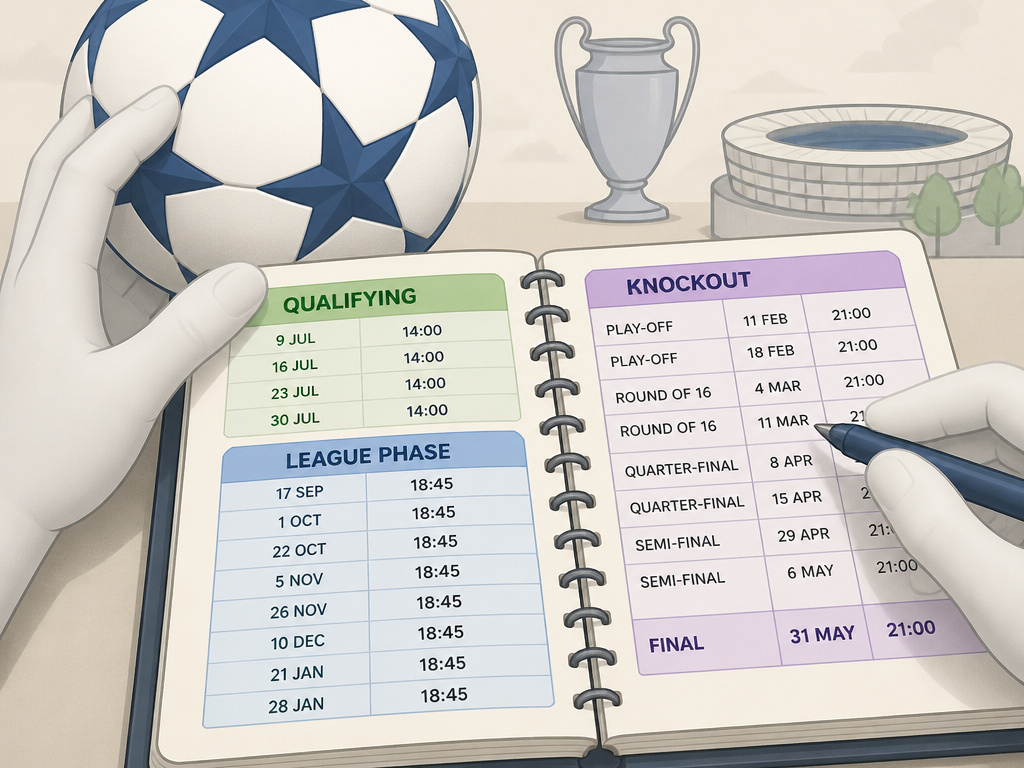
The calendar is a meticulously planned machine from July to June. It has to coordinate three European competitions and fit around domestic leagues.
- Qualifying Rounds (July–August): Two-legged knockout ties. Example dates for 2026/27: First round (7/8 & 14/15 July), Second round (21/22 & 28/29 July), Third round (4/5 & 11 August), Play-offs (18/19 & 25/26 August).
- League Phase (September–January): 8 matchdays spread across autumn and early winter. Matches are on Tuesdays and Wednesdays, kicking off in principle at 21:00 CET, with two matches per day (Tuesday, Wednesday) also scheduled at 18:45 CET. The first matchday of the league phase features matches on Tuesday, Wednesday, and Thursday.
- Knockout Phase (February–May): Play-offs (Feb), Round of 16 (Mar), Quarter-finals (Apr), Semi-finals (Apr/May). All are two-legged ties.
- The Final (June): A Saturday showcase.
For the all-important seeding and draws, club coefficients are everything. These coefficients, based on a club’s European results over the past five seasons, decide which pot a team is in for the league phase draw and seed them in the qualifying rounds. The draws determine the fixtures based on the seeding pots and other regulatory principles.
One quirky rule: from the league phase onward, a club must play all its matches in the same stadium. You can’t switch your European home ground mid-tournament without UEFA’s permission.
The Champions League’s Place in the European Ecosystem
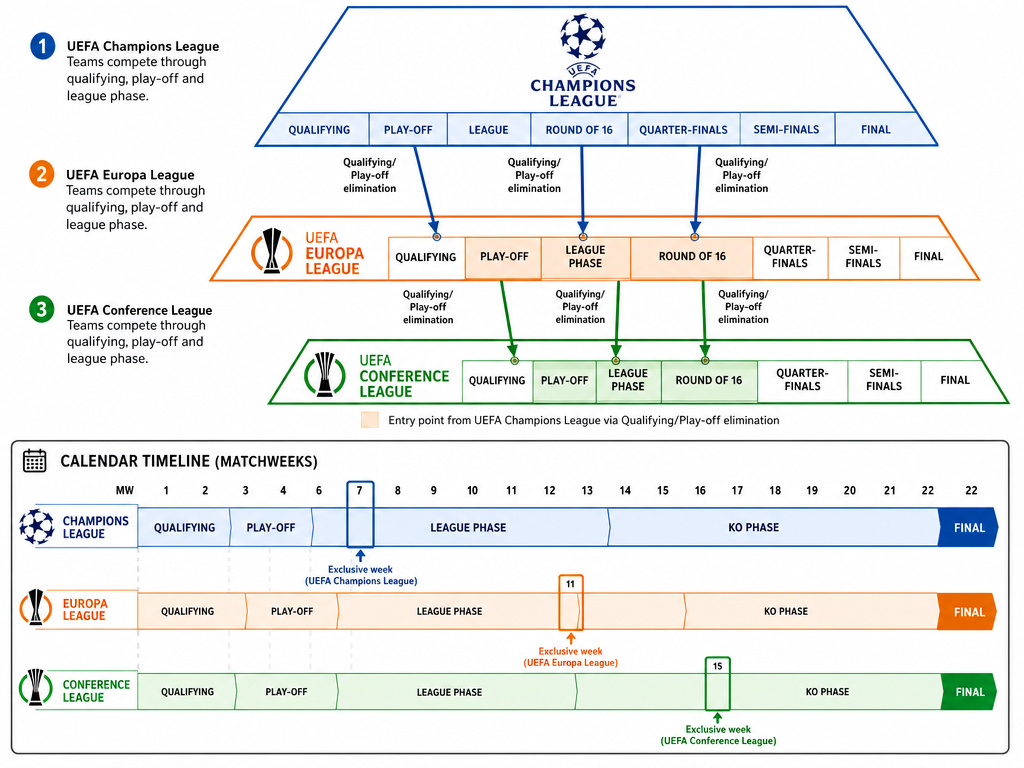
The Champions League doesn’t exist in a vacuum. It’s the apex of a three-tier pyramid, with the UEFA Europa League and UEFA Conference League below it. All three now use a 36-team league phase format, creating a symmetrical structure.
The connections are direct. Lose in the Champions League qualifying rounds, and you parachute into the later stages of one of the other two competitions. The specific drop-down paths are defined in the competition regulations. Clubs eliminated in the qualifying phase or play-offs are admitted to the ongoing UEFA Europa League or UEFA Conference League. For example, a club eliminated in the Champions League third qualifying round (Champions Path) enters the Europa League play-offs. This safety net means a bad night in July doesn’t end your European season, it just changes the address.
The three competitions also share the calendar smartly. Champions League and Europa League matches are played between September and January, while Europa Conference League matches are played between September and December. Each competition gets one exclusive “matchweek” where the other two aren’t scheduled, giving each tournament its own spotlight.
Finally, there’s the Super Cup, the annual curtain-raiser between the Champions League and Europa League winners. Winning the Champions League also guarantees a place in the next season’s league phase, a huge financial and sporting incentive.
How much prize money is in the Champions League?
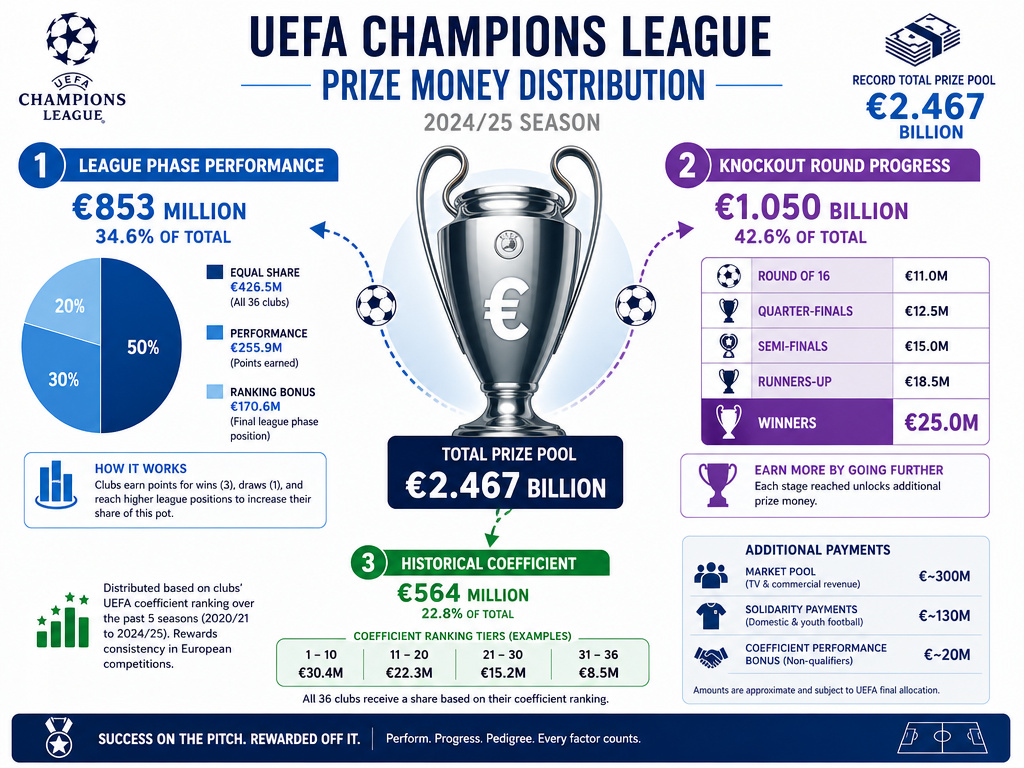
The financial rewards for competing in the UEFA Champions League are substantial and form a complex distribution system. While specific figures change each season, the total revenue pool is divided among the participating clubs based on several factors. A club’s share is influenced by its performance in the competition, including results in the league phase and progress through each knockout round. Historical performance over a ten-season period also contributes to the revenue distribution coefficient. Winning the tournament naturally brings the largest single bonus.
Frequently Asked Questions
How is the Champions League winner decided?
The winner is the team that wins the final, a single match played at a neutral venue. The 2026/27 final will be at the Estadio Metropolitano in Madrid. The winning club receives a full-size replica of the trophy; the original remains with UEFA.
What happens if the knockout play-off ties are drawn on aggregate?
Like all two-legged knockout ties, if the aggregate score is level after the second leg, the match goes to extra time and then a penalty shootout. The away goals rule is no longer used in UEFA competitions.
How does the new format benefit smaller clubs?
It offers more guaranteed matches (8 in the league phase).
Has the Champions League always had this format?
No. This is the third major format in the competition’s history. It started in 1955 as a straight knockout tournament for champions only (the European Cup). It evolved into a group stage plus knockout in 1991, and now into this 36-team league phase in 2024.
Can a team be relegated from the Champions League?
Not exactly “relegated,” but teams finishing 25th to 36th in the league phase are eliminated with no fall-back to another competition. It’s a hard exit. The only relegation-style movement happens earlier, when teams lose in qualifying and drop into the Europa or Conference League.
Before You Go
The new format is built for more games, more drama, and more money. But its real test is whether it preserves the knockout tension that made the old European Cup so compelling. A team can now finish 24th out of 36 and still win the trophy, that’s a safety net the classics never had.
One thing hasn’t changed: the weight of the trophy itself. It still stands 73.5cm tall and weighs 7.5kg. Lifting it in Madrid, or any final city, remains the ultimate prize. The path to get there is just more complicated, a winding road of coefficients, seeding pots, and predetermined play-off brackets. Understanding that road is what turns a casual viewer into a fan who sees the stakes in every matchday.
