
How the UEFA Super Cup Works: Format, History and Rules
This post contains affiliate links. As an Amazon Associate, we earn from qualifying purchases.
The UEFA Super Cup is an annual one-off football match that kicks off the European club season, contested automatically by the winners of the previous season’s UEFA Champions League and UEFA Europa League. The Champions League winner is designated the home team, the Europa League winner the away team, and the match is played at a neutral venue in August. Since the 2023 edition, if the scores are level after 90 minutes, the match goes directly to a penalty shoot-out, a change from the previous rule which included extra time.
The Champions League winner is considered the ‘home’ side for operational logistics like kit choice, but the match itself is staged at a neutral ground selected by UEFA. That single-game format is a relatively modern invention, and the rule for deciding a draw has changed more recently than most fans realise. This is a key part of how the UEFA Super Cup works.
What follows is a walk through the competition’s unique spot in the calendar, the specific rules that govern it, and the tactical and historical wrinkles that make it more than just a ceremonial opener.
Key Takeaways
- The match is an automatic invitation for the Champions League and Europa League holders — no qualifying rounds exist.
- Since 2023, drawn matches skip extra time and go straight to penalties, a recent change from the old 30-minute extra-time rule.
- Clubs must field their strongest team as per UEFA regulations, a subjective but important clause that elevates the fixture’s status.
- Of the first 50 editions, the Champions League winner has won 30 times, though the Europa League holder has pulled notable upsets.
Who Plays in the UEFA Super Cup?
The qualification rule is beautifully simple. The two slots are filled automatically by the clubs that lifted European club football’s two most prestigious trophies the previous season.
According to the official UEFA Super Cup competition format, the winner of the previous season’s UEFA Champions League is “considered as the home team” for operational purposes, while the winner of the UEFA Europa League is the away team. This designation mainly dictates who gets the home dressing room and which team must change kits in the event of a colour clash.
For purely operational and organisational purposes, the winner of the UEFA Champions League is considered as the home team while the winner of the UEFA Europa League is considered as the away team. The competition takes place in August.
This automatic entry is a key difference from other intercontinental playoffs, a central part of how the UEFA Super Cup works. There’s no qualifying path; you earn your ticket by winning one of the two main European finals. Both clubs must also hold a valid UEFA club license, which is a standard administrative check for any UEFA competition participant.
This setup creates a fascinating dynamic at the start of every season. You have one team that has conquered Europe’s elite competition, and another that has mastered the longer, more gruelling path of the secondary tournament. It’s a clash of pedigree versus persistence, often before either side’s domestic campaign has properly found its rhythm.
A Brief History: From Newspaper Idea to Season Opener
The competition’s origin story is pure football romance. It wasn’t conceived in a UEFA boardroom, but in the mind of a Dutch journalist wanting to test a great team.
In 1972, Anton Witkamp of De Telegraaf watched Ajax dominate Europe and asked a simple question. Was the European Cup winner truly the continent’s best club? To find out, he proposed a challenge match against the winners of the other major European trophy, the European Cup Winners’ Cup. He secured the agreement of Ajax and Rangers, the Cup Winners’ Cup holders, and organised a two-legged tie. UEFA, however, refused to endorse this first edition because Rangers were serving a European ban, making the 1972 contest unofficial.
The first officially recognised UEFA Super Cup final was played in 1973, with Ajax beating AC Milan 6-1 on aggregate. For its first 25 years, the fixture bounced between a two-legged format and the occasional one-off final, always featuring the European Cup/Champions League winner against the Cup Winners’ Cup winner.
The competition’s landscape changed dramatically at the turn of the century. When UEFA discontinued the Cup Winners’ Cup in 1999, a new opponent was needed. The 2000 final was the first to feature the UEFA Cup (now Europa League) winner, with Galatasaray beating Real Madrid with a now-defunct golden goal.
| Era | Team A | Team B | Format |
|---|---|---|---|
| 1973–1999 | European Cup / UEFA Champions League Winner | European Cup Winners’ Cup Winner | Mostly two-legged |
| 2000–Present | UEFA Champions League Winner | UEFA Cup / UEFA Europa League Winner | Single match |
That shift cemented the Super Cup’s modern identity. It was no longer a duel between two cup winners, but a showdown between the kings of Europe’s primary and secondary club tournaments.
Venue and Format: The Shift to a Travelling Show
For a generation of fans, the UEFA Super Cup was synonymous with one place: Monaco. Sources disagree on the exact year of the format change; UEFA states the switch to a single game at Monaco’s Stade Louis II occurred in 1998, while Sports Illustrated reports it was changed in 1997. That gave it a unique, almost boutique feel at the start of each season.
After 15 years in Monte Carlo, UEFA decided to rotate the venue annually, much like the Champions League final. This made the Super Cup a travelling showcase, giving different cities a prestigious season-opening event.
The match itself is a standard 90-minute affair, but the tie-breaking rules have a specific, modern twist in how the UEFA Super Cup works. For years, the format mirrored other cup finals: if level after 90 minutes, you’d play 30 minutes of extra time, then penalties. That changed recently.
Where this goes sideways: Assuming extra time is still played. From the 2023 edition onward, UEFA abolished extra time for the Super Cup. If the scores are level after 90 minutes, the match proceeds directly to a penalty shoot-out.
This rule change is a practical response to the congested calendar. It reduces player fatigue at the season’s start and delivers a decisive result on the night. It also increases the likelihood of a shoot-out. Sources disagree on how many have been decided this way; UEFA’s current article states five, while an archived format page stated only one as of 2020.
The Trophy, Medals, and That “Strongest Team” Rule
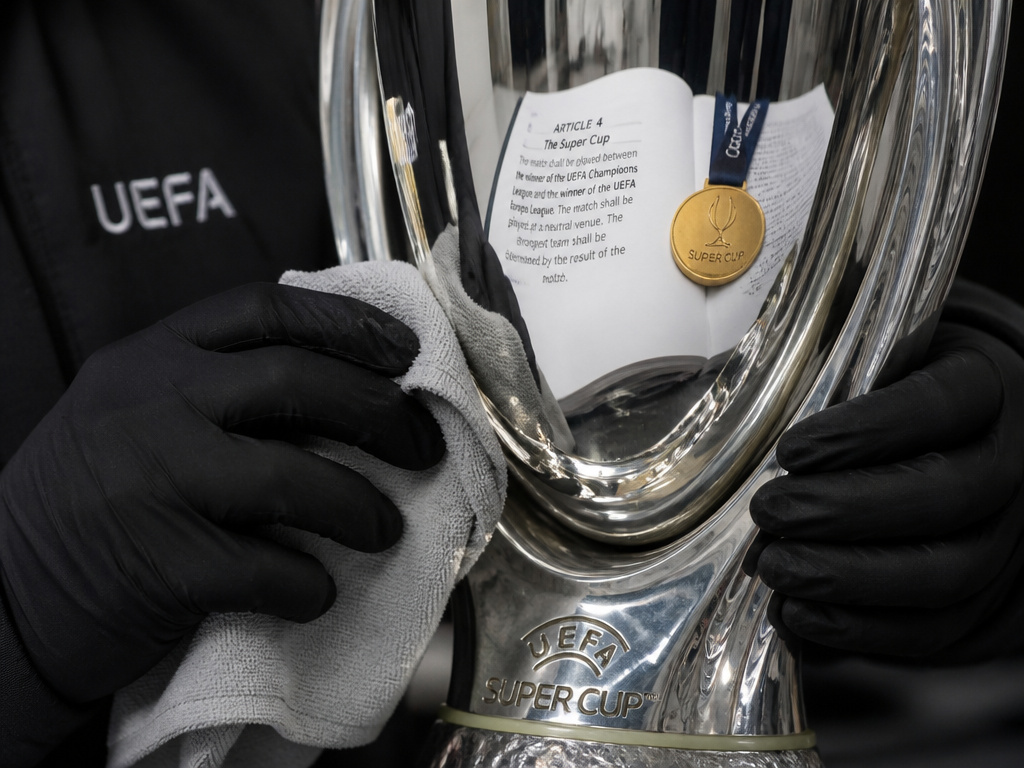
The tangible rewards for winning are clearly defined, and they include one of football’s more curious regulatory clauses.
First, consider the silverware. The gleaming trophy you see captains lift isn’t theirs to keep. The original remains in UEFA’s permanent possession. The winning club is awarded a full-size replica trophy to take home. The players receive 40 gold medals, while the runners-up get 40 silver medals.
Then there’s the prize money. While not on the scale of the Champions League, it’s a significant bonus. Since 2024, the winners have earned £4.3 million, with the runners-up receiving £3.5 million.
But the most talked-about rule is Article 4 of the UEFA regulations, which states clubs must “field their strongest team.” This is UEFA’s attempt to guard against the fixture being treated as a glorified friendly.
The problem is, it’s famously subjective and virtually unenforceable. What constitutes a “strongest team” for a match played in early August, when transfer windows are still open and preseason fitness levels vary? Managers often use it as a chance to integrate new signings or give minutes to squad players, leading to perennial debate about whether the rule is respected.
This game clause, however fuzzy, matters. It’s a line in the sand that sets the expectation. It signals that this is a competitive fixture with honour at stake, not just a marketing exercise. Fans and pundits will still debate team selections, but the rule itself lifts the contest above a mere exhibition.
How the Super Cup Fits Into the Football Calendar
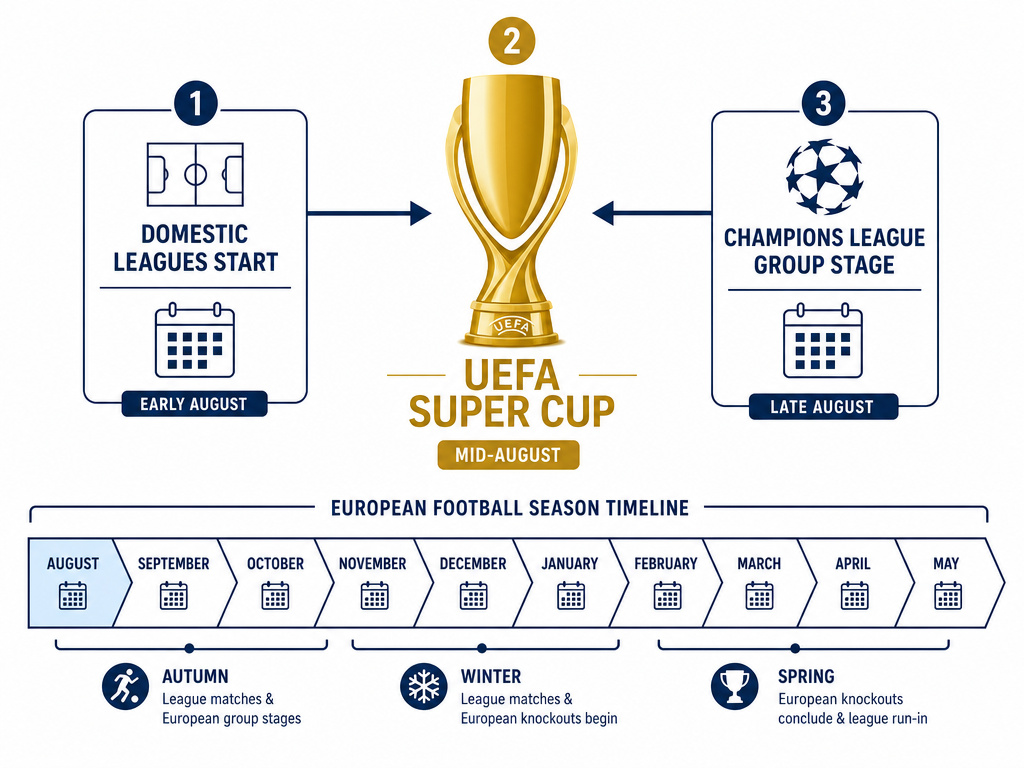
Timing is everything for this competition.
This slot is deliberate. Most major European domestic leagues are either just starting or are only one week old. The Champions League and Europa League group stages are still a month away. This makes the Super Cup a standalone spectacle, the first piece of European silverware on offer and a chance for the previous season’s European triumphs to be celebrated one more time on a continental stage.
The move to mid-August (from a late-August Friday slot) happened in 2014, aligning with changes to the international match calendar. It now sits neatly before the first Champions League playoff rounds, acting as a glamorous appetiser for the months of European football to come.
For the competing clubs, it’s a unique challenge. It’s often their first competitive match against elite opposition since the previous season ended. Pre-season preparations are put to an immediate, high-stakes test. Winning it can provide a massive morale boost; losing can feel like a dampener before the domestic campaign has even hit stride.
Records, Significance, and Common Questions
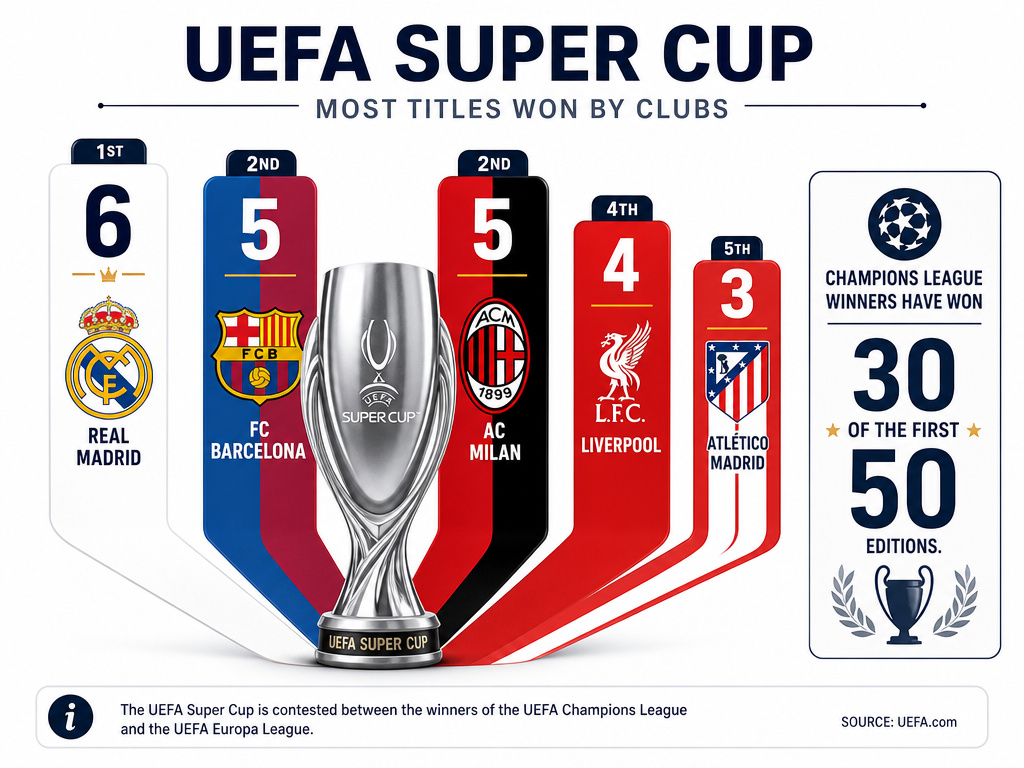
Is it a major trophy? The debate rages. For clubs with vast trophy cabinets, it’s often listed among ‘other honours’. For others, it’s a cherished piece of European silverware. Its significance lies in its exclusivity—you can only win it by first winning one of Europe’s top two competitions.
Real Madrid are the most successful side, having won it six times. AC Milan and Barcelona have five wins each. Historically, the Champions League winner has had the upper hand, winning 30 of the first 50 editions. But the Europa League winner’s victories—like Galatasaray’s in 2000 or Atlético Madrid’s wins in 2010, 2012, and 2018—are often more memorable upsets.
| Club | Super Cup Wins | Key Notes |
|---|---|---|
| Real Madrid | 6 | Most successful club in the competition’s history. |
| Barcelona | 5 | Last won in 2015. |
| AC Milan | 5 | A record five wins, but none since 2007. |
| Liverpool | 4 | Most successful English side. |
| Atlético Madrid | 3 | All three wins came as Europa League holders. |
The competition also holds unique trivia. Aberdeen are the only Scottish winners (1983). Chelsea, in 2013, became the first club to have contested the final as holders of all three major UEFA club honours (Cup Winners’ Cup, Champions League, and Europa League). And the fixture was not held at all in 1974, 1981, and 1985 due to various scheduling issues and political circumstances.
Prize money and trophy details
While the prestige of winning the UEFA Super Cup is significant, there is also a substantial financial reward for the competing clubs. The winning club receives a larger share of the prize fund compared to the runner-up. Beyond the monetary award, the victorious team is presented with a full-size replica of the official trophy. The original trophy, however, remains permanently in UEFA’s possession. The winning squad receives 40 gold medals, while the runners-up get 40 silver medals.
Sponsorship and commercial aspects
Like other major UEFA competitions, the Super Cup operates with significant commercial backing. The event features a range of official partners and sponsors, whose branding is prominently displayed around the stadium and in broadcast coverage.
Frequently Asked Questions
What happens if the UEFA Super Cup is a draw?
Since the 2023 edition, if the scores are level after 90 minutes, the match proceeds directly to a penalty shoot-out. The previous rule, which included two 15-minute periods of extra time, was abolished.
Does the UEFA Super Cup winner get a trophy?
Yes, but not the original. UEFA keeps the original trophy. The winning club is awarded a full-size replica trophy to keep permanently, along with 40 gold medals for the squad and staff.
Is the UEFA Super Cup a major trophy?
This is subjective. It is officially recognised as a UEFA competition and is contested by the winners of the two major European tournaments. However, within a club’s overall honours, it is often considered a secondary European trophy below the Champions League and Europa League. Its prestige comes from the quality of the opposition required to qualify for it.
Why was the UEFA Super Cup not held in some years?
The competition was not held in 1974, 1981, and 1985. The reasons were a mix of scheduling difficulties, political tensions, and, in the case of 1981, the ban on English clubs from European competition which affected the eligible participants.
How is the host city for the Super Cup chosen?
Since 2013, the final has been held at a different neutral venue each year. The host city is selected by UEFA’s executive committee from a pool of bidders, similar to the process for the Champions League final. This replaced the previous 15-year residency at Monaco’s Stade Louis II.
Before You Go
The Super Cup’s beauty is in its simplicity. Two champions, one match, at the dawn of a new season. It’s a hybrid—part celebratory curtain-raiser, part genuine competitive litmus test. The abolition of extra time shows UEFA is willing to adapt its traditions to the modern game’s physical demands.
While its place in the pantheon of trophies will always be debated, its role is clear. It’s the first bridge between one campaign’s triumphs and the next campaign’s ambitions. For a fan, it’s the welcome-back signal that European nights are about to begin again. Watch the next one with this context in mind: you’re not just seeing a friendly with a trophy. You’re seeing a rulebook quirk, a historical evolution, and two teams bound by a regulation to take it seriously. That’s a compelling way to start any season.
