
How Football Seeding and Draws Work: From Pots to Brackets
This post contains affiliate links. As an Amazon Associate, we earn from qualifying purchases.
To understand how football seeding and draws work, treat them as two separate jobs. Seeding ranks teams and sorts them into pots so the strongest stay apart. The draw then picks teams from those pots at random, under rules about who can meet. For the 2026 World Cup, FIFA built its pots from the 19 November 2025 ranking.
Those rules about who can meet are where the randomness starts to leak. Once a draw has to keep certain teams apart, the order of the pots starts to matter. Researchers who simulated the 2026 draw found that the valid groups weren’t all equally likely to come out of the bowls.
What follows: what a seed actually buys a team, how FIFA and UEFA build their pots and brackets, the December morning UEFA had to redo a draw, and the points where FIFA and the academics still disagree.
Key Takeaways
- Seeding and drawing are different steps: seeds are earned, draws are luck, and most “fixed draw” complaints mix the two up.
- FIFA’s 2026 draw used the Skip mechanism, which leaves some valid group line-ups more likely than others.
- In the Champions League knockouts, the bracket is largely fixed by league-phase finish, so the top two can’t meet before the final.
- A higher seed is better, but a seed buys an easier path and nothing more. I’ve drawn my own “perfect” bracket about ten times and been wrong by the quarter-finals every time.
- Draws go wrong in public: UEFA voided its 2021 round-of-16 draw and redid it at 1500 CET the same day.
What Is Seeding in Football, and Why Keep the Best Apart?
Seeding is a promise to the strongest teams that they won’t meet each other early. The organiser ranks everyone first, then uses that ranking to spread the big names across groups or across the two halves of a bracket.
Seeding in football ranks teams before a draw and separates the strongest into different groups or bracket halves. FIFA seeds the 2026 World Cup from its world ranking, with Pot 1 holding the three hosts and the nine strongest teams. Pots 2 and 3 take the next 12 each, and Pot 4 takes the rest plus six play-off placeholders.
National teams get sorted by the FIFA world rankings, frozen on a set date before the draw. That cut-off matters more than it sounds. A side that hits form a week after the ranking date gets no credit for it in the pots.
Why bother keeping the best apart? Because a tournament is a story, and nobody wants the two best characters killed off in chapter one. The final on 19 July 2026 in New York New Jersey is built to be the biggest night. Seeding is how organisers try to save the best matches for it.
The word itself has a gardening ring to it, and the usual story traces it to tennis. I’ll be honest that I’ve never seen a source I fully trust on the origin. The picture works anyway. You space your strongest seedlings out across the bed so they don’t crowd each other out before they’ve had a chance to grow.
Seeding doesn’t promise balance on its own. It only promises separation.
Seeding vs Drawing: How Football Seeding and Draws Work Together
Before every big tournament I sit down with a pen and sketch out the perfect bracket. I’ve done it about ten times now. I’ve been wrong by the quarter-finals every single time (which, for a former goalkeeper, is a familiar feeling of watching things fly past).
What I keep noticing is how much the pots shape the whole thing before a ball is kicked. A top seed in a group of four is often handed a gentler path, and my bracket always assumes that path holds. Then a match happens. Seeding sets the odds. The draw picks the opponents. The football ignores both.
That’s the clearest way to see how football seeding and draws work as a pair. One step is earned over months of results. The other happens in an evening.
| Question | Seeding | Drawing |
|---|---|---|
| What decides it | Rankings or league standings | Balls, slips, or software |
| When it happens | Weeks before the draw | On the night itself |
| What it controls | Who can’t meet early | Who actually meets |
| What goes wrong | A stale ranking cut-off date | Constraints and human error |
FIFA says as much in its own wording. Its 2026 draw procedures aim to keep some randomness while applying the seeding and constraint rules. Notice the hedge in “insofar as possible.” The rules come first. The randomness fills whatever room is left.
If you’re about to call a draw rigged, check first whether you’re really complaining about the seeding. The pots did most of the work before a single ball came out of the bowl.
The 2026 World Cup Draw: 48 Teams, Four Pots, Three Fixed Hosts
48 teams, 12 groups of four, and one draw night in Washington DC on 5 December 2025. It was the first World Cup with 48 teams, and FIFA announced FIFA’s published draw procedures on 25 November 2025, ten days earlier. The updated schedule, with every match given a stadium and a kick-off time, followed on 6 December.
The pots for the 48-team World Cup came straight from the 19 November 2025 ranking:
- Pot 1: the three hosts and the nine strongest teams.
- Pot 2: the next 12.
- Pot 3: the next 12 after that.
- Pot 4: the six lowest-ranked qualified teams, plus six placeholders. Four stood for UEFA play-off winners and two for intercontinental play-off winners, decided only in March 2026, after the draw was done.
The hosts didn’t get drawn at all. Mexico went into slot A1, Canada into B1 and the USA into D1. FIFA’s procedures keep these positions fixed, although Csató argues that pre-assigning a host to a group unnecessarily increases draw distortions.
Where this goes sideways: Treating Pot 4 as “the weak pot” and writing off its teams. Six of its twelve balls were placeholders for sides who didn’t exist yet on draw night, and their identities stayed open until the March 2026 play-offs, three months later.
I’ll admit the placeholder balls bother me. You can’t fully check who’s allowed to sit in a group when you don’t know which country the ball stands for.
Once each group is filled, the rest is familiar ground. The top finishers move on, and how the group stage works decides the knockout path that the seeding was trying to protect.
Why Is a Constrained Draw Never Truly Random?
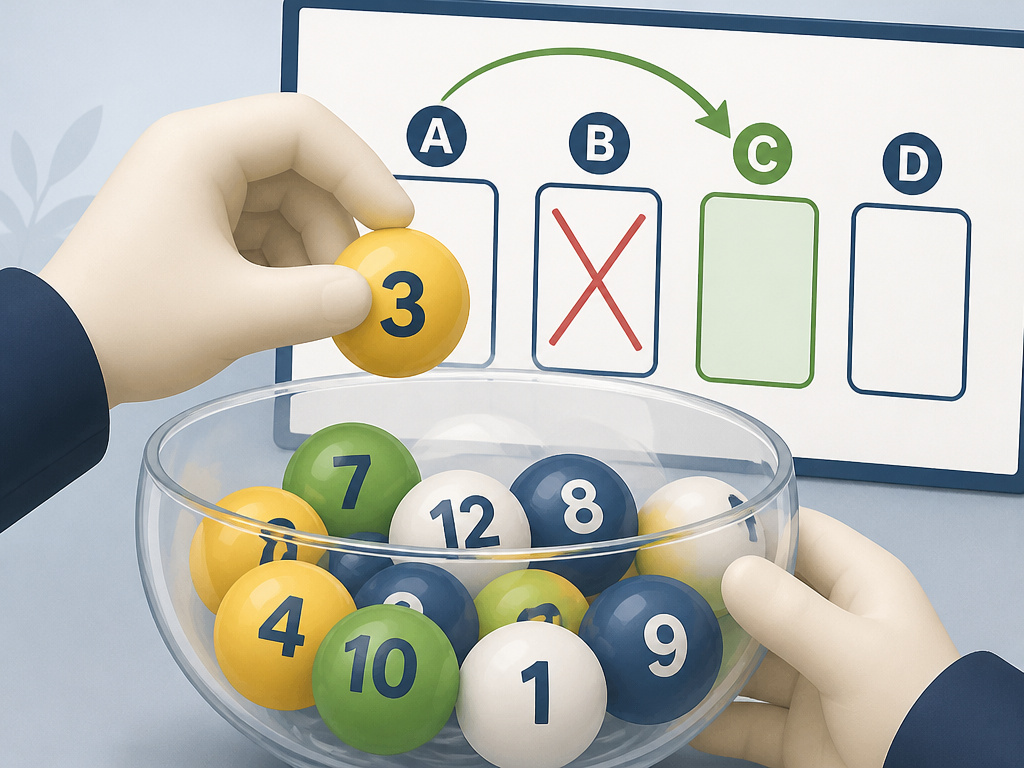
A draw with rules about who can meet stops being an even lottery as soon as the first rule bites. Without rules, it’s simple: balls in an urn, one per pot into each group, and every valid line-up equally likely.
Football adds rules. Before 2018, World Cup draws kept teams from the same continent apart (Europe excepted), with at most two European teams in any group. Rules like that create dead ends. Draw the wrong teams early and the last few balls have nowhere legal to go.
FIFA’s fix is the Skip mechanism. A computer checks each ball as it comes out. If placing a team in the next open group would leave the draw stuck later, the team skips to the next group that works.
There is a problem with that. Every skip pushes teams toward certain groups and away from others. Early balls shape the options for later ones, so some combinations come up more often than a fair lottery would allow. Researchers call this non-uniform: the valid allocations aren’t equally likely.
FIFA didn’t always use it. Julien Guyon’s 2015 critique picked apart the flaws in the 2014 draw, and FIFA adopted Skip for 2018 and 2022. For 2018, Laszlo Csato found the official pot order (1, 2, 3, 4) was clearly better than the 23 other possible orders. Even so, the bias shifted two countries’ chances of reaching the knockouts by more than one percentage point.
The 2026 numbers took far more work. The FIFA 2026 draw procedure analysis by Csato, Becker, Devriesere and Goossens tested the official procedure plus 47 alternatives, with 1.2 million simulated draws for each. In 2018 and 2022, a simpler method produced a million draws in about 1-2 hours. For 2026 it was hopelessly slow because of more restrictive constraints and more groups.
Each of their 48 procedures was evaluated with 1.2 million simulated draws. Their headline: FIFA’s official mechanism comes out best on four measures of non-uniformity. Their twist: the bias falls by more than half if FIFA treats the best teams drawn from Pot 1 equally.
I’ll be straight about my limits here. I can follow what these papers find and why it matters on the pitch. I couldn’t rebuild their simulation or audit it line by line.
Fairer methods exist on paper. Gareth Roberts and Jeffrey Rosenthal proposed two unbiased ball-and-bowl draws. Both lean on a computer step at some point, which raises its own trust problem. Pablo Laliena and F. Javier Lopez proposed two more systems they say beat FIFA’s, one “perfect” and one using pots.
I’d rather keep a small, measured bias that everyone can watch play out on television than switch to a perfectly fair draw that needs a computer behind the curtain. Trust in a draw is worth more than the last percentage point of fairness.
Champions League Seeding: Coefficients, the League Phase and a Fixed Bracket
UEFA seeds its clubs by club coefficients, a points record of recent European results, rather than by a world ranking. What happens after the seeding has changed a lot in the last few seasons.
The League Phase and Paragraph 17.02
The league phase format replaced the old groups, and its draw doesn’t settle the calendar by itself. Under Paragraph 23.01(b) of the regulations, UEFA’s administration decides which matches fall on Tuesday, Wednesday or Thursday, plus the kick-off times.
Paragraph 17.02 then shapes the rhythm. A club in principle plays no more than two home or two away matches in a row. It also gets one home and one away match in both the first two and the last two matchdays. UEFA keeps the right to bend these rules if the fixture list demands it.
Country protection has a long history here. In the old group stage, no two clubs from the same country could share a group.
The Knockout Bracket: Mirrors, Second Legs and Inherited Seeds
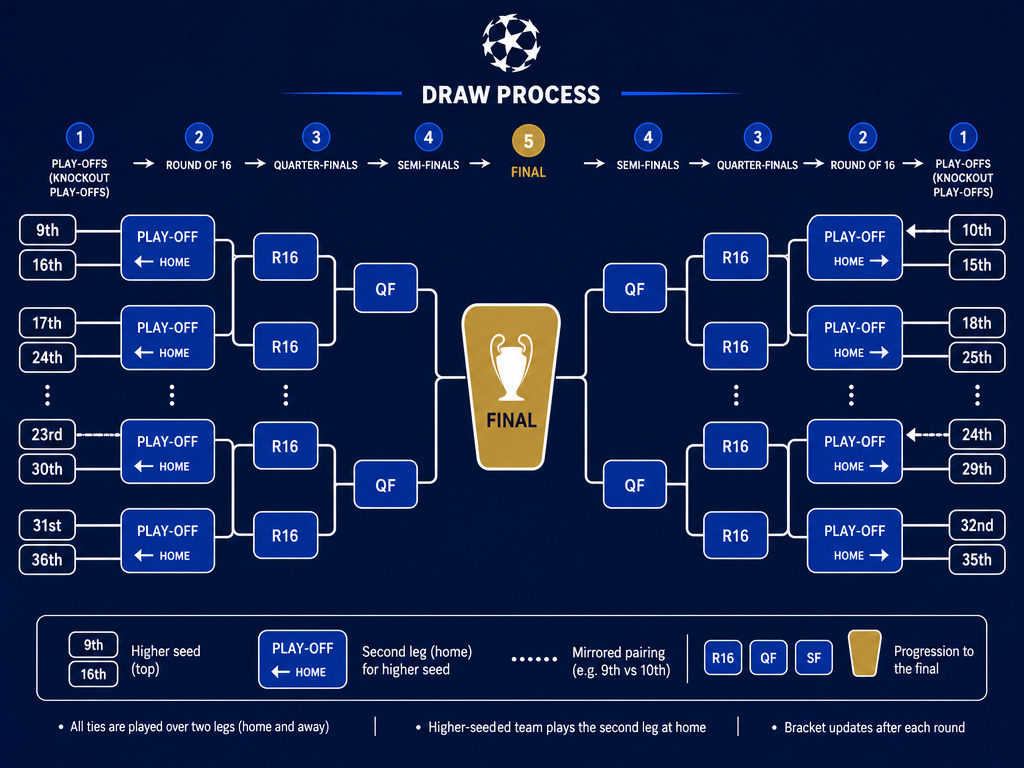
The 2025/26 knockouts used a bracket set mostly in advance. Clubs’ positions came from their league-phase finish, so the top two couldn’t meet until the final. The quarter-final and semi-final pairings, plus the order of legs, were fixed by the bracket.
The draws, held at UEFA headquarters in Nyon, filled in the play-off and round-of-16 ties. The Champions League knockout draw overview on Wikipedia lays out the mirror: both halves of the bracket match each other. Beat a seeded club, and you take over its seeding position.
Easy to miss: One ball settles two ties. If 9th is drawn against 23rd in the play-offs, 10th is automatically drawn against 24th on the other side of the bracket.
The detail I care about most is the second leg. The better-ranked club plays it at home. Home in the second leg means you know exactly what you need. You know whether to chase a goal or sit on a lead, and that shapes how bold a side dares to be in the first leg. Seeding steers risk long before the draw ends.
UEFA’s older round-of-16 draw, used from 2003/04 to 2023/24, also ran with constraints. Csato’s work on the fairness of sports draw mechanisms found it used the least distorted of the four available designs. Least distorted still isn’t zero.
The Night UEFA Voided Its Own Draw
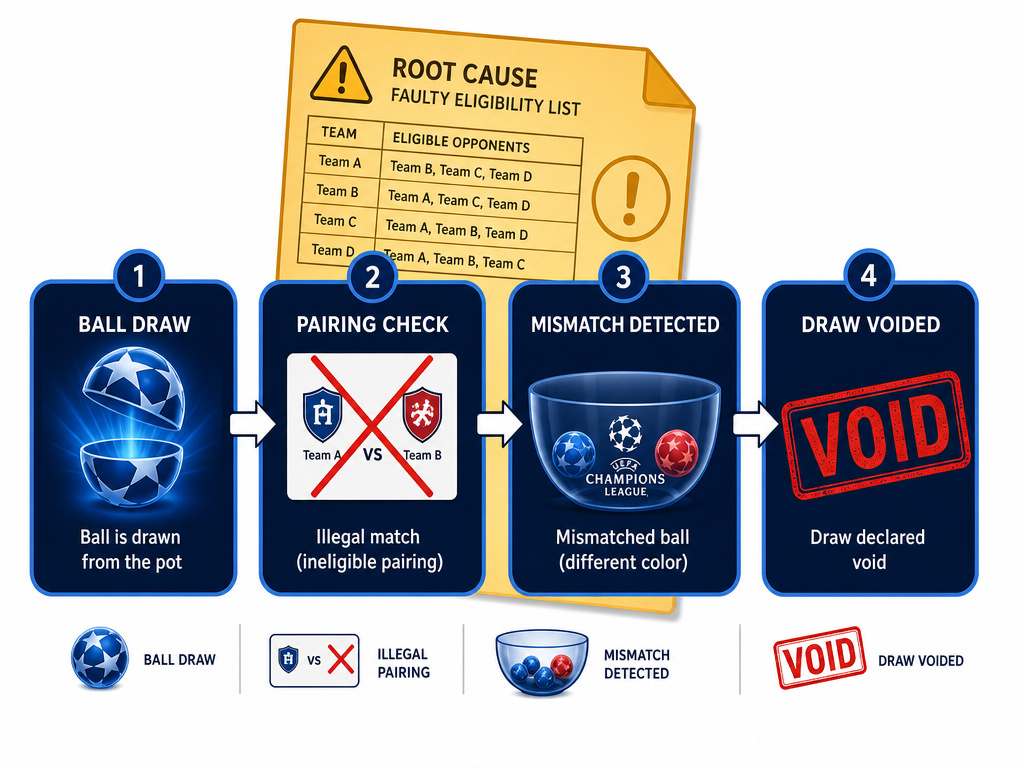
It was a Monday morning, 13 December 2021, and the Champions League round-of-16 draw looked routine. Then the officials started reading out the wrong teams. A draw ball snaps open with a dry plastic click, and you could almost hear the clicks getting more nervous as it unravelled.
Here’s how it fell apart, in order:
- Manchester United drew Villarreal, a team they had already played in Group F. That pairing broke the rules, so it was set aside.
- Atletico Madrid came up next. The official read out their possible opponents and left United off the list, though the earlier United draw had been a mistake.
- When balls went back into the bowl, one appeared to come from Liverpool’s pot instead of United’s.
- Atletico were paired with Bayern Munich. By then the errors had stacked too high, and UEFA declared the draw void.
UEFA blamed “a technical problem with the software of an external service provider” that tells officials which teams can face each other. The full draw was redone at 1500 CET.
Not everyone bought that. A Real Madrid source told ESPN it wasn’t a software fault at all and called it human error, starting with the second pairing.
Pep Guardiola backed the redraw. “It’s better to repeat it than have suspicion,” he said. I side with him. A draw that nobody trusts is worse than an awkward afternoon.
The deeper lesson is about mixing two systems. Physical balls are only as good as the eligibility list behind them. If the list is wrong, the theatre is wrong too.
Where FIFA and the Researchers Still Disagree
Three arguments are still open: whether FIFA’s 2026 draw order is truly the best one, whether hosts should get fixed slots, and who broke the 2021 Champions League draw.
| Question | One side | The other side |
|---|---|---|
| Is FIFA’s 2026 order optimal? | Paper’s abstract: best on four measures | Table reading: order 3-2-1-4 beats it on one |
| Should hosts get fixed slots? | FIFA: Mexico A1, Canada B1, USA D1 | Csato: pre-assigning hosts adds distortion |
| What broke the 2021 draw? | UEFA: external provider’s software | Real Madrid source: human error |
The first row needs care, and I’ve learned to be careful about this kind of thing. In my first year writing football history, I took a cup final score from a single source. A reader corrected me within an hour. These days I check every result against at least two sources before I print it.
So here’s my honest position. The 2026 paper’s abstract says FIFA’s official order is optimal on four measures. A research note I can’t verify against the paper’s text reads its Table 3 differently: order 3-2-1-4 shows a lower worst-case distortion (3.69 against 3.85), with the official order best on only two measures. Until I’ve checked that table myself, I’m treating it as an open question.
The host question is clearer. Csato’s work on optimising FIFA World Cup tournament draws flags pre-assigning the host to a group as a flaw that unnecessarily increases distortion. FIFA kept fixed host slots for 2026 anyway.
Nobody outside the room knows the answer on 2021.
Is a Higher or Lower Seed Better?
Higher. Almost always. A high seed is the reward for months of results, and it buys real advantages.
- Weaker group opponents, since you avoid the other top seeds.
- A home second leg in UEFA’s knockout ties, if you keep winning.
- A bye in some formats.
- Later meetings with the best teams in the field, which in a bracket means more rounds before you meet anyone your size. That last one matters most in single-elimination events, where one bad night ends everything.
The catch is that a seed raises your floor, not your ceiling. My failed brackets prove that every year.
NFL Playoff Seeding Works Differently
American football isn’t my patch, so I’ll keep this short. In the NFL, division winners take the top seeds and wild-card teams fill the rest. The top seed gets a bye and home games. The league also re-seeds after each round, so the best survivor always faces the lowest one left.
Byes, Re-seeding and Fixed Brackets
Byes exist because some fields don’t halve cleanly down to two finalists. The top seeds skip the opening round while everyone else plays to even out the numbers. Tennis, snooker and darts all seed players into a fixed draw so the best avoid each other early.
Fixed bracket vs re-seeding? For football, I’d pick the fixed bracket. Clubs and fans can plan travel and see the path ahead, as in the Champions League. Re-seeding suits a league like the NFL, where rewarding the top seed every round is the point.
When There’s No Seeding at All
Some competitions skip seeding entirely. In how the FA Cup draw works, the open draw means a non-league side can pull a giant out of the bowl. That’s the whole charm of it. Other events let organisers decide placements by judgment rather than by ranking.
Formats change the incentives too. Group stages and round robins forgive one bad night. Single elimination doesn’t. Promotion playoffs add their own strange pressure: I’ve watched clubs chasing a playoff place treat their last two league games like a rehearsal. That baffles me, when a few extra points might lift them clear of the lottery altogether.
Frequently Asked Questions
How does NFL seeding work?
Division winners take the top seeds, and wild-card teams with the best remaining records fill the lower ones. The top seed gets a bye and home field. The NFL re-seeds after each round, so the highest remaining seed always faces the lowest.
What does a #2 seed mean in football?
It means the team ranked second going into the draw or bracket. In a bracket, the second seed sits in the opposite half from the top seed, so the two can only meet in the final. In a pot-based draw, a second-pot team is one of the next tier below the top seeds.
How are tournament seedings determined?
Organisers use a ranking or recent results. FIFA used its world ranking of 19 November 2025 for the 2026 World Cup pots. UEFA uses club coefficients for the Champions League and league-phase standings for the knockout bracket.
Is a higher or lower seed better?
Higher seed is better. It brings weaker early opponents, sometimes a bye, and in UEFA knockouts a home second leg. It doesn’t guarantee anything once the matches start.
Why isn’t the World Cup draw completely random?
Rules keep certain teams apart, and the hosts get fixed slots. To avoid dead ends, FIFA uses the Skip mechanism, which researchers have shown makes some valid groups more likely than others.
Before You Go
Here’s one thing to do before the next big draw. Find the ranking date the organiser used and the pot lists, then read them before the ceremony starts. You’ll know which complaints are about seeding and which are about luck before anyone on television says “group of death.”
A concession, too. My preference for FIFA’s visible, slightly biased draw holds while the measured bias stays small. If future papers show it swinging qualification chances by much more than a point or two, I’d change my mind and back a fairer method with a computer step.
So, think back to the last draw you watched. Did you blame the balls when it was really the pots?
