
48 Team World Cup Format Explained: How It Works
This post contains affiliate links. As an Amazon Associate, we earn from qualifying purchases.
The 48-team World Cup format for 2026 places 12 groups of four teams in a first stage. The top two teams from each group (24 total) advance to the knockout stage, joined by the eight best third-placed teams across all groups. This creates a 32-team knockout bracket, starting with a new Round of 32, meaning the champion must win eight matches to lift the trophy.
That structure is one answer to a simple question central to the 48 team world cup format explained: how do you fit 16 more teams into a tournament without making it unworkably long? The solution FIFA landed on after its 2023 council meeting keeps a familiar rhythm, three group games for everyone, but changes the tournament’s entire knockout rhythm. It’s a bigger story, with more characters, and a plot that doesn’t fully reveal itself until the final group match ends.
What follows is a walkthrough of each stage, from the 72 group games to the final at MetLife Stadium. We’ll cover how teams are ranked, where the new jeopardy points are, and why understanding the tie-breakers is more important than ever in the 48 team world cup format explained.
Key Takeaways
- The 2026 champion will play eight matches, three in the group stage and five in the knockout rounds, one more than in the 32-team era.
- Advancement isn’t just about top two; eight third-place teams from across the 12 groups also qualify, ranked on points, goal difference, and goals scored.
- The new Round of 32 is a fixed, single-elimination bracket, but the placement of the eight third-place qualifiers depends on a predetermined bracket based on 495 possible combinations.
- Head-to-head record is the first tie-breaker within a group if teams are level on points, a change from previous World Cups.
How the 48-Team Group Stage Works
The first change is the most visible. Instead of eight groups, there are twelve, labelled A through L. Each contains four teams. Every side plays the other three once, guaranteeing the three-match minimum FIFA wanted. That makes for 72 group games in total.
The maths of progression is where the 48 team world cup format explained gets its unique flavour. The top two teams from each group advance automatically. That’s 24 spots secured. The remaining eight spots in the new 32-team knockout phase are filled by the best third-placed teams from across all twelve groups. It means finishing third is no longer a death sentence. A team can stutter, pick up four points from a win and a draw, and still have a very strong chance of moving on. Four third-placed teams will still go home.
This “best thirds” rule fundamentally alters the tension of the final group matchday. In the old format, a team with zero points in their last game was often just playing for pride. Now, even a slim chance at a third-place ranking, boosted by a big win, keeps every team invested. Every goal in the final minutes could shift the goal difference that decides which thirds advance.
| Group Stage Fact | Detail | Why It Matters |
|---|---|---|
| Groups | 12 (A-L) | Creates 72 first-round matches, up from 48. |
| Matches per Team | 3 | Guaranteed minimum, unchanged from 32-team format. |
| Auto-Qualifiers | Top 2 in each group (24 teams) | These teams land in fixed slots in the Round of 32 bracket. |
| Wildcard Qualifiers | 8 best 3rd-place teams | Ranked across all groups on points, then goal difference, then goals scored. |
Ranking the Teams: New Tie-Breakers and Third-Place Maths
When two or more teams finish level on points within a group, a tie-breaking sequence decides their final order. For 2026, FIFA changed the first criterion.
According to the FIFA World Cup 2026 Regulations (Article 13), teams are now separated by:
- Head-to-head points
- Head-to-head goal difference
- Head-to-head goals scored
- Overall goal difference in the group
- Overall goals scored in the group
- Fair-play points (yellow/red cards)
- FIFA ranking
This head-to-head-first order is a shift. Previous World Cups used overall goal difference as the first tie-breaker. It rewards the team that performed better in the direct clash, a move many see as fairer.
Where sources disagree: Some secondary fan sites and news articles still list the old tie-breaker order (goal difference first). The sequence above, from the official FIFA regulations, is definitive.
Ranking the third-place teams across different groups is a separate process. These 12 teams are lined up on a single table using these criteria, in order:
- Points
- Goal difference
- Goals scored
- Fair-play points
- FIFA ranking
The cut-off is simple: the top eight advance, the bottom four are eliminated. In practice, analysis suggests four points (a win and a draw) will almost always be enough for a third-place team to qualify. A team with three points and a healthy goal difference will often sneak in.
The New Knockout Map: A Round of 32
With 32 teams emerging from the groups, the tournament needs an extra round to accommodate them. Welcome to the Round of 32, a brand-new layer of single-elimination football that sits before the traditional Round of 16.
This is where the champion’s path gets longer. To win the trophy, a team must now navigate five knockout rounds instead of four. The physical and tactical demand increases. It also introduces a fresh point for a major upset, a top side could be eliminated a full round earlier than before.
The catch, and it’s a significant one, is that which third-place team goes into which slot depends on which groups they come from. FIFA’s regulations (Annex C) contain a pre-determined map of all 495 possible combinations of groups supplying the third-place qualifiers. Once the group stage ends, officials match the actual combination to the map, instantly populating the entire Round of 32 bracket.
The bracket for the third-place qualifiers is pre-calculated. This isn’t a random draw; it’s a massive logistical matrix designed to ensure competitive balance and a workable travel schedule across North America.
The Road to the Final: From 32 to One
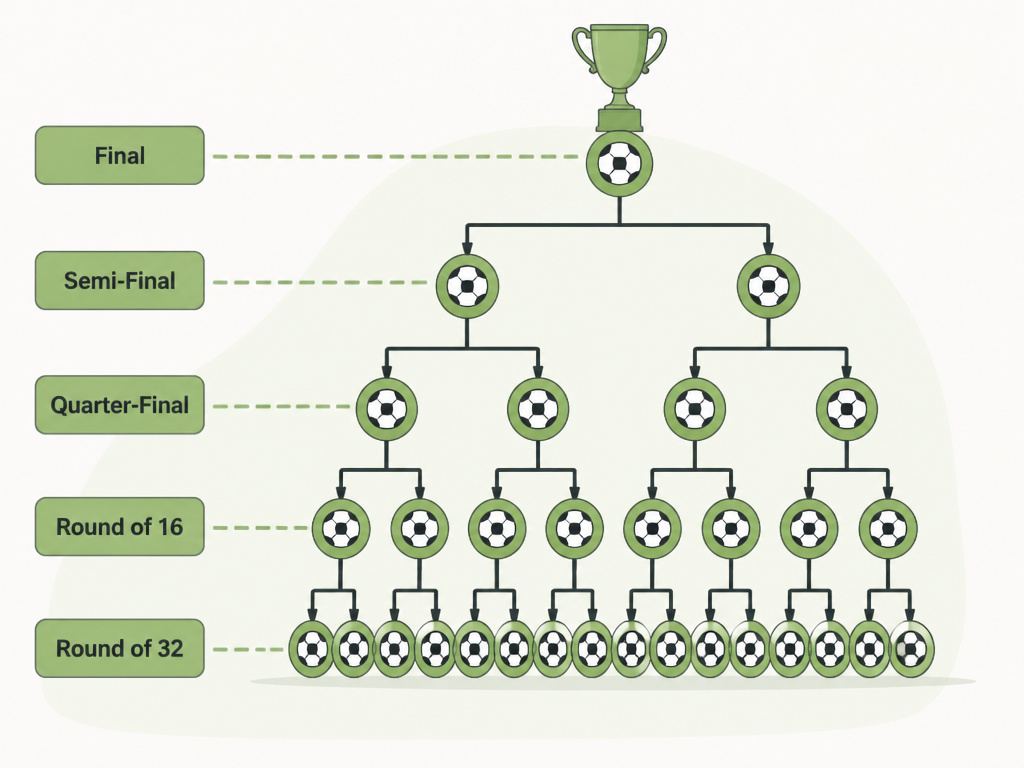
From the Round of 32 onward, the tournament reverts to a familiar single-elimination cadence, but with more teams and matches at each step.
Here’s the full knockout schedule for 2026:
- Round of 32: 28 June – 3 July (16 matches)
- Round of 16: 4 July – 7 July (8 matches)
- Quarter-finals: 9 July – 11 July (4 matches)
- Semi-finals: 14 July – 15 July (2 matches)
- Third-Place Match: 18 July (1 match)
- Final: 19 July (1 match)
That’s a total of 32 knockout matches, adding up to the tournament’s 104-game total. The opening match is scheduled between Mexico and South Africa on 11 June at Mexico City’s Estadio Azteca, and the final will be held at MetLife Stadium in East Rutherford, New Jersey.
| Knockout Round | Teams In | Matches | Dates (2026) |
|---|---|---|---|
| Round of 32 | 32 | 16 | 28 June – 3 July |
| Round of 16 | 16 | 8 | 4 July – 7 July |
| Quarter-finals | 8 | 4 | 9 July – 11 July |
| Semi-finals | 4 | 2 | 14 July – 15 July |
| Final | 2 | 1 | 19 July |
FIFA states the total combined number of rest, release and tournament days is 56 days, while other sources report the tournament runs for 39 days. The mandatory player release period for clubs begins on 25 May 2026.
Why the Change? Expansion and Its Implications
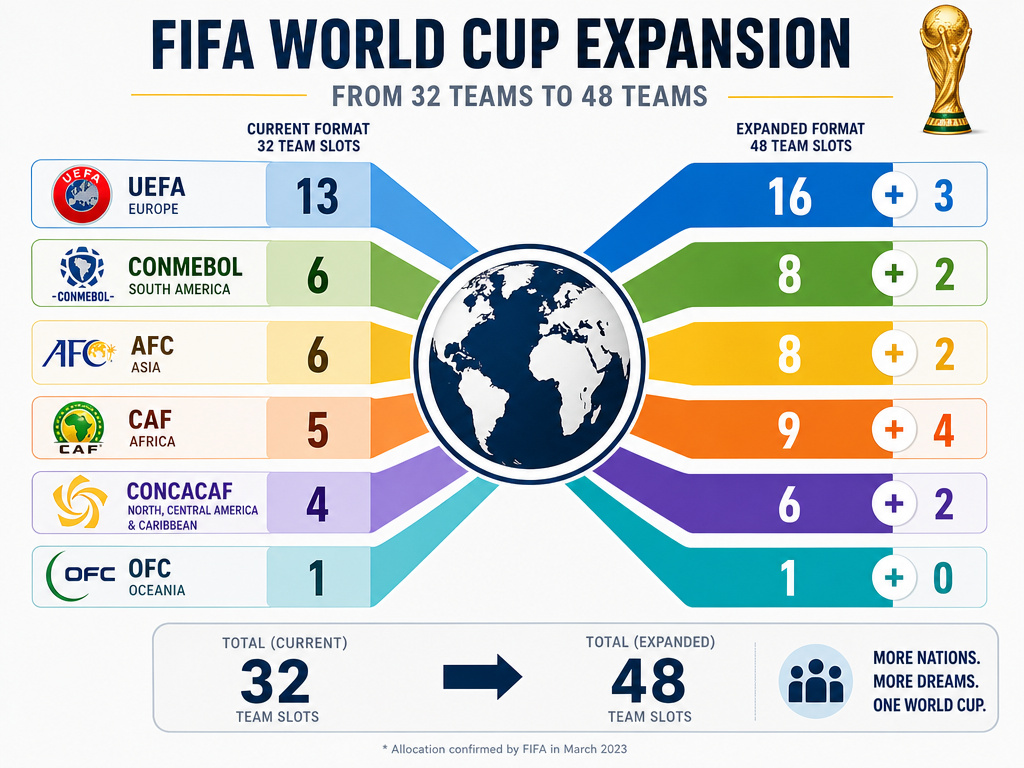
FIFA’s stated goal for expansion is inclusion. A 48-team field offers more slots to every confederation, giving more nations a realistic chance to qualify for the sport’s biggest stage. It also creates more matches, more broadcast inventory, and engages more markets, a clear commercial logic.
But the move isn’t without its critics. Some argue that adding 16 teams dilutes the quality of the group stage, with more potentially one-sided matches. The “best third-place” rule, while keeping teams invested, can also feel like it reduces the jeopardy of finishing third. A team might progress with just three points, potentially rewarding mediocre group-stage performance.
The counter-argument is that it creates more stories. More underdog nations get their moment, and the knockout stage becomes a wider, more unpredictable field. The new format also ensures every team gets three games, a revenue and experience guarantee that the alternative model, 16 groups of three, could not provide.
This format isn’t a one-off. As things stand, the planned 2030 World Cup in Spain, Portugal, Morocco, Uruguay, Argentina, and Paraguay will also use the 48-team structure. The expansion is the new normal.
Frequently Asked Questions
How many matches will the 2026 World Cup champion play?
The champion will play eight matches: three in the group stage and five in the knockout rounds (Round of 32, Round of 16, quarter-final, semi-final, and final). This is one more match than required under the previous 32-team format.
How are the eight best third-place teams determined?
After the group stage, the 12 third-placed teams are ranked against each other on a single table. The ranking order is: 1) total points, 2) overall goal difference, 3) overall goals scored, 4) fair-play points, 5) FIFA ranking. The top eight teams on this list advance to the Round of 32.
What is the new Round of 32?
The Round of 32 is a new knockout round added for the 48-team format. It features the 24 automatic qualifiers (group winners and runners-up) plus the eight best third-place teams. It consists of 16 single-elimination matches played from June 28 to July 3, 2026. The winners advance to the traditional Round of 16.
Will future World Cups use this 48-team format?
Yes. The 48-team format was introduced for the 2026 edition and is currently planned for use again at the 2030 World Cup. FIFA is formally studying a further expansion to 64 teams for future tournaments, but no decision has been made.
How does the 2026 draw and seeding work?
The draw, held in December 2025, placed the 48 qualified teams into four pots based largely on the FIFA World Rankings. Teams were then drawn into the 12 groups, with geographic restrictions to avoid too many teams from the same confederation in one group.
Before You Go
The 48-team format is more than just extra games. It’s a different kind of tournament narrative, one where the group stage is a sieve rather than a sharp cut, and where the path to the final is a marathon of eight matches. The team that wins in 2026 will need depth, stamina, and the ability to survive a new early knockout round where one bad day ends everything.
For fans, it means more football, more unexpected heroes, and a final table that won’t fully make sense until the very last whistle of the group stage. It changes how you watch. Instead of just tracking who finishes first and second, you’ll find yourself calculating goal difference across groups C, F, and I, wondering which third-place team will sneak in and where the pre-determined bracket will slot them. That complexity is the price and the promise of a bigger World Cup.
