
Champions League Phase Format Explained
This post contains affiliate links. As an Amazon Associate, we earn from qualifying purchases.
The new Champions League phase format sees 36 clubs compete in a single league table, each playing 8 matches (4 home, 4 away) against 8 different opponents. The top 8 teams advance directly to the round of 16; teams 9 through 24 enter a two-legged knockout phase play-off; teams 25 through 36 are eliminated. The format, often called the ‘Swiss model’, debuted in the 2024/25 season and aims to keep jeopardy alive through the final matchday.
The old four-team groups were neat stories. Two giants, a tricky outsider, and a minnow – you could sketch the drama on a napkin by matchday three. The new 36-team league phase replaces that with a sprawling, single-table narrative where every result shifts the picture for dozens of clubs at once. It’s a format that rewards consistency over a longer haul but spreads the tension so thin that the real knife-edge moments only arrive late. This is the Champions League phase format explained.
This guide walks through the league phase from the draw to the final whistle on matchday eight, explaining the Champions League phase format. We’ll break down the schedule, the complicated tiebreakers, the path to the knockout rounds, and what this all means for the Champions League’s famous drama.
Key Takeaways
- The league phase consists of 36 clubs, each playing 8 matches (four home, four away) against eight different opponents drawn from four seeding pots.
- Top eight finishers qualify directly for the round of 16; positions 9-24 enter knockout phase play-offs; positions 25-36 are eliminated.
- All matches on the final matchday (Matchday 8) are played simultaneously on a Wednesday at 21:00 CET to preserve competitive integrity.
- The first five tie-breakers (goal difference, goals scored, away goals, wins, away wins) are used during the phase; all ten criteria apply after its completion.
- A higher league finish grants home advantage in later knockout rounds, with the top four seeds getting the second leg at home in the quarter-finals.
How the League Phase Works: Structure and Schedule
The 2026/27 UEFA Champions League phase runs from 8–10 September 2026 to 27 January 2027. Each of the 36 clubs plays eight single-leg matches—four at home and four away—with fixtures scheduled primarily on Tuesdays and Wednesdays at 21:00 CET, with two matches per matchday kicking off at 18:45 CET.
According to the official regulations, a club should not play more than two consecutive home or away matches, a key detail in any Champions League phase format explained. They also aim for each club to play one home and one away match across both the first two and the last two matchdays. The UEFA administration can make exceptions to these sequencing rules, but that’s the blueprint.
Here are the confirmed matchdays for the 2026/27 season:
- Matchday 1: 8–10 September 2026
- Matchday 2: 13/14 October 2026
- Matchday 3: 20/21 October 2026
- Matchday 4: 3/4 November 2026
- Matchday 5: 24/25 November 2026
- Matchday 6: 8/9 December 2026
- Matchday 7: 19/20 January 2027
- Matchday 8: 27 January 2027 (all matches simultaneous at 21:00 CET)
The Draw: How Opponents Are Selected
The clubs are first split into four seeding pots of nine, based on their UEFA club coefficients, with the reigning Champions League titleholder as the top seed in Pot 1.
Each club is then drawn to play two opponents from each pot: one match at home and one away. So, a top-seeded team in Pot 1 will face two other Pot 1 teams, two from Pot 2, two from Pot 3, and two from Pot 4.
Qualification Outcomes: From Top 8 to Elimination
After eight matches, the single league table splits into three distinct tiers.
| Final League Position | Destination | What It Means |
|---|---|---|
| 1st – 8th | Round of 16 | Direct qualification. Skip the play-offs entirely and await the draw for the last 16. |
| 9th – 24th | Knockout Phase Play-offs | Enter a two-legged play-off round. Win, and you join the top eight in the round of 16. |
| 25th – 36th | Eliminated | Exit European competition entirely. There is no drop-down to the UEFA Europa League. |
The cut-off points are absolute. Finish 24th, and you fight for your life in the play-offs. Finish 25th, and your European campaign is over.
The play-off draw is itself a reward for a higher finish. Teams ranked 9th through 16th are seeded and drawn against the unseeded teams (17th through 24th) in predetermined pairings: seeded pairs (9&10, 11&12, 13&14, 15&16) are drawn against unseeded pairs (17&18, 19&20, 21&22, 23&24).
Breaking Ties: The League Phase Tiebreaker Rules
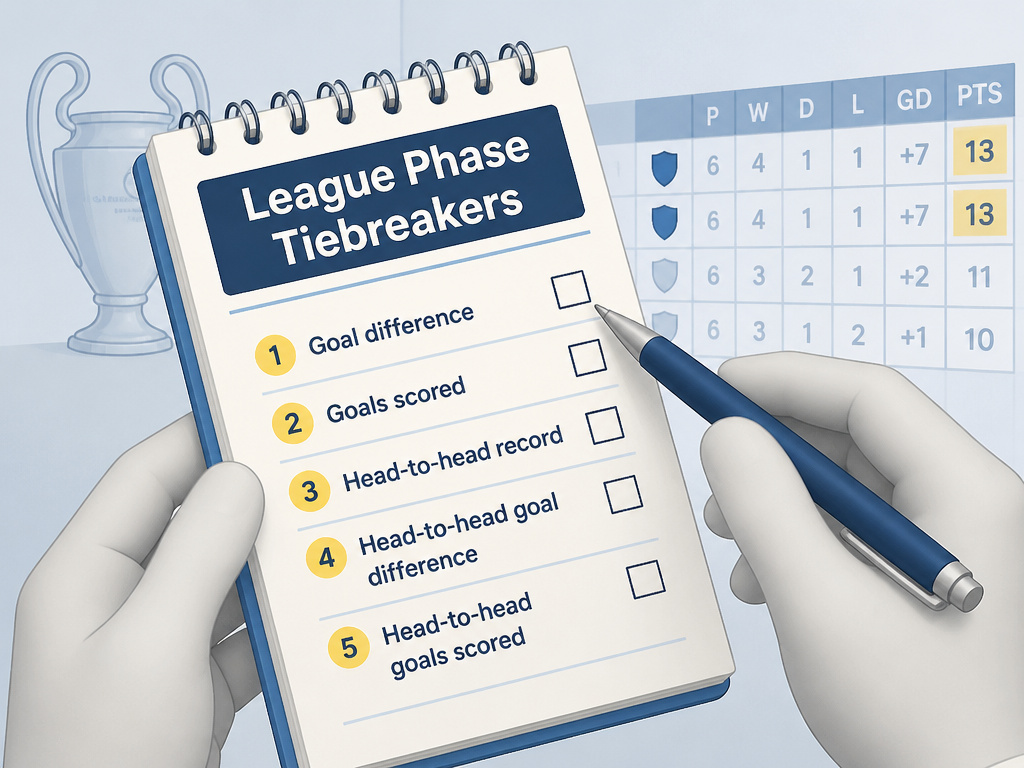
During the league phase (Matchdays 1-7), the standings use only the first five tie-breaking criteria to separate teams:
- Superior goal difference
- Higher number of goals scored
- Higher number of away goals scored
- Higher number of wins
- Higher number of away wins
After the league phase is complete (Matchday 8), the full ten-criteria list from the official regulations kicks in. The first five are the same, followed by:
- Higher number of points obtained collectively by league phase opponents
- Superior collective goal difference of league phase opponents
- Higher number of goals scored collectively by league phase opponents
- Lower disciplinary points total (red card = 3 points, yellow = 1 point)
- Higher club coefficient
The Wikipedia entry on the 2026-27 league phase lays out this full hierarchy, which is lifted directly from UEFA’s own competition regulations.
The Knockout Stage: Seeding and Home Advantage
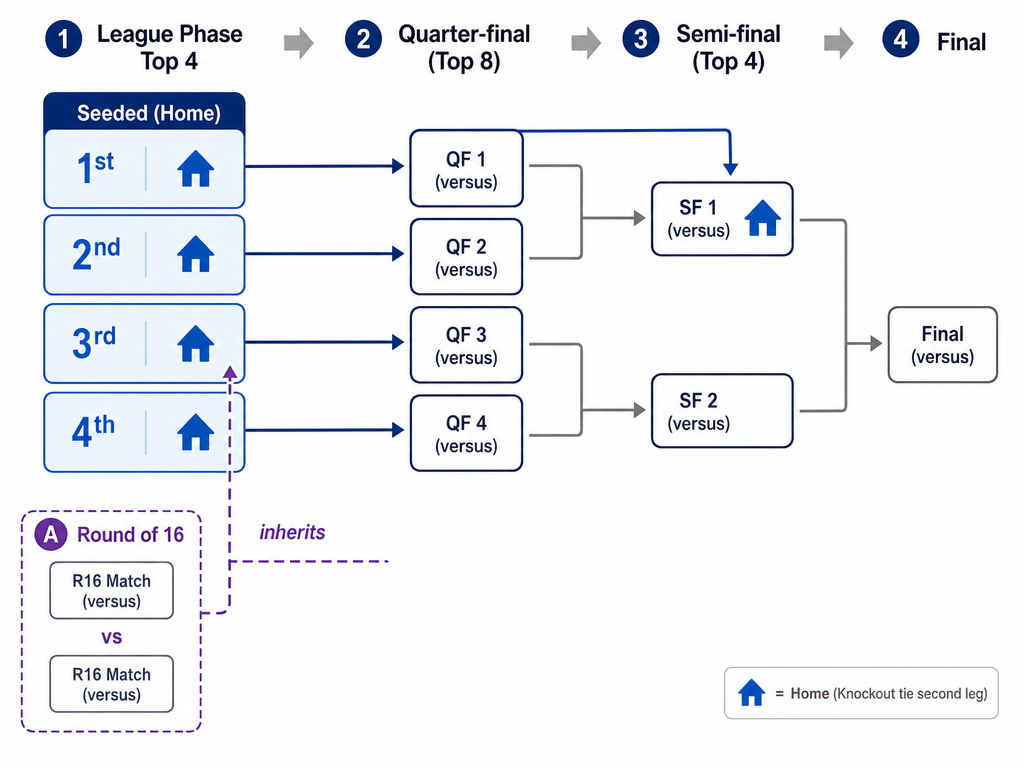
The top eight avoid the play-off round entirely. The winners of those eight ties fill the remaining slots in the round of 16 draw.
Here’s where a high finish really pays off. According to the regulations, the top four teams after the league phase are seeded for the quarter-finals. If they advance that far, they are rewarded with the second leg of their quarter-final at home. The top two teams get the same home-second-leg advantage for the semi-finals.
Where this goes sideways: If a seeded team (like the 1st or 2nd placed team) is knocked out in the round of 16, the team that beats them takes over their seeding position in the bracket. The advantage isn’t recalculated; it’s inherited. This rule protects the integrity of the seeding earned in the league phase.
The ‘Swiss Model’: Why the Format Changed
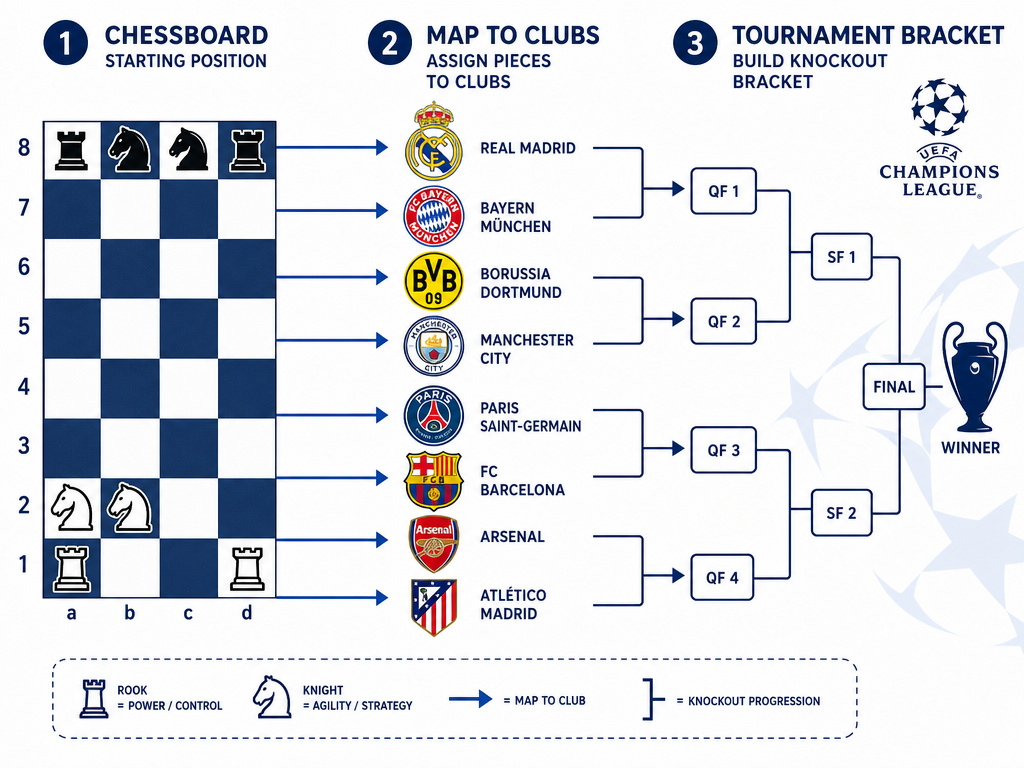
The league phase format is commonly referred to as the ‘Swiss model’, a term borrowed from chess tournaments. The core idea is that competitors are matched against opponents with similar records as the event progresses, theoretically leading to more balanced and meaningful games later on.
UEFA’s shift, which also applies in adapted forms to the Europa League format and the UEFA Conference League structure, was driven by a few goals. It creates more total matches (and thus more broadcast revenue), gives more clubs access to the financial windfall of the competition, and aims to ensure more high-profile clashes occur earlier in the tournament.
Whether it delivers more drama than the history of the European Cup knockout heritage is a matter of taste. As noted in the Sky Sports league phase qualification guide, the target for big clubs is to secure a top-eight finish—a concrete benchmark that defines success in this new era.
Example points needed for top 8 qualification
There is no fixed points target for finishing in the top eight. The league phase consists of 36 clubs, each playing only eight matches. This means the total points available are limited, and the final standings depend heavily on the relative strength of each club’s specific eight opponents. A club’s performance is measured against a unique set of teams drawn from different pots. To aim for the top eight, a club must consistently perform well in its matches, focusing on securing wins to maximize its points total, as goal difference and goals scored are the primary tie-breakers if points are level.
Country protection rules in the draw
The fact sheet does not mention any specific country protection rules for the league phase draw. The draw procedure outlined divides the 36 clubs into four pots of nine based on club coefficient rankings. Each club is then drawn to play two opponents from each pot, one at home and one away. Without specific guidance on country protection, the practical approach is to follow the official draw ceremony, where UEFA administrators will clarify any such restrictions if they exist for a given season. The draw’s primary aim is to ensure each club faces a balanced mix of opponents from different seeding levels.
Frequently Asked Questions
How does the Champions League round of 16 draw work after the league phase?
The eight group winners (teams ranked 1-8) are seeded for the round of 16 draw. They are drawn against the eight winners of the knockout phase play-offs. Teams from the same national association can be drawn against each other at this stage, and there are no other restrictions. The play-off winners are unseeded.
What is the format of the 2026-27 Champions League final?
The 2026/27 UEFA Champions League final will be played on 5 June 2027 at the Estadio Metropolitano in Madrid, Spain. It is a single match. If the score is level after 90 minutes, 30 minutes of extra time are played, followed by a penalty shootout if necessary.
How many games does each team play in the Champions League phase?
Each team plays exactly 8 games in the league phase. This is a reduction from the old group stage, where teams played 6 games, but an increase in unique opponents (8 vs 3).
How does UEFA Champions League qualifying work for the league phase?
Most teams qualify for the Champions League automatically via their domestic league position. The four extra spots in the 36-team league are allocated: one to the association ranked 5th in UEFA’s list (e.g., 3rd place in that league), one via an extended ‘Champions Path’ in qualifying, and two ‘European Performance Spots’ to the associations whose clubs performed best collectively in the previous season’s European competitions.
Before You Go
The new league phase is a format built for television and financial stability first, football romance second. Its genius is in keeping more big clubs involved for longer and manufacturing a dramatic final day. Its flaw is that the weekly, visceral drama of a tight four-team group is gone, replaced by a slow-burn table where consequences are often deferred.
One thing is certain: it pays to finish as high as you can. That difference between 8th and 9th is a month of extra rest and a direct pass to the last 16. The difference between 1st and 4th could be home advantage in a semi-final. Every point matters, but the true weight of each result only becomes clear when 35 other fixtures have also been settled. It’s a continental puzzle, and we’re all still learning how the pieces fit.
