
How Promotion and Relegation Work in Football
This post contains affiliate links. As an Amazon Associate, we earn from qualifying purchases.
How promotion and relegation work in football is simple at heart: the best teams in a division move up a level and the worst drop down, every season, on results alone. England’s Premier League sends three clubs down, while Germany and Scotland make a struggling top-flight side defend its place in a play-off.
That play-off detail is where the countries really split. Every league signs up to the same idea of moving clubs between divisions, but each one writes its own small print on tie-breaks, ground rules and money. That small print decides who actually goes up.
What follows walks the English pyramid first, then the play-off systems in Germany, Scotland and Italy, then the ground rules, the money and the points deductions that can overturn a final table.
Key Takeaways
- In-season Premier League ties are shown alphabetically for display only; at season’s end the Handbook moves to head-to-head points, then head-to-head away goals, then a neutral-ground play-off.
- A National League club needs a ground with 5,000 capacity and 1,000 seats in its first EFL season (by 1 May, says the SGSA; by 30 April, says a Football Writers’ Association column).
- Parachute clubs won promotion from the Championship 31.4% of the time versus 7% over 2015/16 to 2024/25, per the Leonard Curtis report; an older Sheffield Hallam study found “twice as likely”.
- When a club is thrown out, the drop places shrink: Bury’s 2019 expulsion cut League One’s relegation places from four to three.
- Points deductions can redraw the bottom of the table late in the day: Everton’s 10-point penalty was cut to 6 on appeal.
How Promotion and Relegation Work in Football, One Tier at a Time
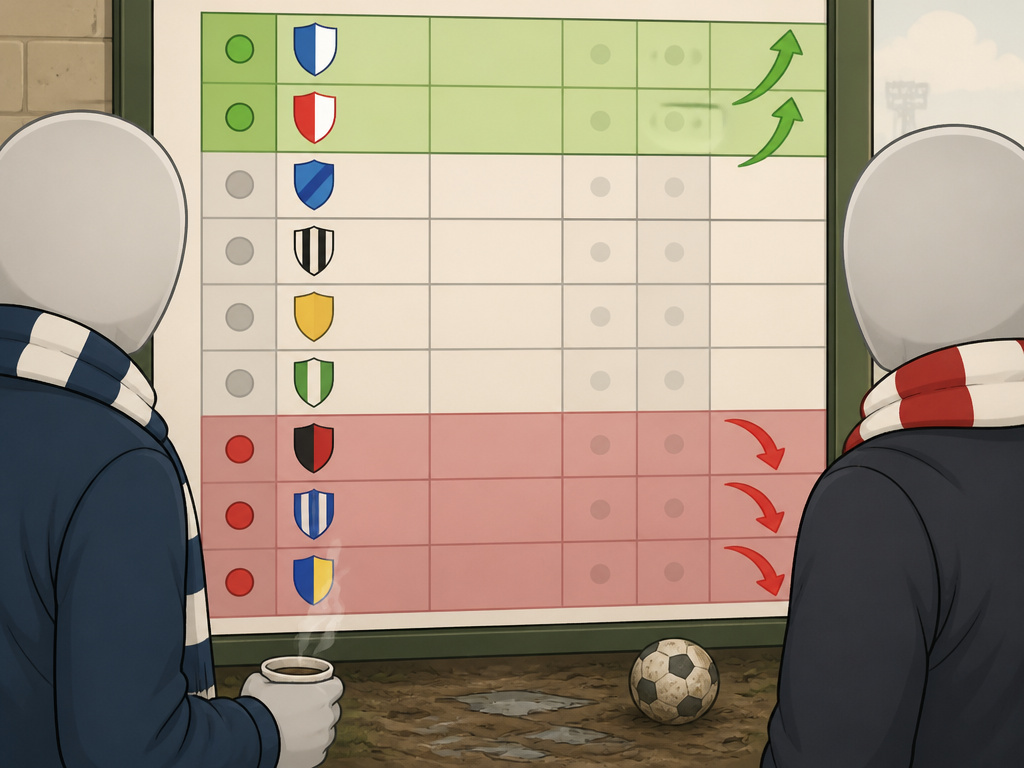
A muddy terrace, a cup of tea that was strictly hot-ish, and a home side hitting it long because three points mattered more than style. I spent roughly one winter going to non-league games, and that’s where the pyramid finally made sense to me. You could feel that a promotion would change the club’s whole budget.
Promotion and relegation link the divisions of a league pyramid into one open system. At the end of each season, the top finishers of a division move up a tier and the bottom finishers drop down. In England, the Premier League relegates three clubs, while the Championship promotes two automatically and a third through play-offs.
Every division in an open system follows that loop. The top finishers climb, the bottom finishers fall, and the whole English football pyramid reshuffles over the summer.
The bottom places form the relegation zone, which fans call the drop zone. The places at the top that lead upward are the promotion zone. Both lines move every week until the last day.
At the top, Premier League relegation takes the bottom three clubs straight down. Below that, the Championship sends its top two up automatically and settles the last place through the promotion playoffs. Germany moves two and uses a play-off for the third.
The second tier is where the system bites hardest.
It’s a long grind, and I’ve watched Championship coaches change shape midweek far more than their Premier League counterparts, purely because legs are gone by Tuesday. Honestly, I think that rotation tells you more about the promotion race than any single result. A deep squad buys you fresh legs in March, and fresh legs win promotions.
Why Does the Premier League Table Sometimes Look Wrong?
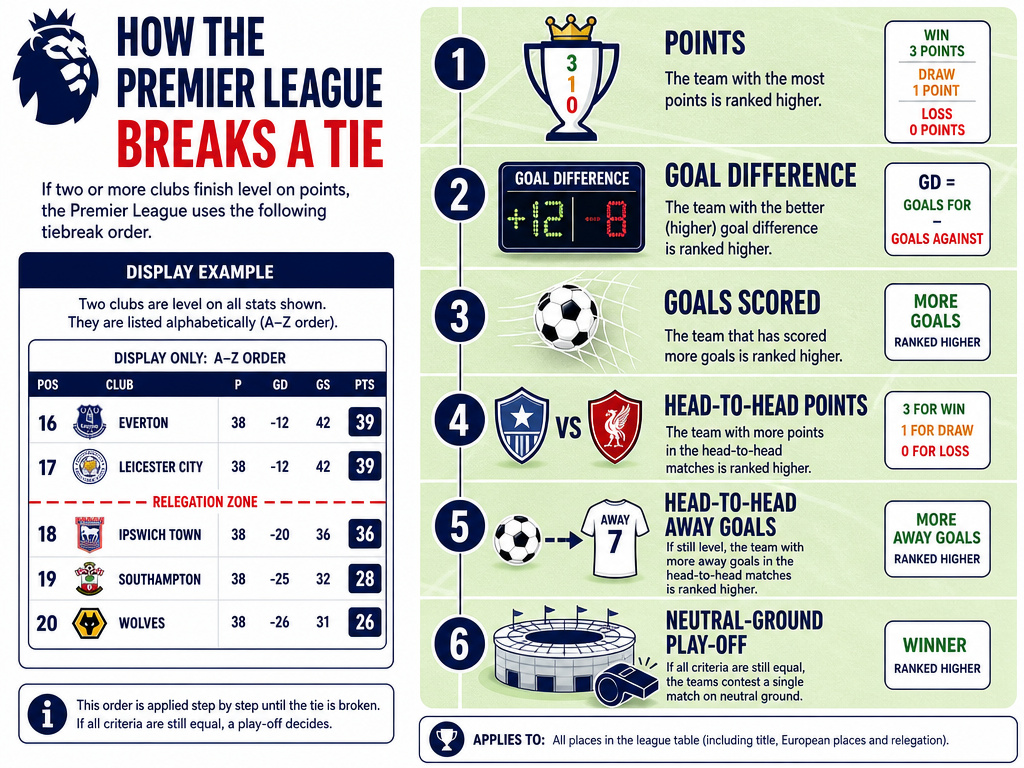
Twenty clubs, zero games, zero points. On the opening weekend the Premier League still has to print a table, so it lists all 20 teams alphabetically.
That habit carries on quietly all season. Under Rule C.7 of the Premier League Handbook tie-break rules, clubs level on points, goal difference and goals scored “shall be deemed to occupy the same position.” The alphabetical order you see is for display only. (I kept goal for years, so goal difference and I have never been on friendly terms.)
At season’s end the rules change, but only where something is at stake: the title, a European place or relegation. Here’s the order the Handbook works through:
- Points first. Nothing else matters until two clubs are level.
- Goal difference. Goals scored minus goals conceded across the season. A single heavy defeat in November can be the thing that sends you down.
- Goals scored. Still level? The club that scored more goes higher. During the season, a tie on all three means a shared position.
- Head-to-head points (C.17.1). This only kicks in at the end of the season and only when a title, relegation or qualification place hangs on it.
- Head-to-head away goals (C.17.2).
- A neutral-ground play-off (C.17.3), with the format, timing and venue set by the Board. Alphabetical order is never used to settle anything at season’s end.
Easy to miss: Two clubs printed either side of the drop line in October might be dead level on everything. The one listed lower sits there because of its name, and it only becomes a relegated club if the tie survives to the final day.
Every league writes its own order of points and tiebreakers, and Italy’s is different enough to need its own play-off. More on that below.
Germany, Scotland and Italy Make a Top-Flight Club Fight for Its Place
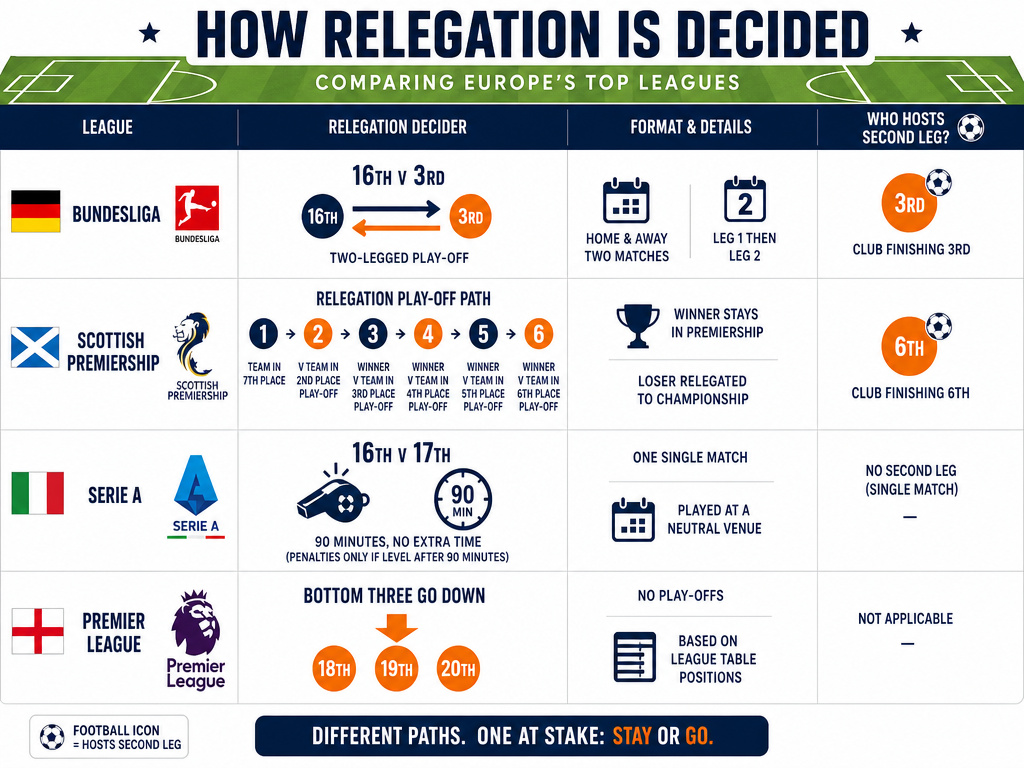
England is the odd one out of these four leagues. Its top flight never has to beat anyone from below to stay up, and I think the competition is poorer for it.
| League | Who plays off | Format | Home advantage |
|---|---|---|---|
| Bundesliga | 16th v Bundesliga 2’s 3rd | Two legs | Fewer rest days hosts 2nd leg |
| Scottish Premiership (2022/23) | 11th v Championship play-off winner | Two-legged QF, SF and final | Premiership club hosts final 2nd leg |
| Serie A (from 2023-24) | Two clubs level at the drop line | Two legs, 90 minutes, no extra time | Better head-to-head record hosts return |
| Premier League | No play-off; bottom three go down | Neutral play-off only for exact ties | Venue set by the Board |
Germany’s 16th v 3rd Tie and the Rest-Day Rule
Germany has only two automatic movers between its top two tiers. The 16th-placed Bundesliga club then plays the 3rd-placed club in Bundesliga 2 over two legs, a tie known in Germany simply as the Relegation.
The home-leg rule is my favourite bit of small print. Whichever club had fewer days off between its last match and the first leg hosts the second leg. A draw settles it if rest days are equal.
Why does the second leg matter so much? The side at home last plays knowing the exact aggregate, meaning the combined score over both games. A team 1-0 down after the first leg can stay compact for an hour, then throw bodies forward late in front of its own crowd. Both coaches set up the first leg around that knowledge.
The same method has decided promotion to Bundesliga 2 since the 3. Liga arrived in 2008. In 2022/23 Freiburg’s reserves finished second but weren’t eligible to go up, so 3rd-placed Osnabrueck went up automatically and 4th-placed Wiesbaden took the play-off spot.
Scotland’s Six-Game Gauntlet
Scotland asks far more of its second-tier clubs. In 2022/23, 4th played 3rd in the Championship over two legs, and the winner then played 2nd over two legs. That winner met the Premiership’s 11th-placed club in a two-legged final, with the Premiership club at home in the second leg.
Count the games and the imbalance jumps out. A team finishing 3rd or 4th needs six matches to go up and the runner-up needs four, per STV. The top-flight side plays just two, one home and one away.
In May 2025 STV reported the SPFL was weighing a change from 2026/27: one-legged quarter- and semi-finals with the higher-placed team at home, and a two-legged final kept as it is. That would cut six games to four for 3rd and 4th, and four to three for 2nd. It needed a vote of all member clubs, and the reporting I have doesn’t say how that vote went.
Single legs change tactics more than they change the fixture list. With no return game to fix a bad night, the away side has to chase early. Scotland also allows a club from the higher league to drop into the lower play-off: in 2022/23, 9th in the Championship faced 4th in League 1.
Italy’s Spareggio, Used Only When Points Are Level
Italy settles ties with a play-off, called the spareggio, at two spots only: the title and the last relegation place. Only two teams ever contest it, and Sky Sport Italia lists the order used to separate them:
- Head-to-head points
- Head-to-head goal difference
- Overall goal difference, then total goals scored
- A draw, if somehow they’re still inseparable after all that
The 2023 tie between Spezia and Verona was a single 90-minute match on Sunday 11 June at 20:45, deciding who joined Sampdoria and Cremonese in going down. The venue is disputed in the sources. Fantacalcio reported on 5 June that Lega Serie A had picked Udine’s Dacia Arena, while Sky Sport Italia, writing a month later, says the game was played in Reggio Emilia.
From 2023-24 the relegation play-off became two legs, with the better head-to-head side hosting the return. The title play-off stays a single match at that club’s ground, unless the authorities choose Rome. All of them run 90 minutes, with no extra time, and go straight to penalties if level.
I like the no-extra-time rule more than I expected to. Both teams know exactly what a draw is worth from the first whistle, so nobody saves their legs for 30 more minutes. I’d still never read the shoot-out that follows as a test of character. It’s a lottery with better camera angles.
Can a Club Finish in a Promotion Place and Still Not Go Up?
Yes. The ground has to pass first.
Clubs chasing promotion from the National League to the EFL had to confirm by 31 December that they could meet the ground criteria, according to a Football Writers’ Association column. They also needed a capacity of 4,000, including 500 seats, by 1 March. Most already had that, since it was a National League requirement.
The bigger jumps come after promotion. The SGSA (the Sports Grounds Safety Authority, the body that licenses grounds for spectators) sets out the timeline below. The two sources disagree on one date.
| Requirement | Deadline | Source |
|---|---|---|
| Confirm ground criteria can be met | 31 December, promotion season | FWA column |
| 4,000 capacity incl. 500 seats | 1 March, promotion season | FWA column |
| 5,000 capacity incl. 1,000 seats | 1 May, first EFL season | SGSA |
| Same 1,000-seat target | 30 April, first EFL season | FWA column |
| 5,000 capacity incl. 2,000 seats | 1 May, third EFL season | SGSA |
| Showers, media power points, directors’ box | 1 July | FWA column |
Where this goes sideways: Planning a stand to finish on the last possible day. The SGSA and the FWA column disagree on whether the first-season seating deadline is 1 May or 30 April, so a club working to the later date leaves itself no margin at all.
The seats matter as much as the count. They must be covered and have backs, so benches or bare moulded bases don’t qualify. Terracing has to be brought up to standard or closed by the end of a club’s third Football League season. Closing it cuts capacity, which can drag a ground back under 5,000.
The surface is the trap that catches the fast risers. A 3G pitch (artificial grass on a bed of black rubber crumb that kicks up around your boots) isn’t accepted in the EFL.
The FWA column lists a long run of smaller jobs due by 1 July:
- Six showers (or individual baths) in the dressing room.
- Ten power points in the media seats.
- Directors’ box seating for 24 home guests and 16 away, which sounds trivial until you’re squeezing it into a stand built for a far smaller crowd.
Promotion also pays. The same column says income from EFL central funds, Premier League solidarity payments and a one-off Football Stadia Improvement Fund payment adds up to a real windfall for a newly promoted club.
Right now only two clubs come up from the fifth tier, and all 72 clubs across the National League and its North and South divisions have backed a National League three promotion places campaign. The National League’s chief executive says 15 of its current clubs are former EFL members. The EFL says it will consider changes, but only as part of a broader package of reforms.
I’d vote for the third place. Just be aware of what it does to a run-in: a 3rd-placed club that currently plays for a play-off spot would suddenly play for automatic safety margins, and mid-table sides lose the chance of a late surge. Every format change rewires the incentives somewhere.
What Happens to a Club’s Money After It Goes Down?
Over the ten seasons from 2015/16 to 2024/25, Championship clubs on parachute payments won promotion 31.4% of the time. Clubs without them managed 7%, according to the Leonard Curtis Football Finance Report by Prof Rob Wilson and Dr Dan Plumley.
A parachute payment is money paid to a club for a few seasons after it drops out of the Premier League, meant to soften the fall in income. The trouble is what it does to the league the club lands in.
The 31.4% Problem, and Why the Premier League Disputes It
The same report found parachute clubs generated 2.8 times the average annual revenue of everyone else in the division. It warns that the payments are turning the Championship into a “two-tier competition”. Other studies agree on the direction but not the size.
| Source | Period | Finding |
|---|---|---|
| Leonard Curtis report (Loughborough) | 2015/16 to 2024/25 | 31.4% v 7%, over four times as likely |
| City AM on the same report | 2015/16 to 2024/25 | Rounded to 30% v 7% |
| Sheffield Hallam paper | 2006/07 to 2016/17 | Twice as likely to be promoted |
| Premier League | Not stated | Disputes the extent of the advantage |
The older Sheffield Hallam work on parachute payments in English football also found these clubs were considerably less likely to suffer a second relegation to League 1. I can read these percentages comfortably. Auditing the models behind them is beyond me, so I lean on the fact that two studies a decade apart point the same way.
The size of the payment is murkier. The financial cost of relegation analysis series on The Esk, an unofficial fan analysis site, sets out a schedule of 55%, 45% and 20% of the Premier League’s equal broadcast share across years one to three. Its estimate of the first-year amount sits below Football Transfers‘ figure, and a 2026 Sun article quoted a higher one that seems to reuse older numbers. Nobody has published an official figure I could find.
On the fix, the sources split three ways:
- The Leonard Curtis report recommends complete removal, while accepting it would likely happen gradually.
- The Sheffield Hallam paper offers three routes: redistribute the payments, abolish them, or bring in a handicap points system.
- The Premier League has resisted removal. The Independent Football Regulator has backstop powers to impose a new financial framework, so it could end up deciding.
The 85% Rule That 18 of 23 Clubs Would Have Broken
The EFL’s new Squad Cost Rules cap each club’s spending on players and managers, transfer fees included, at 85% of income. Applied backwards to 2024/25, the Loughborough research says 18 of 23 Championship clubs would have breached it. Eleven would have been over 100%, with Preston at 160% and Oxford at 152%.
That isn’t a few reckless owners. The division’s combined wages-to-turnover ratio never fell below 91% across the decade, even as league revenue grew strongly. In 2024-25, wages alone exceeded turnover at 13 of the 23 clubs with available accounts.
The report warns that parachute payments are turning the Championship into a “two-tier competition”.
Points Deductions and Expulsions Can Rewrite the Drop Zone
The EFL Board met on the evening of Tuesday 27 August 2019, and by the time it finished, Bury were out of the Football League after 125 years. Here is how it unfolded.
A takeover collapsed, and the 5pm deadline passed with no resolution. Bury hadn’t been able to fulfil their first five league fixtures. They became the first club expelled since Maidstone United in 1992.
I used to think football history was mostly trophies and finals. Reading back through stories like Bury’s changed that for me. What people actually hold on to is the ground, the supporters and the town around it, and that’s what an expulsion takes away.
The table felt it straight away. League One ran with 23 clubs, and relegation places dropped from four to three so the division would be back to 24 in 2020/21. One club’s collapse saved another club from going down.
Deductions work the same lever from the other direction. Everton were docked 10 points for breaching the league’s loss limit. On appeal that was cut to 6, which lifted them from 17th to 15th.
So when is a club truly down? A club is mathematically relegated once it can’t catch the side above the drop zone even by winning every remaining game. These events can still shift that line:
- An expulsion or a folded club, which can cut the number of drop places.
- A points deduction, and then an appeal that partly reverses it.
- A club finishing in a promotion spot with a ground that fails the criteria.
- An ineligible club in a promotion place, like Freiburg’s reserves in Germany.
Treat the bottom of the table as a draft until every appeal is heard and every fixture is played. Clubs have been relegated and reprieved by rulings made long after the final whistle.
Why Leagues Keep It, and Why the NFL Never Adopted It
Three things keep promotion and relegation alive across Europe: stakes, hope and money. Every one of them shows up on a cold Tuesday in March.
- Stakes for the bottom half. A club in 17th has something to play for until the last day, so a dead-rubber fixture is rare.
- Hope for the small club. Luton are an example of a small club that climbed the pyramid to the Premier League.
- Money as the reward. Promotion pays, relegation hurts, and that keeps owners investing.
I think of relegation as pruning. A gardener doesn’t cut everything back; he removes exactly the branches that stopped growing so the rest gets the light. A league that drops its weakest clubs every May is doing the same thing to itself.
The big American leagues run a different model. NFL and MLS teams are franchises, meaning owners bought a permanent place in the league, and a bottom finish costs them nothing in status. Relegation would put that guaranteed place at risk, which is why owners have no reason to vote for it. I’m on thinner ice here, though, since I’m a European football fan rather than an economist.
The idea in England goes back to the game’s earliest professional years, when “test matches” between clubs at the edges of divisions decided who moved. Other countries bent it further. Argentina has used a system based on points averages across several seasons, though I’ll be honest that South American football is a gap in my knowledge, and I’d point you to writers closer to it.
How does promotion and relegation work in other European leagues?
The loop looks familiar abroad, but the details around it change. Germany keeps it tight. Only two clubs move automatically between the Bundesliga and Bundesliga 2, while 16th in the top flight plays 3rd in the second tier over two legs. The club with fewer rest days between its last match and the first leg hosts the second leg, and a draw settles it if rest is equal. The same method has been used between Bundesliga 2 and the 3. Liga since 2008.
Italy changed its approach recently. From 2023-24 the Serie A relegation play-off is two legs, and the club with the better head-to-head record hosts the return. Before that, the 2023 Spezia v Verona decider was a single 90-minute match, with penalties if level. Serie A play-offs have no extra time.
For La Liga and Ligue 1, the fact sheet gives no specific rules, so check each league’s official site for the current format before relying on any detail.
Frequently Asked Questions
Can NFL teams be relegated?
No. The NFL is a closed league, so every team keeps its place regardless of results. Owners bought a franchise with a guaranteed spot, and a bad season leads to a high draft pick instead of a drop to a lower division.
Have England’s biggest clubs ever been relegated?
Yes. Several clubs now seen as giants have spent spells outside the top flight at some point in their history. More recently, Everton’s points deduction showed that off-field rules can drag even a long-standing top-flight club toward the drop.
Why don’t US sports have relegation?
American leagues grew as closed franchises owned by investors who paid for a permanent place. Relegation would put that place at risk, so owners have no reason to vote for it. European leagues grew from open pyramids where clubs earned their level on the pitch.
How many teams are relegated from the Premier League?
Three clubs drop to the Championship each season, with no play-off route to stay up. That’s different from Germany, where the 16th-placed club gets a two-legged play-off, and Scotland, where 11th faces a Championship side.
What happens if two teams finish level at the bottom?
In England, the Handbook goes to goal difference and goals scored, then head-to-head points, head-to-head away goals and finally a neutral-ground play-off. In Italy, a two-legged spareggio has decided the last relegation place since 2023-24.
Before You Go
That’s the core of how promotion and relegation work in football, but the final table only tells you where clubs finished. Whether they actually move depends on paperwork.
One check I’d run before celebrating or mourning: look at pending appeals, the ground criteria if your club is non-league, and how many clubs the division actually has this season. Any one of those can move the drop line after the last ball is kicked.
And a stance I’ll defend: England should borrow Germany’s 16th v 3rd play-off. A top-flight club that has to earn its place over two legs gives us the best fixture of the summer, and it rewards the club that’s playing well in May over the one that banked points in August.
So here’s my question for you: when your club last finished near the drop zone, did you watch the table, or the appeals board?
