
How the English Football League Pyramid Works?
This post contains affiliate links. As an Amazon Associate, we earn from qualifying purchases.
The English football league system is a hierarchical pyramid of interconnected leagues, bound by promotion and relegation, that theoretically allows any club to rise from the bottom to the Premier League. At the top, the 20-club Premier League (Level 1) sits above the 72-club English Football League (EFL), which is split into the Championship, League One, and League Two. Below these four professional divisions, the National League System (NLS), administered by The FA, governs Steps 1 through 6, comprising hundreds of semi-professional and amateur clubs across regional leagues. Promotion depends on both league position and meeting facility and financial criteria, while relegation enforces mobility down the structure.
That framework is simple enough. But the real magic, and the real confusion, happens in the mechanics of how the English football league pyramid works. The system isn’t a single ladder; it’s a sprawling, adaptive network where geography becomes as important as league position, and where a club’s promotion path can split into multiple possible destinations based on a map.
What follows is a breakdown of that network: the precise rules for the top four tiers, the complex, licensed world of the National League System, and the sheer, staggering scale of the grassroots game below, all central to how the English football league pyramid works. We’ll also tackle the common points of friction, like the difference between a ‘Level’ and a ‘Step’, and what happens when the numbers don’t quite add up at the end of a season.
Key Takeaways
- The system is built on promotion and relegation, but moving up also requires clubs to meet strict ground grading and financial licensing criteria, especially from Step 4 upwards.
- Terminology matters: the top four Levels are the professional leagues; below that, the National League System uses Steps 1-6, with further regional leagues below.
- At Step 2 (National League North/South) and below, geographic rebalancing often overhauls league compositions to maintain equal numbers and sensible travel, meaning clubs can be moved laterally.
- The pyramid’s scale is immense, encompassing an estimated 5,300 clubs and over 7,000 teams. The dream of rising from the bottom is real, but the structure is designed for stability as much as mobility.
- Clubs from Wales, Guernsey, Jersey, and the Isle of Man compete within the English system, a historic quirk that underscores the pyramid’s unique, inclusive nature.
The Professional Core: Levels 1-4
This is the part of the pyramid that commands the global television deals and the back-page headlines. It’s often called ‘League Football’, and it’s where the movement between divisions is most standardized, and most lucrative.
The Premier League is Level 1. Its 20 clubs are the full-time professionals at the pinnacle. The promotion and relegation link to the Championship is famously three clubs in each direction: three are relegated from the Premier League, and two automatic promotion spots plus one play-off winner come up from the Championship.
Beneath it, the English Football League (EFL) operates the next three levels. Each of its three divisions contains 24 clubs.
- The Championship (Level 2): The top two teams win automatic promotion to the Premier League. Teams in third and fourth get a bye to the two-legged semi-finals, while fifth plays eighth and sixth plays seventh in one-off quarter-finals.
- League One (Level 3): Here, the top two go up automatically. The teams finishing third, fourth, fifth, and sixth contest the playoffs for the third promotion spot. The bottom four clubs are relegated to League Two.
- League Two (Level 4): The top three teams are promoted automatically. The clubs in fourth, fifth, sixth, and seventh enter the playoffs for the fourth and final promotion place. The bottom two are relegated out of the EFL entirely.
This three-up, three-down dynamic between the Premier League and the Championship is the most high-stakes exchange in world football, shifting hundreds of millions of pounds in revenue with a single playoff final.
The rules here are clean, documented in the annual EFL Regulations. But this clarity vanishes once you drop out of the EFL. The transition from a national professional league to a regionalised semi-professional system is where the pyramid’s true character, and its complexity, emerges.
The National League System (Steps 1-6)
When a club is relegated from League Two, it doesn’t fall into a void. It enters the National League System (NLS), a vast network administered by The Football Association (FA). This is ‘non-league’ football, governed by its own dedicated NLS Regulations.
The NLS is structured into six ‘Steps’. Think of a Step as a tier of playing standard, which can contain one or many parallel leagues. This is the first major terminology shift from the professional ‘Levels’ above.
| Step | Max. Clubs | Key Division(s) | Licensing Required? |
|---|---|---|---|
| Step 1 | 24 | National League | Yes |
| Step 2 | 48 | National League North / National League South | Yes |
| Step 3 | 88 | Northern Premier Prem., Southern League Prem. (x2), Isthmian League Prem. | Yes |
| Step 4 | 160 | 8 regional Division One leagues (e.g., Isthmian D1 North, Northern Prem D1 West) | Yes |
| Step 5 | 320 | 16 regional leagues (e.g., Combined Counties League Premier) | No |
| Step 6 | 340 | 17 regional leagues (e.g., Hellenic League Division One) | No |
The FA states the NLS aims to provide “a level of competitive football appropriate to their playing ability, stadium/ground facilities and geographical location.” Those three factors, ability, facilities, location, are the system’s guiding principles.
Licensing is the gatekeeper for Steps 1-4. A club must hold an FA-granted licence to compete at these levels, verifying its financial sustainability and that its ground meets specific grading criteria. You can’t just finish first and go up; your stadium has to be fit for purpose. This is where many fairy-tale runs meet cold, hard reality.
Promotion and relegation between these Steps follow patterns, but with a critical twist: geography. At Step 2, the National League splits into North and South divisions. If relegations from Step 1 leave one division with more clubs than the other, the FA will move clubs laterally to balance the numbers. A club might stay at Step 2 but switch from the North to the South league based on its postal code. This lateral movement rule is a built-in rebalancing act that prioritises a sensible league structure over pure sporting merit.
The Scale and Chaos of the Lower Tiers
Below Step 6, the pyramid fractures into a constellation of regional leagues, often administered by county FAs. This is the true grassroots, where the FA’s centralised control loosens and the system becomes gloriously, confusingly organic.
The numbers are hard to comprehend. Sources disagree on the precise number: The FA sets a maximum of 340 clubs at Step 6, while Goal.com reported 339 clubs competing recently. Goal.com reports that 319 teams are competing at Step Five. Goal.com reports that Step Seven is home to 787 clubs.
Where this goes sideways: Assuming promotion leads to a single, predetermined league. For a club in the Midland League Premier (Step 5), winning the title could mean promotion to one of two different Step 4 leagues, depending on that year’s geographic needs. The destination isn’t guaranteed until the league’s governing body does its post-season reshuffle.
The principle of promotion and relegation still holds, but the paths multiply. A team facing relegation from a Step 6 division might have three or four possible destination leagues, all at Step 7. The decision hinges on maintaining numerical balance across neighbouring leagues and, above all, on minimising travel for predominantly amateur players and volunteers.
This is also where special restrictions apply. Reserve teams of professional clubs cannot compete above Step 6. There must also be a minimum of two Steps between a club’s first team and its reserve side. Teams from universities or colleges are barred from competing above Step 5. These rules protect the competitive integrity of the pyramid, ensuring places are held for distinct, independent community clubs.
How Cup Competitions Intertwine with the Pyramid
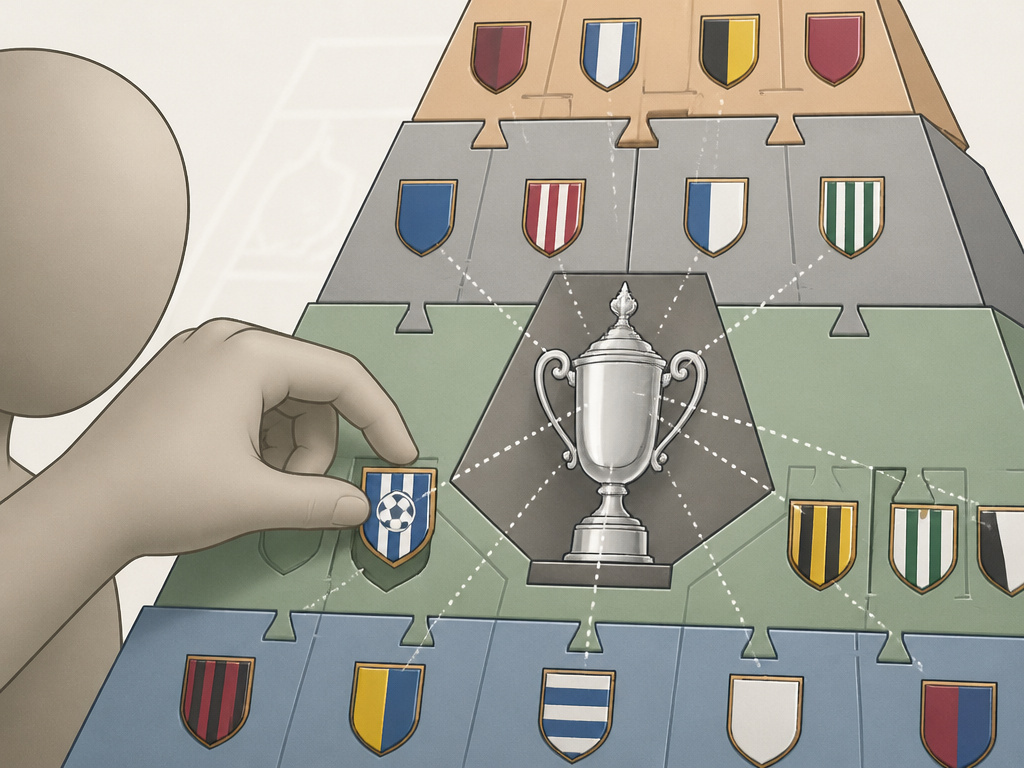
The league system doesn’t exist in a vacuum. It’s woven into the fabric of England’s knockout competitions, which provide lucrative and glamorous cross-tier encounters.
The FA Cup is the ultimate embodiment of this. Clubs enter the competition based on their pyramid level. The earliest qualifying rounds are a battleground for Step 5 and 6 clubs. By the time the professional EFL sides enter in the First Round, they can be drawn against plucky non-league opponents, creating those iconic ‘giant-killing’ opportunities. The dream of a non-league club reaching the later rounds and drawing a top-flight team at home is a seasonal motivator.
For clubs in the NLS, the FA Trophy (for Steps 1-4) and the FA Vase (for Steps 5-7) offer their own Wembley final. Givemesport confirms the FA Trophy is for teams from Steps 1-4. These competitions are exclusive to the non-league pyramid, providing a national stage and a tangible trophy for clubs whose league ambitions may be geographically constrained.
This interplay is crucial. A deep cup run can provide a financial windfall that helps a club meet its licensing requirements for promotion. Conversely, the fixture congestion can wreck a small squad’s league campaign. The pyramid isn’t just about vertical movement; it’s about these seasonal cross-currents that define the experience of following a club at any level.
Common Questions and Confusions
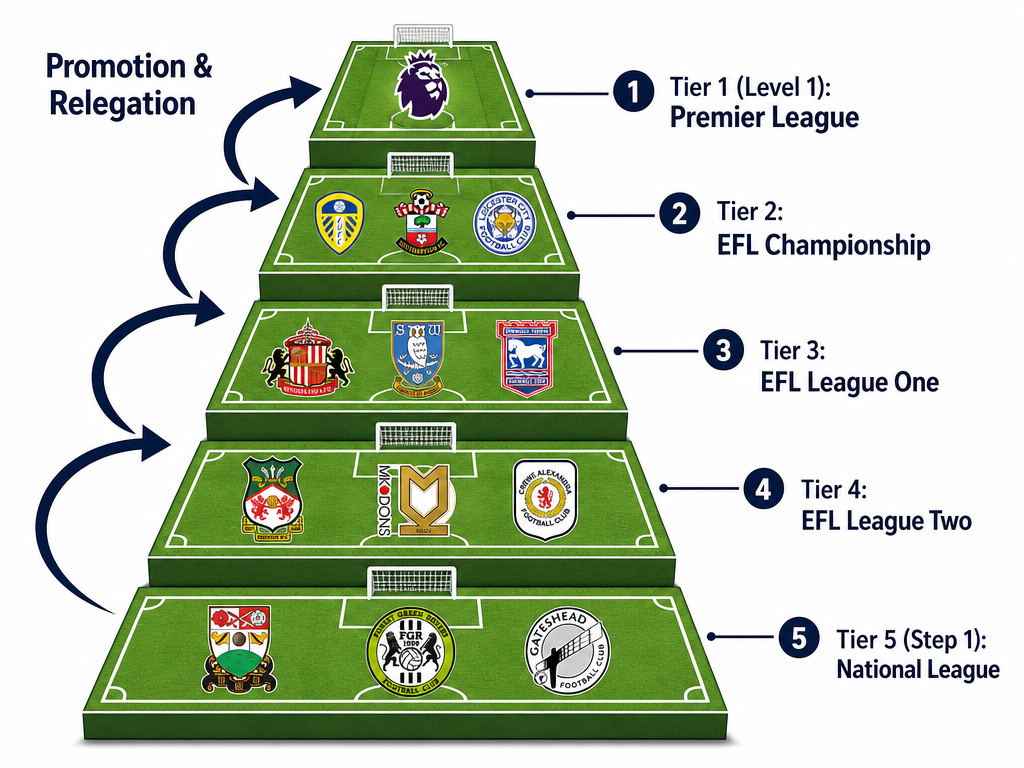
What’s the Difference Between a ‘Tier’, a ‘Level’, and a ‘Step’?
It’s jargon, but it has meaning. ‘Tier’ and ‘Level’ are often used interchangeably to describe the hierarchy, with Level 1 being the Premier League. ‘Step’ is the specific term used by The FA for the six divisions of the National League System (Steps 1-6). So, the National League is a Step 1 competition, but you could also call it Tier 5.
Can a Club Really Go from the Bottom to the Top?
Theoretically, yes. The system of promotion and relegation is designed to allow it. Practically, it’s a Herculean task. A club would need to win promotion consistently for over a decade while continuously investing in its stadium, infrastructure, and playing squad to meet the stringent criteria at each new level. The financial jump from semi-professional to professional football is a canyon. While the path exists, it’s why stories like Wrexham’s recent rise capture the imagination, they are the dramatic exception.
Why Are Some Welsh Clubs in the English Pyramid?
History and geography. Clubs like Wrexham, Cardiff City, and Swansea City were founded and began competing in English leagues long before a structured Welsh league system existed. Their inclusion was cemented by tradition and has been maintained, though they also compete in the Welsh Cup. It’s one of the system’s unique quirks.
How Are Disputes Resolved?
The FA’s Leagues Committee has final say on NLS matters like promotion, relegation, and lateral moves. Clubs can appeal decisions, but it costs them: a £250 deposit for a Step 1 club, £200 for Step 2, £150 for Step 3, £100 for Step 4, and £50 for all other applications to the Leagues Committee. This discourages frivolous appeals and underscores that the governing body’s decisions, aimed at the stability of the whole system, are final.
How has the English football pyramid evolved?
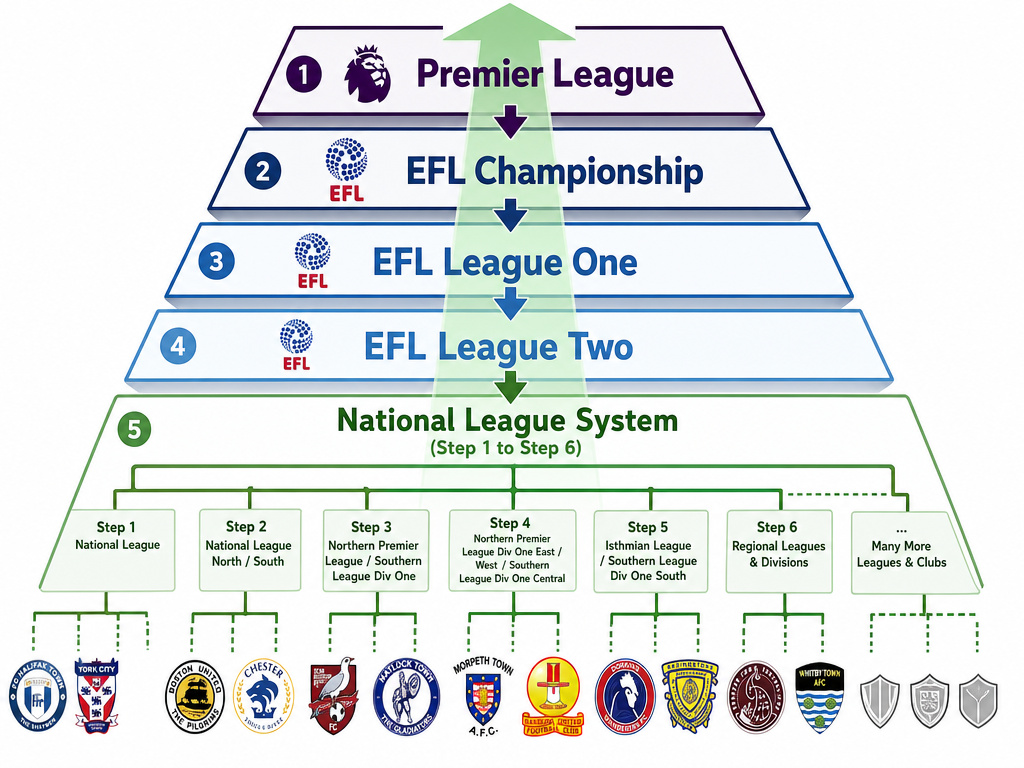
The modern pyramid is a structured evolution from a simpler, fragmented system, illustrating the development of how the English football league pyramid works. Its core principle, the seasonal movement of clubs through promotion and relegation, is now formalised under the National League System (NLS). This framework aims to place clubs at a competitive level appropriate to their playing ability, facilities, and geographical location. The system has expanded downwards over time, incorporating hundreds of semi-professional and amateur clubs into a connected hierarchy. This structure allows for ambition and mobility, from the global spotlight of the Premier League down to local parks football, with specific rules governing entry points and the movement of reserve teams to maintain competitive integrity.
The Bottom Line
The English football pyramid is less a pristine triangle and more a living, breathing ecosystem. It’s a compromise between sporting merit and practical logistics, between the dream of upward mobility and the need for institutional stability.
For fans, understanding it means looking past the Premier League glare. It means appreciating that a club’s journey isn’t just about points on a board, but about floodlight upgrades, stand renovations, and the annual summer wait for the league’s governing body to decide which regional division you’ll be in next. The pyramid’s genius is that it makes every one of those details matter, from the Etihad Stadium down to the village recreation ground. It connects them all in one endlessly compelling story.
