
How Football Referees Communicate During a Match
This post contains affiliate links. As an Amazon Associate, we earn from qualifying purchases.
How football referees communicate during a match runs on three channels: the whistle and cards for players, hand and flag signals between officials, and, where the competition allows it, headsets linking the referee, assistants, fourth official and VAR. Law 5 permits that equipment but never requires it, and the referee always takes the final decision.
That word “permits” does a lot of quiet work. A Sunday league referee with no headset is following the same Laws as a Premier League official wired to a video room. So the backup channels matter as much as the expensive ones, and when the wired version breaks, everyone falls back on the oldest tools in the bag.
What follows: what the Laws let officials carry, how they talk to players who don’t share a language, how the flag and the headset split the work, and two real breakdowns (Tottenham in 2023, Chelsea this season) that show exactly where the system cracks.
Key Takeaways
- The referee always has the final decision; every other official, VAR included, only advises under Law 6.
- Headsets and buzzer flags are permitted, not mandatory, so grassroots games still run on whistle, flag and voice.
- VAR can step in on four decision types only: goal/no goal, penalty/no penalty, red card and mistaken identity.
- Since the 2023 Diaz error, PGMOL requires the VAR to confirm the check with the AVAR before telling the on-field team.
What Do the Laws of the Game Actually Allow Referees to Use?
Law 5 hands the referee a short kit list: whistles, a watch, red and yellow cards, and something to record the match. Communication gear gets its own line, and the wording is careful.
Under Law 5 of the IFAB Laws of the Game, referees and other on-field officials may be permitted to use equipment for communicating with other match officials, such as buzzer or bleep flags and headsets. All other electronic equipment, including cameras, is prohibited, except body cameras supplied by the competition organiser. VAR use requires IAAP approval and written FIFA permission.
Read IFAB Law 5 on the referee and the key phrase is “may be permitted.” A competition can switch on referee headsets and buzzer flags. A referee running a park game with a whistle and a notebook is just as legal.
That matters.
IAAP is FIFA’s Implementation Assistance and Approval Programme. Think of it as a checklist a league has to clear, plus a signed letter from FIFA, before a single VAR replay is allowed.
| Item | Status in Law 5 | Where you’ll see it |
|---|---|---|
| Whistle, watch, cards | Required kit | Every match, any level |
| Buzzer flags, headsets | “May be permitted” | Where the competition provides them |
| Body cameras | Only if the organiser supplies them | Selected competitions and trials |
| Any other electronics | Prohibited | Nowhere, officially |
Cameras show how the rules have moved. Today’s Law 5 allows body cameras the organiser supplies.
I like that restraint. The Laws treat technology as a helper for the referee’s eyes, and the referee still owns the decision.
Talking to Players Who Don’t Share Your Language
Referees say far less than the touchline noise suggests. Most of the talking comes after a foul or a contested call, and the context carries the meaning. A player who has just clipped an opponent doesn’t need the decision translated.
The referee whistle does more talking than the voice. A short, light pip restarts play after a routine free kick. A long, hard blast stops everything, and you can watch twenty-odd heads snap round to find the referee before he’s even reached for a pocket.
English on the World Stage, Local Language at Home
The Laws of the Game don’t name a language. I went through Law 5 and Law 6 looking for one and found nothing, which surprised me more than it should have.
In practice, English tends to be the common ground at international level, where a referee from one country takes charge of players from two others. Whatever FIFA asks of its international referees on language sits outside the Laws. I haven’t seen that document, so I won’t pretend to know the detail.
Domestic football is simpler. A Premier League referee works in English, a La Liga referee in Spanish. My view here leans European, I’ll own that; I know far less about how referees in Asian, African or American leagues handle mixed-language dressing rooms.
The Cards Were Built for This Exact Problem
The usual story credits English referee Ken Aston, who is said to have thought of yellow and red cards at a set of traffic lights after a World Cup caution got lost in translation. That’s where the story really starts. A colour needs no grammar.
Everything else leans on short words and helpers. The captain is the referee’s first intermediary, and a bilingual teammate translating in the moment is a familiar sight at the top level. The phrases that cross borders best are blunt:
- “Play on.”
- “Advantage.”
- “Captain, come here.” This one does the heavy lifting, because it moves the conversation away from the angriest player and toward the one with a reason to keep his team on eleven men.
- “No.”
(In my years at right back, my entire dialogue with referees was the word “sorry,” delivered in a surprising range of tones.)
How Football Referees Communicate During a Match Without Saying a Word
A friend who used to call football dull started coming to weekend games with me. Within about two months he was spotting offside traps before I did. Nothing magic happened. He’d simply learned what to watch, and for offside that means the back line and the flag.
That flag is the oldest wireless system in the sport. Law 6 gives the assistant referees a set of jobs they signal for, and the approved assistant referee flag signals appear in the Laws only as graphics:
- Ball out of play, and which team takes the restart.
- Offside offences.
- Substitution requests.
- At penalty kicks, whether the goalkeeper left the line early and whether the ball crossed it.
The referee answers in kind. Referee hand signals tell twenty-two players and a stand full of fans what just happened, in a way no spoken sentence can manage across a pitch.
Law 6 also says the other on-field officials assist when they have a clearer view than the referee. That’s why referee positioning is half of communication. An official standing in the wrong spot has nothing useful to say.
I think of an officiating team as joinery. The referee, two assistants and the fourth official hold together because each piece covers an angle the others can’t see. A referee working alone is a single plank asked to be a chair.
And honestly? The moment a back four steps up as one and the flag rises in the same breath is still my favourite thing in football that isn’t a goal.
Inside the Headset: Who Talks to Whom
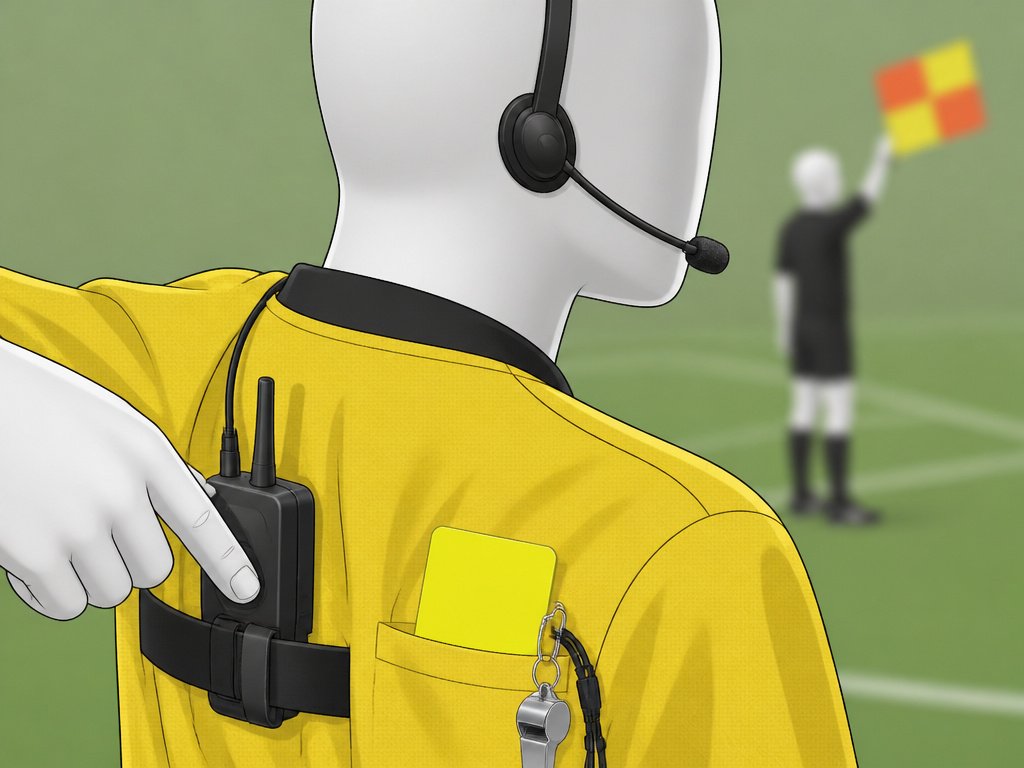
Four decision types, no more. Law 6 says the VAR may help the referee only for a “clear and obvious error” or “serious missed incident” involving a goal, a penalty, a red card, or mistaken identity. Everything else stays on the pitch.
Law 6 lists who can be on the channel: two assistant referees, a fourth official, two additional assistant referees, a reserve assistant, a VAR and at least one AVAR, the assistant VAR who backs up the main video official. The VAR system sits off the pitch, but those two count as match officials in their own right.
The rules on who speaks are tight. Law 5 says the referee acts on other officials’ advice about incidents he didn’t see. Law 6 adds that any official filing a report on serious misconduct out of the referee’s view must tell the referee and the others.
The research on headset talk is genuinely thin. Schnyder and Hossner (2016) interviewed 23 elite European referees, and “communication through headset” was one of seven themes that came out. The same authors flagged supporting devices and within-team communication as areas needing more study. I haven’t read their full findings on headsets, so I’ll leave it there.
The Kit Behind the Voices
The newer problem is radio traffic. Stadiums are crammed with broadcast and security signals, and the Vokkero Elite Smart Gateway launch was pitched around switching channels automatically when the airwaves get crowded.
Flag vs Headset: Which Wins When
Flag beats headset for offside and out-of-play calls, because the whole ground sees the decision at once. Headset beats flag for the elbow behind the referee’s back, where the assistant needs a sentence, not a signal. VAR wins on factual calls and gets shaky on interpretation.
| Channel | Wins for | Weak spot |
|---|---|---|
| Whistle and cards | Telling players and crowd | Can’t explain why |
| Flag signal | Offside, ball out of play | Limited to one angle |
| Headset | Incidents behind the referee | Crowd noise, kit failure |
| VAR link | Clear factual errors | Human handover mistakes |
I’d judge any VAR call by the protocol before the broadcast angle. The replay shows you what happened. The protocol tells you whether the video room was even allowed to act on it.
Why Couldn’t VAR Fix the Diaz Goal After the Restart?
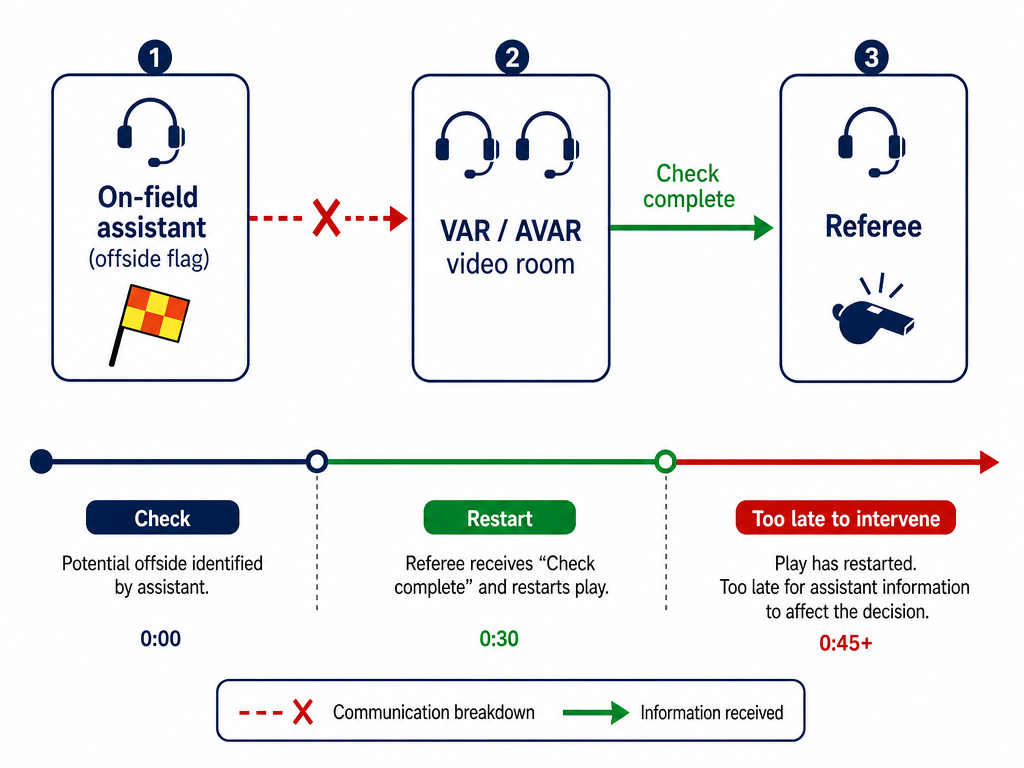
At Tottenham v Liverpool in September 2023, the VAR team concluded the protocol barred them from intervening once play restarted, so a wrong offside call against Luis Diaz stood. The technology worked. The conversation didn’t.
CBS Sports’ account of the released audio shows VAR Darren England and AVAR Dan Cook correctly establishing that Diaz was onside. They seemed unaware the on-field assistant had flagged offside. Referee Simon Hooper’s reply, “well done boys, good process,” is now part of English football folklore.
Rewind a second.
The PGMOL statement on the Diaz review says the VAR lost sight of the on-field decision and communicated “check complete” without any dialogue with the AVAR. The original offside call was never part of the check. Play restarted, and afterwards the Replay Operator, then the AVAR, queried it. By then the VAR said he “can’t do anything.”
The part nobody mentions: A correct VAR check still produces a wrong result if the video room doesn’t know the on-field call. At Tottenham, that gap meant the check never took the original offside call into account.
The sources don’t line up neatly on what was possible after the restart:
| Source | Position on acting after a restart |
|---|---|
| PGMOL, 2023 statement | VAR protocol didn’t permit intervention once play restarted |
| Law 5, main text | A restart decision can’t change once play restarts |
| Law 5, exceptions | Sanctions after a restart possible under Law 12.3 and the VAR protocol |
My read: an offside goal is a restart decision, which is why the VAR team felt boxed in. But Law 5 carves out exceptions for disciplinary sanctions, so I’d stop short of calling the restart rule absolute in every case.
PGMOL’s fixes were all about talk. A new VAR Communication Protocol to make on-field decisions clear to the video team, and an extra step where the VAR confirms the outcome with the AVAR first. Guidance would stress efficiency “but never at the expense of accuracy.”
This one hurts to watch, because offside is exactly the factual call VAR should nail.
When the Radio Dies: Fallbacks From Sunday League to Stamford Bridge
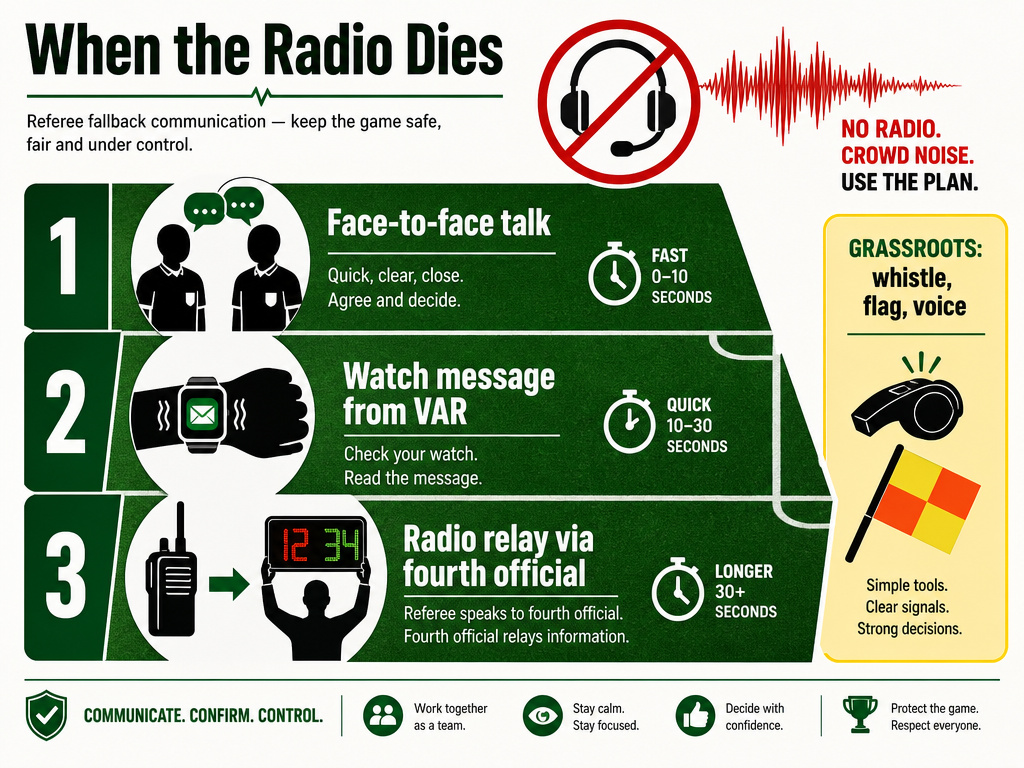
Every radio fails eventually. In late August, at Chelsea v Brighton with Michael Oliver refereeing, the officials’ comms pack reportedly failed to filter out crowd noise. The on-field team reportedly lost working radio comms.
Picture what that means. A full stadium’s roar isn’t just loud; you feel it in your chest. An unfiltered pack passes that wall of sound straight into the earpiece, and the official hears nothing usable.
Reports say the officials fell back in this order:
- Face-to-face talk between the on-field team. Skip it and the referee is guessing about anything the assistants saw, with no way to correct a call before the restart.
- Watch messages from VAR Andrew Kitchen to the referee. Without them, the video room has no route to the one person who makes decisions.
- A radio relay through fourth official Tom Bramall. Lose that too and every message needs someone to physically walk it over, while the match keeps moving.
South Africa had its own version. After Kaizer Chiefs drew with AmaZulu, coach Johnson said the fourth official told him nothing could be done about an offside equaliser “because the mics were not working.” Reports disagree on when in the first half the comms dropped, so I’d treat the timeline as unsettled.
Rugby has been here as well. In Perth, a referee lost contact with the TMO (the television match official) and a mobile phone ended up being carried onto the pitch. Not ideal. Anyway, back to football.
Skip this if: you referee youth or Sunday league games. You don’t need a headset to follow the Laws. Agree flag and eye-contact signals with your assistants before kick-off, because a signal nobody discussed in the dressing room is easily misread.
Grassroots football never left the fallback order. Whistle, flag, voice and a quick word at half-time are the full system, and it’s the one every elite official started on.
Talking to the Crowd, and Cooling Down the Players
Fans only got their own channel recently. In January 2025, at the Carabao Cup semi-final between Tottenham and Liverpool, Stuart Attwell made the first stadium PA announcement of a VAR decision in England, ruling out a Dominic Solanke goal.
The IFAB trial behind that keeps the referee-VAR conversation private and announces only the decision. As the referees trial VAR stadium announcements coverage from ESPN described, it started at the 2023 Club World Cup in Morocco.
There’s a tension here worth naming. PGMOL’s Mic’d Up releases referee-VAR audio after matches rather than live. Delayed isn’t live, so nothing’s broken. Still, I’d like more of it.
The player-facing side has barely been studied in football. The closest evidence I can find comes from rugby: Lewis and colleagues (2023) transcribed audio from 18 professional games refereed by 6 IRFU referees. The abstract says nine communicative behaviours but lists eight, among them Preventative Instruction, Command, Explanation and Game Management.
A referee who explains a decision buys calm. A referee who argues about one sells it.
Their main point carries over: pick the type of talk that fits the moment. A word of warning before a corner prevents a shirt-pull; a calm explanation afterwards defuses a protest. Push past that and a player is into dissent, where the card takes over from the conversation.
Do football referees have to speak English or any other set language?
Nothing in the material behind this article names a language that referees must speak, and it sets out no FIFA language test or training course. The Laws of the Game cover what officials may carry and who makes the final call, but they say nothing about which words are used. So treat any claim of a fixed rule with caution unless you can check it with FIFA or your own association.
What the Laws do make clear is that communication has to work. Officials must advise the referee of serious misconduct or anything out of the referee’s view, and the referee acts on that advice. Research on elite European referees found that communication through the headset was one of seven main themes, and the authors called for more study of how teams talk to each other. In practice, a referee who works across borders benefits from a shared working language with the crew, short clear phrases, and rehearsed signals agreed before kickoff.
Frequently Asked Questions
Do referees get punished for bad calls?
Officials do get stood down after serious errors. After the Diaz incident, PGMOL said the VAR must now confirm the outcome of the check with the AVAR before confirming the final decision to the on-field officials.
Can a referee change a decision after play restarts?
Not a restart decision. Law 5 says it can’t change once play has restarted, or once the referee has ended the half and left the field. A disciplinary sanction is still possible if another official spotted the offence and tried to communicate it before the restart.
What happens if the referee’s headset stops working?
The officials fall back on face-to-face talk, flag signals and any backup channel they have. At Chelsea v Brighton, reports describe watch messages from the VAR and a radio relay through the fourth official. At grassroots level, whistle and flag are the system anyway.
Is the conversation between the referee and VAR broadcast live?
No. Stadium announcements share only the decision. PGMOL does release some audio after matches.
Do grassroots referees use headsets?
Rarely, and they don’t need to. Law 5 permits communication equipment but doesn’t require it, so a referee with a whistle, cards and a notebook is fully within the Laws.
Before You Go
One thing to try at your next match: ignore the ball for a minute after any big call. Watch the assistant’s flag, the referee’s hand drift to an earpiece, and the captain walking over. You’ll see how football referees communicate during a match far better from the stand than on any highlight reel.
If there’s a limit to everything above, it’s this. Elite communication rests on kit that fails in crowd noise and on people who mishear each other under pressure, and the published research on it is still thin. The fixes after Tottenham were rules about talking, not new hardware.
I’ll stick my neck out: I’d rather every big VAR decision got a stadium announcement than another camera angle on TV, because the crowd deserves the reason as well as the result.
So which matters more for getting the big calls right: better technology, or better conversations between the people using it?
