
Football Referee Equipment Explained: A Gear Comparison
This post contains affiliate links. As an Amazon Associate, we earn from qualifying purchases.
Football referee equipment is defined by the Laws of the Game: a whistle, a watch, red and yellow cards, and a notebook. These four items are compulsory. Everything else, from communication headsets to body cameras, is permitted equipment, though body cameras are allowed only under specific competition rules. The gear’s job is to make the official authoritative, mobile, and accurate, not to be a distraction.
That distinction between compulsory and permitted is where most guides get fuzzy. The whistle stops play, the watch tracks time, the cards enforce discipline, and the notebook records it. But the real story starts with what the competition organiser allows on top of that baseline, and a clear football referee equipment explained guide would clarify this.
What follows is a breakdown of the official list, the tech you see at the top level, and the practical kit differences between a Sunday league referee and one at a World Cup.
Key Takeaways
- The four compulsory items for every referee are a whistle, a watch, red/yellow cards, and a notebook, anything else is optional and governed by competition rules.
- Electronic communication gear like buzzer flags and headsets is permitted, but body cameras are allowed only if supplied and controlled by the competition organiser.
- For a second caution sending-off, the yellow card is shown immediately before the red card, a specific sequence many miss.
- At the grassroots level, your focus is durability and basic organisation; professional gear adds fitness monitoring and real-time communication.
- A player refusing to remove jewellery must be cautioned; using tape to cover it is not permitted and is a common pre-match inspection failure.
The 4 Compulsory Items (and Why You Need Them)
The IFAB Laws of the Game 2026/27 are blunt. Law 5 lists the compulsory equipment: whistle(s), watch(es), red and yellow cards, notebook (or other means of keeping a record of the match). This isn’t a suggestion. If you step onto a pitch without these four things, you’re not equipped to referee.
A referee’s whistle(s), watch(es), red and yellow cards, and notebook are the only items designated as compulsory by the International Football Association Board (IFAB) in Law 5 of the Laws of the Game. All other equipment is considered permitted under specific conditions.
The whistle is your voice. It needs to cut through crowd noise, wind, and player shouts. Referees must have at least one whistle, and many carry a backup.
The watch does more than count to 90. You’re tracking stoppage time for injuries, substitutions, and delays. The FA Referee Course reminds officials to add the full amount of time lost. That means separate timing for each pause, not a guess. A digital watch with multiple timers or a dedicated stopwatch function is the tool for the job.
Cards and notebook work as a pair. The notebook is for the facts: player numbers, times of incidents, the score. The cards are the consequence. The FA mandates a specific sequence: state the caution, enquire the player’s name, warn about future conduct, then show the yellow card. For a dismissal for a second caution, you show the yellow card immediately before the red. That sequence is drilled for a reason, it keeps the procedure calm and factual.
What Else Is Allowed? The Permitted Equipment List
The compulsory list is short because the permitted list is long and situational. Law 5 explicitly allows for modern tools, but with strings attached.
Electronic communication equipment is the biggest category. This covers buzzer/beep flags for assistant referees and headsets for the officiating team. At the professional level, such equipment is commonly used. For a beginner, such equipment is often not used.
Body cameras are the most conditional item. They are permitted only if the competition organiser supplies the cameras, has control of the footage and complies with the relevant guidelines. The referee doesn’t own the camera or the data. If the camera has a microphone, it cannot be used to broadcast communication with the video assistant referee (VAR). Its use is subject to strict conditions set by the competition organiser.
Electronic Performance and Tracking Systems (EPTS) are also permitted. Think GPS vests that monitor fitness data such as distance covered. The competition organiser must ensure the tech is not dangerous and meets the FIFA Quality Programme requirements. Its use is more common in professional competitions.
The Uniform and On-Person Organisation
Your kit makes you identifiable. A standard referee uniform typically consists of a coloured shirt, shorts, and socks. The shirt typically has pockets to hold essential items like cards, a notebook, and a spare whistle. The shorts are part of the standard uniform and should allow for movement.
Footwear is critical but not specified by the Laws. You need firm-ground boots or turf shoes that provide traction and support for 90 minutes of constant movement, back-pedalling, and sudden changes of direction. It’s a personal choice, but one with direct consequences for your performance and safety.
The organisation is tactile. You develop muscle memory for where each item lives. The primary whistle is on a lanyard around your neck, or in your dominant hand. Cards are in the breast pocket, separate from the notebook. The watch is on your non-dominant wrist. This isn’t just about looking professional; it’s about accessing the right tool in under a second when a flashpoint occurs.
Grassroots vs. Professional: A Gear Comparison
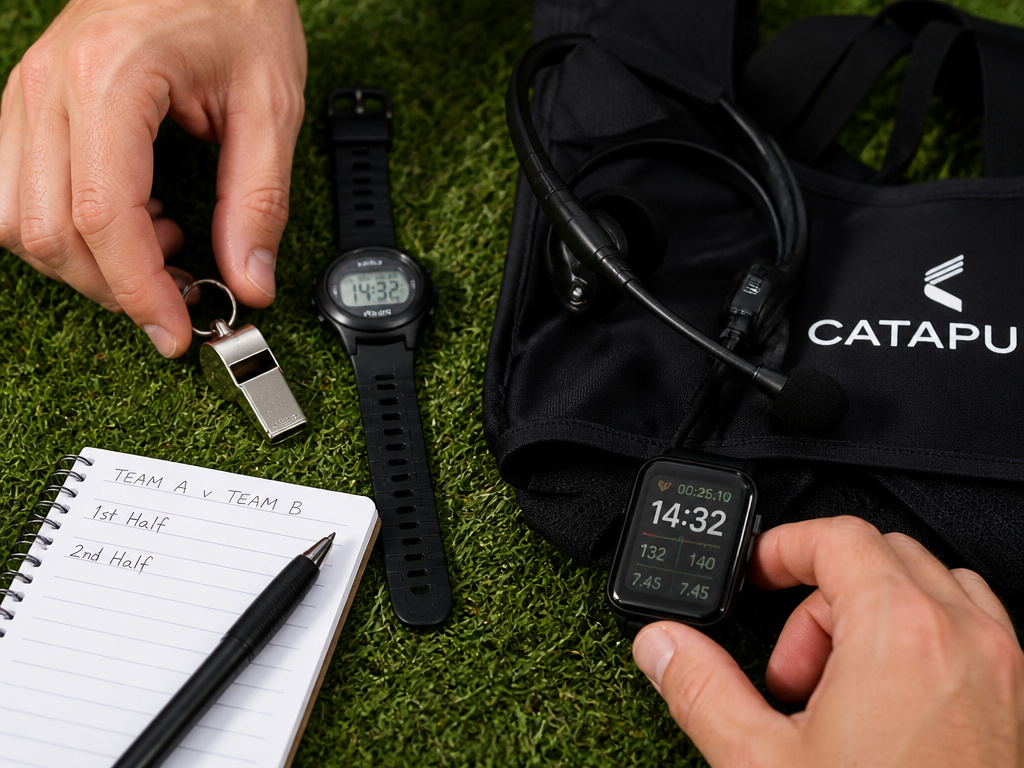
The equipment needs of a Sunday league referee and a Premier League official are worlds apart. The laws are the same, but the tools available are not. The following table breaks down the key differences in their kits and why.
| Gear Category | Grassroots / Amateur Focus | Professional / Elite Focus |
|---|---|---|
| Communication | Whistle, voice, basic flag signals. | Digital headsets, buzzer flags, linked to VAR hub. |
| Timekeeping | Durable digital watch with stopwatch. | Multiple synchronized watches, linked to stadium clock and fourth official. |
| Monitoring | None. | EPTS (Electronic Performance & Tracking Systems) GPS vests for fitness data. |
| Recording | Notebook and pen. | Electronic match record, linked to competition database. |
| Attire | Standard polyester shirt/shorts, self-purchased. | Competition-issue technical kit, often with moisture-wicking and tailored fit. |
For a beginner, your investment is in durability and basics. A whistle, a watch, and a comfortable pair of referee shoes are the foundation. The professional’s kit often includes more integrated technology. Their EPTS data is collected for performance analysis.
The gap isn’t about quality; it’s about scope. The grassroots referee manages the game in front of them. The professional referee is a node in a larger system of technology and oversight.
Player Equipment Checks: The Referee’s Responsibility
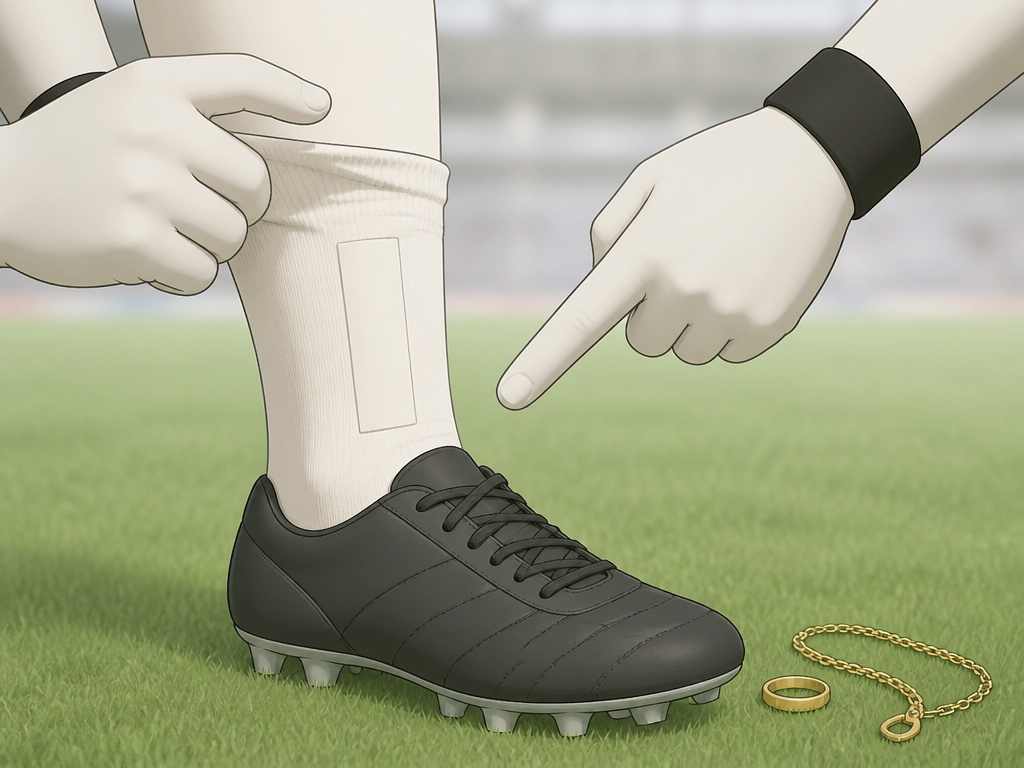
Your equipment matters, but so does the players’. Law 4 gives you the authority, and the duty, to check it. Safety is the fundamental principle.
Before kick-off and during the match, you should check for dangerous items if you have reason to doubt safety. All items of jewellery are forbidden and must be removed. The law is absolute: using tape to cover jewellery is not permitted. If a player refuses, you caution them. If a player refuses to remove jewellery, they must be cautioned.
You may examine footwear and equipment if you have any reason to doubt their safety. The FA guidelines add that you may examine equipment during a match or at half time if you have any reason to doubt its safety. You may examine equipment during a match or at half time if you have any reason to doubt its safety.
Other equipment rules are specific. Sock tape must be the same colour as that part of the sock it is applied to or covers. Goalkeepers get an exception: they may wear tracksuit bottoms if conditions warrant it. And the captain’s armband must be either competition-issued or a single-coloured band that may have the word ‘captain’ or the letter ‘C’. The captain’s armband must comply with the rules: it must be issued or authorised by the competition organiser, or be a single-coloured armband that may also have the word ‘captain’ or the letter ‘C’.
Common Gear Mistakes and How to Avoid Them
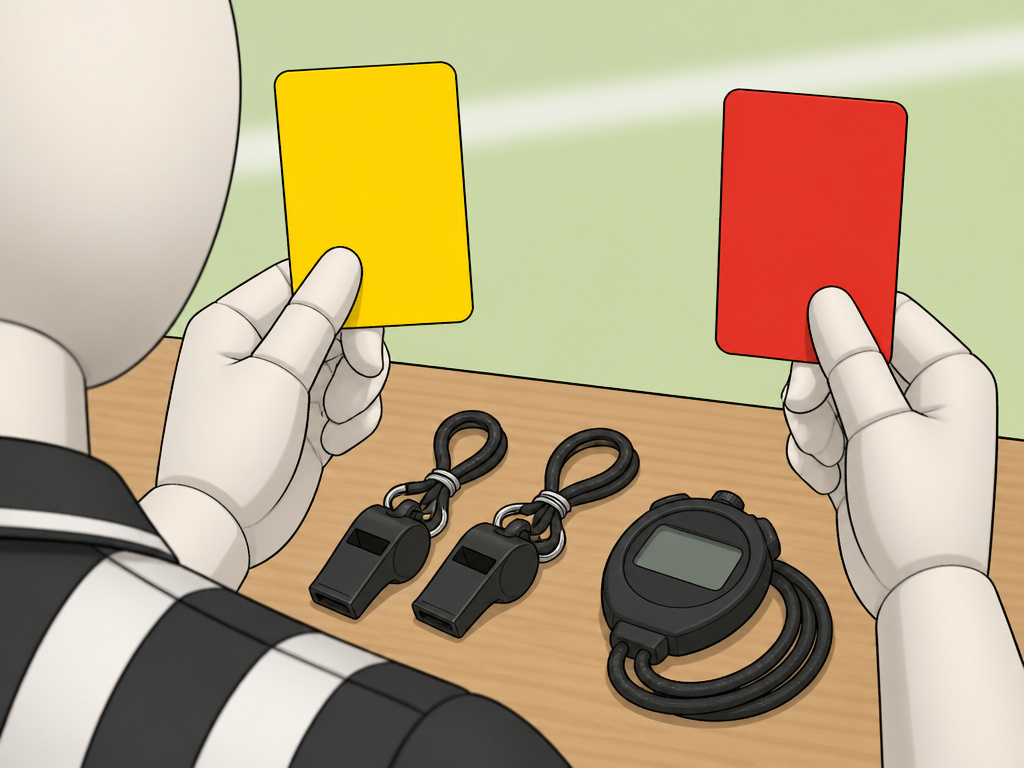
The mistakes aren’t usually about forgetting a whistle. They’re about misuse and misunderstanding.
Common mistake: Carrying only one whistle. If a whistle is lost or fails, having a backup is crucial. Always have a backup in a secure pocket.
Not understanding card protocol is another. The sequence isn’t just ceremonial. The sequence is: state the caution, enquire the player’s name, warn about future conduct, then show the yellow card. Showing a red card for a second caution without first showing the yellow is a procedural error.
Accurate timekeeping is essential, and referees are reminded to add the full amount of time lost. Referees must ensure they accurately track all stoppage time.
Finally, there’s a misconception about technology. You cannot decide to wear a fitness tracker or use your own comms gear. If the competition hasn’t supplied and authorised it, it’s unauthorized equipment. For team officials, using electronic communication is permitted for welfare or tactics, but only small, mobile, handheld equipment. Abuse it, and they can be sent off.
How does a substitution board work?
The substitution board, or electronic board, is used by the fourth official to signal player changes. It clearly displays the jersey numbers of the player coming off and the substitute coming on. This visual communication is essential for players, officials, and spectators. The substitution board is used by the fourth official to signal player changes. The referee relies on this signal to manage the substitution process correctly and ensure the match record in their notebook is accurate for the players involved.
Do referees wear a belt?
Frequently Asked Questions
What is the most important piece of referee equipment?
The whistle. It’s your primary tool for controlling the match. Without a reliable whistle, you cannot stop play decisively, which undermines every other decision you make. Everything else supports the authority that first blast establishes.
Can referees wear jewellery?
No. The FA Referee Course states that match officials must remove their own jewellery. The same rule that applies to players applies to you. It’s a safety and consistency issue.
Why do some referees have two watches?
Redundancy. One watch can fail, or you can accidentally stop it. Having a second watch, often on the other wrist or in a pocket, ensures you never lose track of time. Having a second watch provides redundancy.
What is EPTS equipment?
EPTS stands for Electronic Performance and Tracking Systems. It’s wearable technology, like GPS vests, that monitors player and referee fitness data (distance, speed, heart rate). Its use is permitted in competitions if the technology is safe and meets the FIFA Quality Programme.
Are referee uniforms always black?
No. While black is traditional, modern referee shirts come in several colours, yellow, blue, red, green, to avoid clashing with either team’s kit. The choice of shirt colour is made to avoid clashing with either team’s kit.
The Bottom Line
Referee equipment boils down to a simple formula: the four compulsory items get you on the pitch, and the permitted items help you manage the modern game’s complexity. Your first kit should be built on durability and simplicity, a loud whistle, a clear watch, solid shoes. The advanced tech, the headsets, the EPTS, the body cameras, isn’t for you to buy; it’s for the competition to provide if and when you reach that level.
The gear doesn’t make the referee. That’s the goal: your tools should fade into the background, so your decisions can stay in the foreground.
