
Strength Training for Football Players
This post contains affiliate links. As an Amazon Associate, we earn from qualifying purchases.
Strength training is the single most effective way to improve your sprint speed, jump height, and maximal strength for football, according to a 2026 systematic review. A 2026 Frontiers in Physiology review of 53 studies ranked it highest for boosting 5m sprint times (99.6% probability), 30m sprints (88.8%), and vertical jumps (94%). The optimal weekly dose for these gains falls between 297 and 372 METs-min/week, a volume that fits into two focused sessions.
That number, METs-min/week, is the key to moving from guesswork to a plan. It translates the chaotic energy of a match into a measurable training load you can manage week to week, and it is a crucial metric for strength training for football players. Going under that dose leaves gains on the table; going far over it, especially for endurance, leads to a decline in VO2max performance.
What follows: the exact exercises that move the needle, how to slot them into your week around matches, and the one common mistake that turns a strength block into a recovery nightmare.
Key Takeaways
- For raw power and speed metrics like jumps and sprints, strength training beats every other modality, according to a 2026 meta-analysis.
- Aim for a weekly volume of 300–350 METs-min/week for peak power and sprint gains, roughly two hard sessions.
- Your in-season priority is one strength session (MD-4) and one power session (MD-2) per week, as used in a 2026 elite youth study.
- Endurance training is still essential for VO2max, but its optimal dose is lower (248 METs-min/week).
- Single-leg work and hamstring eccentrics are the underrated keys to injury-proofing your season.
The #1 Benefit: Strength Training Beats Everything Else for Speed and Power
The debate is over. If you want to get faster and jump higher, lifting weights isn’t just helpful, it’s the best tool you have. A massive 2026 systematic review in Frontiers in Physiology compared multiple training modalities. The researchers used a statistical ranking called SUCRA (Surface Under the Cumulative Ranking Curve) to score them. A 99.9% SUCRA means the method is almost certainly the best.
Strength training won, convincingly.
The 2026 network meta-analysis of 53 randomized trials found strength training had the highest probability of being the most effective intervention for improving Counter Movement Jump (SUCRA: 94%), Squat Jump (87.5%), one-repetition maximum squat (99.9%), 5-meter sprint (99.6%), 10-meter sprint (87.4%), 30-meter sprint (88.8%), and agility T-test performance (69.4%).
Looking back at those sprint numbers. A 99.6% SUCRA for the 5m sprint means that in 996 out of 1000 statistical simulations, strength training came out on top. This settles an old argument. Some coaches used to worry that getting “bulky” would slow you down. The data says the opposite: getting stronger is the most reliable path to getting faster.
The mechanism is simple. Football speed isn’t about cruising; it’s about exploding from a standstill or a jog to win a 50-50 ball. That initial burst comes from your muscles’ ability to produce maximal force against the ground. Strength training, particularly with compound lifts, increases that force ceiling. Your nervous system also learns to recruit more muscle fibers, faster. So when you push off, you push harder. The pitch feels shorter.
How This Changes Your Priority List
This evidence flips a common training mistake on its head. I’ve seen too many players, and yes, I was one of them, spend hours on long, steady runs thinking it builds a football engine. It builds an endurance engine, sure. But the game is played in short, violent bursts.
Now, look at your weekly schedule. How much time is dedicated to pure strength training for football players? If it’s zero, you’re ignoring the most potent performance enhancer available. If it’s one rushed session after training, you’re not giving it the focus it deserves. The research tells us to promote it to a main event.
How Much Is Enough? Finding Your Optimal Weekly Dose
More is not always better. This is where the 2026 review gets incredibly practical. The researchers didn’t just say “do strength training”; they calculated the optimal dose for each physical quality, measured in METs-min/week (Metabolic Equivalent of Task minutes per week).
Think of METs-min/week as a universal currency for training load. It combines the intensity and duration of your work. Hitting the optimal dose gives you the best return on your effort for that specific metric.
| Performance Metric | Optimal Dose (METs-min/week) | What Happens If You Go Over? |
|---|---|---|
| Counter Movement Jump (CMJ) | 296.97 | Performance gains diminish after this peak. |
| Squat Jump (SJ) | 339.39 | Performance gains diminish after this peak. |
| 1-Rep Max Squat | 351.52 | Maximal strength gains diminish after this peak. |
| 30-Meter Sprint | 371.72 | Sprint performance gains diminish after this peak. |
| VO2max (Endurance) | 248.48 | Aerobic capacity increases before this peak, with each unit of dose resulting in an average increase of 0.108 in VO2max. |
How to translate this: A dose of ~350 METs-min/week is a great weekly target for overall power. What does that look like in the gym? It’s roughly two solid strength sessions. For example, a 60-minute session centered on barbell squats, deadlifts, and presses, performed with intent, will easily hit 175-200 METs-min. Do that twice a week, and you’re in the zone.
Common mistake: Chasing endless volume. Once you pass these dose peaks, you’re spending energy for diminishing returns, or worse, negative ones. Your body uses resources to recover from the extra load that could have gone into adapting to the effective load.
The standout here is VO2max. Its optimal dose (248.48) is notably lower than the strength targets. This is critical for in-season planning, as the optimal dose for improving VO2max is lower than for strength and power qualities.
Strength Training vs. Other Methods: When to Use What
You need a complete toolkit. Strength is your hammer, but not every problem is a nail. The same 2026 review gave us clear rankings, so you know exactly when to reach for another tool.
| Training Modality | Best For Improving… | Key Limitation / Consideration |
|---|---|---|
| Strength Training | Maximal strength (1RM), sprint speed (5m-30m), vertical jump (CMJ/SJ) | Less effective for pure aerobic capacity (VO2max). Optimal dose is critical. |
| Endurance Training | Maximal oxygen uptake (VO2max) – SUCRA: 84.7% | Lower optimal dose (~248 METs-min/week). Overdosing hurts other qualities. |
| Speed & Agility Training | Sport-specific change of direction, acceleration mechanics | Its effectiveness for improving raw strength and power is lower than strength training. |
| Plyometric Training | Reactive strength, rate of force development | Can be effective for improving sprint performance, with individual factors like muscle elasticity influencing results. |
The table shows a clear division of labor. Use strength training for football players to build your engine’s horsepower. Use endurance training to improve its fuel efficiency. Trying to use one to do the other’s job is inefficient.
There’s an active debate on the best type of strength work. A 2026 RCT in Sports Medicine – Open found complex training (pairing heavy lifts with plyometrics) was superior for maintaining hamstring health in highly trained players. Conversely, a 2024 study found no difference in maximal strength gains between eccentric and concentric focus. The takeaway? Sources disagree on the superiority of specific modalities: one RCT found complex training superior for hamstring health, while another study found no difference in maximal strength gains between eccentric and concentric focus. For injury resilience, especially in-season, pairing heavy lifts with explosive moves has compelling data.
The 4 Essential Lifts for Football Strength
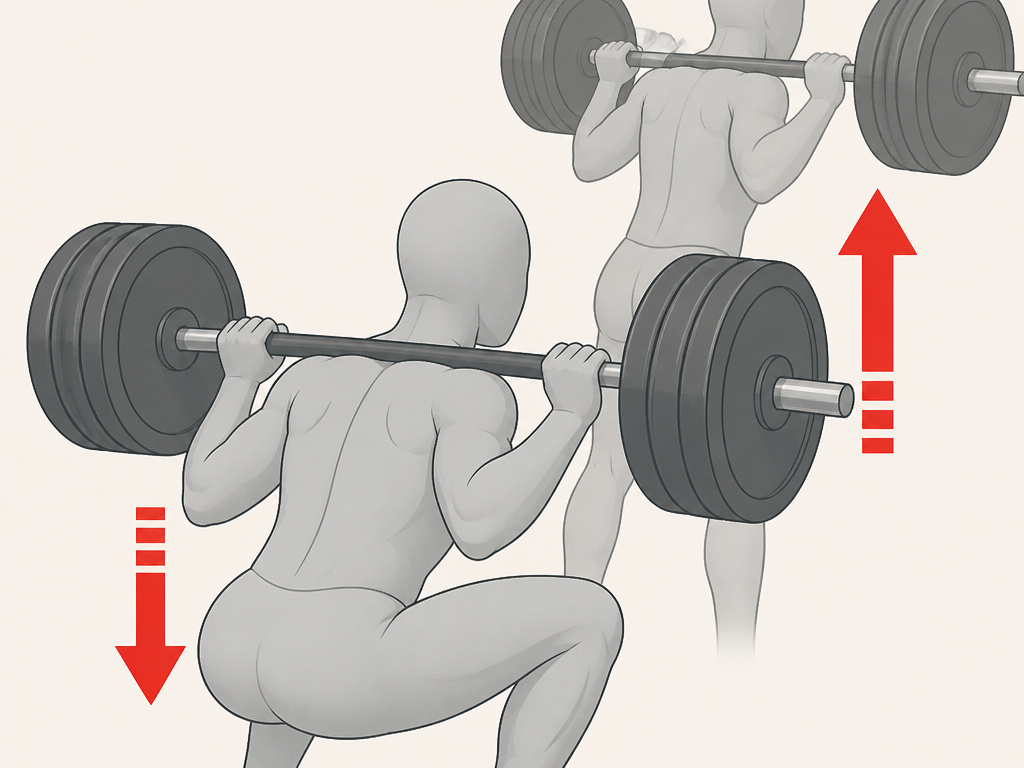
Forget the isolation curls. Football strength is about moving your own body with force and handling external loads through big, compound movements. These four lifts train the movement patterns you use on the pitch.
- Barbell Back Squat. This is the king. It builds the leg and hip drive for jumping, sprinting, and holding off challenges. Skip it if: you have no access to a barbell. The fix: Goblet squats or split squats with heavy dumbbells.
- Deadlift (Conventional or Trap Bar). This is the queen. It teaches your posterior chain, glutes, hamstrings, back, to work as a unit. This is crucial for sprint mechanics and preventing hamstring pulls. You’ll feel this in your first explosive step.
- Single-Leg Romanian Deadlift. The underrated bodyguard. It builds stability and strength in each leg independently, correcting imbalances and fortifying knees and ankles. Do this before you ever feel you need to.
- Weighted Push/Pull. A heavy bench press or row isn’t for vanity. That upper body strength lets you shield the ball, hold your arm up against a defender, and stay upright in a tackle. It’s structural integrity.
A session doesn’t need all four. Pair a lower-body lift (Squat or Deadlift) with an upper-body lift. Keep reps low (3-6) and intensity high. The goal is to lift more weight over time, not to get a pump.
How to Structure Your Weekly Strength Sessions
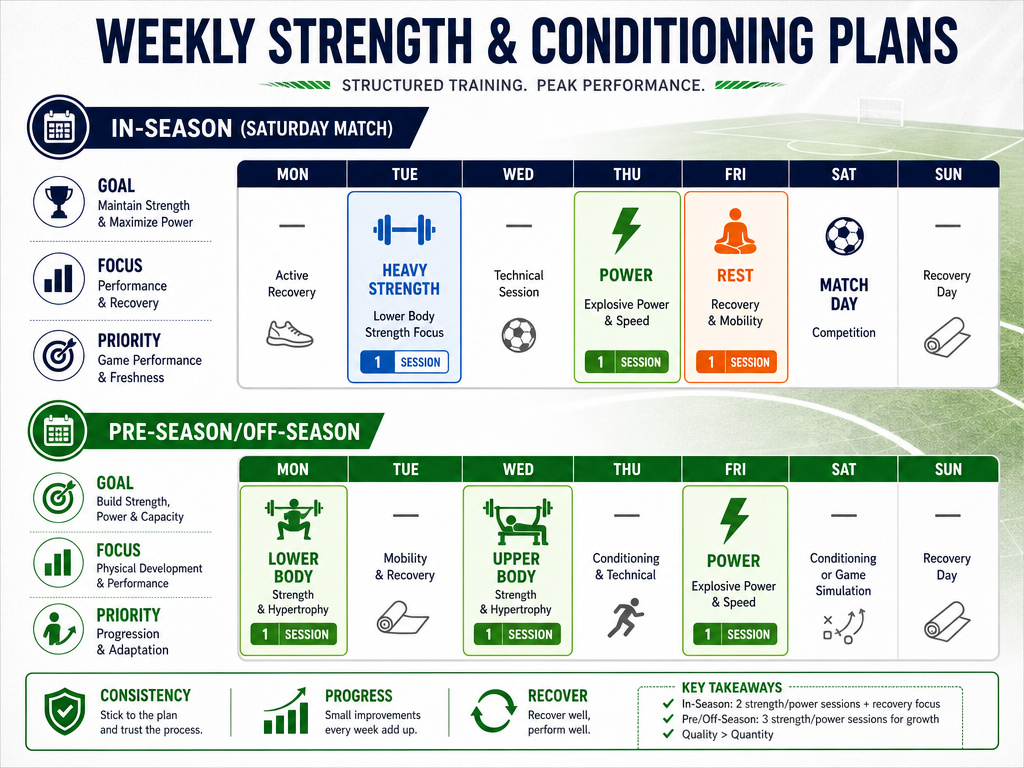
Your schedule isn’t static. A pre-season building phase looks different from an in-season maintenance week. The guiding principle is proximity to match day. Here’s a framework based on the research, including a protocol from a 2026 Medicina study on elite youth players.
In-Season Weekly Template (Based on a Saturday Match):
- Match Day -4 (Tuesday): Strength Session. Focus on the main heavy lifts (Squat, Deadlift). This is your primary stimulus. The 2026 study prescribed a strength-oriented session on this day.
- Match Day -2 (Thursday): Power Session. Lower the weight, increase the speed. Think box jumps, medicine ball throws, or speed squats. The same study placed a power session here to prime the nervous system without causing fatigue.
- Match Day -1 (Friday): Complete Rest or Very Light Movement. No lifting. Let your body fully recharge.
Pre-Season/Off-Season Weekly Template:
- This is your development phase. You can train strength 2-3 times per week with higher volume.
- Sample Split: Monday (Heavy Lower Body), Wednesday (Upper Body & Accessories), Friday (Power Focus / Speed Development).
- This is the time to build your off-season training plan and work on weak points.
The hardest part is holding back. After a great strength session, you feel powerful. The temptation is to add more. But remember the dose-response curves. That extra set might push you over the peak for the week. Trust the process, not the fatigue.
Integrating Strength with Football Practice and Conditioning
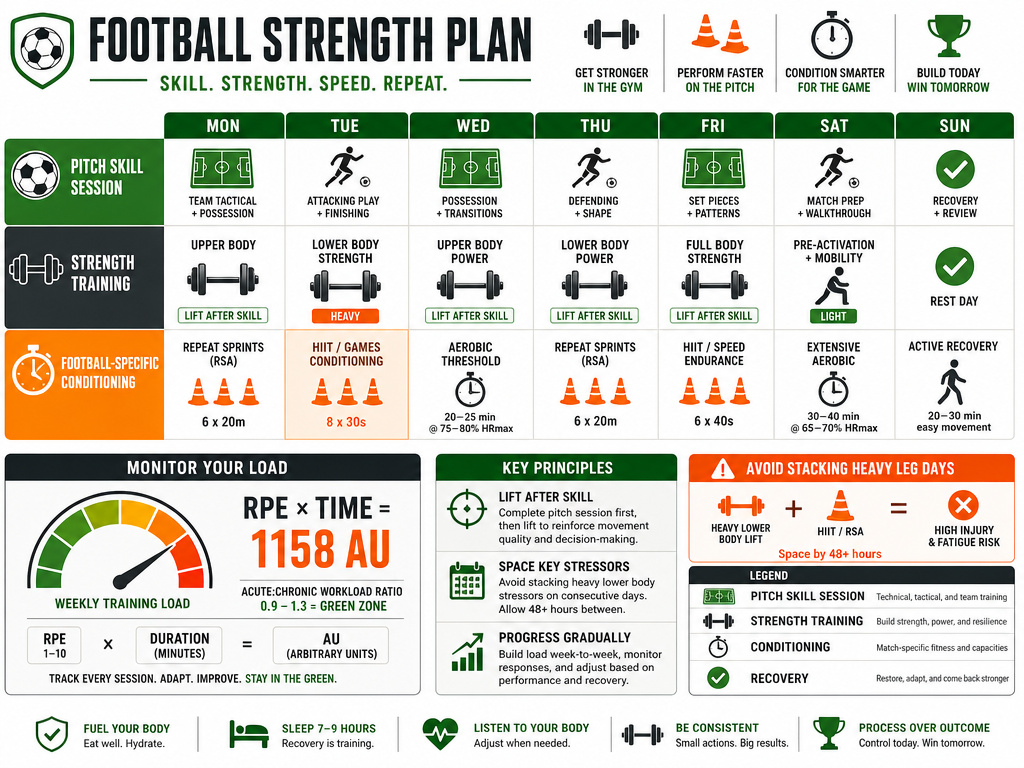
Strength training doesn’t exist in a vacuum. It’s one part of your total load, which also includes pitch sessions, matches, and pre-season conditioning. A 2024 study quantified total load as “rating of perceived exertion × time,” reporting an average of 1158.4 ± 67.7 arbitrary units (AU) per week for the strength group. Your job is to manage that sum.
- Schedule Strength After Skill Sessions. Never lift heavy before a technical training where sharpness matters. Lift after, when the priority work is done.
- Conditioning Should Be Football-Specific. Replace long jogs with repeated sprint drills, small-sided games, and high-intensity intervals. This matches the game’s demands and respects the lower optimal dose for pure endurance.
- Listen to Your Legs. The single best indicator is how you feel during your football speed drills. If your first step is sluggish, you’re either under-recovered or your strength session was too close to your sprint work.
Where this goes sideways: Stacking a heavy leg day, a high-intensity pitch session, and a conditioning run all within 48 hours. That’s how you trigger excessive muscle damage, spike fatigue for days, and increase injury risk. Space your key stressors out.
The Critical Role of Recovery and Injury Prevention
Lifting makes you temporarily weaker. You get stronger during the recovery period. If you don’t manage that process, you’re just accumulating damage. This is where injury prevention and recovery techniques are critical.
- Sleep is Your Best Supplement. Aim for 7-9 hours. Growth hormone release, muscle repair, and nervous system recovery happen here.
- Fuel the Repair. Your football nutrition guide is key. Protein intake around your sessions is crucial for muscle synthesis. Don’t train hard in a calorie deficit.
- Eccentrics are Preventative Medicine. The lowering phase of a lift (e.g., the descent in a squat) causes the most muscle damage but also builds the most resilience. Nordic hamstring curls are the gold standard for preventing the most common football muscle injury.
A 2016 review in Sports Medicine noted that professional players need ‘to significantly increase their strength to obtain slight improvements’ in sprint and change of direction, while a 2026 meta-analysis found strength training to be the most effective modality for improving sprint times. That’s the reality at the top level. The margins are tiny, and the work required is huge. Smart recovery is what lets you put in that work week after week without breaking down.
Warm-up and flexibility routines
A warm-up prepares your body for the demands of strength training and the pitch. While the research focuses on training effects, the principle is to activate the muscles you’ll use. Start with general movement to raise your core temperature, then move into dynamic stretches that mimic football actions. Think leg swings, walking lunges, and controlled torso twists. The goal is to improve readiness for explosive movements like jumps and sprints, which strength training directly enhances. Save longer, static stretches for after your session when your muscles are warm to aid recovery and maintain flexibility for the next training block.
Assessing fitness level and individualization
Your starting point dictates your program. Research shows individual factors matter; for example, one study found players with higher baseline vastus lateralis (VL) elasticity saw greater 5m sprint gains from plyometric training. A 2016 review notes that already strong professional players need large strength increases for even slight sprint improvements, while others may see bigger jumps. Start by testing key football metrics: short sprints, vertical jump, and a maximal strength lift. These baselines let you track progress and personalize focus.
Frequently Asked Questions
What is the 3-3-3 rule for strength training?
For football, your compounds should be squat, hinge (deadlift), and push/pull.
What strength workouts are good for football players?
The best workouts are built around the four essential lifts: Squats, Deadlifts, Single-Leg Work (like lunges), and Weighted Pushes/Pulls (like bench press or rows). A sample workout: Barbell Back Squat (4 sets of 5), Trap Bar Deadlift (3 sets of 5), Dumbbell Bench Press (3 sets of 8), and Single-Leg RDLs (3 sets of 8 per leg).
How do I balance getting bigger with staying fast for football?
Focus on strength, not size. Train in lower rep ranges (3-6 reps) with heavy weights and longer rest periods (2-3 minutes). This improves neural drive and maximal force without adding excessive muscle mass. Pair this with your football fitness and sprint work. The “bulky and slow” myth comes from bodybuilding-style training (high reps, short rest), which is not football strength training.
Can I get stronger without a gym?
Yes, but you’ll hit a ceiling faster. Your body weight and resistance bands are great starting points for core exercises and plyometrics. For serious strength gains, you eventually need to add significant external load, which means weights. A simple setup with a pull-up bar, a dip station, and a heavy kettlebell or sandbag can take you a long way.
The Bottom Line
The beautiful game rewards power. The data is unequivocal: if you want to win more sprints, jump higher for headers, and hold off stronger opponents, you need to get under a barbell. The optimal dose is roughly two hard sessions a week, focused on the big lifts. In-season, slot them smartly: strength on MD-4, power on MD-2.
This isn’t about becoming a weightlifter. It’s about building a body that can express the skill in your feet. Start with the squat and the deadlift. Track your weekly volume. And remember, the goal isn’t to be sore; it’s to be faster on Saturday. Everything else is just noise.
