
Football Pre Season Training Guide: The 6-Week Blueprint
This post contains affiliate links. As an Amazon Associate, we earn from qualifying purchases.
A football preseason training guide is a process of rebuilding strength, restoring sprint speed, and progressively exposing your body to the specific high-intensity chaos of a match, all while cutting injury risk by following evidence-backed protocols like the FIFA ’11+’ program and a 14-day heat-acclimatization period.
The old model of preseason as a pure endurance grind is fading. A 2025 study in BMC Sports Science, Medicine and Rehabilitation found that a 6-week Neuromuscular Training program, built on strength, plyometrics, and stability, beat a traditional Endurance Training program for boosting strength and reducing muscle damage in female players. That’s the shift: from building a generic engine to forging a resilient, powerful, and football-specific athlete, a principle central to any modern football pre season training guide.
What follows is a framework, not a rigid template, much like a condensed football pre season training guide. We’ll walk through the essential components, strength, speed, conditioning, and injury prevention, and how to sequence them across a realistic 6-week timeline. You’ll also get the numbers that matter: why the FIFA ’11+’ needs 10–12 weeks to work, how to progress weekly sprint volume, and the single biggest mistake that leads to early-season hamstring strains.
Key Takeaways
- Preseason is 6 weeks for most. Four weeks is too short to build robust fitness; eight weeks risks burnout. The sweet spot gives you time to progress load, peak, and taper.
- Strength before stamina. A peer-reviewed study shows a neuromuscular program (strength, plyometrics) improves isokinetic strength and reduces muscle damage markers better than endurance-focused training. Your first priority is rebuilding the muscle and tendons.
- Injury prevention starts now, but finishes later. The FIFA ’11+’ program reduces injuries by 30–50%, but only after 10–12 weeks of consistent, twice-weekly use. Start it in preseason, but commit to continuing it into the season.
- Conditioning must be football-specific. Match data shows elite players perform over 1,300 activity changes per game. Your conditioning should mirror that: short, sharp bursts with incomplete recovery, not long, steady jogs.
- Heat acclimatization is a rule, not a suggestion. The NATA/Korey Stringer Institute mandates a 14-day period for safety. Practices are capped at 3 hours, and anyone arriving late must still complete the full two weeks from their first session.
The Preseason Puzzle: What You’re Actually Solving For
The goal is to arrive at matchday one capable of handling 90 minutes of what the game actually demands. We can examine a single match. Research citing elite female players shows they cover 9 to 11 km, with about 30% of that at high intensity. The real story is in the changes: over 1,300 shifts in activity, with 423 accelerations and 430 decelerations. That’s the puzzle, preparing for constant, explosive redirections.
A preseason Neuromuscular Training (NMT) program, lasting 6 weeks with three 45–60 minute sessions weekly, leads to greater improvements in isokinetic strength and lower markers of muscle damage (CK, LDH) and inflammation (IL-6) compared to a traditional Endurance Training program in highly trained female soccer players.
The old-school answer was endless laps. The modern answer, backed by that BMC study in female players, is neuromuscular training. This includes exercises like forward leaps over 25 and 45 cm obstacles, side jumps over a 35 cm hurdle, the Nordic hamstring curl, and the Copenhagen adductor exercise. The focus is on teaching your muscles, tendons, and nervous system to handle force and change direction efficiently.
Where this goes sideways: Treating all players the same in week one. A player returning from an international tournament has a vastly different load history than a teammate who had eight weeks off. Your initial fitness training load must be individualized, light to moderate, to match that starting point. A one-size-fits-all spike in workload is the fastest route to the treatment table.
The 6-Week Preseason Blueprint: A Week-by-Week Framework
Four weeks is a crash course. Eight weeks can grind you down. Six weeks is the pragmatic middle ground, enough time to build, peak, and taper. Here’s how the priorities should shift across that timeline, synthesizing guidance from sports medicine networks and performance sites.
| Week | Primary Focus | Volume Trend | Intensity Trend | Key Implementation Note |
|---|---|---|---|---|
| 1-2 | Re-acclimatization & Strength Foundation | Light – Moderate | Low – Moderate | Individualize loads. Introduce strength training and start the FIFA ’11+’. |
| 3-4 | Building Capacity & Football-Specific Power | High (Peak in Week 3/4) | Moderate – High | Ramp up football drills, sprint volume, and strength intensity. Conditioning becomes sport-specific. |
| 5-6 | Taper & Maximize Readiness | Reduce (Taper) | High (Maintain) | Cut overall volume but keep intensity high. Simulate match demands. Prioritize recovery techniques. |
The logic is simple, as outlined in any good football pre season training guide. Weeks 1 and 2 are about waking the body up safely, especially under summer heat. The NATA/Korey Stringer Institute Heat-Acclimatization Guidelines mandate a 14-day period where a single practice (including warm-up and cool-down) lasts no more than 3 hours. This is a strict requirement. If you practice for six straight days, day seven is complete rest. And if a player shows up late? They still must complete their own full 14 days from their first practice.
Weeks 3 and 4 are where the hard work accumulates. Total distance climbs, one 4-week study progressed players from 7,000 meters per day to 10,000 meters per day. But crucially, that distance wasn’t just jogging; it was built from dribbling sets, active walking, and sprinting reps. Volume peaks here to expand your physical capacity.
Weeks 5 and 6 are for sharpening. You reduce total volume (the taper) to shed fatigue, but you maintain or even increase intensity. The goal is to hit matchday one feeling fresh, fast, and powerful, not exhausted from a final pre-season slog. This is when your interval training sessions should feel most match-like.
Building a Better Engine: Conditioning That Actually Works
Football’s fitness demands are nothing like a steady-state run. I’ve stood on that muddy touchline watching teams fade because their “fitness” was built for a marathon, not a match.
Football conditioning is about repeating high-intensity efforts. A practical 4-week model from Trends in Sport Sciences breaks each session into specific, measurable blocks: 160 meters of dribbling per set at a moderate pace, followed by 20 meters of active walking, then 20 meters of sprinting. Repeat that circuit.
Common mistake: Conditioning with long, slow distance runs. This trains your energy systems for steady output, not the 1,300 changes in activity a match requires. You’ll have a great aerobic base but won’t be able to recover between repeated sprints in the 75th minute.
Your conditioning should improve your ability to recover. The aim is to shorten the time it takes for your heart rate to drop after a 30-meter sprint, so you’re ready to go again. This is best developed with small-sided games and repeated sprint drills with appropriate work-to-rest ratios. It’s less about how far you run and more about how often you can run hard.
The sensory reality: You know it’s working when you finish a set and your breath is coming in sharp gasps, but after 45 seconds of walking, you feel the urge to go again. That’s the repeat-sprint ability you’re building.
Your Non-Negotiables: Strength, Speed, and Injury Proofing

You can’t sprint if you’re not strong. You can’t stay strong if you get hurt. These three elements are interlocked, and neglecting one undermines the others.
Strength: The Foundation of Everything
Stronger athletes perform at a higher level, recover quicker, and get injured less. Your strength program during preseason has two jobs: rebuild muscle lost in the off-season and build resilient tendons. Focus on compound movements and don’t neglect single-leg work. The hamstrings are the most commonly injured muscle group in football, so exercises like the Nordic curl are not optional; they are essential armor.
Speed: Relearning Top Gear
Hamstring strains are the most common soft tissue injury. Often, they happen when a player tries to sprint at 100% without having trained that specific skill in months. Speed training must be progressive.
Speed training must be progressive, building up to the point where, by the end of preseason, players should hit near-maximal sprint speeds twice a week. Total weekly volume should match in-season levels, anywhere from 200 to 800 meters, depending on position.
The key is to build up the volume and frequency gradually. You’re not just running fast; you’re teaching the hamstring to contract forcefully and eccentrically absorb load at speed.
Injury Prevention: The 10-Week Commitment
This is the part most plans get wrong. The famed FIFA ’11+’ injury prevention program can reduce injury risk by 30–50%. But the manual is clear: it requires 10–12 weeks of consistent implementation (at least twice weekly) for that effect to manifest.
That timeline conflicts directly with a typical 6-week club preseason. The implication is huge: injury prevention work cannot start and end with preseason. You must begin it during the off-season training phase and continue it well into the competitive season. It’s a 20-minute warm-up routine, not a preseason-only box to tick. This long-term commitment is the cornerstone of any strategy to prevent injuries.
The Supporting Cast: Warm-Up, Recovery, and Nutrition
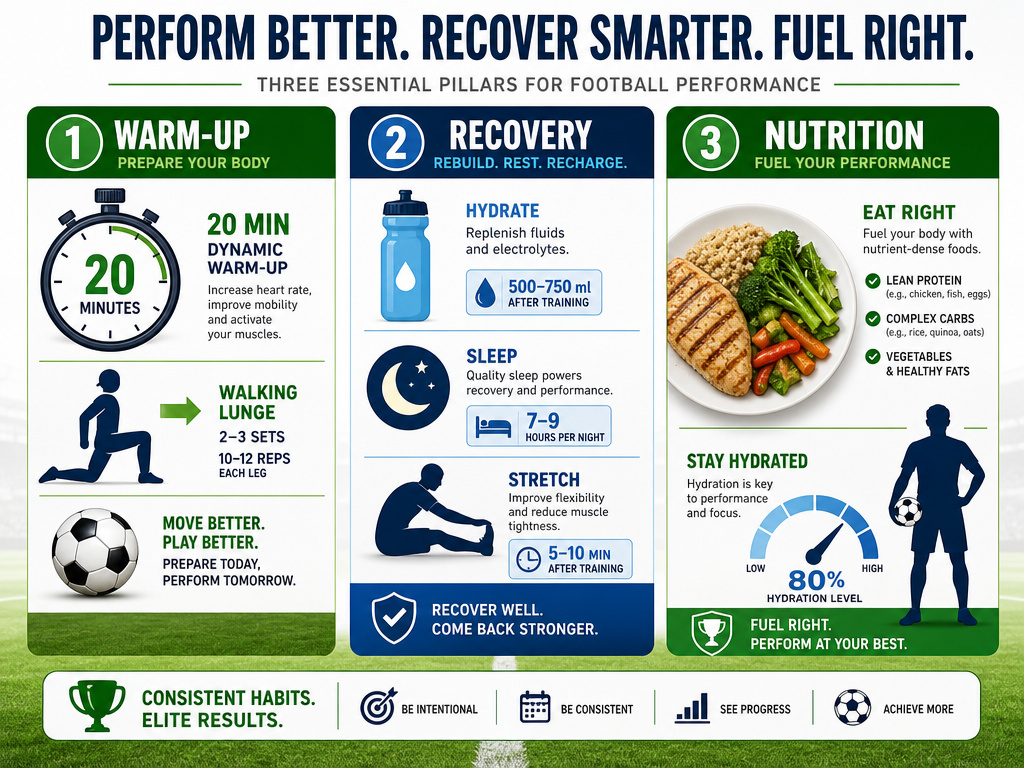
The main sessions get the glory, but these elements determine whether you adapt or break down.
- The Warm-Up: Ditch the static stretching. A complete dynamic routine like the FIFA ’11+’ (which takes about 20 minutes) prepares the body for movement. For lighter days or different programs, a shorter 5–10 minute routine of light jogging and dynamic stretches may suffice. A proper warm-up routine is essential.
- Recovery: This is when fitness is built. A 5–10 minute cool-down with static stretching helps kickstart the process. Hydration, sleep, and nutrition are the real drivers.
- Nutrition: You can’t fuel a high-performance engine with low-grade fuel. A detailed football nutrition guide is beyond our scope here, but consistent hydration is critical, especially during the heat-acclimatization period.
Weekly/Daily Training Schedule Examples

In elite football, preseason is typically a period of four to six weeks. Start the first week with a light to moderate load, as players return with different fitness levels. Individualize load progressions early. For a five-week block, build volume for the first three weeks, then taper it in weeks four and five while raising intensity to high levels. Sample schedules from research, such as a 6-week neuromuscular program or a 4-week conditioning program, involve three training sessions per week. In the 6-week neuromuscular training study, each session lasted 45 to 60 minutes. By the final weeks, integrate near-maximal sprint work twice weekly and agility movements twice a week to match the demands of the game.
Football-Specific Drills (with and without the ball)
Drills should replicate match demands, which include constant changes of pace. Without the ball, a neuromuscular training program is effective. This includes exercises like forward leaps and side jumps over low obstacles, the Nordic hamstring exercise, and the Copenhagen exercise. With the ball, integrate conditioning. A sample drill from a 4-week study involves repeated sets of 160 meters of dribbling at a moderate pace, followed by 20 meters of active walking for recovery, and finishing with 20 meters of sprinting. This pattern builds the ability to perform high-intensity actions, recover, and immediately go again, mirroring the hundreds of accelerations and decelerations in a match.
Common Mistakes to Avoid
The biggest mistake is spiking training load too quickly, which research links to a higher risk of injury. Avoid relying solely on endurance running; a neuromuscular training program leads to greater strength gains and better controls muscle damage. Do not neglect hamstring strength, as this muscle group is the most commonly injured. Starting an injury prevention program like the FIFA ’11+’ during a short preseason is another error; it requires 10 to 12 weeks of consistent use to be effective, so it must begin well before camp. Finally, in hot conditions, failing to follow the mandated 14-day heat-acclimatization period puts players at risk.
Frequently Asked Questions
What is a good pre-season training schedule for football?
Good schedule for a 6-week preseason could be divided into phases: an initial re-acclimatization and strength foundation phase, a building phase, and a tapering phase. It includes multiple pitch and strength sessions per week, complemented by consistent injury prevention work like the FIFA ’11+’.
How to get fit for football in 2 weeks?
You can’t, not properly. Two weeks is generally considered insufficient time to develop robust fitness for the season.
What is the most important part of pre-season training?
The most important part is injury-proofing your body through progressive strength training and consistent injury prevention protocols. Building a high level of fitness is useless if you’re injured in week three. The peer-reviewed evidence is clear: a neuromuscular training focus builds more resilient athletes than an endurance-only focus.
How long should a pre-season last?
As a general rule of thumb, 6 weeks is often viewed as an ideal balance, with 4 weeks considered too short and 8 weeks bordering on too long. Research and expert commentary suggest 4 weeks is too short to develop robust fitness, while 8 weeks risks mental and physical burnout. A 6-week timeline allows for a logical progression of load, a clear peak, and an effective taper into the first competitive match.
The Bottom Line
Preseason is a calculated rebuild. Ditch the mindless mileage. Follow the evidence: build strength and power with a 6-week neuromuscular program, condition with football-specific repeat-sprint drills, and protect your season by committing to the 10–12 week FIFA ’11+’ injury prevention timeline.
Start your first week light, and tailor it. The player who just finished a tournament needs a different plan than the one who’s been on the couch. Get your training gear ready, commit to the process, and remember, the goal is to thrive from the first whistle of the season.
