
Football Fitness Training Guide
This post contains affiliate links. As an Amazon Associate, we earn from qualifying purchases.
Football fitness is built on the ability to repeat high-intensity actions, sprinting, changing direction, jumping, under fatigue, over 90 minutes, not on long, slow runs. The guide that works matches your training to those exact demands, using protocols proven to cut injuries and boost performance.
That gap between general fitness and football fitness is where most amateur plans fail. They build an engine for a marathon when the game is a series of sprints. A proper football fitness training guide addresses this. The difference shows up in the 70th minute, when sharpness fades and the first hamstring twinge appears.
What follows is how to bridge that gap. We’ll walk through the essential warm-up, the three training modes that actually move the needle, and how to stitch them into a weekly schedule that leaves you match-sharp, not burned out. We’ll also tackle the research on where experts disagree, so you can see the map for yourself.
Key Takeaways
- Use the FIFA 11+ warm-up before every training session, teams that did this at least twice a week saw 37% fewer training injuries.
- For acute performance before a match, a more intensive protocol like the Football+ warm-up may be superior to the FIFA 11+ for sprint and agility tests.
- Strength training has the highest probability of being the best method for improving key metrics like vertical jump (CMJ) and short-distance sprint speed, according to a 2026 network meta-analysis.
- Avoid doing more than four high-intensity interval training (HIIT) sessions per week; exceeding this can increase muscle microdamage by 30%.
- Build your weekly schedule around football-specific conditioning like small-sided games, which train fitness and decision-making simultaneously.
The 20-Minute Injury Shield: How to Run the FIFA 11+
I used to think a warm-up was a few lazy laps and a stretch. Then I watched a youth team I helped coach get through a full season with almost no muscle strains, while another team down the road seemed to lose a player every other week. The difference wasn’t luck. It was a 20-minute routine.
The FIFA 11+ is that routine. It’s a complete warm-up package designed to replace your usual warm-up. The official manual states it should be done on grass in boots before every training session, and a shortened version (parts 1 and 3) before each match.
The FIFA 11+ is a complete warm-up program to reduce injuries among male and female football players aged 14 years and older. It takes about 20 minutes to complete and should be performed at least twice a week. Teams that performed the FIFA 11+ regularly at least twice a week had 37% fewer training injuries and 29% fewer match injuries, with severe injuries reduced by almost 50%.
The structure is specific and the order matters. You start with controlled running drills as part of the warm-up. This isn’t about speed; it’s about preparing the muscles and tendons for change of direction.
Part two focuses on strength, plyometrics, and balance. This is the core of the program. Think single-leg squats, planks, and controlled jumping exercises. The key is precision over power. A wobbly single-leg squat done correctly does more good than a deep one with a knee caving in.
You finish with speed running. The whole thing is built on progression: start at Level 1 for every exercise and only move up when you can complete all the reps with perfect form.
The timeline is honest. The manual says the protective effects take about 10–12 weeks to fully manifest, depending on how often you train. This is a habit, not a magic spell you do once.
| FIFA 11+ Part | Duration | Focus | Key Exercise Example |
|---|---|---|---|
| Part 1: Running | 8 minutes | Activation & Coordination | Jogging, hip-out/in runs |
| Part 2: Strength | 10 minutes | Stability & Power | Single-leg squat, plank, Nordic curl |
| Part 3: Speed | 2 minutes | Neuromuscular Priming | Controlled sprinting |
Why does this work so well? It targets the muscle groups and movement patterns most vulnerable in football, the hamstrings, the groin, the knee stabilizers. By training them in a dynamic, football-specific context before you load them fully, you’re essentially rehearsing for safety.
The Pre-Match Dilemma: Injury Prevention vs. Peak Performance
Here’s where it gets interesting. The FIFA 11+ manual says to use a shortened version before matches. But what if your goal isn’t just to stay safe, but to fire on all cylinders from the first whistle?
A 2023 study in PLOS One compared the acute effects of the FIFA 11+ against a different protocol called “Football+” on collegiate players. The Football+ warm-up was more intensive, with a higher volume of anaerobic and plyometric work. The result? The Football+ group showed superior performance in sprinting, agility, and dribbling tests right after the warm-up.
Where this goes sideways: Using a low-intensity, static-heavy warm-up before a match. It might keep you safe, but it can leave your explosive power and reaction speed dormant when the whistle blows.
This points to a genuine disagreement in the sources. The FIFA 11+ is the gold standard for injury prevention. But for acute performance optimization, getting your body to its highest possible output for the next 90 minutes, a more dynamic, intensive warm-up might be better.
Think of it as choosing the right tool. Use the full FIFA 11+ as your training-day default. It builds long-term resilience. Before a match, consider blending its principles with higher-intensity activities. You could do the FIFA 11+ running exercises, then add a few short, sharp sprints and some dynamic ball work to wake up the nervous system.
The study’s authors also called for more gender-specific research, which is a crucial edge case. A warm-up that perfectly primes a male player might need tweaking for a female player due to differences in muscle activation and injury risk profiles. One size rarely fits all.
What Actually Works: Strength, Conditioning, and Small-Sided Games
Forget the vague advice to “get fitter.” Modern research tells us exactly which training modes improve specific parts of your game, a focus of any good football fitness training guide. The challenge is that sometimes, the research seems to contradict itself.
Take vertical jump power (Counter Movement Jump or CMJ). A 2024 network meta-analysis in BMC Sports Science found plyometric training was most effective, while a 2026 network meta-analysis in Frontiers in Physiology gave the highest probability ranking (SUCRA: 94%) to strength training. Plyometrics (jump training) are fantastic for translating existing strength into explosive power. But if you lack foundational strength, if you can’t squat your own bodyweight with control, then jumping alone has a low ceiling. Strength training builds that ceiling.
The Frontiers optimal training dose review is worth reading because it doesn’t just pick winners; it ranks them by probability. Its data is clear: for raw, measurable outputs like your one-repetition max squat or a 5-meter sprint time, strength training is the most reliable bet.
For the engine, your aerobic capacity, the same review confirms endurance training has the greatest effect on VO2max. But not all endurance is created equal for a footballer.
| Training Mode | Best For Improving | Practical Football Translation |
|---|---|---|
| Strength Training | CMJ, Sprint Speed (5m, 10m), Max Strength | Power in duels, explosive acceleration, injury resilience |
| High-Intensity Interval Training (HIIT) | VO2max, Repeat Sprint Ability | Maintaining high intensity throughout the match |
| Small-Sided Games (SSGs) | Football-Specific Endurance, Decision Making | Match fitness that includes technical/tactical load |
This is where my opinion on interval training for football clicks in. Running repeat 400s on a track has value, but it’s a poor proxy for the game. Your heart rate spikes when you decide to press, when you see a passing lane, not when a beeper tells you to run.
That’s why Small-Sided Games (SSGs) are the secret weapon. A 3v3 or 4v4 game in a tight space forces endless repetitions of football’s core actions: short sprints, sharp turns, quick passes. The Springer systematic review of training modes confirms SSGs are not just tactical tools; they are potent conditioning tools that integrate the cognitive load of real play.
The beauty of SSGs is they train fitness without you noticing. You’re just trying to win the ball back. The 90th-minute lung-bursting effort feels organic, not prescribed.
Building Your Weekly Schedule: The Art of the Mix
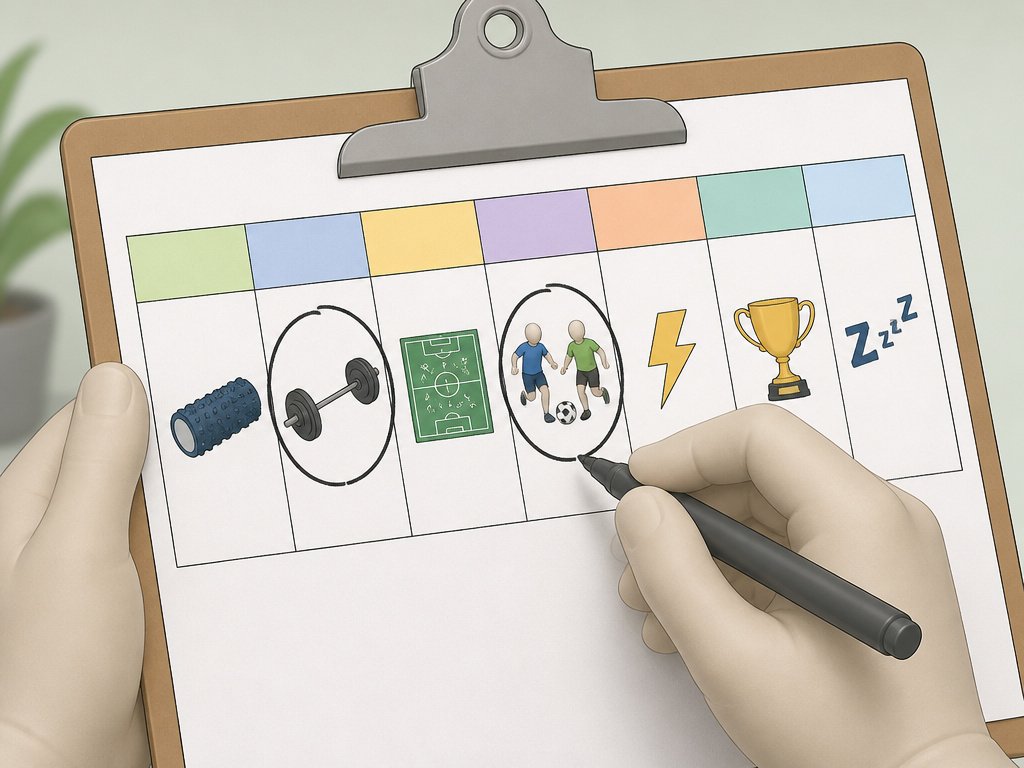
Knowing the ingredients is one thing. Knowing when to add them is another, a key lesson from a football fitness training guide. The biggest mistake I see is the “kitchen sink” approach, doing everything, hard, every day. That’s how you arrive at Saturday feeling flat.
Your week needs rhythm. It needs to balance stimulus with recovery, and it must pivot around your match day. Here’s a template for a once-a-week match schedule, adaptable for amateurs and serious players alike.
Monday (Recovery / Low Intensity)
- Active recovery: light cycling, swimming, or a very gentle jog.
- Focus: Mobility work and foam rolling. This is essential for clearing the fatigue metabolites from Saturday’s game.
Tuesday (Quality Conditioning / Strength)
- Warm-up: Full FIFA 11+.
- Main Session: This is your hardest physical day. Choose one focus:
- Option A (Pitch): High-intensity interval training. Example: High-intensity interval training with work and rest periods appropriate for football.
- Option B (Gym): Full-body strength session. Squats, deadlifts, presses. Low reps (4-6), high weight, long rest (2-3 mins).
- Cool-down: Proper stretching.
Wednesday (Technical / Tactical)
- Light warm-up.
- Session focused on passing patterns, set pieces, or tactical shape. Low physical load, high mental load.
- Could include low-intensity SSGs (e.g., 5v5 possession).
Thursday (Football-Specific Fitness)
- Warm-up: FIFA 11+.
- Main Session: Small-Sided Games. This is your gold standard. Set up small-sided games in a tight space to force repetitions of football’s core actions. The fitness is a byproduct of the competition.
- This also perfectly complements any strength training for football players done earlier in the week.
Friday (Pre-Match Activation)
- Very short, sharp session.
- Dynamic stretching, a few short sprints (10-15m), some light ball work.
- Goal: Wake up the nervous system, not create fatigue. No heavy lifting or exhausting drills.
Saturday (Match Day)
- Pre-match: Shortened, intensive warm-up (e.g., FIFA 11+ Parts 1 & 3 plus some dynamic ball work).
Sunday (Rest)
- Complete rest. Let the body adapt.
Common mistake: Doing your hardest running or lifting session on a Thursday or Friday. You’re digging a hole you have to play out of on Saturday. Hard stimulus needs sufficient recovery time before a match for peak performance.
This schedule works because it sequences the training stresses. You hit strength and pure conditioning early in the week (Tuesday), when you’re fresh and can generate maximum intensity. You then use football itself (Thursday SSGs) to translate that fitness into a sport-specific context, while the technical day (Wednesday) provides active recovery. The taper towards the match (Friday, Saturday) allows fatigue to drop and energy stores to replenish.
Navigating the Gray Areas: Age, Gender, and the Off-Season
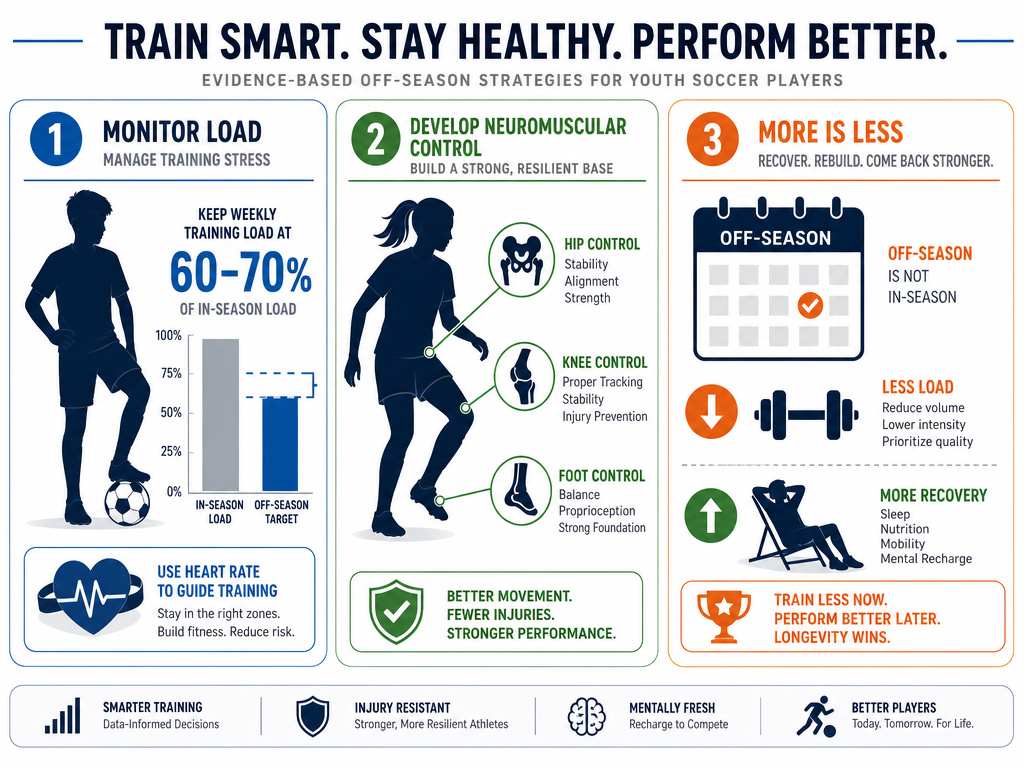
A guide isn’t complete without the caveats. The “optimal dose” changes if you’re 16 or 36, male or female, in pre-season or just finished a long campaign.
The 2026 Frontiers review flagged a critical limit: youth athletes (12–18 years) have only 60–70% of the tolerance of adults for training intensities above 85% of max heart rate. Their bodies are still developing. The priority should be technical mastery and general athleticism through fun, varied games. Loading them with adult-style HIIT or heavy lifting is a recipe for burnout or injury.
For female players, the research is playing catch-up. The PLOS One warm-up study explicitly called for more gender-specific studies. We know female athletes have a different injury risk profile (notably higher ACL injury rates) and may respond differently to certain training stimuli. This isn’t about doing “less,” but about smartly emphasizing neuromuscular control, hip strength, and landing mechanics within the same core principles.
Then there’s the transition period, the off-season. The goal shifts from performance to rest and rebuilding. Some studies suggest that excessive training during the off-season can hinder power and strength gains even if endurance improves. This is the “more is less” principle in action. The body needs a genuine break from the specific demands of football to super-compensate and come back stronger.
This is where a broader football training guide for the entire year is essential. The six-week pre-season block looks totally different from this in-season maintenance schedule.
Sample weekly workout schedule
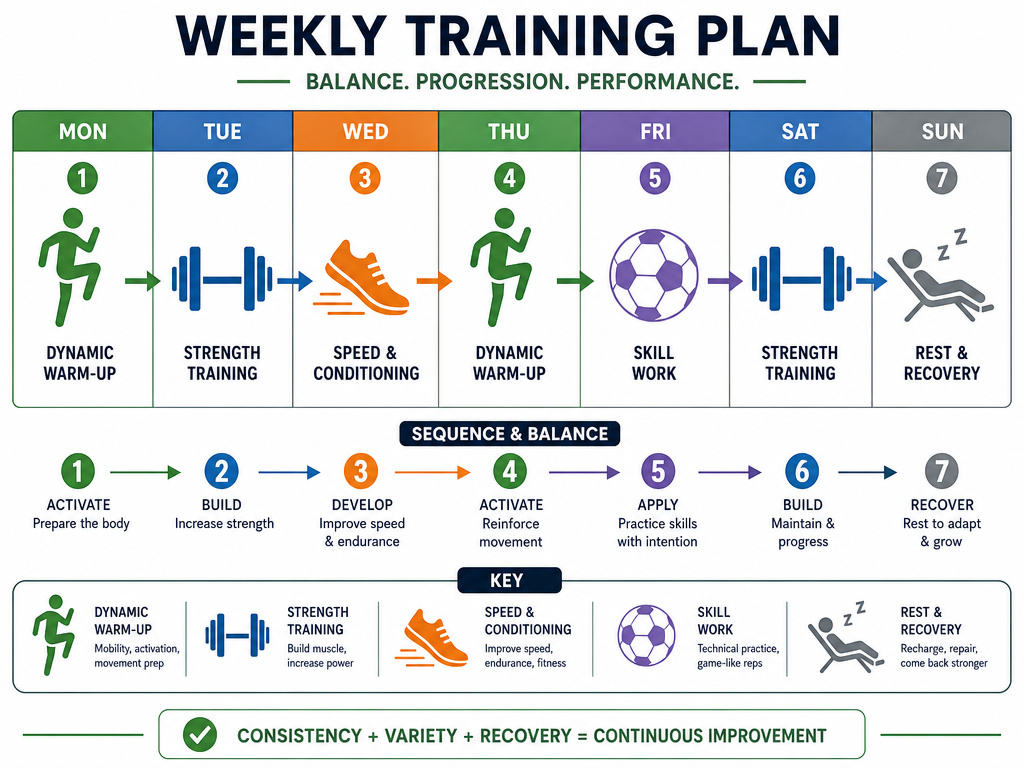
Structure your week around key training modes. Begin every session with a warm-up like the FIFA 11+, which should be performed before every training session at least twice a week. Dedicate separate days to focused strength training, as it is highly effective for improving sprinting and power. Integrate endurance sessions, but be cautious with high-intensity interval training frequency to avoid excessive muscle microdamage. Include a lighter day for active recovery or skill work. The full effects of a structured routine take time to manifest, so consistency over a period of weeks is key to seeing performance gains and reduced injury risk.
Speed and agility training
Football demands repeated high-speed actions. A match involves many short, intense bursts, with a significant portion of total distance covered at high speed. To train for this, incorporate running drills that mimic match conditions, such as changes of direction and accelerations over short distances. Strength training forms a critical foundation, as it has been shown to be highly effective for improving short-distance sprint performance. Your warm-up can also serve as a platform for speed work; some protocols include intensive small-sided games and anaerobic exercises to sharpen agility and dribbling under fatigue.
Plyometrics and explosive power exercises
Developing explosive power is crucial for jumping, sprinting, and striking. Plyometric exercises, like jumps and hops, are a direct method to train this quality. Research indicates plyometric training is highly effective for improving vertical jump height. These exercises are often included in full warm-up programs, with some protocols dedicating a specific section to them. For the best results, ensure you have an adequate base of strength before progressing to high-volume or high-intensity plyometrics. Always perform these exercises with control and proper technique to maximize benefit and maintain safety.
Frequently Asked Questions
What is the best way to train for football fitness?
The best way integrates three layers: a consistent injury-prevention warm-up (like the FIFA 11+), dedicated strength training to build power and resilience, and football-specific conditioning through small-sided games. Isolated long-distance running is a poor substitute for the repeat-sprint nature of the sport.
How often should I do strength training for football?
Aim for two full-body strength sessions per week during the season, placed early in your weekly schedule (e.g., Tuesday). This allows sufficient recovery before your match. Focus on compound movements like squats, deadlifts, and presses with good form over maximum weight.
Is the FIFA 11+ suitable for beginners?
Yes, but they must start at Level 1 for every exercise and prioritize perfect technique over speed or difficulty. The program is designed for players aged 14 and up. For younger players, coaches should modify the intensity and supervise closely.
What’s more important for football, HIIT or small-sided games?
For pure physiological adaptations like VO2max, HIIT is highly effective. For match-ready fitness that includes decision-making and skill under pressure, small-sided games are superior. A balanced program uses both, with SSGs forming the core of your football-specific conditioning.
How long does it take to see improvements in football fitness?
Measurable improvements in strength and power can begin in as little as 4-6 weeks with consistent training. The full injury-prevention benefits of a program like the FIFA 11+ take about 10-12 weeks to manifest. Peak football fitness is a long-term project built over seasons, not weeks.
The Bottom Line
Football fitness is the product of targeted, consistent habits. Start every session with the 20-minute FIFA 11+ shield. Lift weights twice a week to build the power for jumps and sprints. Then, use the game itself, in the form of small-sided games, as your primary conditioning tool. This approach trains your body and your brain simultaneously.
The one rule to hold above all others: protect your recovery. However tempted you are to add an extra session, remember the 2026 review’s finding, exceeding four high-intensity sessions a week spikes injury risk. Fitness is built in the rest periods between the work, not during the work itself.
So pick one thing to start with next week. Maybe it’s downloading the FIFA 11+ manual. Maybe it’s swapping a long run for a 4v4 game. The beautiful game rewards patience. Build the foundation first, and the performance will follow.
