
Core Exercises for Football Players: Beyond Just Planks
This post contains affiliate links. As an Amazon Associate, we earn from qualifying purchases.
Core exercises for football players build a platform for power transfer, stabilize the torso during tackles and turns, and are a proven component of injury resilience. The most effective programs are simple, consistent, and football-specific, focusing on isometric holds like planks and bridges, anti-rotation work, and hamstring eccentrics, performed at least twice a week for a minimum of four weeks to see measurable gains in sprint speed and kicking power.
The research gives us something better than guesswork: specific timelines, measurable strength gains, and even clear disagreements on topics like agility. This moves us from generic lists to training programs that reflect real game demands.
What follows is a breakdown of the doses that work, the exercises with the strongest track record, and how to slot this work into a full training week without overloading it. You’ll also get a straight answer on the common debates, like whether you need a BOSU ball.
Key Takeaways
- A minimum of 15 minutes, twice weekly for 4 weeks is the baseline protocol to improve skill-related fitness, per a 2022 systematic review.
- A simple program of just plank, side plank, and Nordic hamstring exercises, done at least three times a week, increased pediatric players’ trunk flexion strength from 1.9 to 2.6 Nm/kg over one year.
- Core training significantly improves ball-kicking velocity and sprint speed, but its impact on agility and specific sprint distances is contested; some studies show clear benefit, others show none.
- For most football-specific gains, prioritize anti-movement and isometric exercises (planks, Pallof presses) over dynamic crunches; they better mimic the stability demands of the game.
- Integrate core work at the end of a training session or as part of a circuit, not before skill or speed work where fresh core stability is crucial.
The Minimum Effective Dose
How little work can you do and still get better? A 2022 systematic review of 26 studies gave us a clear floor: a minimum effective protocol for improving skill-related fitness in soccer players is 15 minutes per session, twice weekly, for 4 weeks.
That’s the baseline. For more durable strength changes, the timeline stretches. A 2021 study in the Journal of Experimental Orthopaedics had pediatric players do a simple three-exercise program (plank, side plank, Nordic hamstring) at least three times a week for a full year. The results weren’t subtle. Trunk flexion strength jumped from 1.9 to 2.6 Nm/kg, and extension strength rose from 4.3 to 5.3 Nm/kg. The takeaway isn’t that you need a year to start, but that consistency over seasons pays a massive dividend.
Where this goes sideways: Thinking more frequency always equals faster results. Another 2024 study on adult amateurs used a twice-weekly, eight-week circuit and saw improvements in strength and balance. Twice a week gets the job done; three times is effective but not compulsory. The body needs recovery time to adapt, especially when combined with other football training.
Research-backed protocols for core exercises for football players can be adapted into a periodized schedule. For example, the 2-3 times per week, 20-30 minute sessions used in off-season studies can build capacity, while the minimum effective dose of 15 minutes twice weekly can serve as in-season maintenance.
Stable Floor or Wobble Board?
The fitness aisle is full of inflated discs and balance balls. Do they help? A 2024 meta-analysis in PeerJ compared Instability Core Training (ICT) against Traditional Core Training (TCT). It found ICT had a moderate to large effect size advantage for improving trunk strength and sprint performance. But the details matter.
The benefit seems specific to core exercises for football players: instability challenges your body’s stabilizers differently, which can transfer to better force application in certain contexts.
| Training Type | Best For | Limitation / Consideration |
|---|---|---|
| Stable Surface (floor) | Building maximal trunk strength, foundational endurance, and learning proper form. | May not challenge proprioception and fine motor control as much. |
| Unstable Surface (BOSU, balance pad) | Improving neuromuscular control, engaging stabilizers, and adding variety for trained athletes. | Can reduce the load on target muscles; not ideal for max strength development. |
So, should you use them? Yes, as a supplement, not a replacement. Start athletes on the floor. Once they master a 60-second plank with perfect form, introducing a stability ball plank creates a new challenge. But the core of your program, literally, should be on solid ground.
The ‘Big 3’ Football Core Exercises
Most exercise lists are a kitchen-sink approach. The science points to a potent minimalist strategy. The 2021 pediatric study that showed 37% strength gains used only three moves. They are football-relevant because they train anti-extension, anti-lateral flexion, and posterior chain integrity, exactly what you need when bracing for a challenge, shifting direction, or decelerating.
- Plank (Anti-Extension): Hold a straight line from head to heels, elbows under shoulders. The goal is stiffness, not time. Maintain a straight line from head to heels, elbows under shoulders, focusing on full-body stiffness. Separately, a 2024 study on adult amateurs used a four-exercise circuit of plank, crunch, supine bridge, and side bridge twice weekly for eight weeks and saw improvements in strength and balance.
- Side Plank (Anti-Lateral Flexion): Stack your feet and prop up on one elbow, lifting your hips to form a straight line. This directly engages the obliques that stabilize you against tackles. The burn along your side is the muscle working to prevent your torso from buckling.
- Nordic Hamstring Curl (Posterior Chain / Eccentric): Kneel on a pad with your ankles secured. Slowly lower your torso toward the floor, resisting gravity with your hamstrings in a controlled eccentric motion. Use your hands to catch yourself at the bottom. This eccentric focus strengthens the posterior chain, which is integral to core stability.
A simple core muscle training program of three exercises (plank, side plank, Nordic hamstring) performed at least three times weekly for a year significantly increased trunk flexion strength from 1.9 ± 0.5 Nm/kg to 2.6 ± 0.5 Nm/kg and extension strength from 4.3 ± 1.1 Nm/kg to 5.3 ± 1.2 Nm/kg in pediatric soccer players.
These three form a robust foundation. You can build out from here, but you don’t have to.
Programming for Power vs. Injury Resilience
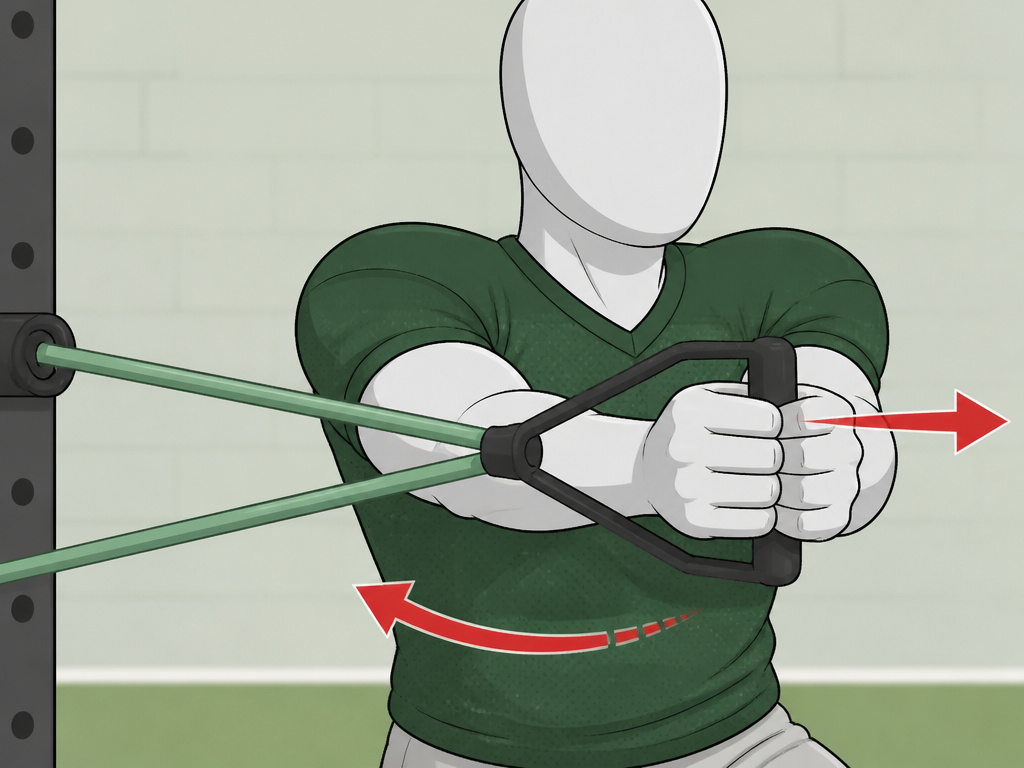
Core work serves two masters: performance and protection. The emphasis shifts slightly depending on the goal.
For Performance (Power, Speed, Shot Force):
The focus is on force transfer. Exercises that teach your core to rigidly link lower and upper body power are key. Think of your torso as a solid conduit.
- Pallof Press: Stand sideways to a cable machine or resistance band anchor. Hold the handle at your chest and press it straight out, resisting the pull to rotate. Press it straight out, resisting the pull to rotate, then return. This is pure anti-rotation, mimicking bracing against a challenge while playing a pass.
- Medicine Ball Slams: A dynamic, explosive movement that trains your core to coordinate a powerful contraction from the ground up.
- Dead Bugs: Lying on your back, extend opposite arm and leg while keeping your lower back flat to the floor. This teaches pelvic stability while limbs are moving.
For Injury Resilience:
The focus is on endurance and control, particularly in the deep stabilizers and the posterior chain. The 2021 pediatric study noted that neuromuscular control (measured by a K/H ratio) improved at 6 months but was not sustained at 12 months, even as strength kept climbing.
- The aforementioned ‘Big 3’: Their isometric nature builds the muscular endurance needed to maintain posture and stability late in a match.
- Bird-Dog: On all fours, extend opposite arm and leg. It is an exercise that challenges coordination and core stability.
- Glute Bridges: Glute bridges also engage the core for stabilization.
A program that threads both needles incorporates both strength and neuromuscular control exercises.
Does It Actually Make You More Agile?
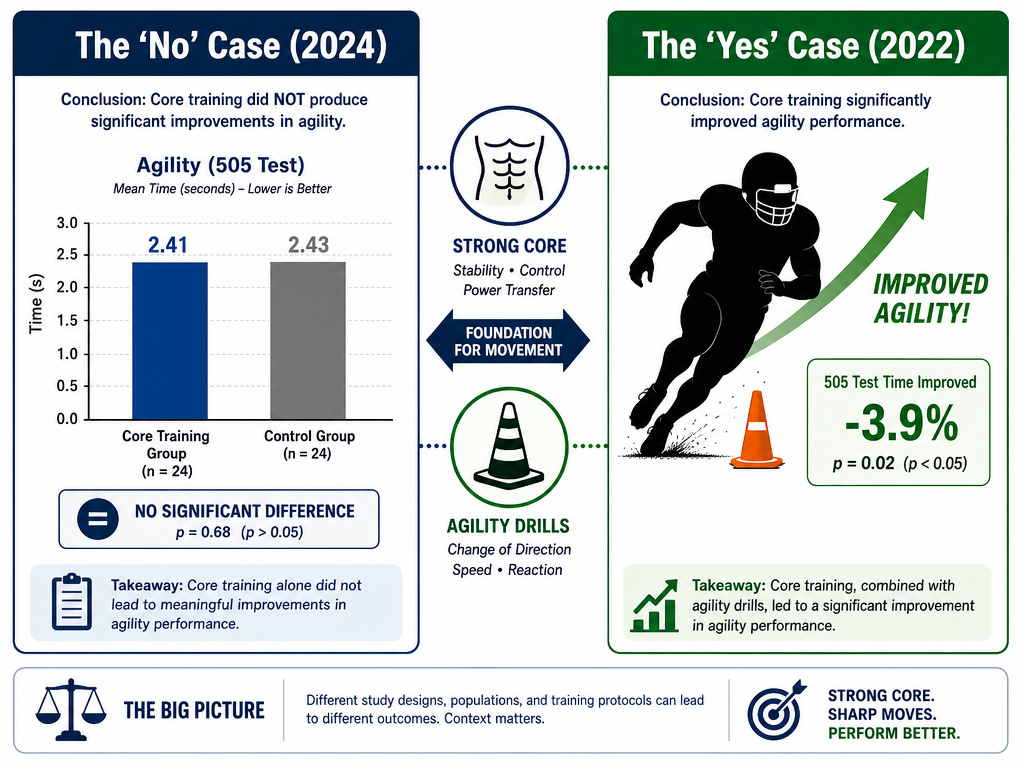
Here’s where the sources don’t sing in perfect harmony. It’s a useful disagreement because it shows the nuance in training.
- The ‘No’ Case: The 2024 PLOS One study on adolescent players found an eight-week core stability program did not lead to a significant improvement in agility performance (505 test) compared to the control group, despite clear gains in kicking and sprinting.
- The ‘Yes’ Case: A 2022 systematic review states that core training can improve soccer players’ agility. Other studies, like one in Applied Sciences, have concluded core training “significantly and clearly improved agility” in young players.
How do we square this? Agility is complex, it’s a blend of strength, power, coordination, and decision-making. Core strength is a necessary component, but it may not be the limiting factor for everyone. A player with weak core stability will likely see agility improvements from addressing that weakness. A player who already has good core control might need more specific change-of-direction drills to see further agility gains. The core provides the stable platform from which to push off and cut; it doesn’t automatically teach you how to cut better.
The 3-3-3 Rule and Sample Session
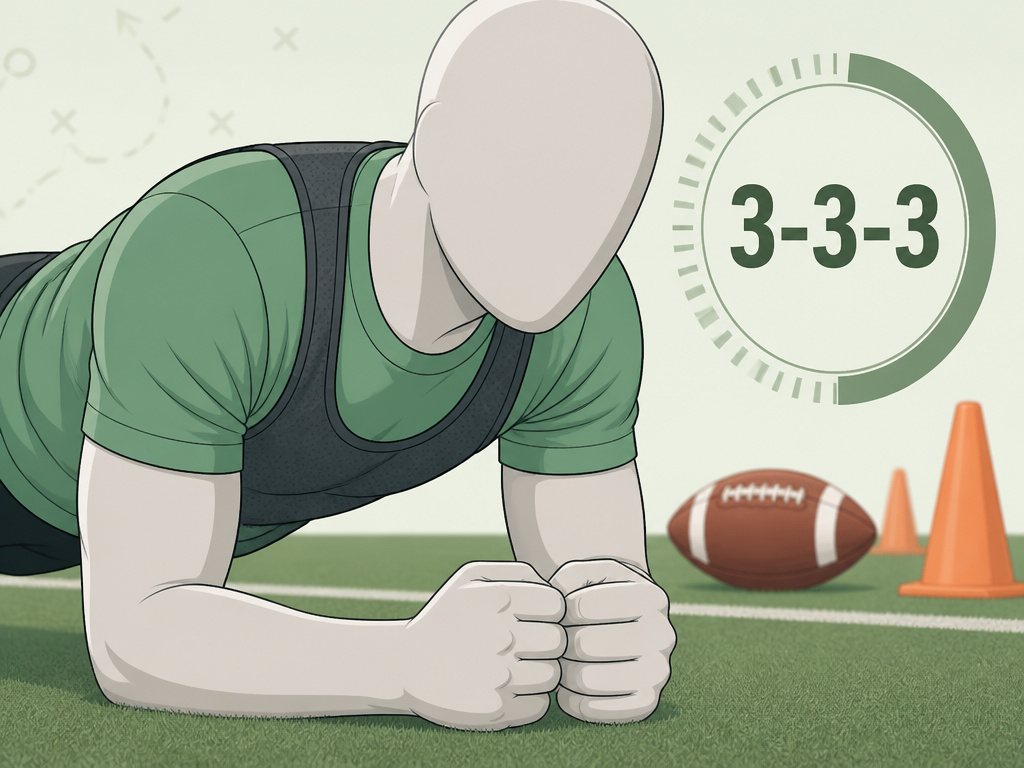
This kind of focused circuit fits perfectly at the end of a technical or fitness training session. The key is consistency, applying that minimum effective dose week after week.
Medicine Ball Exercises for Football
Medicine ball slams and twists are a form of dynamic core training that builds explosive power. A 2024 meta-analysis found Instability Core Training (ICT) showed a moderate to large effect size advantage over Traditional Core Training (TCT) for improving trunk strength, though its effect on sprint times varies across studies.
How to Progress Core Exercises
Start with foundational exercises on a stable floor. A proven simple program from one study includes the plank, side plank, and Nordic hamstring curl. Another effective circuit includes the plank, crunch, supine bridge, and side bridge. Research shows performing these exercises at least three times weekly builds significant trunk strength over time. For a greater challenge, introduce instability. Studies indicate that moving exercises to an unstable surface, like a stability ball, can provide a stronger stimulus for trunk strength and certain sprint improvements compared to training only on the floor. Always master the basic movement pattern before adding instability or dynamic power.
Common Core Training Mistakes
A major mistake is neglecting consistency for intensity. A core program performed three days a week for eight weeks improved kicking velocity and sprint speed, but the same program showed no significant agility gain in one study, highlighting that results are specific. Avoid assuming all core work directly improves every athletic metric. Another error is improper progression; jumping straight to advanced unstable movements without a strength base can limit gains. Finally, do not overlook exercise selection. Research comparing protocols shows that simply adding planks and bridges is effective, but incorporating a variety of exercises, including dynamic and unstable variations, may offer broader performance benefits.
Frequently Asked Questions
What is the best core exercise for football players?
There isn’t one “best” exercise, but the most fundamental is the plank. It directly trains the anti-extension stability needed to transfer force from your legs during a shot or sprint and to brace for contact. From that foundation, the side plank and Pallof press are essential for building the 360-degree stability football requires.
What are the big 3 exercises for the core?
In a general fitness context, the “big 3” are often the squat, deadlift, and bench press. For the core itself, especially in football, a more relevant “big 3” would be the plank (anti-extension), side plank (anti-lateral flexion), and Pallof press (anti-rotation). This trio covers the primary directions in which your core must resist movement to stabilize the spine.
What are the 5 best core exercises for football?
Comprehensive football core program would include: 1) Plank, 2) Side Plank, 3) Pallof Press, 4) Nordic Hamstring Curl, and 5) Dead Bug. This selection builds isometric endurance, rotational stiffness, posterior chain strength, and coordinated control, hitting all the major needs for performance and injury prevention.
What is the 3-3-3 rule for workout?
The 3-3-3 rule is a straightforward core workout template: choose 3 different exercises, perform 3 sets of each, and hold each isometric exercise for 30 seconds (or do 30 seconds of work for dynamic exercises). It’s designed to be a quick, effective, and repeatable framework for building core endurance.
Before You Go
The biggest mistake isn’t skipping core work entirely, it’s doing it randomly. Pulling out a flashy ab routine once every two weeks does nothing. The evidence is clear: pick a few key exercises that fight unwanted movement, do them consistently twice a week, and give the process at least a month.
Start with the floor before the BOSU ball. Prioritize the quality of a 30-second plank over struggling through a 90-second one with a sagging back. And remember, this work supports your football, not the other way around. Slot it in after your pitch work or speed training, never before. A solid core is the quiet engine that lets everything else you train, your power, your plyometrics, your agility, work as intended.
