
Football Passing Patterns Drills: A Practical Framework
This post contains affiliate links. As an Amazon Associate, we earn from qualifying purchases.
Football passing patterns drills are structured sequences of passes and movements designed to improve technical execution, build collective understanding, and rehearse tactical scenarios. The three core types are unopposed circuits for technique, opposed circuits for decision-making under pressure, and combination patterns that integrate with finishing. The goal is intelligent progression from isolated skill to game-like application through repetition.
Right, so the reality with these drills is this. They look tidy in a video, players moving in sync, crisp passes, perfect angles. On a muddy Tuesday night with sixteen kids, it feels different. The gap between the tidy pattern and the messy game is where coaching actually happens.
What follows is a breakdown of why we use patterns, the three types you need, and how to stitch them into a session that builds. We’ll cover the specs from the governing bodies, the frameworks from coaching educators, and the practical tweaks for when your cones keep blowing over.
Key Takeaways
- Unopposed drills prioritize technique, but as the 205 Academy framework argues, they must have a “clear path to the introduction of opposition” to avoid becoming mere ball-kicking.
- Limit touches to enforce tempo. FIFA’s circuits prescribe a minimum of 1 minute per drill for high-tempo focus, using the most appropriate foot to maintain speed and pass quality.
- Scanning and body shape are essential. Players must perform an over-the-shoulder scan before receiving and adopt a side-on position to see the field and drive into space.
- Design for progression, not perfection. Every pattern should allow you to add static defenders (cones), then active defenders, and finally integrate dribbling or feints, as supported by the 205 Academy platform.
- Connect patterns to a game model. Ask “when would we use this?” A pattern targeting play between the lines, for instance, directly rehearses a build-up phase against a mid-block.
The Real Point of Passing Patterns: Rehearsal vs. Repetition
For unopposed exercises, the FIFA Training Centre states the emphasis in football passing patterns drills is “placed on the execution of technique, with less focus on awareness and decision-making.” This is the clean-room approach for technical repetition.
The 205 Academy critiques standard unopposed drills, stating “mistakes are not punished through loss of possession.” Their framework is built for tactical rehearsal, arguing the pattern should be an opportunity to ‘rehearse’ aspects of the game model with a clear path to the introduction of opposition.
The 205 Academy passing pattern framework insists the activity must have a relationship to the game model, asking coaches to define what happens “next” after the pattern ends, does the team switch play, or does a runner break the line?
So which is right? Both. You start with the clean room to install the technique, the specific weight of pass, the timing of the run. But if you stay there, you are training robots, not footballers. The session must progress. The value isn’t in the pattern itself, but in how you use it as a stepping stone toward the chaos of the match.
The 3 Core Types of Passing Pattern Drills
Not all patterns serve the same purpose. Choosing the right one depends on what you want to develop in that 15-minute block of your session.
1. The Technical Circuit: Building the Engine
This is your unopposed foundation. Players follow a set sequence around cones or mannequins. The focus is purely on the technical execution: pass weight, first touch, body shape. According to FIFA, these can be set up in different sizes (small, medium, large) to allow for various ranges of passing and movement.
I have watched sessions where this part drags. Players go through the motions, their touch gets lazy, and the coach shouts about concentration. The fix is in the constraints. FIFA’s Technical Activation Circuit 1 prescribes 30 seconds per drill for initial familiarization and a minimum of 1 minute per drill for high-tempo focus. That short, intense burst forces concentration.
Common mistake: Letting the drill become a slow walkthrough. Without a time constraint or a touch limit (try two-touch), the technical quality plummets. The ball must keep moving.
| Drill Focus | FIFA Prescription | Coaching Cue |
|---|---|---|
| Initial Familiarization | 30 seconds per drill | “Find the rhythm” |
| High-Tempo Execution | 1 minute minimum per drill | “Tempo! Appropriate foot!” |
| Passing Distance | Up to 40m or more in large circuits | “Weight of pass—to feet, into space” |
2. The Opposed Circuit: Adding the Decision Chip
Here is where you bridge the gap. You keep the pattern’s structure but add passive or active pressure. A defender might follow a runner or apply light pressure to the passer. FIFA’s opposed passing circuits mandate players perform at high intensity and limit touches to advance into space.
The key technical demand shifts. Now, the side-on receiving position is critical. This position allows the player to see both the pressure and the escape route at the same time. This is where the habit of scanning the pitch you build separately becomes a game-saver.
Where this goes sideways: Adding a defender but not giving them a real objective. If the defender is just a cone with legs, the offense learns nothing. Give the defender a simple goal: force the play wide, or intercept the pass into the central runner. Now the passer has to read and decide.
3. The Combination Pattern: Connecting to the Game Model
This type of football passing patterns drills looks most like a slice of the game. It often involves three or more players and ends with a shot or a final pass into a scoring zone. The FIFA 3-player combination finishing drill emphasizes timing of runs, avoiding offside, and ensuring “the ball keeps moving at all times,” which is achieved by limiting touches.
The magic here is in the “why.” You are not just practicing a pass-and-move. You are rehearsing a specific solution to a tactical problem, like how your winger, full-back, and midfielder combine to break a compact flank. This is where your training session structure makes the pattern meaningful, placing it after a tactical briefing and before a small-sided game that demands the same combination.
The Non-Negotiables: What Makes a Pattern Actually Work
You can draw the prettiest diagram on the board. If these elements are missing, the drill falls apart on the grass.
Scanning Before Receiving. This isn’t a nice-to-have. It’s the trigger for everything that follows. FIFA drills explicitly state players should perform an over-the-shoulder scan before receiving the ball. The passer aids this by using verbal instructions and varying the weight of their pass to signal what’s next.
Movement After the Pass. The most common static moment in a bad pattern is after a player makes their pass. They stand and admire it. The rule must be ironclad: after playing a pass, players should always look to move into space or open up passing angles. This is the heartbeat of improving your vision, you move to see the next picture.
Collective Understanding Over Individual Brilliance. A perfect through ball is useless if the runner isn’t expecting it. FIFA’s advanced circuits place special emphasis on collective understanding and the quality of movement, timing and passing. This is built through repetition, but intelligent repetition where players communicate and adjust.
Designing Your Own Patterns: A Practical Framework
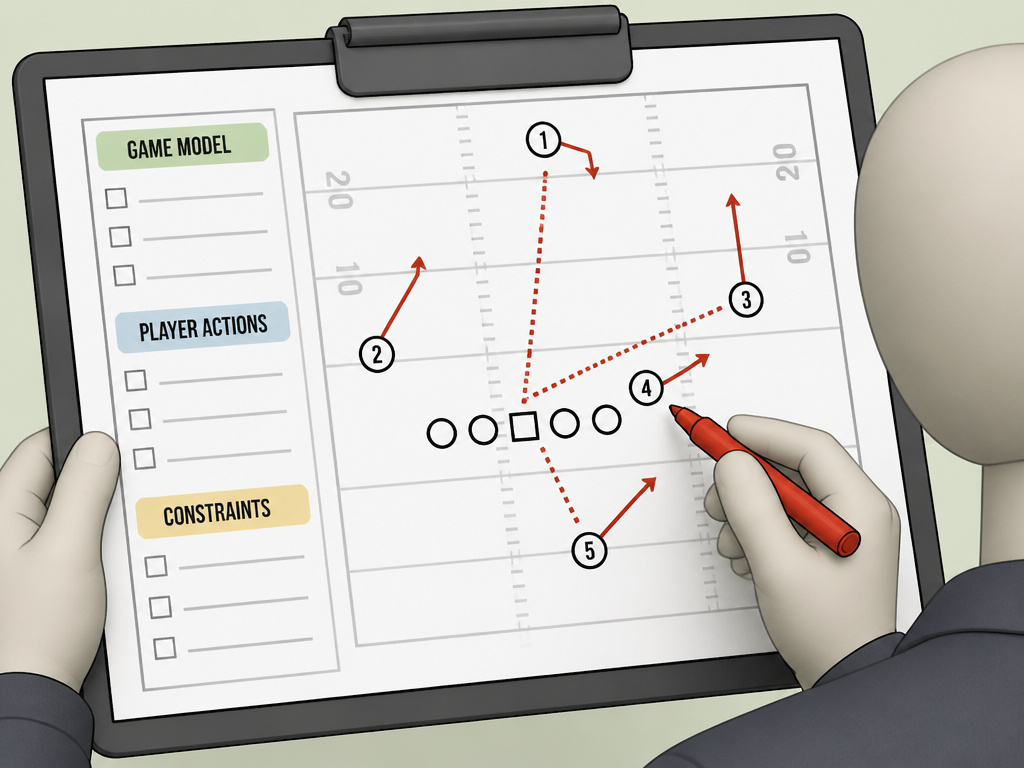
You do not need to copy drills forever. Use this checklist to build or adapt a pattern for your team’s needs.
- Start with Your Game Model. What situation are you rehearsing? Playing through a midfield block? Switching play? Build-up against a high press? Your pattern should be a 3-5 second snapshot of that.
- Define the Player Actions. For each position in the pattern, specify:
- Their starting body shape (open, side-on).
- Their first touch direction.
- Their passing foot and weight.
- Their movement after the pass.
- Set the Constraints. This is how you coach without constant talking.
- Touch Limit: Start with 3-touch, progress to 2-touch, then 1-touch.
- Time Limit: Use the FIFA benchmarks: 30 seconds to learn, 1 minute to execute at tempo.
- Space: Adjust the grid size. A small grid forces quick passes and tight control; a large grid demands longer passes and earlier communication.
- Plan the Progressions. This is the 205 Academy philosophy in action. Your platform should support adding challenges.
- Add static defenders (cones/mannequins).
- Add a passive defender who shadows.
- Add an active defender trying to intercept.
- Allow the ball carrier to dribble or feint if the pass isn’t on.
- Connect to an Outcome. Never let the pattern end with a dead ball. It should end with a shot, a pass into a mini-goal, or a transition into a 2v2. This bridges to the game.
Adapting for Age, Space, and Numbers
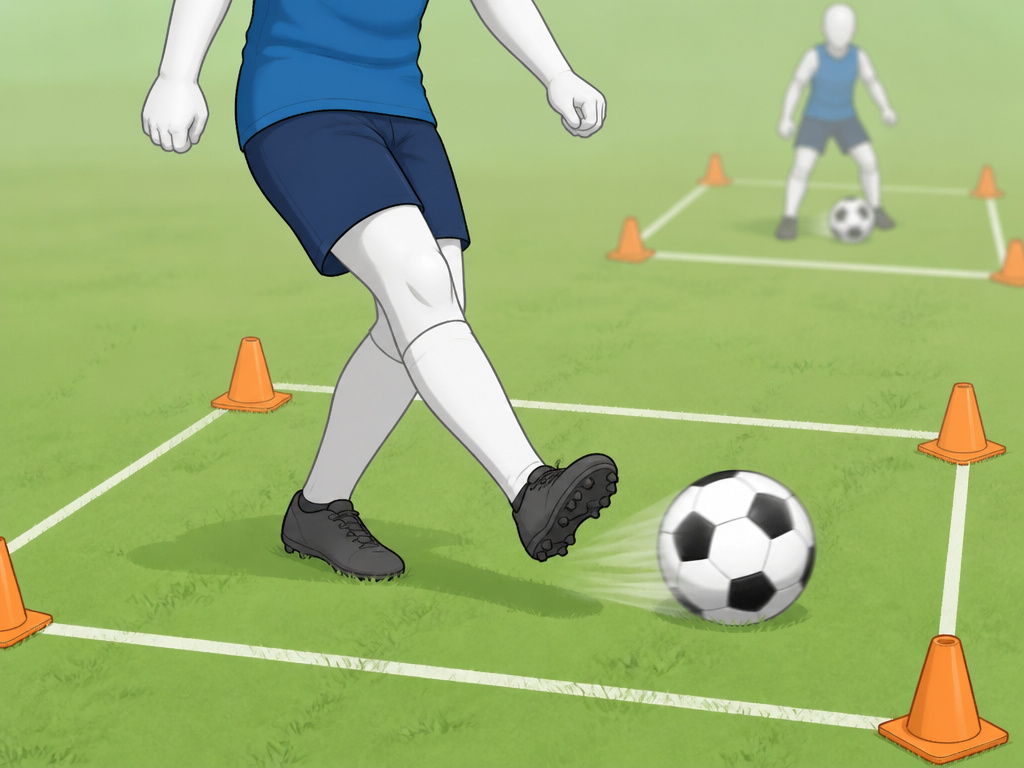
The resources are clear but often ignore real-world constraints. Here is how to adapt.
For Younger Players: Soccer Coach Weekly is blunt: for younger players, passing patterns aren’t the most exciting of challenges. Their advice is sound: sandwich a simple pattern between two fun small group drills or rondo exercises. Keep it short, keep it successful.
For Limited Space: You do not need 40 meters. Use the FIFA principle of small, medium, and large circuits. A small grid can focus on sharp, one-touch passing technique and close support. The pattern becomes about speed of thought and foot, not power.
For Large Groups: The worst thing you can do is run one long line. Set up two identical patterns side-by-side. Split your group in two and run them simultaneously. This doubles repetitions and keeps players engaged.
From Pattern to Game: A Sample Session Blueprint
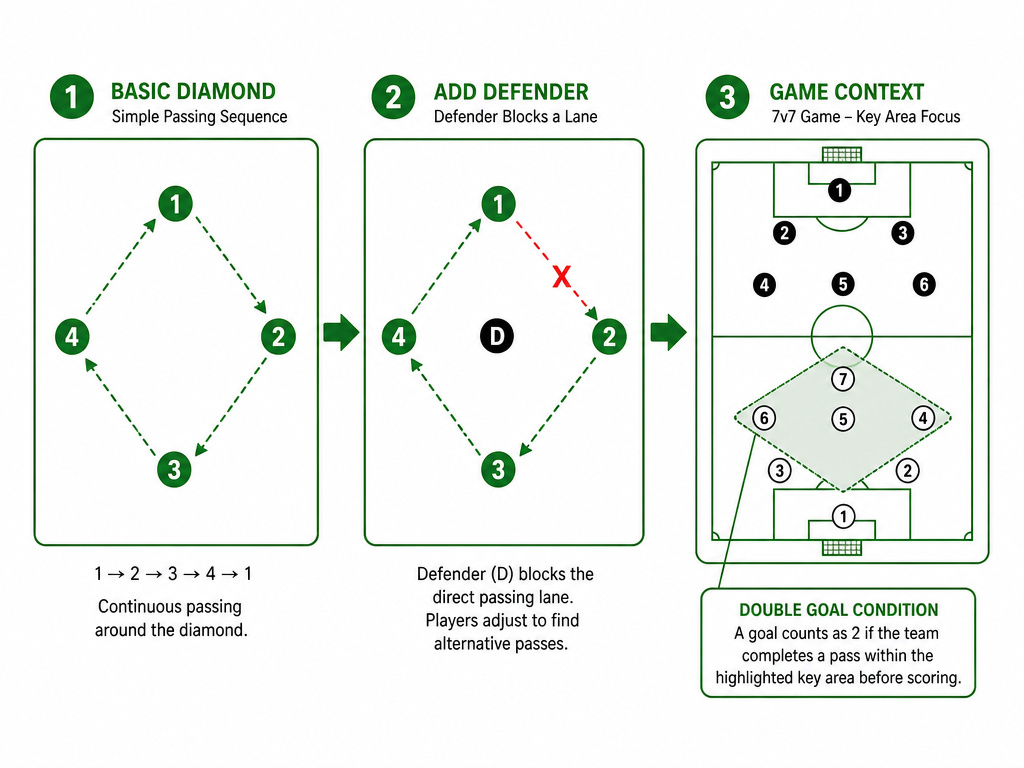
This is the gap most guides miss. Here is how a 90-minute session might flow, using a pattern designed to break a midfield line.
- 0-15 mins: Warm-up & Activation. Basic passing drills in pairs, focused on crisp, foot-specific passes. Introduce the over-the-shoulder scan.
- 15-30 mins: Install the Pattern (Unopposed). Set up a 4-player diamond pattern. Focus on the technical execution: the timing of the check, the weight of the pass into the receiver, the movement to open the next angle. Use a 1-minute work, 30-second rest interval.
- 30-45 mins: Add Pressure (Opposed). Add a passive defender in the centre of the diamond. Their job is to block the passing lane to the central player. The offensive players must now use their body shape and pass weight to disguise the pass. This directly trains executing a wall pass under pressure.
- 45-60 mins: Conditioned Game. Move to a 7v7 game in a narrowed pitch. The condition: a goal counts double if it is preceded by the diamond combination you just practiced. This forces recognition of the trigger.
- 60-90 mins: Free Play & Cool-down. Remove conditions. Let them play. Observe if the pattern emerges naturally. Finish with stretching.
Common Passing Pattern Drills
Common drills like triangle or diamond passing focus on specific shapes and movements. In a diamond pattern, players form a diamond shape around the ball carrier to create multiple passing angles. The core idea is repetition of a sequence to build collective understanding, with emphasis on the quality of movement, timing, and passing. These patterns are often performed unopposed around cones or mannequins. While they develop technical skills within limits, some frameworks argue they should serve as a rehearsal for a game model, providing a foundation for decision-making before defenders are added.
Drills for Different Skill Levels
Passing patterns can be used with players of all ages and skill levels, though complexity varies. For younger or less experienced players, use simple patterns alongside more game-based activities, as patterns alone may not be engaging. For warm-ups or technical activation, use unopposed drills focusing purely on technique execution. Intermediate drills introduce constraints like limited touches and higher tempo. Advanced progressions add physical defenders to create pressure, forcing players to think about body shape, pass weight, and decision-making, bridging the gap to game-like situations.
Frequently Asked Questions
What are some good football drills to improve passing?
Start with technical circuits for consistency, then move to opposed circuits that add decision-making. The rondo is arguably the best all-around passing drill, as it combines technique, pressure, and vision in a tight space. Always pair pure passing drills with small-sided games where players have to apply the skill.
What are some passing patterns for the 4-2-3-1 system?
The 4-2-3-1 relies heavily on the “10” receiving between the lines. A great pattern is a 4-player drill: a centre-back passes to a deep midfielder, who sets back to the other centre-back, who then plays a direct pass into the 10 checking between two mannequins. The 10 must receive side-on and play a through ball to a wide runner. This rehearses a classic build-up sequence for that formation.
Are passing patterns only for advanced teams?
No. According to Soccer Coach Weekly, they can be used with players of all ages and skill levels, although complexity may vary. For beginners, simplify the movements, enlarge the space, and focus on one coaching point, like passing to the correct foot. The pattern is a tool; you adjust the difficulty.
How do you make passing patterns more challenging?
Increase the tempo, reduce the touch limit (go to one-touch), shrink the space, or add defenders. You can also change the starting point or direction of the pattern, or require players to use only their weaker foot. The 205 Academy framework emphasizes that the platform should “support progressions that increase the physical, technical, or cognitive challenges.”
Why do my players look good in patterns but not in the game?
This is the classic trap. It likely means the pattern is too isolated. You have not bridged the gap. The pattern lacked realistic pressure, or it didn’t end with a game-relevant outcome (like a shot), or you didn’t create a conditioned game that rewarded using the pattern. The drill taught the “what,” but not the “when” or “why.”
Before You Go
One rule I have learned the hard way: if your pattern drill runs longer than 15 minutes without changing, you have lost the plot. The players are bored, the technique gets sloppy, and you are just filling time.
The real test is whether, in the final 10 minutes of a tight game, your midfielder automatically checks into that pocket of space and your centre-back finds him first time, not merely their ability to execute the pattern at the start of training. This outcome is trained by repetition that is progressively pressured, constantly questioned, and always connected back to the whole, rather than by endless repetition alone.
That is the beauty of it. A passing pattern is a rehearsal for a moment that matters, not merely a drill.
