
Football Drills for Small Groups
This post contains affiliate links. As an Amazon Associate, we earn from qualifying purchases.
Football drills for small groups work when you match three things: the specific drill to your player count, the grid size to the available space, and a strict rotation timer to keep intensity high. FIFA’s technical activation circuits for 3-6 players run for 2-4 minutes in a 15×15 metre grid, while a complete small-space practice can fit into a 24 × 18 yard area and last 60 minutes.
The grid size is the lever most coaches ignore when planning football drills for small groups. A 15×15 metre space isn’t just a constraint; it’s the engine for technical repetition. Short passing distances of around ten metres force consistent technique, and the lack of space means a higher frequency of ball contact. Miss the size, and the drill turns into a jog. Get it right, and every touch is under pressure.
What follows is a breakdown of why small groups work, a ready-to-run 60-minute session you can use this week for football drills for small groups, and the specific timings and rotations that stop players from standing in line. This plan includes technical circuits, small-sided games, and methods for managing three players as effectively as twelve.
Key Takeaways
- Run FIFA’s technical activation circuits for 2 to, 4 minutes precisely, with duration dictated by your player count (3 players + 1 server = 2 to 3 minutes for full rotation, 5 players = 4 minutes).
- A 15×15 metre grid is the gold standard for small-group technical work, creating short passing lanes and high ball-contact frequency.
- In any drill with uneven roles (like a rondo with defenders), rotate players every 60–90 seconds to prevent disengagement and distribute workload.
- Design your session with opposition and a directional goal in every activity; rondos and small-sided games build decision-making, cone lines do not.
- A full, effective practice for 6–12 players needs only a 24 × 18 yard area and can be completed in 60 minutes with tight timing.
Why Small Groups Work: The FIFA Data
The pitch tells the story, and the story here is about touches. I ran a session for an under-12s team once with a classic “line drill” – players queued for a minute to take three touches. The best player got many more contacts than the quiet kid at the back. We scrapped it the next week.
FIFA’s research formalises this. Their technical activation circuits are built on a 15×15 metre grid. That small space isn’t an accident. According to FIFA Training Centre, the short passing distances of around ten metres promote technical consistency because the margin for error is tiny, though some research suggests player numbers may not substantially affect total technical actions. A sloppy pass ends the exercise. More importantly, FIFA Training Centre suggests that confined area leads to a higher overall workload and increased frequency of ball contact and technical interaction, though some research suggests player numbers may not substantially affect total technical actions.
For a technical activation circuit with 3 players and 1 coach/player server, drills with full left-to-right rotation should last 2 to 3 minutes. With 4 players, aim for 3 minutes. With 5 players, extend to 4 minutes. The fewer the players involved, the greater the overall workload intensity.
That last line is the key. Fewer players means less rest, more repetitions, and a higher heart rate. It turns a technical drill into a physical one. The structure is everything: strict timers, defined rotations, and a grid that forces players to work.
The 60-Minute Small-Space Practice Plan
You don’t need a full pitch. A complete session lives in an area of 24 × 18 yards. This plan, adapted from icoachfootball.net, is a blueprint. It works for 6–12 players when you split them into parallel stations or small teams.
The magic is in the timer. Every block is short, sharp, and has a clear, directional objective. No activity is just “keeping possession.” It’s about scoring in a mini-goal, hitting a target player, or breaking through a gate.
| Time | Activity | Key Objective | Grid Size |
|---|---|---|---|
| 0–7 min | Tight-Space Ball Mastery Boxes | Close control & awareness | 6×6 yard squares |
| 7–14 min | Three-Player Wall-Pass Triangle | Passing & combination play | 7–9 yard sides |
| 14–22 min | 4v2 Rondo With a Rotating Target | Possession & support angles | 10×10 yard square |
| 22–30 min | 2v2 Plus Two Wall Players | Wall passes & movement | 14×10 yard rectangle |
| 30–38 min | 3v3 Plus Two End Targets | Directional possession | 18×14 yard rectangle |
| 38–45 min | 1v1 Plus Two Side Support Players | Combination play | 12×8 yard rectangle |
| 45–52 min | 3v3 Four-Gate Transition Game | Counterattacking | 18×14 yard field |
| 52–60 min | 4v4 Tight-Space Four-Goal Game | Scanning & competition | 24×18 yard field |
The part nobody mentions: the transition between activities must be quick to maintain intensity. Have the cones for the next drill laid outside the current grid. Shout the next grid size, let players move the markers, and go. Downtime kills intensity.
Two core drills form the foundation of this plan.
Drill Deep Dive: The 4v2 Rondo & The 1v1 Game
The 4v2 rondo is the ultimate small-group tool. It’s a possession rondo with a job. You create a 10 × 10-yard square. Four outside players, two defenders inside, one target player in the middle who plays for the team in possession.
The target is what changes it from a passing exercise to a decision-making drill. The target must move continuously to find a new passing lane. The rule is simple: four consecutive passes earn one point, but passing into the target and receiving the next pass back earns a bonus point. Now players are looking for the incisive, forward option.
Where this goes sideways: Letting defenders stay in for more than 90 seconds. They become fatigued, pressure drops, and the drill loses its edge. Rotate the target and defenders every 60–90 seconds.
Now, for pure competitive fire, use the ‘Striker Wars‘ 1v1 game from the Campbell River Youth Soccer Association (CRYSA). Two players, each with a goal, play 1v1 in a very small space divided by a halfway line. Games last 2 mins. A unique rule allows players to block the ball with any part of their body, including their hands. It forces quick shots, clever feints, and relentless pressure. You’ll hear the ball thumping against bodies and the short, sharp shouts of effort. It’s exhausting and brilliant.
Matching Drills to Your Exact Player Count
The worst thing you can do is run a drill designed for eight players with only four. The geometry breaks, the workload plummets, and players stand around. Here’s how to match the activity to the heads you have.
For 3-5 Players: Technical Activation Circuits
This is FIFA’s domain. Use their circuit drills with a coach or server feeding the ball. The drill duration is non-negotiable:
- 3 players + 1 server: 2 minutes for drills requiring left and right rotation; drills with full left-to-right rotation should last 2 to 3 minutes.
- 4 players: 2 to 3 minutes per rotation for drills requiring left and right rotation; drills with full left-to-right rotation should last 3 minutes.
- 5 players: 3 minutes per rotation for drills requiring left and right rotation; drills with full left-to-right rotation should last 4 minutes.
All drills emphasise one- and two-touch play. The coach’s key instruction, repeated on the FIFA site, is to reinforce scanning. Before receiving the final pass, the player should scan towards their next option. It builds habit.
For 5-8 Players: Speed & Coordination Circuits
When you have a few more bodies, FIFA’s speed technical coordination circuits fit. Drills 1 to 3 can be run with one ball for 5-8 players. If you have exactly 6 players, a coach/server must permanently occupy one starting position to feed the ball. With 5 players, you need a server at both ends of the grid.
For 6+ Players: Small-Sided Games (SSGs)
This is where small-sided games come into their own. Don’t just play 5-a-side. Impose conditions that train specific things.
- 6v6+2: Focuses on progressing through zones. Use a 2-2-2 formation. The offside rule applies.
- 5v5+3: Aimed at breaking a high press. Play on half a full-size pitch. Offside applies.
- 4v4+1: Focuses on creating chances from the middle third. Offside applies.
The “+2” or “+3” are neutral players who always play for the team in possession. They create overloads and solve the problem of uneven numbers.
Rotation & Structure: Keeping Everyone Locked In
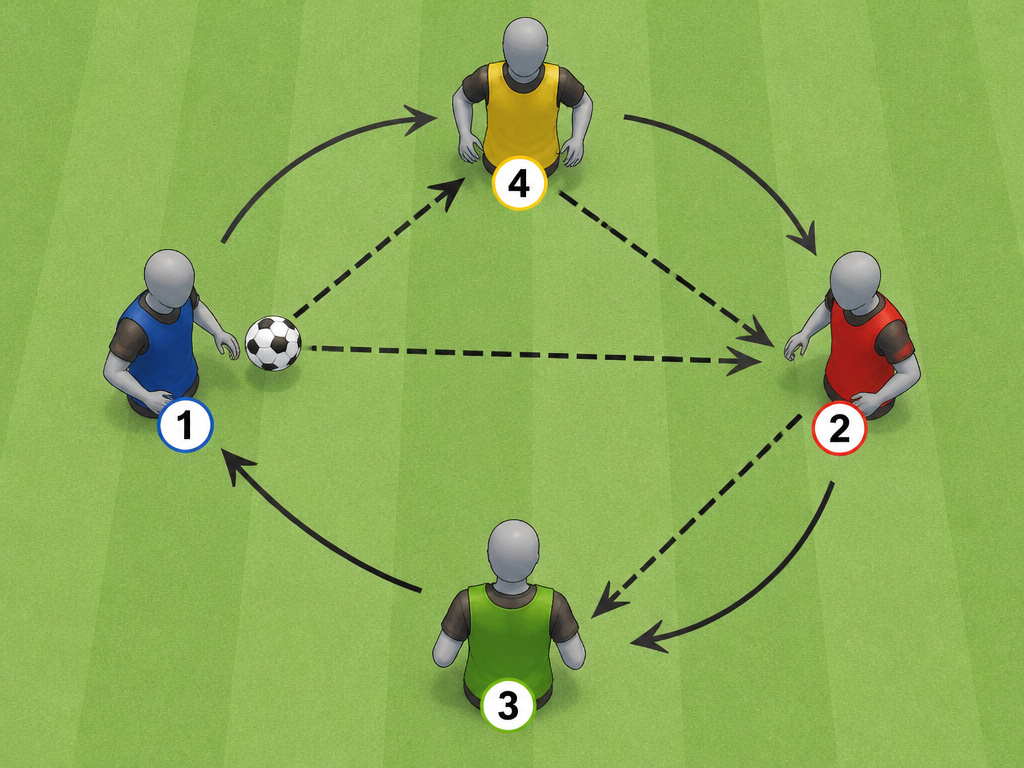
Small-group management is about flow. If one player is a permanent defender in a rondo, they’re not training. If target players stay static, they disengage.
The rule is to rotate any specialised role frequently to prevent disengagement and distribute workload. In the 3v3 + targets activity, CRYSA notes you should rotate the target player every few minutes. If you have a group of 5, use 2 target players. This isn’t just about fairness; it’s about exposure. Every player needs to feel the pressure of being a defender and the puzzle of being a target.
For structured passing drills with fixed patterns, rotate positions after each completed sequence. Player A passes and moves to B’s spot. B moves to C’s spot. It keeps the drill moving and ingrains movement after passing.
Rotating players between positions is the most effective means to achieving a high volume speed metric outcome for all players.
That’s from FIFA’s speed coordination guide. It’s not a suggestion.
Equipment & Space Modifications for Any Environment

You’re in a car park. Or a cramped indoor hall. The cones are in the shed. Here’s how to adapt.
For Minimal Equipment:
- Use water bottles, jumpers, or bags as markers.
- A single ball is fine for most technical circuits and rondos.
- Use bibs or other markers to designate goals or zones.
For Extremely Limited Space:
- Use 1v1 or 2v2 formats.
- Create two parallel, identical stations to split the group.
- Reduce grid sizes further. A rondo can work in a smaller space than the recommended 10×10 yards.
The Safety Check:
Always leave a small safety gap between parallel drill stations. A stray pass should not roll into another active area. On hard indoor surfaces, ensure markers are safe and won’t cause slips.
Remember, the objective isn’t to replicate a full-pitch game. It’s to maximise touches and decisions. A drill for close ball control in a 6×6 yard box with three players is more valuable than a full-sized shooting practice with one goalkeeper and a queue of ten.
Finishing and Shooting Drills for Small Groups
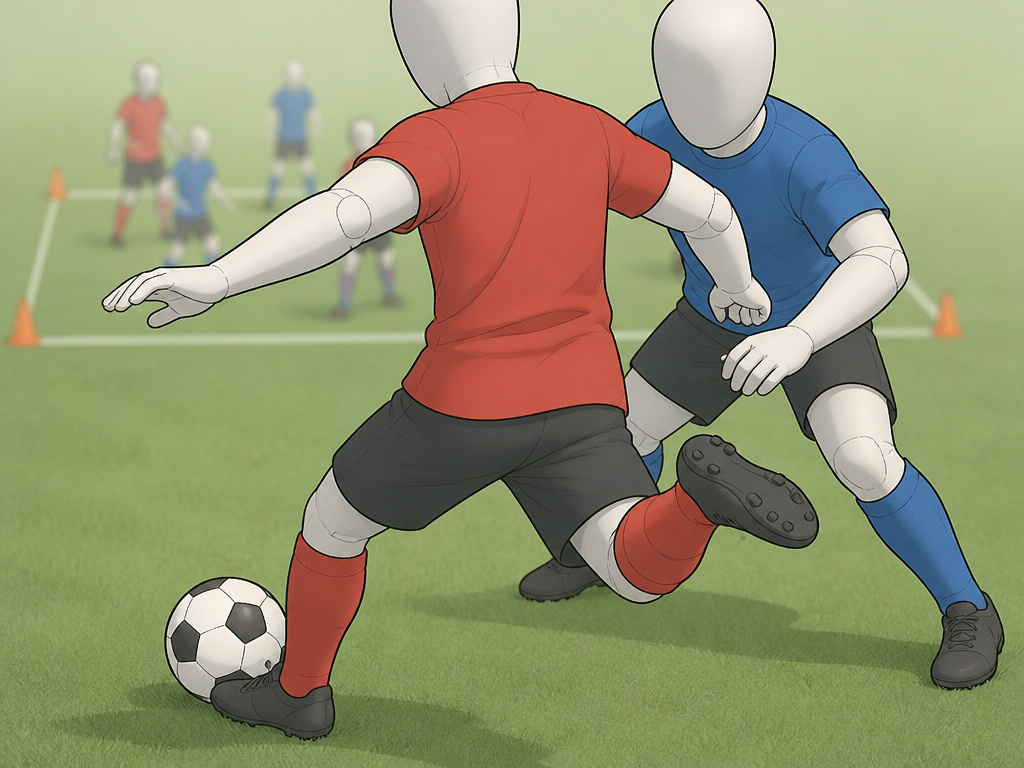
Create game-like pressure for your finishers. Use 1v1 games in tight grids where the attacker must protect the ball and shoot quickly, encouraging them to use their body to shield. For slightly larger groups, set up a 4v4+1 small-sided game focused on creating chances from the midfield third. The offside rule applies here, forcing attackers to time their runs. In any shooting drill, the key is repetition under pressure. Use short, intense rounds and rotate players through the striker role so everyone practices the final action in a crowded, competitive space.
Frequently Asked Questions
What are the best soccer drills for 3 players?
The best drills for three players are technical activation circuits with a coach or server feeding the ball. FIFA’s model uses a 15x15m grid with 2-minute drills that emphasise one-touch passing, movement after passing, and constant scanning. A simple three-player passing triangle, with sides of 7-9 yards, where players pass and immediately move to the next cone, is a common small-group drill.
How long should a small-group football practice last?
Complete, intensive small-group practice should last approximately 60 minutes. This is based on a model session that fits eight different activities into that window, each lasting 6-8 minutes with quick transitions. The short duration of each block is part of the session structure.
Can you work on fitness with small-group drills?
Absolutely. In fact, small-group drills are often more physically demanding than large-group running. The constant involvement, short rest periods, and high number of accelerations and decelerations in tight spaces provide excellent conditioning. FIFA notes that fewer players in a circuit leads to greater overall workload intensity.
How do I make drills competitive with few players?
Introduce scoring and consequences. Use timed games like the 2-minute ‘Striker Wars’ 1v1 battle. In possession drills, award points to maintain competition. Always keep score, even if it’s just tally marks on a whiteboard. Competition drives intensity.
Are small-sided games better than drills for small groups?
For developing game intelligence, yes. Small-sided formats present problems that drills cannot replicate—real opposition, transition, and decision-making under pressure. Drills build technique; small-sided games teach players how to apply it. A session should blend both.
Before You Go
The real test of a small-group session isn’t the drill sheet. It’s the sound. Listen for the constant tap-tap-tap of one-touch passes, the sharp shout of a defender organising, the thud of a block in a 1v1, and the quick, gasped breaths during a 60-second water break. If you hear long silences or casual conversation, your timers are too long or your rotations are broken.
Start with the 60-minute blueprint. Stick to the grid sizes. Enforce the rotations. The structure seems rigid, but within it, players find the freedom to solve problems. That’s where the learning happens—not in the queue, but in the scramble.
