
Small Sided Games in Football Explained: How to Choose
This post contains affiliate links. As an Amazon Associate, we earn from qualifying purchases.
Small-sided games in football are modified matches played with fewer players on a smaller pitch than the standard 11v11 game. They are a foundational tool for player development, increasing touches, decision-making, and game-like intensity. Formats range from standardized youth matches (like 4v4 for U8s) to flexible training constraints (like 5v5 with floaters) used by elite academies to target specific physiological and technical outcomes.
That definition covers the what, but the real story is in the why and the how. The gap between a chaotic kickabout and a purpose-built training tool is the design of the game itself, which is what small sided games in football explained truly gets into.
What follows is a breakdown of the mechanics: the proven benefits, the key variables coaches manipulate, the split between grassroots rules and elite training, and how to avoid the common mistakes that turn a great tool into wasted time.
Key Takeaways
- Small-sided games increase individual involvement, with studies showing they boost touches, passes, dribbles, and tackles per player compared to 11v11.
- Sources disagree on the critical design variable: US Youth Soccer provides standardized absolute pitch dimensions for youth play, while the LJMU consensus statement emphasizes relative Area per Player (ApP) as a key variable for shaping training demands in elite contexts.
- Sources reflect different focuses: US Youth Soccer provides standardized rules and fixed dimensions for broad youth implementation, while the LJMU consensus statement analyzes SSGs as a flexible training tool for elite development where constraints are intentionally manipulated.
- Randomize teams and formats within a session. Playing the same 5v5 every week teaches players to solve only one specific puzzle.
- The biggest mistake is over-coaching and stopping the flow. Canada Soccer’s guide advises letting kids experience the game’s ‘flow’; constant interruption kills the learning environment.
What Exactly Is a Small-Sided Game?
Rewind for a moment. Forget the complex diagrams. A small-sided game (SSG) is, at its heart, football returned to its roots. It’s the street football, the park kickabout, the lunchtime game where you played 3-a-side and used jumpers for goalposts.
The formal definition from the LJMU SSG implementation consensus statement calls them “game-based drills coaches use to replicate multiple match-play scenarios by manipulating the number of players, pitch size, game rules, and/or other constraints.” US Youth Soccer simply says they are “games played on smaller fields and with fewer players than the adult game of 11 versus 11.”
Small-sided games are not just scaled-down football. They are a distinct training modality where constraints, player numbers, space, rules, are intentionally designed to amplify specific learning opportunities, from technical repetition to tactical problem-solving.
This is where most guides stop. They’ll list 4v4, 5v5, 7v7 as examples and move on, which is precisely what a small sided games in football explained article should avoid. But that misses the fundamental split in how SSGs are actually used in the wild. You have two parallel worlds operating under the same name.
World One: The Grassroots Standard. Here, SSGs are the actual format of competition. Governing bodies like US Youth Soccer mandate them for age groups. For U6-U8, that means games on a maximum field of 35 yards by 25 yards, with a size 3 ball and a 4ft by 6ft goal. For U12, it’s 7v7 (6 field players + 1 keeper) on a 65×45 yard pitch. The rules are fixed to create a consistent, age-appropriate environment for millions of kids. The goal is broad participation and foundational fun.
World Two: The Elite Training Tool. In academies and professional setups, SSGs are a flexible framework for training. The coach is a designer, manipulating levers to stress specific physical or tactical systems. The same LJMU consensus statement notes coaches can change the pitch shape (rectangle vs. Diamond), add “floaters” (players who are always on the attacking team), impose touch limits, or create numerical imbalances (like 5v4). The goal here is targeted adaptation, not standardized play.
If you’re a parent or a new grassroots coach, you live in World One. Your club will provide the rules for 5-a-side or 7-a-side football. If you’re coaching at a competitive level, you operate in World Two. You’re not just running a 5v5; you’re engineering a 5v5 with a specific ApP and a neutral player to encourage overloads. Understanding which world you’re in is the first step to using the tool correctly.
The Core Benefits: Why SSGs Are Non-Negotiable
The research is not subtle on this. Canada Soccer, citing studies by Ford et al. (2010) and Hill-Haas et al. (2011), states SSGs “increase the number of ball touches, successful passes, dribbles, and goal-scoring opportunities per player,” a core benefit that any good small sided games in football explained guide will highlight. A Frontiers review on pitch size effects confirms that manipulating space directly alters technical and physical outputs.
But listing “more touches” is commodity content. Every article says that. The non-commodity insight is how these benefits manifest and what they actually displace.
Think about a standard 11v11 practice match for a youth team. Two or three technically gifted players dominate the ball. The less confident kids hide, making fewer decisions, touching the ball maybe a dozen times in an hour. They learn to spectate. In a 4v4 game, there is nowhere to hide. The game finds you. The benefits of small-sided football for youth are not just additive; they are corrective. They force involvement.
The benefits break down into four pillars:
- Technical Density: More actions per minute. The ball is always close. A bad first touch is immediately pressured. A successful dribble instantly creates a chance. This frequency accelerates skill acquisition far faster than isolated drills for small groups.
- Tactical Clarity: With fewer players, the “problems” the game presents are simpler. In a 3v3, your options when you receive the ball are: pass to one of two teammates, dribble, or shoot. That’s it. This reduces cognitive overload, allowing young players to actually see and execute solutions.
- Physical Appropriateness: Smaller pitches match younger players’ stamina and speed. A full-sized pitch for an 8-year-old is a marathon; they spend energy just covering space. A 35×25 yard grid creates a game where they can sprint, recover, and stay engaged.
- Psychological Safety & Success: Canada Soccer notes SSGs “boost self-esteem through frequent success.” Scoring chances happen every minute. Every player gets to be the hero who scores or makes a tackle. This positive feedback loop is the engine of long-term engagement.
Common mistake: Using SSGs solely for fitness. While they provide a great conditioning stimulus, using them only as a conditioning drill wastes their primary value as a decision-making crucible. The players stop playing and start surviving.
The Coach’s Toolkit: Key Variables to Manipulate
This is where coaching becomes design. You are not just throwing down cones and saying “play.” You are assembling a learning environment. The LJMU SSG framework document provides a clear menu of elements a coach can change. Your choices here dictate what the players learn.
| Variable | What It Is | What It Influences |
|---|---|---|
| Player Numbers | Total players & team size (e.g., 4v4, 5v2, 7v7). | Decision speed, passing options, defensive compactness. Fewer players = more individual responsibility. |
| Pitch Dimensions | Absolute size (e.g., 30x20m) and Relative Area per Player (ApP). | ApP is the master variable. More space per player increases sprinting, encourages possession. Less space increases pressing, quick passing. |
| Pitch Shape | Rectangle, square, long/thin, wide/short. | Channels play. A long, thin pitch encourages vertical passes; a wide pitch encourages switches of play. |
| Game Format | Directional (score in goals), Non-directional (possession), Mixed. | Player mindset. Directional games replicate match intensity. Possession games build comfort under pressure. |
| Rules | Touch limits, mandatory passes, offside, goalkeepers. | Forces specific behaviors. A two-touch rule forces scanning before receiving. No goalkeepers encourages finishing from distance. |
| Numerical Imbalance | Uneven teams (e.g., 5v4, 6v3). | Creates specific overload scenarios to teach defensive cover or attacking exploitation. |
The most important concept here, and the one most grassroots guides miss, is Area per Player (ApP). Governing bodies publish absolute dimensions (e.g., 65×45 yards for U12). But for training design, the relative space is what matters. For example, a 5v5 game in a given area creates a specific Area per Player (ApP) that influences the game’s demands. Reducing the pitch size for the same number of players significantly decreases the Area per Player (ApP). The first game will have more long sprints and longer passes. The second will be a tight, pressing, one-touch firefight.
A Journal of Human Kinetics study noted that “maximal sprint exposure is rarely achieved unless pitch dimensions exceed ~300–365 m² per player.” If you want to train high-speed running, you need to give players the space to actually reach top speed. This is the kind of specific, sourced insight that separates a designed session from a random game.
From Grassroots to Elite: Adapting SSGs by Age and Level
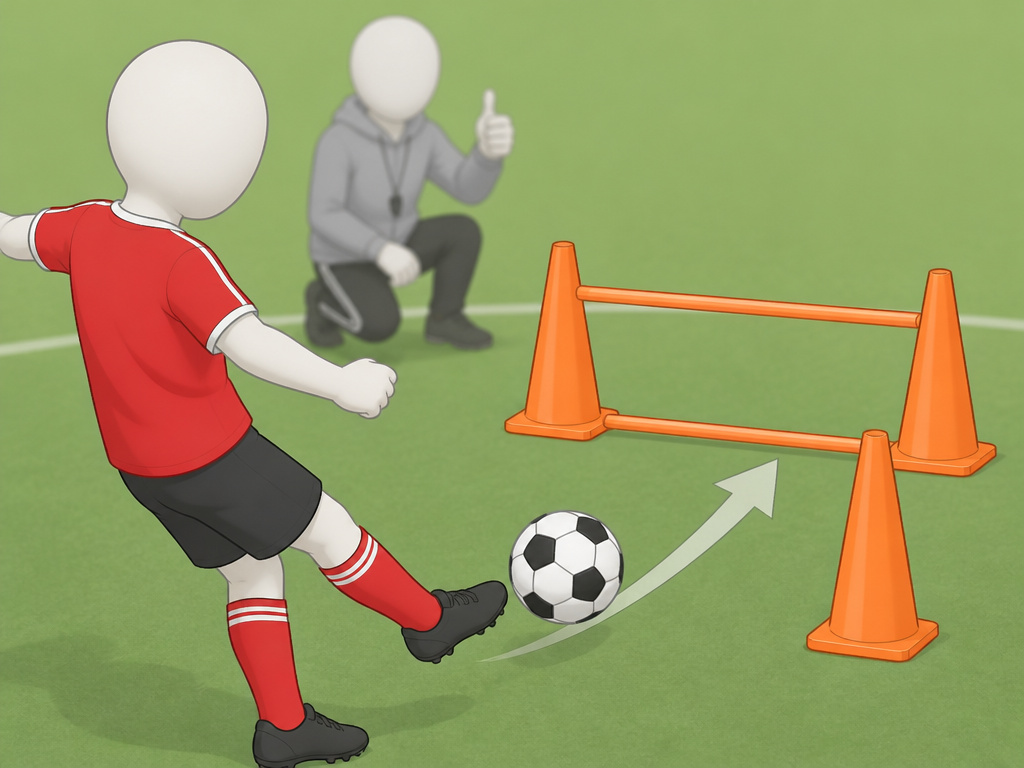
Your approach must fit your context. The muddy Saturday morning pitch for seven-year-olds and the pristine academy training ground demand different playbooks.
For Young Children (U6-U10): Keep It Simple, Safe, and Flowing.
The priority is joy and fundamental exposure. Use the standardized small-sided formats for kids. US Youth Soccer even states that for U6, “manufactured goals are not mandatory; clubs can use cones, pop-up goals, or other items.” The center circle and corner arcs aren’t required either. The point is to remove friction.
Canada Soccer’s guide offers golden rules for this age: “Ensure players get to play a match every session,” and “Try not to stop the game too often, because children want to experience the ‘flow’ of the game.” Your job is to set up the small soccer goals, balance the teams, and let them play. Coach in the flow with positive, specific feedback (“Great turn to find space, Alex!”), not lengthy stoppages.
For Youth Players (U11-U16): Introduce Complexity and Competition.
Here, SSGs can start to target specific tactical concepts. You can move from basic 7v7 to more nuanced formats. This is where understanding formations for 7v7 and 9v9 formations becomes valuable. You might design a 6v6 game with two wide zones that only wingers can enter, to teach isolation and 1v1 play. Or a 5v5 game where a goal only counts if it follows a sequence of three consecutive passes, building possession patterns.
Rotate groups constantly. As Canada Soccer advises, this “encourages adaptability, builds more chemistry, and helps players learn to communicate and collaborate with a wider range of peers.” The kid who always plays with his best friend in defense never learns to organize a new partner.
For Elite/Advanced Players: Precision Engineering.
This is World Two. SSGs are your laboratory. You might use a 4v4+2 (with two neutral “floaters”) to work on pressing triggers in a midfield block. The floaters always play for the team in possession, creating a permanent 6v4 overload and forcing the defending four to coordinate their press perfectly. For elite training, coaches might design a 5v5 game on a large pitch to train endurance and transitions, and a 5v5 game on a very small pitch to train quick combination play under pressure.
The NCBI review of soccer SSGs and the PLOS One umbrella review of SSG research provide the evidence base for these manipulations, showing how each variable shifts physiological and technical outputs.
Common Pitfalls and How to Avoid Them
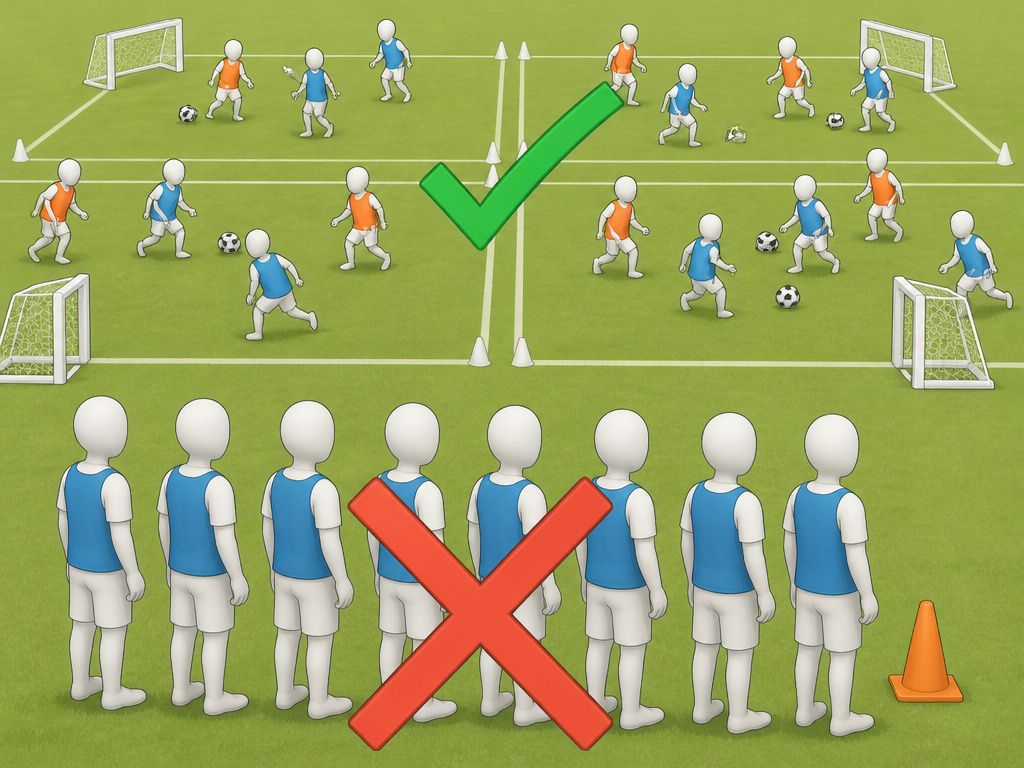
Good intentions aren’t enough. I’ve watched, and run, sessions where SSGs became a waste of time because of a few avoidable errors.
Pitfall 1: The Queue of Death.
This is the classic “drill” masquerading as an SSG. You see it all the time: a line of eight players behind a cone, waiting to attack a 1v1 against a single defender. One player is active; seven are stationary. This is the antithesis of a small-sided game. It teaches nothing about support, movement off the ball, or defensive shape. The fix is simple: add players. Turn it into a 2v2 or 3v3 continuous game. If you have 16 players, run four simultaneous 4v4 games, not two lines of eight.
Pitfall 2: Over-Coaching the Flow.
You blow the whistle every 20 seconds to make a coaching point. The game has no rhythm. Players stop trying creative solutions because they know the whistle is coming. Remember Canada Soccer’s advice: let them play. Give the coaching point between games, or better yet, design the game so the constraint itself teaches the lesson. If you want more through balls, make the pitch longer and narrower. Don’t just shout “play the through ball!” every minute.
Pitfall 3: Stagnant Teams and Formats.
Playing the same 5v5 with the same teams every week is a recipe for stale development. Players learn to beat their specific opponents, not to solve football problems. The LJMU consensus statement warns that “relying on a single task is unlikely to foster the simultaneous advancement of multiple technical and tactical skills.” Mix it up. Play 3v3, then 4v4, then 5v2 overload. Change the teams every game. Add a rule where a goal from a first-time finish counts double.
Pitfall 4: Ignoring the Score.
Football is a game of objectives. If there’s no goal to attack or defend, intensity drops. Always have a clear scoring system, even in possession games (“10 consecutive passes equals a goal”). It engages the competitive instinct and replicates match pressure. This principle is just as true in indoor football rules and the core rules of futsal, where the fast-paced, high-scoring nature is part of the design.
Integrating SSGs into a Complete Session
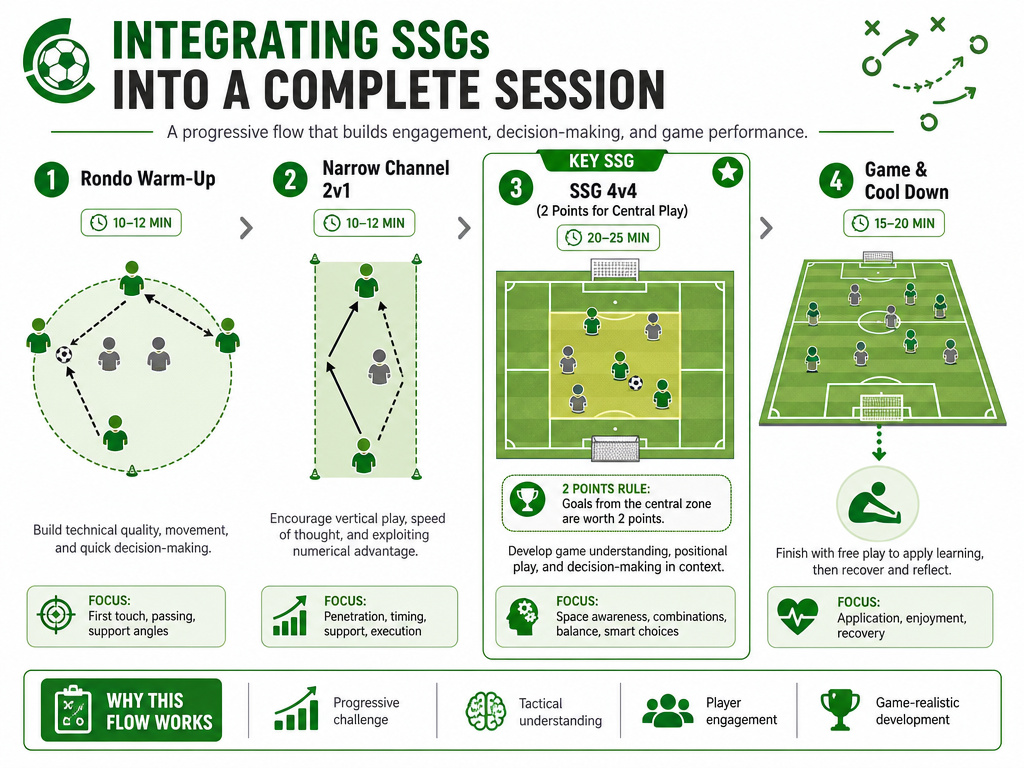
An SSG shouldn’t be an island. It should connect to your session’s theme. Here’s a simple, effective structure for a 90-minute youth session with a theme of “quick combination play in tight spaces.”
- Warm-up (15 min): Dynamic movement followed by a high-tempo rondo (5v2 in a 10x10m square). This immediately gets players passing and moving under pressure, setting the psychological and technical tone.
- Technical Practice (20 min): A 2v1 overload exercise in a narrow channel, focusing on the give-and-go pass. Isolate the skill you want to see in the game.
- Small-Sided Game (40 min): This is the main course. Set up a 4v4 tournament in a 30x20m area (a small ApP to encourage tight play). Rule: a goal is worth 2 points if it follows a one-touch pass. Don’t stop play. Observe. Between 6-minute games, give one simple feedback point (“Look for the wall pass!”).
- Conditioned Game/Cool-down (15 min): Finish with a less constrained 7v7 game on a slightly bigger pitch, asking players to focus on the theme. Follow with a gentle cool-down.
It also provides a natural home for working on specific 5-a-side formations or tactics for 5-a-side within a broader plan.
The Roots of Small-Sided Games
While the fact sheet doesn’t provide historical quotes, the philosophy behind small-sided games is timeless. It’s a return to the game’s informal origins, mirroring the street football and park kickabouts where the sport was first enjoyed. This child-centered approach, where play is not overly controlled by the coach, prioritizes engagement and the natural flow of the game. The modern framework views these games as a flexible training tool, allowing coaches to manipulate constraints to create specific learning scenarios, moving beyond rigid formats to foster adaptable, intelligent players.
Frequently Asked Questions
What are small-sided games in football?
They are modified football matches played with fewer than 11 players per side on a proportionally smaller pitch. They range from standardized youth formats (like 4v4 for young children) to flexible training tools used by elite coaches to develop specific technical, tactical, and physical attributes.
What is not a benefit of using small-sided games?
The main thing SSGs do not provide is authentic experience in the full 11v11 match structure, specifically, the positional specialization, complex phase transitions, and extreme stamina demands of the full-sized game. They are a developmental tool to build components of that game, not a perfect replica. They can also be poorly designed, leading to chaos if constraints aren’t clear.
What’s the difference between SSGs and conditioned games?
The terms are often used interchangeably, but there’s a nuance. “Small-sided games” typically refers to the player numbers and pitch size. “Conditioned games” can include those, but also refers to adding specific rules (like touch limits, mandatory switches of play) to any game format, including 11v11. All SSGs are conditioned games, but not all conditioned games are small-sided.
How do I choose the right player numbers?
Follow governing body guidelines for youth league play (e.g., 4v4 for U8, 7v7 for U12). For training, start with even numbers (4v4, 5v5, 6v6) for balanced play. Use uneven numbers (5v4, 6v3) specifically to train overload scenarios, attacking with a man-advantage or defending when outnumbered.
Can SSGs improve fitness?
Absolutely. Research on SSGs confirms they impose varied acute physiological demands. By manipulating the Area per Player and game duration, coaches can use SSGs for high-intensity interval training, improving aerobic and anaerobic capacity in a sport-specific context. However, using them solely for fitness wastes their superior value for technical-tactical learning.
The Bottom Line
Small-sided games are the closest thing football has to a universal teaching tool. For the kid on a muddy park pitch, they are the game itself. For the academy coach, they are a set of dials to tune the training stimulus. The magic isn’t in just playing 5-a-side; it’s in understanding why you’re playing this specific 5-a-side.
The rule of thumb is this: if your players are waiting in lines, you’re not running a small-sided game. If they’re all moving, thinking, and solving problems in a game with goals, you are. Start with the standardized formats, respect the flow of the game, and then, as you grow, begin to manipulate the constraints with purpose. That’s when you stop just running drills and start building players.
