
Small Sided Football for Kids Explained
This post contains affiliate links. As an Amazon Associate, we earn from qualifying purchases.
Small sided football for kids is a modified version of the full 11v11 game, played with fewer players on a smaller pitch. National governing bodies mandate it for children under 13 because it drastically increases each player’s touches, decisions, and involvement, accelerating skill development and keeping the game fun. The formats progress from 3v3 (for U6-U7 in BC Soccer) or 4v4 (for U8 in US Youth Soccer and U8-U9 in BC Soccer) for the youngest players up to 9v9.
That core idea, fewer players, smaller space, isn’t just a scaling exercise. It rebuilds the entire game around what a child can actually see, process, and physically do. On a full-sized pitch, a ten-year-old midfielder might get few touches. In a 7v7 game, the number of touches increases significantly. This is the essence of small sided football for kids explained. The game stops being a distant spectacle and starts happening at their feet.
What follows is the practical guide that top search results often skip: the exact player numbers, the pitch dimensions, the simple rule modifications, and the why behind each one. By the end, you’ll be able to look at any youth setup and know whether it’s giving kids the game they need.
Key Takeaways
- Small sided football is mandatory for children in specific age groups in many nations: the Football Association of Wales mandates it for children under 13, BC Soccer for age groups U13 and below, and US Youth Soccer for players 12 and younger.
- The progression varies by association: for example, BC Soccer specifies 3v3 for U6-U7, 4v4 or 5v5 (with GK) for U8-U9, 7v7 for U10-U11, and 9v9 for U12-U13, while US Youth Soccer recommends 4v4 for ages 5-8 and 7v7 for 9-10 year olds.
- A “Game Leader” or facilitator often replaces a formal referee for the youngest age groups, focusing on keeping the game flowing and explaining rules as they happen.
- Equal playing time is a priority. Substitutions can happen at any time, and the focus is on participation and skill-building over results.
- Header restrictions are strict: no heading at all for players 10 or younger in matches and training, with limited, controlled introduction only after age 11.
Why Small Sided Football Works
Picture a standard youth match from twenty years ago: twenty-two kids on a vast, echoing pitch, the ball ping-ponging between the two biggest players, and at least half the children barely involved. That was the norm. It was also, as every major football association now agrees, completely backwards.
The shift to small-sided formats flips that script. By reducing the number of players and the size of the pitch, you increase the density of action. A child is never more than a few seconds from the ball. This isn’t a theory; it’s a measurable outcome documented in development guides from Canada Soccer to the FAW. More touches mean more practice. More decisions, pass, dribble, shoot, happen in a simpler environment, so the learning sticks.
Small-sided games are widely recognized as a powerful tool for player development. They provide more touches, more decision-making opportunities, and a greater sense of involvement for every player on the field. – Canada Soccer Grassroots Standards
The benefits cascade. With fewer “lines of interaction” on the pitch, the basic tactical pictures, 1v1, 2v1, supporting a teammate, become clear. A child can see the whole game. They understand that their pass created a chance, or that their positioning closed down an attack. That direct feedback loop builds confidence and a genuine love for the game far faster than waiting for a rare moment in an 11v11 mismatch.
Age and Format Progression: The Official Roadmap
You don’t teach calculus before arithmetic. Small sided football for kids explained applies the same logic, scaling up the game’s complexity in step with a child’s capabilities. Different national bodies have slightly different models, but the progression is remarkably consistent.
The Football Association of Wales is the most absolute: small-sided football is “the only form of football in Wales for children under 13 years of age.” BC Soccer applies its small-sided rules to “age groups of U13 and below.” US Youth Soccer defines its “Zone 1” as all players 12 and younger. The message is unified: the full 11v11 game is an adult format, and children need a version built for them.
Here’s how that looks on the ground, using the detailed specifications from BC Soccer and US Youth Soccer as a benchmark.
| Age Group | Typical Format | Field Size (Approx.) | Key Equipment |
|---|---|---|---|
| U6 – U7 | 3v3 (no GK) | 25-30m long x 18-22m wide | Size 3 ball, small pop-up goals |
| U8 – U9 | 4v4 or 5v5 (GK optional) | 30-36m long x 25-30m wide | Size 3 ball, 4x6ft goals |
| U10 – U11 | 7v7 | 40-55m long x 30-36m wide | Size 4 ball, 6x18ft goals |
| U12 – U13 | 9v9 | 65-75m long x 45-55m wide | Size 4 ball, 6x18ft goals (per US Youth Soccer) |
This table is your starting point. Notice the ball size increases with age and strength. The goals grow proportionally. The pitch expands to introduce the concepts of width and depth gradually.
Where this goes sideways: Sticking a 9-year-old in a permanent position. At this age, they should experience the game from everywhere. A season at full-back teaches a child what a winger actually needs, lessons that last a lifetime.
The one notable disagreement between federations is at the U8-U9 level: to use a goalkeeper or not? BC Soccer’s rules include the option for a 5v5 format with a goalkeeper. The US Youth Soccer manual, however, recommends 4v4 or 3v3 with no dedicated keeper for U8, arguing it encourages all players to attack and defend. My stance leans toward the no-keeper model for the youngest groups, it removes the temptation to just boot the ball downfield and forces everyone to engage.
The Simple Rules That Make It Work
The laws of the game are simplified, but they’re not absent, a key point in small sided football for kids explained. They’re stripped back to the essentials a child can grasp and apply. Forget offside traps and complex restart procedures. The focus is on flow, safety, and understanding.
First, the official in charge is often not a referee in the traditional sense. For the under-11 age group and below, the FAW specifies a “game leader” who supervises from the touchline, a role similar to Football Australia’s ‘Game Leader’. Football Australia’s MiniRoos handbook describes this role perfectly: to “facilitate the development of the players, keep the game moving fluently, limit stoppages and assist players with all re-starts.” The whistle is a teaching tool, not a judicial gavel. A formal referee is introduced at the under-12 age group in some systems, like the FAW’s, while other systems like BC Soccer’s may use a nominated official if both teams agree.
The rules are simple and as near to real football as possible. A game leader… Must supervise the game from the touchline for the under 11 age group and below… No person should be officiating the game on the pitch. – Football Association of Wales Small Sided Regulations
Here are the core modifications you’ll see across almost all small-sided frameworks:
- No Offside. This is the biggest and most important change. It opens up the game, prevents constant stoppages, and lets children learn to attack space naturally.
- Retreat or Build-Out Lines. For younger age groups (U6-U11), you’ll often see a line marked across the pitch. When the goalkeeper has the ball, opponents must retreat behind this line, giving the defending team space to play out rather than just hoof it.
- Simple Restarts. Throw-ins are often replaced with kick-ins or pass-ins to keep the ball moving. Goals are usually restarted with a pass from the centre spot, with opponents 5 metres away.
- Unlimited Substitutions. Players can rotate on and off at any time, usually while the ball is in play. This is essential for maintaining energy and ensuring equal playing time.
- Ball-In-Play Condition. BC Soccer includes a specific rule you won’t find in the senior laws: “The ball must not be torn, water-logged, or in a condition which could endanger players.” It’s a grassroots reality check.
These rules exist for one reason: to maximise time spent playing football. Every modification cuts out a delay, simplifies a decision, or removes a barrier to participation.
Safety and Responsibility: The Non-Negotiables
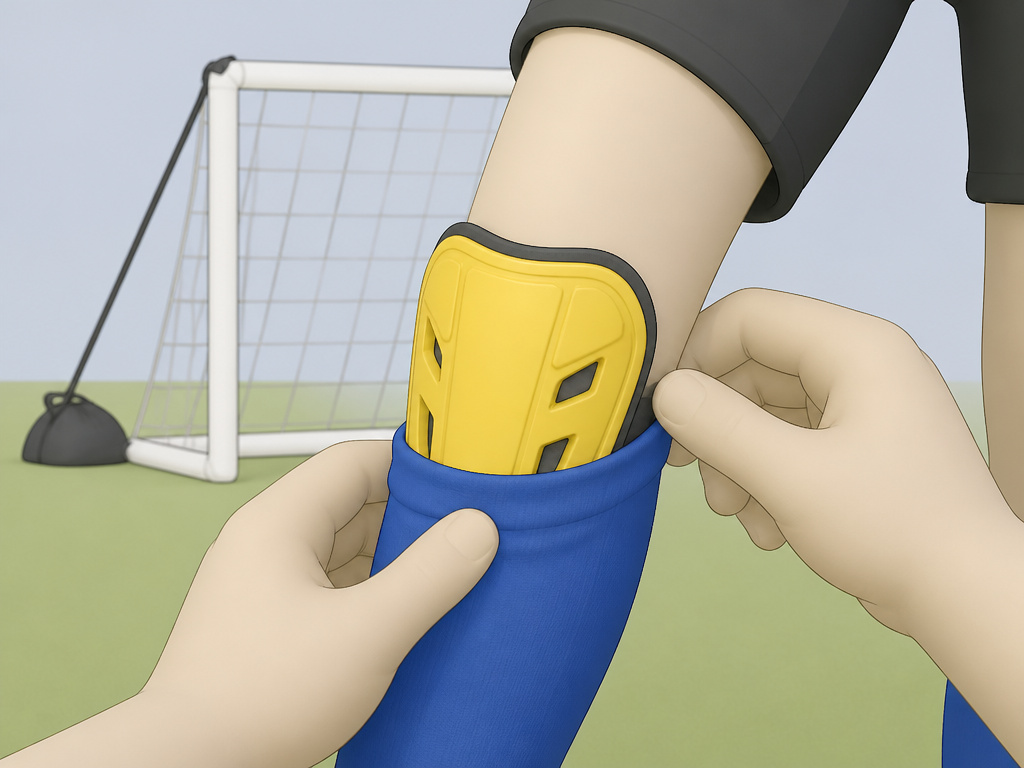
This is youth sport, so safety and duty of care are the foundation everything else is built on. The rules here are explicit and uncompromising.
The most prominent safety rule concerns heading. Based on concussion research, US Youth Soccer’s policy is definitive: no headers for players 10 or younger in matches and training. The skill isn’t even introduced until age 11, and even then, practice is strictly limited to no more than 30 minutes of heading training per week, with a maximum of 20 headers per player. This is a medical guideline, not a coaching preference.
Other mandatory safety protocols are just as clear:
- Shin guards must be worn by all players without exception. (Football Australia)
- Any player bleeding must leave the field and can only return when the bleeding has stopped and the official signals. (BC Soccer)
- Portable goals must be securely anchored to the ground with sandbags or pegs.
The responsibility extends to the adults on the touchline. The FAW mandates that each age-group squad has at least one qualified coach (minimum FAW Football Leaders Award) and that all coaches must have a valid, FAW-approved Enhanced DBS Check. Also, a player may only participate in one team per match day to prevent overload and protect welfare. This structured, professional approach is what separates a safe development environment from a chaotic kickabout.
Equipment and Setup: What You Actually Need

You don’t need a stadium. One of the beauties of small-sided football is how accessible it is. The equipment list is short, but getting the right specs matters.
The Pitch: You can use any flat, grassy space. Cones or painted lines work for markings. The dimensions in the table above are your guide. For a U8 4v4 game, a 30×36 metre pitch is a manageable size. It’s manageable.
Goals: For the youngest ages, small pop-up or portable soccer goals are perfect. As sizes increase, look for lightweight, collapsible goals that meet the size specifications (e.g., 4ft x 6ft for U8). The anchoring rule is critical, always weight them down.
The Ball: This is essential. Using the wrong size ball handicaps development. A size 3 ball is for U8 and below. A size 4 is for U9 up to about U13. The right ball size by age allows for proper technique. Brands like Mitre and Select make excellent, durable balls suitable for youth footballs training and matches.
Player Kit: Comfortable sportswear, football boots (moulded studs for grass), and those mandatory shin guards. That’s it.
The setup is simple because the focus should be on the play, not the peripherals. A few cones, a correctly sized ball, and a safe space are all you need to run a session that beats any structured drill for development.
Coaching a Small Sided Game: The Mindset Shift
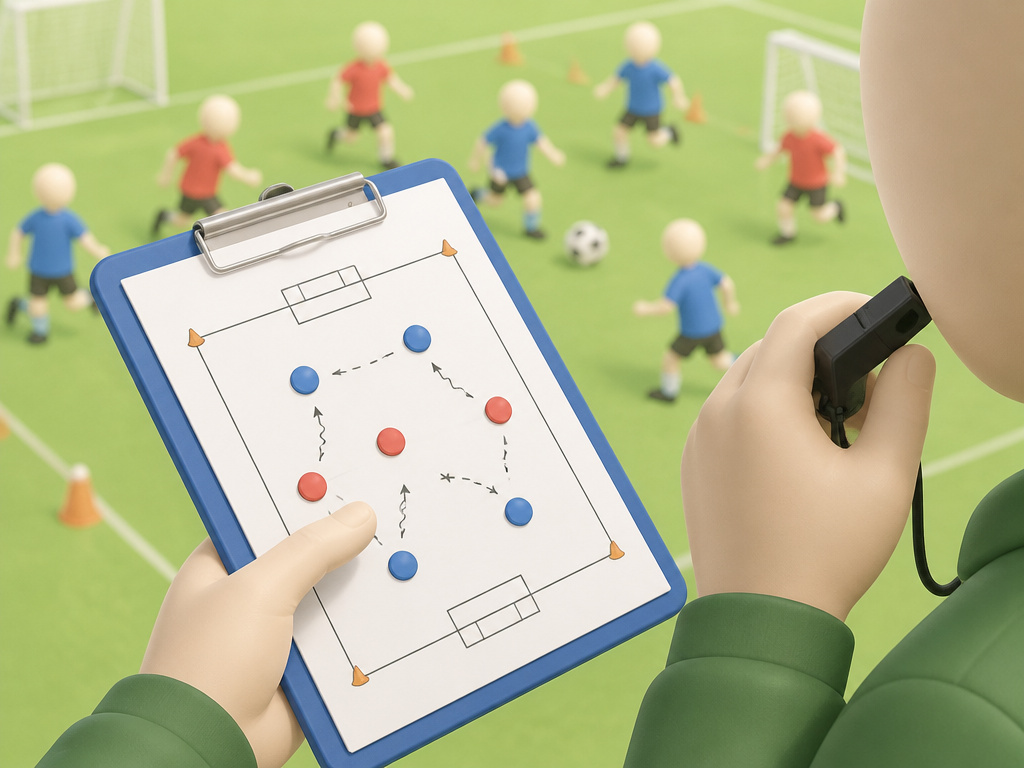
If you’re used to coaching or watching the full game, stepping into a small-sided environment requires a mental reset. Your role changes from director to facilitator.
Your primary job is to set up the game and then let it happen. The small-sided format is the teacher. Instead of stopping play every minute to correct a positional error, let the game show the consequence. Did the defender get caught because they were too tight? The goal they conceded will teach that lesson more vividly than any lecture. Use the natural pauses, after a goal, when the ball goes out, for your 30-second interventions. “What could we have done differently there?”
Common mistake: Coaching from the second the whistle blows. The best learning happens when the kids are solving problems themselves. Your voice should be the quietest one on the pitch.
Embrace the chaos of rotating positions. This is where deep understanding grows. That fast child who always plays on the wing? Put them at centre-back for a half. They’ll learn about space behind them. The technical player in midfield? Let them have a stint up front to learn about playing with their back to goal. This philosophy of rotation is central to developing intelligent players and is a cornerstone of modern managing playing time fairly.
Your session plans should be simple. One or two small-group drills to warm up and introduce a theme (e.g., passing and moving), followed by a long block of conditioned small-sided games (e.g., 4v4 with two-touch passing). The game is the main course.
Frequently Asked Questions
What’s the difference between small sided football and futsal?
Futsal is a specific, codified indoor sport played with a smaller, low-bounce ball on a hard court. Small sided football is a broader term for any reduced-format football played outdoors on grass or artificial turf, following adapted versions of the regular laws. Futsal is fantastic for technical development, but small-sided football is the direct pathway to the 11v11 game.
Won’t kids be unprepared for 11v11 if they only play small sided games?
The opposite is true. The official USYS small-sided games manual frames it as a “developmentally appropriate environment.” Small-sided games teach the core technical and tactical skills, first touch, passing, decision-making, spatial awareness, at a higher repetition rate. By the time they graduate to the full pitch at U13/U14, they have a robust skill set and a better understanding of the game’s principles, which they can then apply to the larger space.
How do I find small sided leagues or programs for my child?
Check with your local football club or county football association. Most youth clubs now structure their youngest age groups around small-sided formats. You can also look for “Mini Soccer” (UK), “MiniRoos” (Australia), or “Small Sided Games” programs, which are often non-competitive festivals focused on fun and participation.
Are there winners and losers in small sided football?
For the youngest age groups (U6-U11), the focus should be on experience, not results. Many leagues organise festivals rather than competitive leagues. The FAW even mandates a non-competitive block for U13s in certain structures. The competitive element naturally increases as children get older and move to 9v9, but the primary measure of success should always be development and enjoyment.
Can I set up a small sided game in my backyard or local park?
Absolutely. This is how the game was meant to be played. Grab a few friends, some cones for goals, a size-appropriate ball, and you have a perfect development session. The informal, player-led nature of a park game often produces the most creative and joyful football. Just remember the 5-a-side rules for safety and flow.
The Bigger Picture
Small sided football is the essential first chapter of the game. It returns the sport to its roots, street football, the jumpers-for-goalposts spirit, but within a structured framework that actually teaches. The numbers from the federations prove it: more touches, more decisions, more smiles.
The real test of any youth system isn’t the trophy cabinet at U12. It’s how many players still love the game at U16, and how many have the technical foundation to express themselves on the pitch. The small-sided revolution, now enshrined in the policy documents of every major football nation, is designed to pass that test.
So when you see a cluster of kids on a mini-pitch, understand what you’re watching. You’re not seeing a simplified game. You’re seeing the game itself, distilled to its purest, most effective form for learning. Every pass, every tackle, every burst of joy is happening at the right scale. That’s how you build a footballer, and more importantly, a lifelong fan.
