
Football Age Groups Explained: U6 to U18 and Beyond
This post contains affiliate links. As an Amazon Associate, we earn from qualifying purchases.
*Youth football age groups are defined by a governing body’s specific cut-off date. A player’s age on that date, for example, August 31 for The FA in England, July 31 for US Youth Soccer, and December 31 for AYSO, determines their “U” designation for the entire season.* This system creates teams of players with similar physical development, which then dictates the pitch size, match duration, and number of players on the field.
That cut-off date is the single most important piece of information, and it’s where most of the confusion starts. A child born on September 1 in England is in a different academic year and a different football age group than a teammate born on August 31, even though they are just one day apart. The system of football age groups explained is based on this annual cut-off.
What follows is a walk through the core logic, the major governing bodies’ conflicting calendars, and the practical realities of formats and exceptions. By the end, you’ll be able to decode any club’s registration form and understand why the game looks so different from one age to the next.
Key Takeaways
- The “U” number is always one higher than the player’s age on the cut-off date. A child who is 6 on August 31 plays in the Under 7 (U7) age group for that season.
- Cut-off dates are absolute and vary by organization. The Football Association (FA) uses August 31, US Youth Soccer uses July 31, and AYSO uses December 31. You must check your league’s specific rules.
- From the 2026–27 season, FA formats shift: U7s play 3v3, and full 11v11 football now starts at Under 14, not Under 13.
- Playing up one age group is widely permitted, but playing down is heavily restricted, usually allowed only for girls in all-female teams or for players with disabilities via special dispensation.
- Small-sided formats (5v5, 7v7, 9v9) are not just scaled-down games; they are development tools designed to give young players more touches and decisions, which is why they are mandated for specific age bands.
The Universal Rule: What Does “U” Actually Mean?
“U10” does not mean “for 10-year-olds.” It means “under 10.” The number is a ceiling, not a target. The universal rule across every major football association is simple: take the child’s age on a specific cut-off date, then add one. That gives you their age group for the entire playing season.
A child who is 9 years old on the cut-off date plays in the Under 10 (U10) group. They will turn 10 during the season, but they remain a U10 player. This system groups children who were roughly the same age at the season’s start, creating a cohort for fair competition and development.
A youth player’s age group is determined by their age at a fixed point in the year, as defined by the governing body. This creates a season-long cohort for competition, with playing formats, such as 3v3, 7v7, or 11v11, tailored to the physical and cognitive development typical of that age band.
The logic of the football age groups explained is about creating a level field. The alternative, moving a child up an age group the day they have a birthday, would constantly reshuffle teams and create chaos. This one-date-fits-all approach is why you must know your league’s cut-off before you look at a birth certificate.
The Cut-Off Date Calendar Clash

This is where a single, global rule splinters into a dozen local ones. The date that matters is not universal. The three biggest systems in the English-speaking world all use a different day, which means a child born in early August could be in three different age groups depending on where they play.
| Governing Body | Age Cut-Off Date | Key Region/Note |
|---|---|---|
| The Football Association (FA) | August 31 (midnight) | England, mainstream grassroots football |
| US Youth Soccer (USYSA) | July 31 | United States, affiliated competitive clubs |
| American Youth Soccer Org (AYSO) | December 31 | United States, volunteer-led recreational leagues |
| Football Association of Wales (FAW) | August 31 (Academic year: Sept 1 – Aug 31) | Wales, aligns with school year |
| Western Australian CFA (WACFA) | Calendar year (e.g., for U6, child must be turning 5 in that year) | Western Australia, community football |
Look at a child born on August 15. In England (FA rules), they are judged on August 31. They might be U10. For a US Youth Soccer club using a July 31 cut-off, that same child was judged nearly a month earlier, so they’d be in the U11 bracket. Register them in an AYSO league, and the December 31 date puts them back into U10. There is no “correct” answer, only the rule your specific competition follows.
This clash in the football age groups explained is the source of most parental confusion. A club “going grade-based” is usually adopting an August or September cut-off to align teams with school classes. But these are still date rules, not grade rules. A child held back a year in school is still grouped by their birthday, which can awkwardly separate them from their classmates on the pitch.
From 3v3 to 11v11: How Age Groups Shape the Game
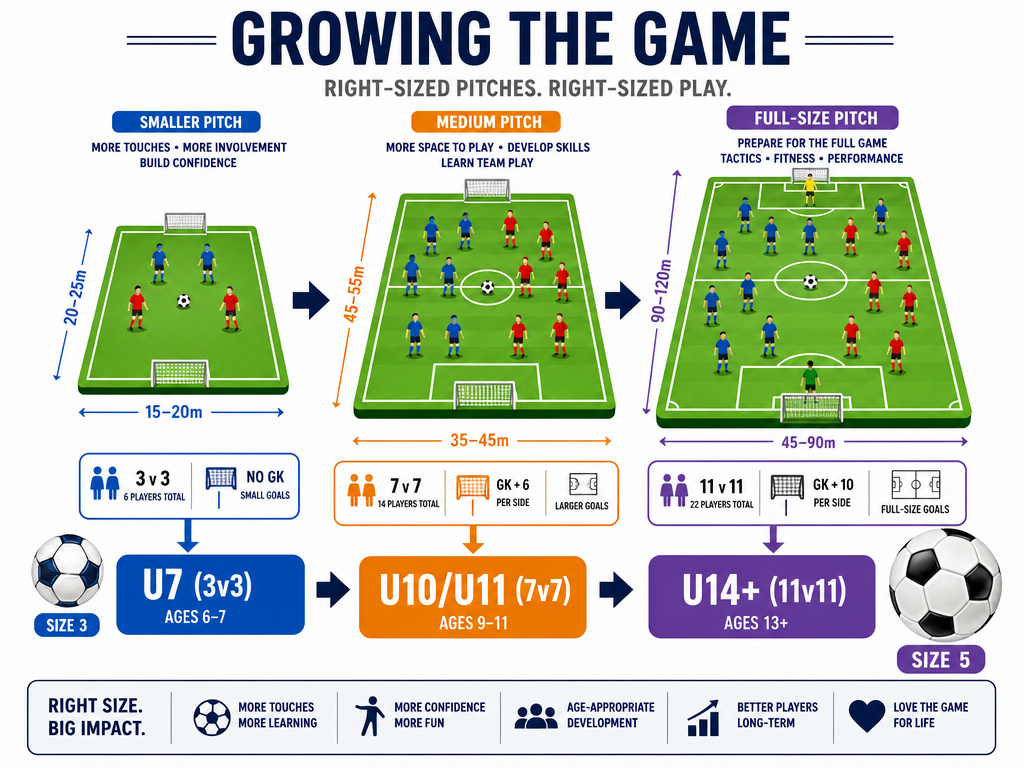
The age group isn’t just a label on a jersey. It mandates everything about the match your child will play: how many teammates are on the pitch, the size of the ball, and how long the halves are. These rules exist for development, not bureaucracy.
The FA’s “FutureFit” changes, effective from the 2026–27 season, tie each stage to a developmental phase, but formats vary by association; for example, the Football Association of Wales mandates 4v4 for U7s. Smaller formats for younger ages mean more involvement, more touches, and more decisions per player, the exact ingredients for skill acquisition.
| Age Group (FA, from 2026/27) | Playing Format | Ball Size | Development Focus |
|---|---|---|---|
| Under 7 | 3v3 | Not specified by FA fact sheet | Basic movement, ball familiarity, play-based learning |
| Under 8 & Under 9 | 5v5 | 3 | Introducing positions, simple cooperation, skill repetition |
| Under 10 & Under 11 | 7v7 | 3 | Tactical shape (e.g., 2-3-1), build-up play, wider pitch awareness |
| Under 12 & Under 13 | 9v9 | 4 | Transition to larger pitch, defined roles, structured set pieces |
| Under 14+ | 11v11 | 5 | Full-game tactics, physical conditioning, position specialization |
This structured pathway is mirrored elsewhere with local variations. In Wales, the Football Association of Wales junior football regulations mandate 4v4 for U7s and 7v7 for U11s. US Youth Soccer uses modified rules for U10 and below, with specific ball sizes (Size 3 for U8, Size 4 for U12) and match durations tied directly to each age band in their official policy document.
The shift from a Size 3 to a Size 4 ball around the U12 age group isn’t arbitrary in associations like US Youth Soccer, where it is mandated. A Size 3 ball is lighter and easier for a younger child to control and strike with proper technique. Forcing a U9 player to use a Size 5 ball encourages poor kicking form, they’ll likely toe-punt it, and can be intimidating. The right equipment for the age is a safety and development issue.
Playing Up, Playing Down, and The Exceptions
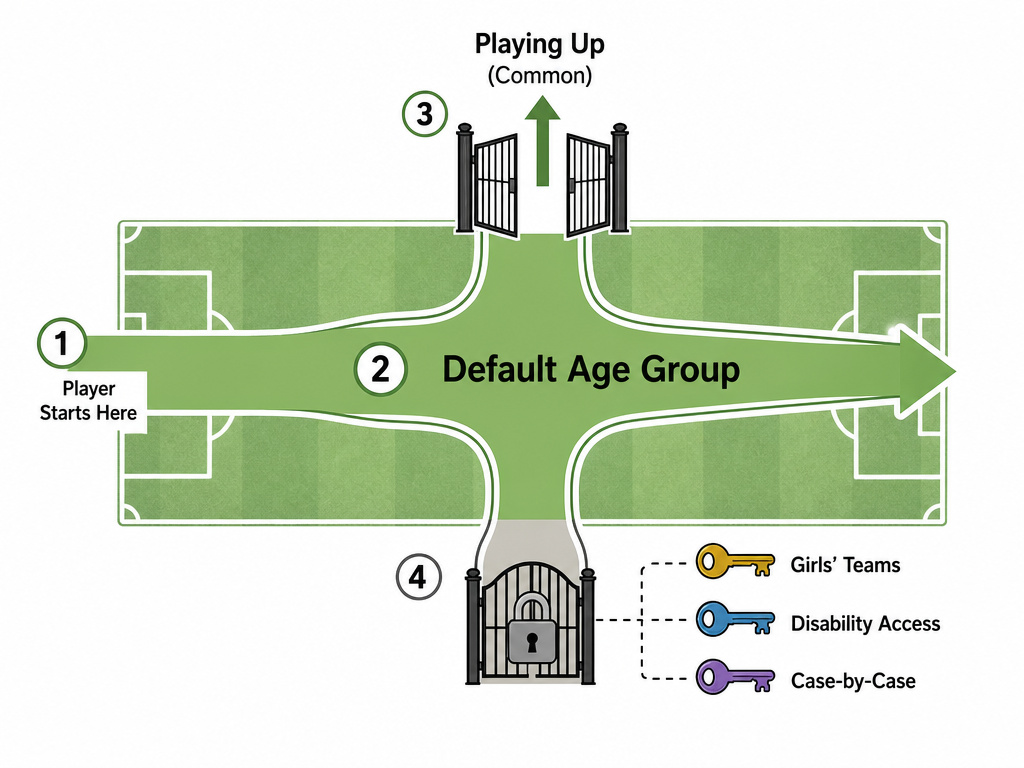
The rules have a clear default path, but they also have doors, some are usually open, others are locked and require a special key. Understanding these exceptions stops you from assuming something is possible when it isn’t.
Playing up, joining an older age group, is commonly allowed. The FA and the FAW permit it, typically for one age group only. The stated reason is to challenge advanced players. But it requires agreement from the club and the league. It’s not an automatic right.
Playing down, joining a younger age group, is heavily restricted. It is generally prohibited for competitive advantage, but specific exceptions exist, such as for girls in all-female teams (FA) or girls in mixed teams (WACFA). The exceptions are narrow and specific:
- For girls: The FA’s Rule 4(F) allows girls in all-female teams to play one age group down. The Western Australian CFA bylaws allow girls to play down one year into a mixed team. This is often used to help form viable girls’ teams where player numbers are low.
- For players with disabilities: The FA states it can enable disabled children to play in an age group “other than the groups dictated by their birth date, including ‘playing down’.” This is a discretion-based allowance for accessibility, not competition.
- AYSO’s case-by-case basis: The AYSO age division guide notes that requests to play down are “strongly discouraged” and must be handled individually, focusing on the child’s best interest.
Where this goes sideways: Assuming playing down is an option for a slightly smaller or less confident child in a mixed, mainstream team. Leagues will almost always say no to maintain competitive integrity. The alternative is to find a club with a philosophy that rotates positions and focuses on development over results, which often helps smaller players thrive within their own age group.
There’s also a hard edge-case in the FA rules: a child who turns 6 after August 31 may only play in the Under 7 age group that season, not Under 8. They cannot play up, even though they are in the same school year as some U8 players. It’s a rare but absolute line.
Navigating the System: A Practical Guide for Parents
So, your child wants to play. The flyer from the local club says “Register for U11.” What do you do next? Cut through the jargon with this four-step checklist.
- Identify the Governing Body. Is it an FA-affiliated club, a US Youth Soccer club, or an AYSO region? The club’s website or a quick ask will tell you. This tells you which cut-off date calendar they use.
- Apply the Cut-Off. Take your child’s date of birth. Find the next relevant cut-off date (e.g., this coming August 31). How old are they on that exact day? Add one to that age. That’s their “U” age group.
- Understand the Format. Look up the mandated format for that age group. If they’re U10 under FA rules, they’ll be playing 7v7 on a midsize pitch. This sets your expectations for the game they’ll actually play.
- Ask About Philosophy. Especially for younger ages (under 14), ask the coach or club: “What is your approach to playing time and position rotation?” A good development-focused player rotation system is a better indicator of a positive experience than a team’s win-loss record.
This process demystifies the registration. You’re not just signing up for “football.” You’re signing up for a specific type of football, designed for a specific stage of childhood, governed by a specific book of rules. Knowing which book you’re in is half the battle.
Why Football Uses a School-Year Age Cutoff (August 31)
The use of a school-year cutoff (like August 31) by associations such as The FA aligns the sport with the academic and social development of children. The most common model, used by bodies like The Football Association and the Football Association of Wales, sets the age cutoff at midnight on August 31. A child’s age on that date determines their age group for the entire playing season, which runs from September to the following summer. This system prioritizes stable peer groups over strict chronological age, reflecting the understanding that children develop alongside their school year cohort.
How Age Groups Differ Between Tackle and Flag Football
The age structures for tackle and flag football are governed by different priorities, primarily concerning physical contact and player safety. These can include wider age bands or combined divisions to facilitate participation and focus on skill development without the physical demands of tackling. The key difference lies in the purpose: tackle structures prioritize safety through physical parity, while flag structures often prioritize accessibility and learning the game’s fundamentals in a safer environment.
Frequently Asked Questions
What does U10 mean in youth football?
U10 means “Under 10.” It is the age group for players who were 9 years old (or younger) on the league’s specified cut-off date for that season. A player will turn 10 during a U10 season, but they remain in the U10 category for all matches and training.
Can my child play up an age group?
Usually, yes. Most associations like the FA and AYSO allow players to move up one age group with club and league approval. It’s often used for more skilled or physically mature children seeking a greater challenge. You cannot typically play up more than one group.
Why are there different cut-off dates?
Different governing bodies adopted dates for historical and practical reasons. The FA’s August 31 aligns with the English academic year. US Youth Soccer’s July 31 may reflect a different seasonal calendar. AYSO’s December 31 is a legacy birth-year system. The move towards August/September cut-offs is largely to align teams with school grades.
What is the youngest age a child can play organized football?
It depends on the organization. The minimum age varies by organization. The Football Association (FA) states a child must be 6 to play in any match, while AYSO allows participation from age 3 in its non-competitive Playground Soccer program. However, AYSO runs a non-competitive “Playground Soccer” program for children as young as 3, focusing on motor skills. Always check the specific program’s minimum age and whether it involves match play or just skill development.
How does the “Relative Age Effect” impact my child?
The Relative Age Effect (RAE) is the advantage a child born just after the cut-off date has over a teammate born just before it. In an U10 group, one child could be nearly a full year older than another. This can lead to early physical dominance for the older child, which sometimes gets mistaken for greater talent. Coaches should be aware of RAE to ensure all players, especially younger-looking ones, get equal opportunities to develop.
The Bottom Line
Football age groups are a framework, not a cage. The cut-off date is the fixed point everything else rotates around, but the real-world experience is shaped by the coach and the club’s philosophy. A great U10 experience in a rigid, win-at-all-costs team can be worse than a challenging U11 experience in a club that values structured development in academies and player rotation.
The system of U7 to U18 is designed for long-term development. The best clubs use the rules to serve that purpose, not just to sort kids onto a pitch.
