
How Football Academies Work: The Academy Player Pathway
This post contains affiliate links. As an Amazon Associate, we earn from qualifying purchases.
Football academies are professional club-run systems for identifying and developing young players, governed by frameworks like the EPPP in England. They operate in defined age phases (Under-9 to Under-21), employ multidisciplinary staff, and use holistic models like the Four Corner Model. This creates a highly structured, competitive environment where only a tiny fraction, as low as 7.4% at some clubs, go on to earn a professional contract.
The structure is more rigid than most people picture. It’s not just about coaching kids; it’s a formalised business unit with standardised procedures, mandated staffing roles, and extensive tracking. The Premier League’s Elite Player Performance Plan, introduced in 2012, created this framework to raise standards, but it also created a specific kind of institutional pressure. This is a key part of how football academies work.
What follows is a breakdown of that system: the age groups, the staff you never see on TV, the daily clash between long-term development and short-term results, and the hard numbers on who actually makes it.
Key Takeaways
- Academies operate in three core phases: Foundation (U9-U11), Youth Development (U12-U16), and Professional Development (U17-U21), though official definitions from bodies like the EFL extend the academy player classification to Under-21.
- The English system is governed by the Elite Player Performance Plan (EPPP), which mandates standards for coaching, facilities, and player welfare across four academy categories (1 being the highest).
- A modern Category 1 academy employs a median of 12 medical and 9 performance staff, and from the 2025/26 season, its Academy Psychologist must be on the Health & Care Professions Council (HCPC) Register.
- Holistic development is preached via the FA’s Four Corner Model (technical/tactical, physical, psychological, social), but coaches often admit the psychological and social corners get neglected in daily planning.
- The odds are long: at one English club, only 7.4% of 364 male players who entered the academy from U9 to U18 achieved a professional contract at age 18.
How Football Academies Are Structured and Licensed
Forget the image of a loose collection of training pitches. In England, an academy is a licensed establishment. The FA rules state it must be “licensed by the Professional Games Board (PGB).” This isn’t a suggestion; it’s a requirement for operation. The licensing process ties directly into the Elite Player Performance Plan, the Premier League’s framework launched in 2012 that categorises academies from 1 to 4.
Category 1 is the pinnacle, with the highest funding, the best facilities, and the most stringent staffing requirements. A Category 4 academy might be run by a lower-league club with a part-time coordinator. The category dictates everything from how far you can recruit players from to the minimum hours of coaching. It creates a tiered, competitive development landscape before a ball is even kicked.
The system’s goal is standardisation. A global survey of elite academies found about 60% of club and federation respondents agreed their organization “is defined by its standardization. Work is very formalized, there are many routines and procedures.” This isn’t about stifling creativity; it’s about creating a measurable, auditable pathway in a multi-million pound industry, which is central to how football academies work. The downside is that it can feel corporate. The upside is that a player moving from a Category 2 to a Category 1 academy enters a system that, on paper, operates in a recognisably similar way.
The Academy Player Pathway: From Schoolboy to Scholar
So who actually goes through this system? The definition of an Academy Player seems straightforward but has nuance. According to the EFL and Premier League rules, an Academy Player is a male player in an age group between Under 9 and Under 21, while a peer-reviewed study notes young players in England typically join on schoolboy terms between the ages of 8 and 16. However, a peer-reviewed study notes that young players in England typically join on schoolboy terms between the ages of 8 and 16 for part-time training. This slight discrepancy, 8 vs. 9, highlights the difference between formal registration and early identification.
The pathway is commonly broken into three phases, a structure supported by research:
- Foundation Development Phase (FDP): Under-9 to Under-11. This is the entry point. Training is about skill acquisition and enjoyment. The physical differences between kids are minimal, so technique is king.
- Youth Development Phase (YDP): Under-12 to Under-16. The intensity ramps up. Training intensity ramps up significantly during the Youth Development Phase. This is when the great puberty lottery begins, and players who mature early often dominate. It’s also when the scholarship clock starts ticking.
- Professional Development Phase (PDP): Under-17 to Under-21. This is the make-or-break stage. Players are on full-time academy scholarships, balancing training with education. The goal is a professional contract at the end.
The scholarship is the formal gateway to the PDP. FA regulations are precise: a club may offer a scholarship on or after 1 January in the year a player turns 14, and in any event on or before 1 March in his Under-16 year. The player has 28 days to respond. If accepted, the Scholarship Agreement commences no earlier than the last Friday in June in the academic year he turns 16. This marks the transition from promising schoolboy to full-time apprentice footballer.
Where this goes sideways: Families often see an U9 offer as a guaranteed ten-year ticket. In reality, players move between academies constantly. A player released at U14 from a Category 1 club might be picked up by a Category 3 club where he plays more. The pathway is a winding road, not a straight escalator.
The Staff and Support Structure of a Modern Academy
The manager and the first-team coaches are the visible tip of the iceberg. Below them is a small army of specialists. That global survey of elite academies gives us hard numbers: in clubs, there were a median of 12 medical and 9 performance staff members. In national federations, the medians were 10 medical and 6 performance staff.
This table breaks down the key support roles beyond the head coach:
| Staff Role | Primary Function | Why It Matters |
|---|---|---|
| Academy Psychologist | Mental skills, coping with pressure, performance mindset. | EFL rules mandate that from the 2025/26 season, a Category 1 academy’s psychologist must be on the Health & Care Professions Council (HCPC) Register. |
| Sports Scientist | Monitor fitness, load management, physical development metrics. | Prevents overtraining and tracks growth against benchmarks, crucial during the YDP. |
| Player Care Officer | Wellbeing, logistics, liaison between club, player, and family. | Handles everything from arranging transport to being a point of contact for a homesick residential scholar. |
| Education Officer | Ensures academic progress alongside football training. | Manages timetables and liaises with schools; a scholar’s contract is dependent on completing his Education Programme. |
The push for this multidisciplinary support comes from the Four Corner Model (FCM), the FA’s holistic development framework. It advocates assessing and developing players across technical/tactical, physical, psychological, and social attributes. The idea is that you can’t just coach the feet; you have to develop the person, which is a fundamental principle of how football academies work.
But here’s the tension. A separate peer-reviewed study on adaptive coaching found that coaches themselves admit the model isn’t evenly applied. “Coaches described two corners, technical/tactical and physical, as demanding most of their attention,” the study reports. The psychological and social corners often get planned as an afterthought, seen as the responsibility of the specialist psychologist rather than the day-to-day coach. This creates a gap between the holistic philosophy and the grind of session planning.
Tracking and Assessment: The Performance Clock and Bio-Banding
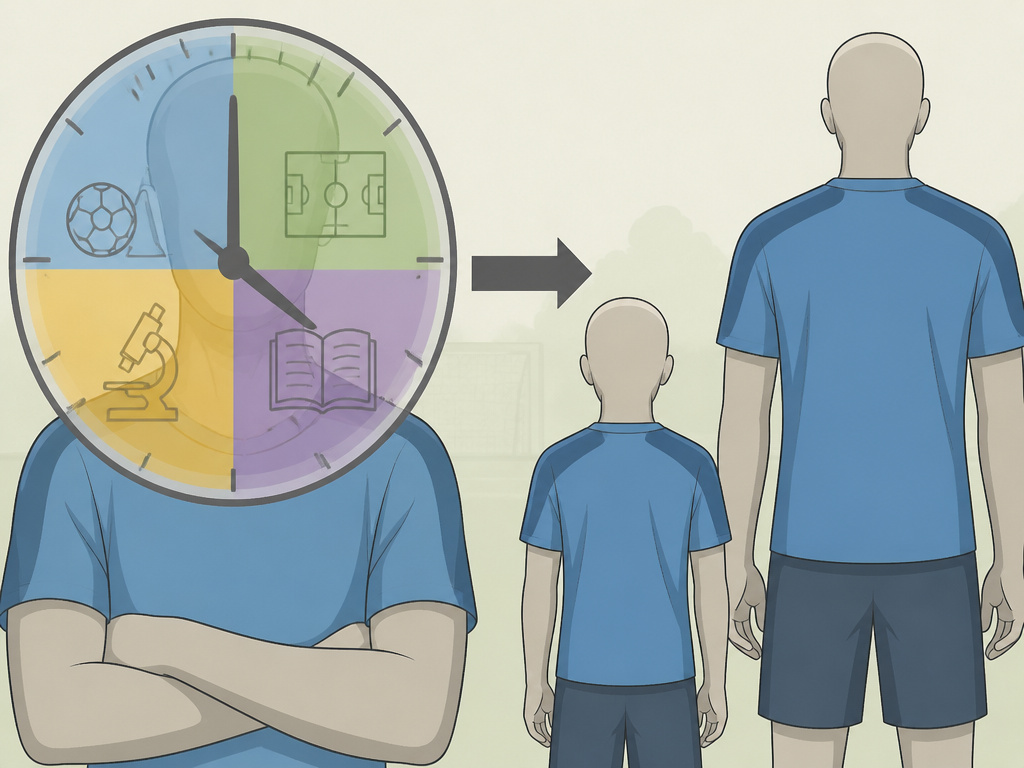
How does an academy measure a player’s progress over a decade? It’s not just match reports. The EFL’s Youth Development Rules introduce two key tools: the Performance Clock and Multi-disciplinary Reviews (MDRs).
The Performance Clock is a digital log embedded in the club’s management software. It’s not a stopwatch. It’s a record that tracks time spent across four areas: technical/practical development, matches, sports science/medicine (including psychological and social support), and education. It builds a year-on-year, club-to-club record for each player. The MDR is the meeting where staff from all departments, coaching, medical, education, player care, sit down to discuss a player’s progress against this logged evidence. It’s meant to be a holistic check-up.
One of the biggest challenges this system tries to manage is biological maturation. During the YDP, you can have two 14-year-olds where one looks like a child and the other looks like a man. The early developer often dominates with physicality, while the late developer might be more technically gifted but gets muscled off the ball.
To address this, some academies use bio-banding. This is the practice of grouping players by biological maturity (measured by factors like height growth) rather than chronological age for certain training sessions or tournaments. The goal is to create a more level playing field where skill, not just size, determines success. It’s an edge-case solution to a universal adolescent problem, and it reflects a more sophisticated approach to long-term talent identification than just picking the biggest kids.
The Real Numbers: Staff and Success Rates
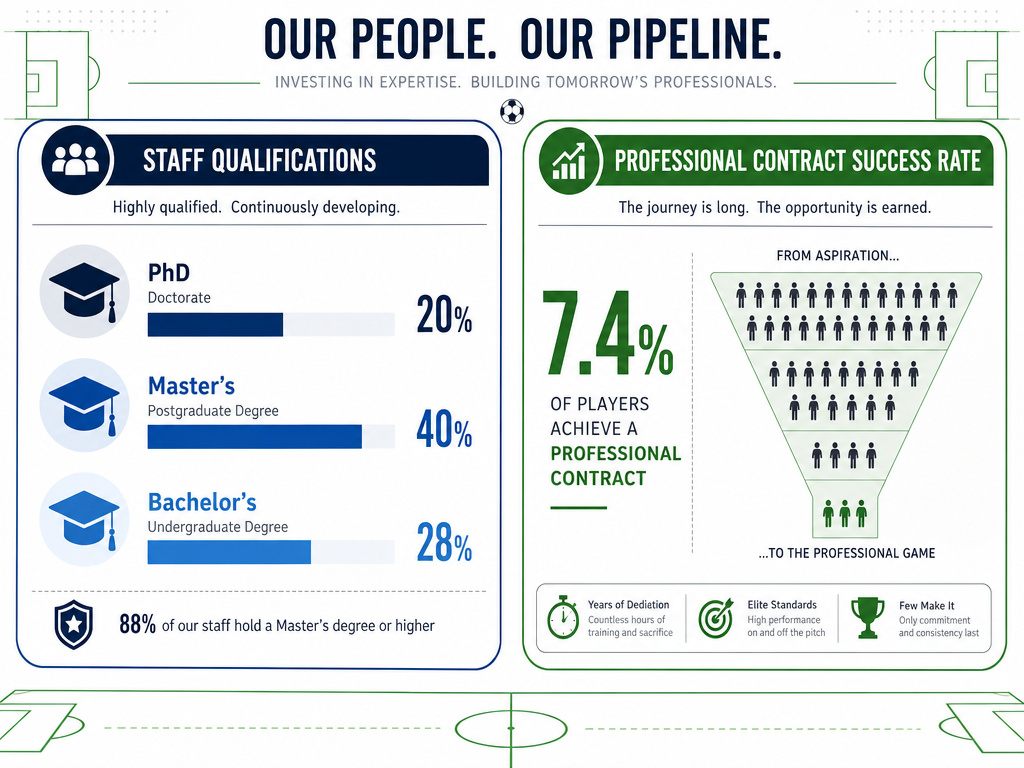
We will examine two sets of numbers: who works in academies, and who actually makes it. The data here comes from peer-reviewed research, not club marketing.
First, the staff. That global survey of academy operations provided a snapshot of the people in charge. Among club respondents, 20% had a PhD, 40% a Master’s degree, and 28% a Bachelor’s degree. They had a median of 10 years of experience in professional football. These are qualified, experienced operators. The organizational structures they work within had been in place for a median of 5 years at clubs. This is a professionalised environment.
Now, the success rates, or more accurately, the attrition rates. The dream is a professional contract. The door is narrow. A machine learning study of an English academy tracked 364 male players who entered from under-9 to under-18. The result? Only 7.4% achieved a professional contract at age 18. That’s not an outlier; The odds of transitioning to professional level are low.
The same study used data to identify what factors correlated with higher player review ratings. The key predictors weren’t just about flashy skills. They included:
- Advanced percentage of predicted adult height (coefficient 0.196)
- Greater lob pass completion (0.160)
- More total match-play hours (0.145)
- Older relative age (being born in the first quarter of the selection year)
This tells a story. Physical development (height), smart decision-making (lob passes), and simply playing a lot of football are significant. This shows that development is multidimensional, but also that biological factors a player can’t control play a substantial role in how they are perceived during the critical YDP years.
| Academy Metric | Club Median | National Federation Median | Source |
|---|---|---|---|
| Medical Staff | 12 (IQR 6-16) | 10 (IQR 6-15) | PMC9727309 |
| Performance Staff | 9 (IQR 6-15) | 6 (IQR 3-24) | PMC9727309 |
| Staff Experience | 10 years (IQR 6-18) | 13 years (IQR 6-22) | PMC9727309 |
| Professional Contract Rate | 7.4% (at one English academy) | N/A | PMC9611883 |
The Daily Reality: Philosophy vs. Pressure

On paper, the system is a perfectly engineered talent pipeline. In practice, it’s a daily negotiation between long-term philosophy and short-term pressure. The EPPP and the Four Corner Model preach holistic, long-term development. But academy coaches work in institutions that, like all football clubs, value winning.
Research interviews with academy staff have revealed this conflict directly. Coaches report feeling pressure to select physically mature players who can win games now, even if a less physically developed player might have superior technique and a higher long-term ceiling. The scholar in his final year needs to impress to earn a contract, which can tempt coaches to focus on immediate results over individual development. This is the core tension: is the academy a development unit or a performance unit? The answer, frustratingly, is that it has to be both.
This pressure trickles down. A 16-year-old scholar isn’t just learning to play; he’s in a high-stakes evaluation that determines his career. The structured environment, the Performance Clock, the MDRs, they provide support but also constant assessment. The role of the psychologist is therefore critical, which is why the HCPC registration requirement for Academy Psychologists is a significant step. It professionalises a support system for a high-pressure job that these teenagers are doing.
Which clubs have the best football academies?
While specific club names aren’t detailed in the available data, the structure of elite academies is defined by significant investment in specialist staff and long-term planning. A survey of elite football academies showed that club staff typically have a decade of experience in professional football, with many holding advanced degrees. These academies operate with sizable support teams, including dedicated medical and performance staff. A majority (~60%) of club and national federation respondents agreed their academies’ organization is defined by its standardization.
What are the different types of football academies?
Academies vary primarily in their category level and the commitment they require from young players. The highest category academies, such as Category 1, must employ full-time, registered psychologists as part of their staff, indicating a greater resource for holistic player support. For player involvement, most young players join on a part-time, schoolboy basis, balancing football with education. From age 16, the most promising players may be offered a full-time scholarship, representing a shift to a more intensive, professional training environment. The development pathway itself is segmented into distinct phases focusing on different age groups, from foundational skills to professional readiness.
Frequently Asked Questions
Do you pay to be in a football academy?
No, you do not pay for coaching at an EPPP-licensed academy. Academy coaching is typically free for players regardless of category. However, families often bear significant indirect costs: travel to training and matches, specialist equipment, accommodation for away games, and the time commitment for parents. These “free” programs can still be expensive.
Do kids in football academies still go to school?
Yes, education is mandatory and integrated. Schoolboy players (U9-U16) attend their normal schools alongside part-time training. At 16, scholars enter full-time football training but are legally required to continue an education program, usually through a linked college or bespoke tuition, often at the training ground. Their scholarship is contingent on meeting academic requirements.
What is the best age to get into a football academy?
There is no single “best” age. Formal registration begins at U9 (Foundation Phase), but many are scouted earlier through development centres. Many players are identified and enter the system during the Youth Development Phase. Late developers can and do enter at older ages. The key is being in an environment where you play regularly and are challenged, whether that’s a Category 1 academy or a strong local club side.
Do football academy players get paid?
Schoolboy players (U9-U16) are not paid a salary. At 16, players who sign a scholarship receive remuneration as outlined in their Scholarship Agreement. They only begin earning a professional salary once they sign a professional contract, usually at 18 or older.
Before You Go
The academy system is a remarkable, professionalised machine for producing footballers. It’s also a system where the odds are starkly quantified. For every player who makes it, roughly nine do not. The takeaway isn’t to be discouraged, but to be clear-eyed.
If you’re a player or a parent, understand that the badge on the training kit is less important than the pathway it offers. A place in a top-tier academy is an opportunity, not a destination. The real work, the technical reps, the tactical understanding, the psychological resilience, happens regardless of the category. And sometimes, the winding road through lower categories or non-league football provides the minutes and maturity that the pristine academy pathway cannot.
The system works. It produces technically excellent players. But it works on its own terms, with its own pressures and priorities. Navigating it successfully means understanding not just how to play, but how the machine itself operates.
