
5 a Side Football Rules Explained: Kick-Ins, Subs & Fouls
This post contains affiliate links. As an Amazon Associate, we earn from qualifying purchases.
The official 5-a-side football rules are a streamlined version of 11-a-side, with 5 players per team on a small rectangular pitch, unlimited rolling substitutions, restarts via kick-ins instead of throw-ins, and no offside law. The Football Association’s recommended pitch dimensions are a length of 25–50 metres and a width of 16–35 metres, with all lines 8cm wide.
The biggest difference from the full game is the pace. The confined space and kick-ins mean the ball is almost always in play, and a bad substitution can cost you a goal before you’ve even sat down.
What follows is a breakdown of the core laws, from the size of the pitch to the specifics of the sin-bin, and where the official 5 a side football rules explained leave room for your local league to make its own calls.
Key Takeaways
- A 5-a-side team fields 5 players with 3 named substitutes, but substitutions are unlimited and rolling, a replaced player can return later.
- The pitch is much smaller: The FA recommends a length of 25–50 metres and a width of 16–35 metres, with the touchline always longer than the goal line.
- The ball is returned to play with a kick-in, not a throw-in; defenders must stand at least 3 metres away.
- There is no offside rule in small-sided football, which fundamentally changes defensive positioning and attacking runs.
- Infringements like a botched substitution or a dangerous challenge can lead to a sin-bin temporary dismissal instead of an immediate red card.
The Pitch: How Big Is a 5-a-Side Field?
The size of the playing area is the first thing that changes the game in a 5 a side football rules explained. It’s not just a scaled-down version of a full pitch; the dimensions create a specific kind of chaos.
Official guidance from The Football Association states the recommended length for a 5-a-side pitch is a minimum of 25 metres and a maximum of 50 metres. The recommended width is a minimum of 16 metres and a maximum of 35 metres. One essential geometric rule: the touchline must be longer than the goal line. All lines on the pitch are to be 8cm wide.
For 5-a-side, The FA’s Small-Sided Laws recommend a pitch length of 25–50m and a width of 16–35m. The touchline must be longer than the goal line, and all pitch markings are 8cm wide. These dimensions create a high-tempo game where the ball is rarely out of play.
These numbers aren’t universal, and that’s where confusion starts. Different governing bodies have different standards for their competitions. The Special Olympics, for its 5-a-side format, specifies a larger minimum field size of 40m x 30m, with a maximum of 50m x 35m. You’ll find local leagues and sports halls operating anywhere within these broad ranges.
The practical effect is simple: there is no hiding. The ball pings from one end to the other in two or three passes, and a goalkeeper’s poor throw can easily turn into a shot on their own goal. Defenders have to be comfortable on the ball because the opposition’s press is always in their face.
Players, Subs, and the “Rolling” Change
This is where 5-a-side feels most different from a Saturday league match. The squad is small, but the bench is active.
A match is played by two teams, each consisting of 5 players on the pitch and a maximum of 3 substitutes, making a total squad size of 8. The critical twist is that the number of substitutions made during a game is unlimited. A player who has been substituted can return to the pitch later to replace another teammate. This is the “rolling sub” system.
| Aspect | 5-a-Side Rule | Why It Matters |
|---|---|---|
| Players on Pitch | 5 | Creates a 4-outfield + 1 keeper standard shape. |
| Named Substitutes | 3 | Total matchday squad of 8 players. |
| Substitution Limit | Unlimited | Allows for high-intensity “hockey-style” changes. |
| Re-entry Allowed | Yes | A substituted player can return later. |
| Change Procedure | During a break in play (or during play with a 2nd official). | Prevents sneaky extra-player advantages. |
Substitutions should take place when there is a break in play. If a second official is involved in refereeing, some competition rules allow changes to be made during active play. The key procedural rule is this: the substitute cannot enter the playing area until the player being replaced has completely left it, usually over the touchline or through a designated barrier opening.
Get this wrong, and you’re in trouble. If a substitute enters before the outgoing player has fully left, play is stopped. The substitute is sent to the sin bin for an agreed period (often two minutes), and the opposition restarts with an indirect free kick. It’s a harsh but fair punishment for trying to gain a numerical advantage.
Kick-Ins, Not Throw-Ins

Forget the long throw into the box. When the ball goes out over the touchline in 5-a-side, play restarts with a kick-in.
A kick-in is awarded to the opponents of the player who last touched the ball before it crossed the touchline. The ball must be stationary either on the touchline itself or, if barricades are in use, 2 metres into the playing area from the barrier. The player taking the kick-in must have part of each foot on the touchline or on the ground outside it at the moment they kick the ball.
Common mistake: Taking a kick-in with a moving ball or with both feet inside the pitch. The restart will be given to the other team, handing away possession cheaply.
Defenders have to give space. The players of the defending team must be at least 3 metres from the place where the kick-in is taken. You cannot score directly from a kick-in, the ball must touch another player first. Also, the player taking the kick-in cannot touch the ball a second time until it has touched another player; doing so concedes an indirect free kick.
The tactical implication in a 5 a side football rules explained is huge. A quick kick-in can catch a team napping as they retreat to shape up, turning a defensive clearance into an immediate attacking chance. It rewards teams who are alert the moment the ball goes out.
Match Duration and the Referee’s Authority

How long is a game? It depends who’s organising it.
The FA’s Small-Sided Laws provide a framework but leave the final say to local competition rules. They state the game shall be divided into two equal periods of over 5 and up to 25 minutes each, while the standard IFAB law is two 45-minute halves (which may be reduced by agreement). The half-time interval must not exceed 5 minutes unless the referee agrees otherwise. Competition rules can even allow for a game to be played in its entirety without a half-time break or the requirement to change ends.
This differs from the standard IFAB (International Football Association Board) law of two 45-minute halves, which may be reduced by mutual agreement. In practice, many adult 5-a-side leagues run shorter halves, with the duration set by competition rules.
The referee’s power is absolute. They have full authority to enforce the Laws of the Game from the moment they arrive at the venue until they leave. This includes enforcing the core principle: where the small-sided laws don’t state otherwise, the normal Laws of Association Football apply, with the major exception that there is no offside in small-sided football.
Equipment and Safety: No Jewellery, Yes Shinguards
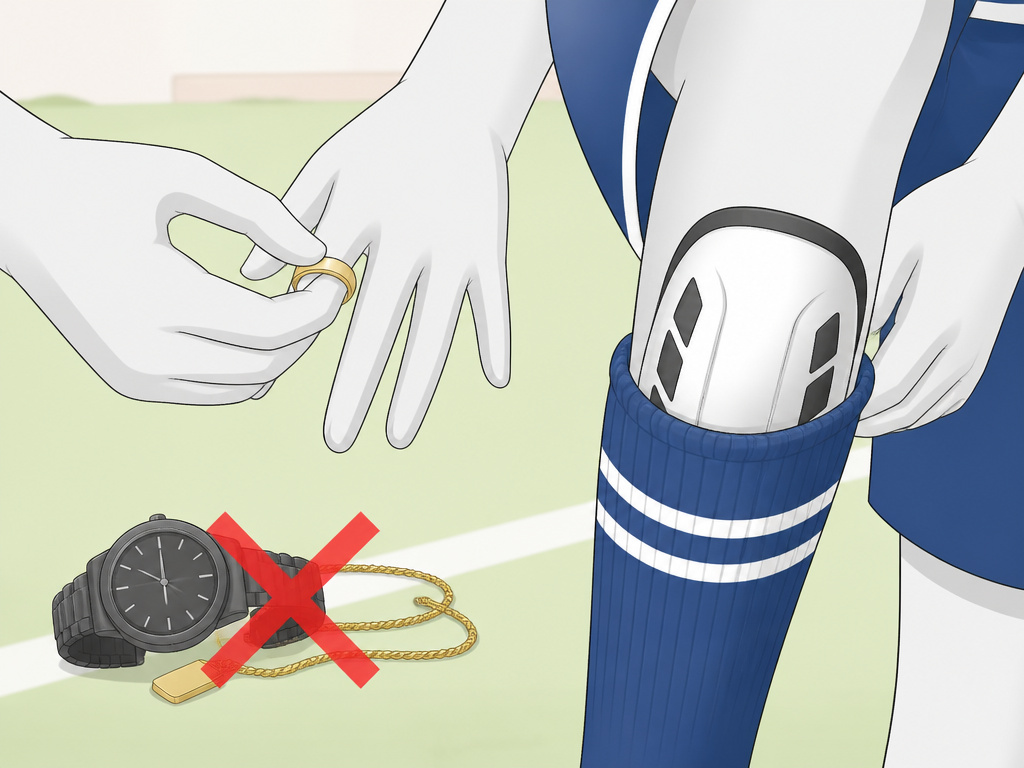
The rules here are strict for obvious reasons. A player must not use equipment or wear anything dangerous to themselves or another player.
The big one: all jewellery must be removed. No watches, no rings, no necklaces. Taping over earrings is not sufficient, they must come out. This isn’t a style critique; a stray ring can cut someone in a challenge.
Shinguards are mandatory. They must be covered entirely by the socks, be made of suitable material like rubber or plastic, and provide a reasonable degree of protection. Goalkeepers get a slight pass on attire: they are permitted to wear long trousers and must wear colours that easily distinguish them from all other players and the referees.
Where this goes sideways: Letting a player on with a fitness tracker wristband. It’s still jewellery, and a referee is within their rights to send them off to remove it, leaving their team short-handed.
Fouls, the Sin-Bin, and Goalkeeper Rules
The disciplinary system has a unique tool: the sin-bin. Not every infringement leads to a straight red card.
For certain offences, a player can be temporarily dismissed (sin-binned) for an agreed period. Their team plays short-handed during that time. This is commonly used for substitution infringements, persistent fouling, or dissent. Serious offences, violent conduct, serious foul play, still warrant a straight red card and a report to the local County FA within 48 hours.
Any of the players or substitutes may change places with the goalkeeper, provided the referee is informed before the change and it is made during a stoppage in play. The new goalkeeper must wear a distinguishing jersey.
5-a-Side vs. Futsal vs. Indoor: What’s the Difference?
People often lump these small formats together, but the rules differ in key ways. Knowing which you’re actually playing clarifies everything.
| Feature | 5-a-Side (FA Laws) | Futsal (FIFA) | Generic Indoor Football |
|---|---|---|---|
| Pitch Surface | Artificial grass or hard court | Hard, flat surface (wood) | Hard court, often with boards. |
| Ball | Size 4 or 5 (low bounce) | Size 4 (30% reduced bounce) | Size 5 standard. |
| Restart from Touchline | Kick-in | Kick-in | Often a kick-in, sometimes a pass-in. |
| Head Height Rule | Varies by league | No specific rule | Commonly used (no ball above head height) |
| Goalkeeper Distribution | Cannot use hands from a back-pass | 4-second limit to release ball | Often has a 4-second limit. |
The futsal rules are codified globally by FIFA, with a specific low-bounce ball and accumulated fouls. Your local indoor football rules might use a standard ball and introduce a “head height” rule to stop aimless punts. Standard 5-a-side, as per The FA, sits between them.
Organising a Game: The One Rule You Must Set First
If you’re setting up a casual game or a new league, the official laws give you a framework but demand one decision upfront: what are your competition rules?
The duration of halves, the use of sin-bins versus direct dismissals, the size of the ball (a Size 4 ball is specified for ages 8-12 by bodies like the Special Olympics), and whether head-height rules apply are all up to the competition organiser. Get everyone to agree on these variables before the first kick-off. It saves endless arguments when a player used to one league joins another.
This is especially crucial for small-sided football for kids, where simplified rules and smaller pitches help development. The principles are the same, but the focus is on participation.
What is the head height rule in 5-a-side?
Some local and recreational leagues may adopt additional rules, such as restricting the height the ball can be played, but these are not part of The FA’s official small-sided laws. This rule changes the game significantly, preventing long aerial balls and focusing the action on passing and movement at feet.
Frequently Asked Questions
What are the basic rules of 5-a-side football?
Five players per team on a small rectangular pitch, with unlimited rolling substitutions. There are no throw-ins, play restarts with a kick-in. The offside rule does not apply, and matches are typically played in two short halves of up to 25 minutes each.
Does 5-a-side include a goalkeeper?
Yes, a goalkeeper is included as one of the five players on the pitch. Specific rules for goalkeepers apply, such as the requirement to wear a distinctive jersey. Goalkeeper rules in football cover these in detail.
How do substitutions work in 5-a-side?
Substitutions are “rolling” and unlimited. A player can be replaced, and that same player can return later to replace someone else. Changes must happen during a break in play (or during play if a second official is present), and the substitute cannot enter until the outgoing player has fully left the pitch.
What is a sin-bin in 5-a-side?
Sin-bin is a temporary dismissal. For certain infringements, like a botched substitution or persistent minor fouls, a player is ordered off the pitch for a set time (e.g., two minutes). Their team plays with fewer players until the time is served or a goal is conceded.
Can you score directly from a kick-in?
No. A goal cannot be scored directly from a kick-in. The ball must touch another player before entering the net. If it goes straight in, the restart is a goal kick or corner kick.
Before You Go
The appeal of 5-a-side lies in its simplicity and speed, but that simplicity rests on specific, fixed laws. The pitch has defined dimensions. Substitutions have a strict procedure. Kick-ins replace throw-ins.
The single biggest strategic shift for any 11-a-side player is the absence of the offside trap. It changes defensive positioning from a high line to a more zonal, goal-side approach. Your 5-a-side formations need to account for runners coming from anywhere.
Finally, always check the local competition rules. Whether it’s the 2024 Special Olympics official football rules or your local sports centre’s league, the organiser’s specific adaptations on match length, sin-bin duration, and ball size are the final word. Play by those, and the only arguments will be about the scoreline.
