
Rondo Drills in Football Explained
This post contains affiliate links. As an Amazon Associate, we earn from qualifying purchases.
*A rondo drill in football is a small-sided possession game where a group of players with a numerical advantage (like 4v2 or 5v2) tries to keep the ball from defenders inside a confined grid, often a square of varying size.* The drill sharpens first touch, passing under pressure, and decision-making in tight spaces. According to some sources, it was invented by Laureano Ruiz at FC Barcelona’s academy in the 1970s, while others state it rose to prominence at Barcelona in the 1990s.
That 10x10m square is the standard you see in Pep Guardiola’s Manchester City sessions, but the size can swing from 8×8 yards to 40×40 yards depending on what you want the drill to teach. The smaller the space, the less time players have. The bigger the overload, the easier it is for the attackers. That’s the basic dial you turn. The principles of rondo drills in football explained are rooted in these variables.
What follows is a walk through the numbers that matter in the rondo drills in football explained: the player ratios that change the physical load, the grid size debates coaches have over a pint, and the one rule from a 2026 study that reframes the whole exercise from a warm-up to a high-intensity conditioning tool. By the end, you’ll know how to set one up, why the shape might need to be a diamond, and when to stop it before your players are cooked.
Key Takeaways
- The most common rondo setup is a 10x10m square with a 5v2 or 4v2 player ratio, popularised by Pep Guardiola.
- A 2026 study found the 4v1 format causes the highest acceleration demands, meaning rondos aren’t just technical drills, they’re serious conditioning.
- For a true 4v2 rondo, coach Ben Kamara-Adams insists the shape must be a diamond, not a square, to force diagonal passes that break defensive lines.
- Run a rondo for 8 to 15 minutes; the Silva et al. Study used 8-minute blocks, while coaching resources often recommend 15-minute sessions.
- Johan Cruyff’s famous quote undersells it slightly: “Everything that goes on in a match, except shooting, you can do in a rondo.”
What Is a Rondo Drill (And What Is It For?)
You see it every weekend before a Premier League match kicks off. A tight circle of players, one or two in the middle hunting, the rest pinging one-touch passes around them. It looks like a glorified game of piggy in the middle, and in its simplest form, that’s exactly what it is. But calling it just a keep-away game misses the point entirely.
A rondo is a structured small-sided game where an attacking team, positioned around the perimeter of a defined grid, uses a numerical overload (e.g., 4 players vs. 2 defenders) to maintain possession. The objective for the defenders is to win the ball, triggering a transition where they swap places with the player who lost it. The confined space and player ratio create constant pressure, decision-making, and technical repetition.
The pitch tells the story here. The small grid, be it 8×8 yards or 10×10 meters, compresses the game. There’s no hiding space. A bad first touch is immediately punished. A slow pass is cut out. This is why the drill is foundational at academies like La Masia. It builds the habits you need when an opponent is breathing down your neck in the final third: scan before you receive, play on the back foot, move the ball quickly.
Johan Cruyff, who learned from the drill’s inventor Laureano Ruiz, put it best: “Everything that goes on in a match, except shooting, you can do in a rondo.” He was talking about the competitive aspect, creating space, and what to do both on and off the ball. It’s a microcosm of the game. Every pass and movement in a rondo mirrors a triangle or relationship you’d see on a full-sized pitch.
A Quick History: From 1970s Barcelona to Your Training Pitch
The story of the rondo drills in football explained doesn’t start with Guardiola or Cruyff, though they are its most famous evangelists. Rewind for a moment. The rondo was invented by Laureano Ruiz at FC Barcelona’s academy in the 1970s. When Dutch coaching legend Rinus Michels arrived at Barcelona, Ruiz’s rondos became a perfect tool for teaching his “Total Football” philosophy, a system where players constantly interchange positions.
A young Johan Cruyff played under Michels and absorbed this blend of Spanish and Dutch ideas. When Cruyff returned to Barcelona as manager in 1988, the rondo became the essential first exercise of every training session. He passed that on to his captain, Pep Guardiola, who in turn has made it the signature warm-up at Manchester City. The drill’s journey from a Catalan training ground to global ubiquity is a lesson in how good ideas spread.
Consider this about the game. A poll of 155 coaches showed that 42 use them every session, 107 use them sometimes, 5 are take-it-or-leave-it, and 1 never uses them. But the same poll revealed the core issue: 42 coaches use them with purpose every session, while 107 just use them sometimes, often as a filler while players arrive. That gap between using a rondo and coaching a rondo is where most sessions fail to get value from it.
Common Rondo Formats and How They Change the Game
You can’t just throw players into a square and say “keep the ball.” The player ratio is the first and most important variable. It changes everything from the technical difficulty to the physical output.
The common formats are defined by specific numerical ratios: 3v1, 4v1, 4v2, 5v1, 5v2, 6v2, and 6v3. A 4v1 is a beginner-friendly introduction to possession. A 4v2 is the classic, demanding more from both attackers and defenders. A 5v2 gives the attackers more security but requires better movement to avoid being static.
But the ratio does more than change the passing options. It directly alters the physical demands, something a 2026 study in the Journal of Strength and Conditioning Research made crystal clear. Researchers put elite players through 4v1, 4v2, and 5v2 rondos and tracked every acceleration and deceleration.
The findings were stark. The 4v1 format elicited greater acceleration magnitudes and higher end speeds than the 4v2 and 5v2 formats. Players also accelerated for longer times and distances in the 4v1. Why? Fewer defenders mean more space for the sole defender to cover, leading to more explosive, longer recovery runs. The study concluded that the high intensity of these actions may contribute to fatigue and muscle damage.
| Rondo Format | Best For | Physical Demand Profile |
|---|---|---|
| 4v1 | Introducing possession concepts, high-intensity conditioning. | Highest acceleration magnitudes and distances. Most physically taxing. |
| 4v2 | Developing passing under pressure, defensive coordination. | High frequency of actions, balanced accelerations/decelerations. The classic test. |
| 5v2 | Working on movement and support angles in a more secure setup. | Lower acceleration demands than 4v1, but more complex decision-making. |
This turns the rondo from a simple warm-up into a precise conditioning tool. If your session focus later is on high-intensity pressing, starting with a 4v1 rondo primes that physical output. If you’re working on compact defensive shapes, the 4v2 is your go-to. The format should connect to your session’s theme, not just be a random pick.
Where this goes sideways: Running a 5v2 in a huge grid. The attackers get too comfortable, the defenders can’t apply pressure, and the drill loses its purpose. Shrink the space or add a defender.
Setting Up Your First Rondo: Size, Shape, and Rules
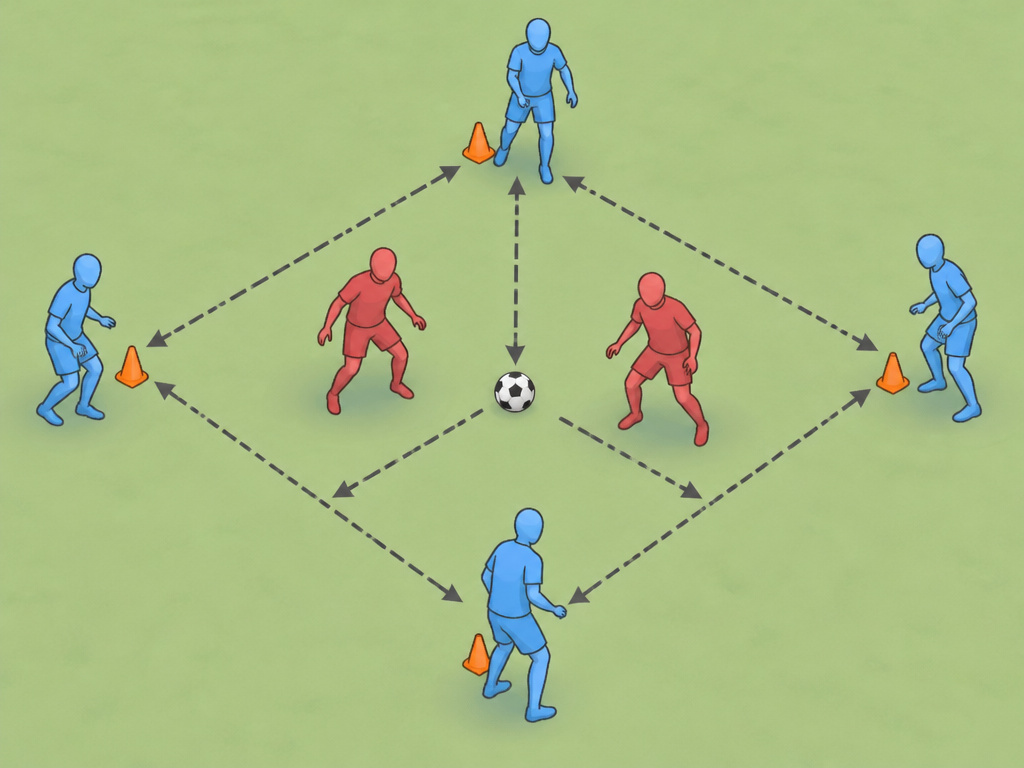
Now for the practical part. You’ve got cones and a ball. How do you set it up? The sources disagree on the exact dimensions, which is a gift, it means you have a dial to turn based on your players’ age and skill.
- Grid Size: The most cited standard is a 10x10m square, the size used in Guardiola’s sessions. Other guides suggest starting with an 8×8 yard grid. For younger or less skilled players, make it bigger (the area can be up to 40×40 yards). For a brutal, high-tempo exercise, shrink it (the area can be as small as 8×8 yards). The smaller the square, the less time and space, the higher the difficulty.
- Player Positions: For a 4v2, place one attacker on each side of the square. The two defenders start inside.
- Basic Rules: Attackers must stay on their line (they can move along it, but not inside the square). They try to keep possession. If a defender wins the ball, they immediately swap places with the attacker who lost it. Play one- or two-touch.
But here’s the first major coaching debate you’ll encounter, and it’s about geometry. Most resources describe a square. But coach Ben Kamara-Adams, in his Teach Like a Champion coaching guide, states a firm rule: “A 4 v 2 rondo must be in the shape of a diamond and not a square. This is so the passes are diagonal.
His reasoning is tactical. A diamond shape (one player at the top, one at the bottom, one on each side) naturally creates diagonal passing lanes that “break lines”, meaning the pass goes between or past defenders, not just sideways to a teammate. This is a more game-realistic passing pattern than simple square-to-square balls. It’s a prescriptive detail most guides miss, and it’s worth experimenting with.
Coaching Points: What to Shout (And What to Avoid)
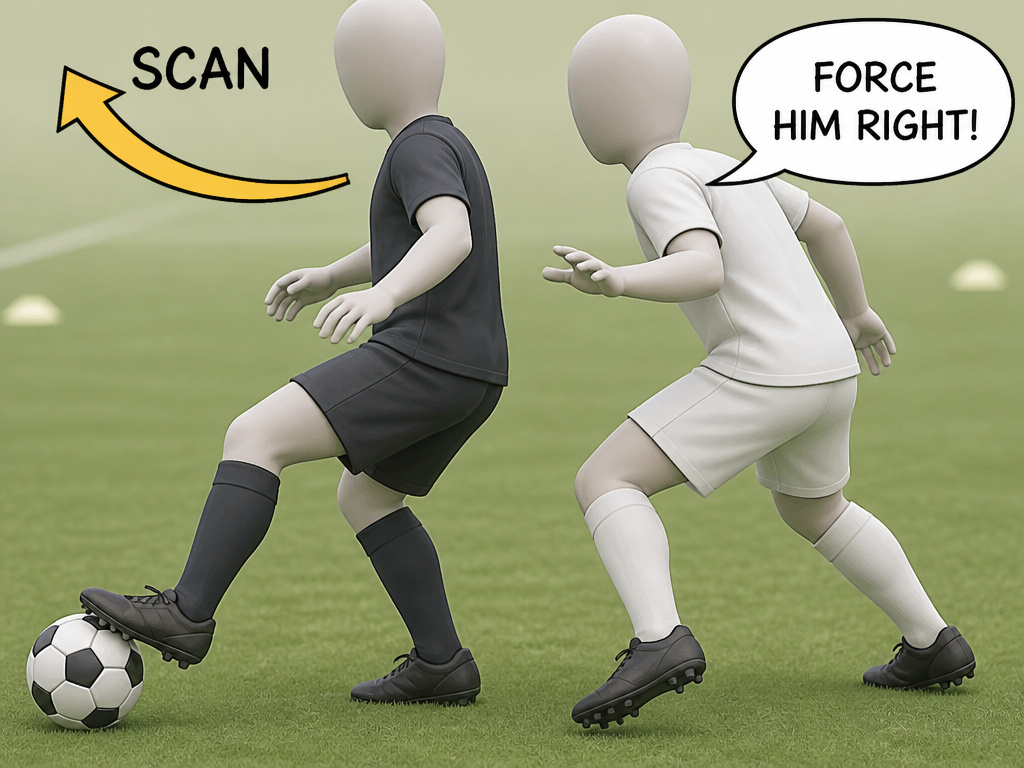
A rondo with no coaching is just a game. A coached rondo builds habits. Your job is to focus on one or two key points per session and repeat them relentlessly.
For the Attackers (The Possession Team):
- Scan Before Receiving: This is essential.
- Body Shape: Are they side-on, ready to play forward? Or are they square, forcing a back pass? Coach the open body shape.
- Pass Selection: Are they playing the safe pass to the nearest teammate, or are they looking to “split” the two defenders with a pass through the middle? Reward the risk that breaks lines.
For the Defenders (The Pressing Team):
- Press as a Pair:
- Communication: They should be talking constantly. “I’ve got left,” “Force him right,” “Switch!”
- Trigger to Press:
Common mistake: Letting players reset after every turnover. In a match, transitions are immediate.
Integrate these points into your wider training session structure. A rondo focused on defensive triggers should lead into a larger drill about pressing from the front.
Progressions, Variations, and When to Move On
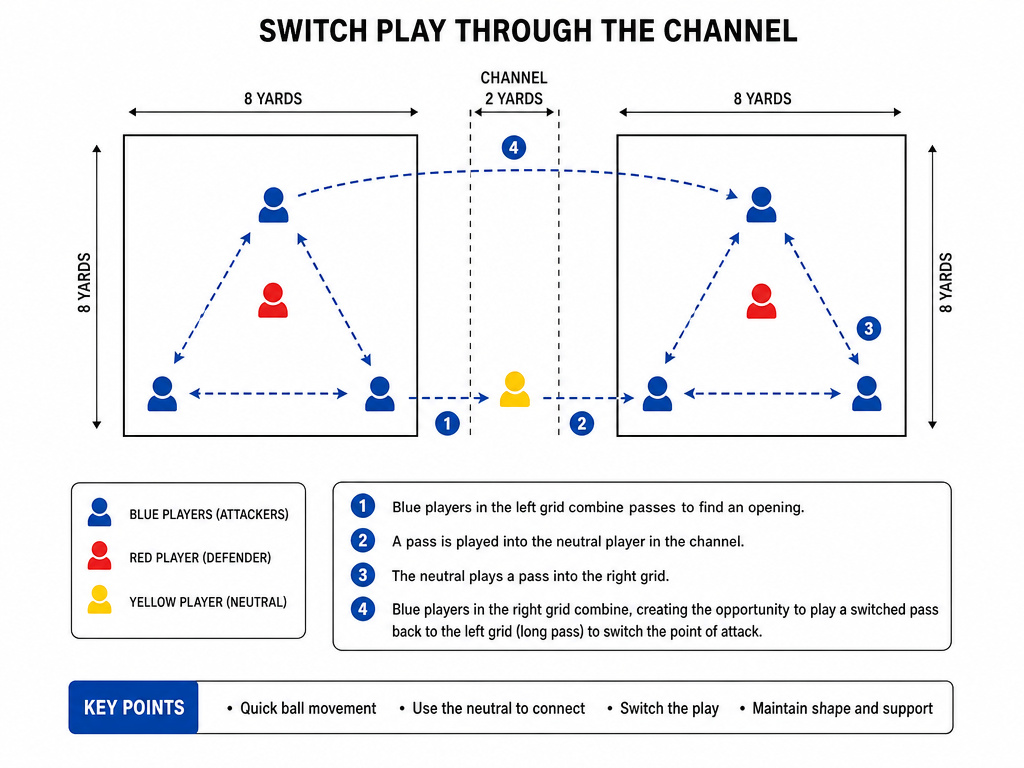
Once the basic 4v2 is solid, you change the constraints to teach new lessons. This is where rondos become a flexible framework, not just a single drill. Here are three powerful progressions:
- The Double Rondo: Set up two adjacent 8×8 yard grids with a 2-yard channel between them. Play 3v1 in each grid. Add a neutral player in the channel who can support either side. This teaches players to scan across a wider area and introduces longer, switched passes. It’s a fantastic bridge to larger small-sided training games.
- Directional Rondo: Add small goals or target players on opposite sides. Now, after a set number of passes (e.g., 8), the attacking team must play a forward pass into a goal or to a target player to score a point.
- Conditioned Rondo: Limit touches (two-touch, then one-touch). Or award extra points for a “split pass” that goes between the defenders. Or demand that every player must touch the ball before you can score.
These variations keep the drill fresh and target-specific skills.
Frequently Asked Questions
What’s the difference between a rondo and other possession drills?
Rondo is defined by a specific structure: an overload of attackers (e.g., 4) positioned around the perimeter of a small grid, against defenders (e.g., 2) inside it. Other possession games might have equal numbers, no perimeter rule, or larger grids. The rondo’s constraints create unique pressure and passing angles.
How long should a rondo last in a training session?
Sources vary. The Silva et al. Study analyzed 8-minute blocks. Soccer Coach Weekly recommends 15 minutes for a focused drill. For a warm-up, a shorter duration like the 8 minutes used in a study may be appropriate. The key is intensity, if the tempo drops, stop it. A sluggish 20-minute rondo is worse than a frantic 8-minute one.
Can I use rondos with very young players (U8-U10)?
Absolutely, but simplify drastically. Use a 3v1 or 4v1 format in a much larger grid (the area can be up to 40×40 yards). Forget touch limits. It’s less about tactics and more about fun, repetition, and basic ball mastery.
Why do some coaches hate rondos?
This is a failure of coaching, not the drill. A bad rondo is the coach’s fault.
Did Pep Guardiola invent the rondo?
No. He perfected its use and popularised it globally, but the drill was invented by Laureano Ruiz at Barcelona in the 1970s. Guardiola learned it as a player under Johan Cruyff, who had adopted it from Ruiz.
The Bottom Line
A rondo isn’t a warm-up to kill time. It’s a tactical and conditioning tool with adjustable levers: the grid size, the player ratio, the touch limit, the shape.
The 2026 study is the final word of caution. That 4v1 rondo you’re about to run? It’s a high-intensity sprint drill in disguise. Plan your session around that load. Use it to train the physical output you want, then use other formats like 5v2 to work on different aspects. That’s the difference between filling ten minutes and building a player.
