
Goal Kick Rules in Football: Four Steps Explained
This post contains affiliate links. As an Amazon Associate, we earn from qualifying purchases.
Under the goal kick rules in football, the ball sits stationary in the goal area and is in play once it is kicked and clearly moves. Opponents must stay outside the penalty area until then. A delayed goal kick brings a five-second countdown, and if the ball isn’t in play by the end, the opponents get a corner kick.
The “in play once kicked” idea only arrived on 1 June 2019. Before then, the ball had to leave the penalty area before anyone could touch it. IFAB, the body that writes the Laws of the Game, dropped that demand, and teams have restarted from the back very differently since.
Below: the countdown first, then the step-by-step procedure, the offences and their restarts, the quick-kick exception, the rule timeline, the tactical data, and the way youth leagues bend all of it.
Key Takeaways
- A goal kick that goes straight into your own net gives the opponents a corner. One into the opponents’ net counts.
- The kicker’s second touch before anyone else plays the ball costs an indirect free kick. A goalkeeper who does it to stop an obvious goal chance is sent off.
- The countdown can start before the keeper has the ball, and a yellow card only follows excessive delay after the corner is awarded.
- Premier League 2019/20 data shows short kicks progressed the ball 49 m against 38 m for long ones, yet led to 9 goals conceded against 5 scored.
- US youth build-out lines are local rules. They don’t come from Law 16.
Does the Five-Second Countdown Apply to Every Goal Kick?
No. It starts only when the referee decides a goal kick is taking too long or is being deliberately delayed. A restart at a normal pace doesn’t trigger it.
The countdown protocol for delayed goal kicks starts with a whistle, a clear hand or arm signal for the restart, and a raised-hand visual count from five. A verbal count can join the signal. If the ball is not in play when the count ends, the opposing team receives a corner kick on the side nearest the intended kick.
IFAB approved the extension at its 140th Annual General Meeting in Hensol, Wales, on 28 February 2026. It builds on the earlier change that stops goalkeepers holding the ball too long, and it stretches the same countdown to throw-ins as well as goal kicks.
The penalty differs by restart. A delayed throw-in goes to the opponents, from the same position as the original. A delayed goal kick hands the opponents a corner kick on the side of the field closest to where the goal kick was to be taken.
The Laws of the Game 2026/27 took effect on 1 July 2026. Concacaf applies them to its sanctioned competitions from 20 July 2026. A competition already running on 1 July could adopt the countdown early or wait for its next season, so ask your league which sanction applies.
From the touchline it looks like this: a whistle, an arm pointing at the ball, then a raised hand counting down from five. Five seconds sounds generous. It feels short when a keeper is jogging to the far side of the six-yard box.
IFAB’s throw-in and goal kick countdown protocol lists what can start the clock:
- Slow retrieval. A player who dawdles over fetching the ball.
- Wrong ball position. Putting the ball in an incorrect position at the goal kick counts as a deliberate delay.
- No possession needed. The referee can start counting before the keeper has picked the ball up, and the “hurry up” whistle or shout beforehand is optional.
- Safe on the last tick. A player already in the process of kicking when the count ends isn’t penalised, because the aim is tempo.
The discipline is lighter than you’d expect. In one of IFAB’s own Law 16 scenarios, a keeper puts the ball down, picks it up, walks a few metres and places it on the other side of the goal area. The referee whistles, signals and counts. If the ball isn’t in play after five seconds, it’s a corner, and the keeper escapes a card unless they then excessively delay that corner.
In my view that’s a fair design. The stalling side loses the restart, and the card stays in the pocket unless the stalling carries on.
Where this goes sideways: Treating the countdown as a booking. The sanction is a corner to the opponents, and a yellow card only follows if the delay continues after that corner is awarded, with a red only for excessive delay on top of that caution.
Four Steps From Goal Line to Live Ball, and What Each Skipped Step Costs
A goal kick follows a short chain of events, and every link carries a penalty.
The chain starts when the attacking team touches the ball last and it crosses the goal line. The defending team restarts. The NFHS (the US high school governing body) says the kick is taken by “a player of the defending team”, and IFAB’s own scenarios talk about “a player of defending Team A” taking quick ones. Any defender can take one. Goalkeepers take plenty, and the goalkeeper rules in football cover the rest of that job. The full text sits in IFAB’s Law 16.
- Spot the ball on the ground, still, anywhere in the goal area. Corner of the six-yard box or centre, both are legal. Put it in an incorrect position on purpose and the referee can start the five-second countdown.
- Kick it so it clearly moves. That’s the instant it’s live, and it doesn’t have to leave the penalty area. A touch that leaves the ball sitting there restarts nothing, and the opponents still have to stay out.
- Opponents stay outside the penalty area until then. Enter early and foul someone, and the kick is retaken while the offender risks a caution or a sending-off.
- The kicker waits for a second player to touch it. Play it again first and the opponents get an indirect free kick.
On a wet grassroots pitch, a ball set in a muddy patch of the goal area sits down and won’t roll. A keeper hunting for a better spot burns the clock.
Easy to miss: Opponents have to clear the penalty area, the bigger box, and standing outside the six-yard box doesn’t count. An early foul anywhere inside it gets the kick retaken the moment the whistle goes, and the offender risks a card.
I think the second-touch rule catches more enthusiastic players than cynical ones. The kicker who chases their own clearance to “get it going again” hands the opponents an indirect free kick, and nobody planned that.
Second Touches, Handballs and Own Goals: Which Restart Follows
Law 16 splits a kicker’s handball three ways. An outfield kicker who handles the ball after it’s in play concedes a direct free kick, or a penalty kick if it happens inside the kicker’s own penalty area. A goalkeeper kicker concedes an indirect free kick instead.
That split sits alongside the other rulings, which are easier to read side by side. DOGSO means denying an obvious goal-scoring opportunity. SPA means stopping a promising attack.
| Situation | Restart | Discipline |
|---|---|---|
| Kicker plays it twice | Indirect free kick | Keeper: red for DOGSO, yellow for SPA |
| Ball straight into own net | Corner to opponents | None |
| Flick-up to a team-mate | Indirect free kick | Yellow for the initiator |
| Opponent fouls before ball is live | Kick retaken | Caution or red, by severity |
| Attacker deliberately stays in area | Kick retaken | Yellow only if persistent |
| Opponent had no time to leave | Play continues | None; goal can stand |
The second touch
The kicker who touches the ball again before another player does gives the opponents an indirect free kick, which can’t score directly. If that touch stops an obvious goal chance, a goalkeeper is sent off. If it stops a promising attack, the card is yellow.
Advantage changes the picture. In one IFAB scenario, a keeper slips and plays the ball twice to deny a clear chance, but the attackers score anyway. The goal stands and the keeper gets no card. IFAB’s 2026/27 Law 12 wording backs this up: the offender isn’t cautioned if a goal is scored, because the offence didn’t prevent one.
The flick-up trick fails too. If a keeper flicks the ball up so a team-mate can head it back, the initiator is cautioned for unsporting behaviour and the opponents get an indirect free kick.
Watch the referee’s arm. NFHS rules have the referee raise an arm above the head for an indirect kick and hold it until the ball touches another player or goes out of play.
Handball by the kicker
Handball only counts once the ball is in play. Before the kick moves, there’s nothing to punish.
Scoring straight from the kick
A goal can come directly from a goal kick, but only against the opponents. Kick it into your own net and the opponents get a corner. That’s the legal basis for goalkeepers scoring from goal kicks.
Offside at restarts has its own explainer covering offside from a throw-in, goal kick and corner. Law 16’s own example only covers an attacker in an offside position who doesn’t touch the ball before it crosses the goal line: the restart is still a goal kick. The wider Law 11 wording on goal kicks isn’t in the sources I checked for this piece, so confirm it with IFAB before you quote it to a referee.
When Can an Opponent Play a Quick Goal Kick?
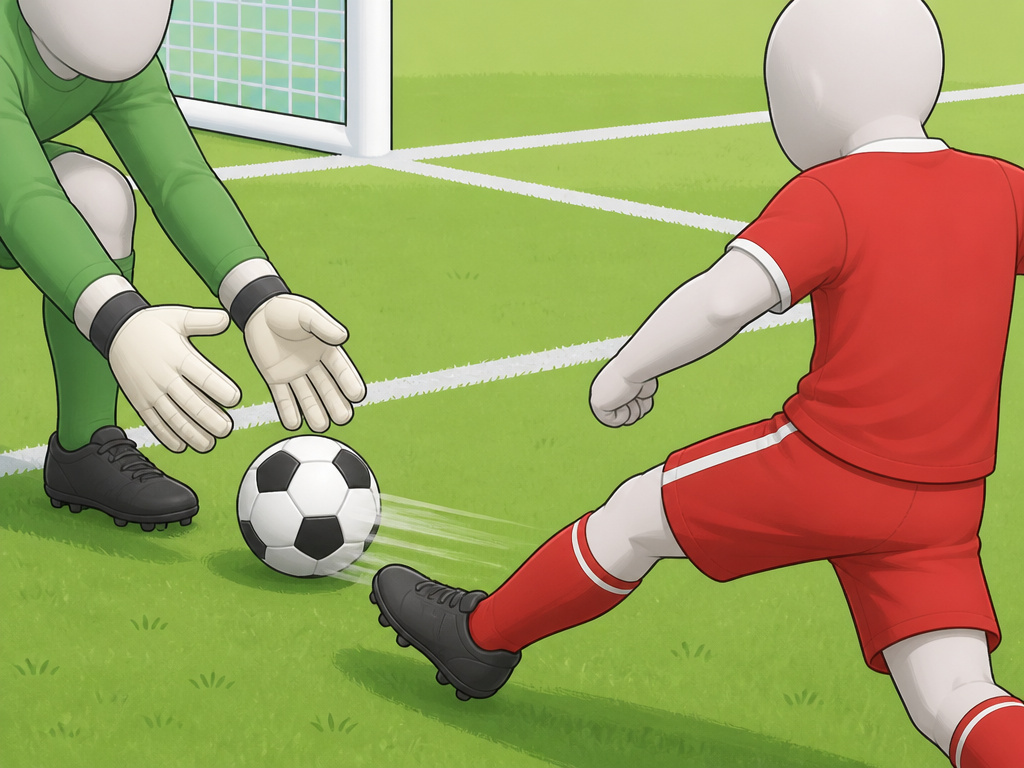
When a quick kick catches an opponent who genuinely had no time to leave the penalty area, play carries on and that opponent can use the ball.
Picture the IFAB scenario. An attacker falls over a bad touch, the ball goes out, and the keeper restarts at speed while the attacker is still inside the box with their back to goal. The attacker intercepts and scores. The goal stands.
Why? IFAB’s reasoning is that the kicking team tried to gain an advantage by going quickly, and if that “goes wrong” the Law isn’t there to save them. The same goes if the keeper’s kick accidentally hits a late-leaving opponent who controls it and scores.
Deliberate staying is another matter. An opponent who remains in the area and tries to intercept the ball gets the kick retaken, because they shouldn’t gain from loitering even when the kick is quick. A yellow card only follows if the player persistently offends.
I’d rather a referee judge an attacker’s effort than their position. One sprinting out of the box as the kick is struck is playing fair. One standing still and watching the ball is cheating the restart.
Rewind a second. Who decides what “genuinely” means? The referee does, by watching effort, which makes it a judgement call and a fair source of grumbling.
I like quick restarts, and I think too many sides treat a goal kick as a pause. Law 16 is plain that speed is allowed.
Goal Kick Rules in Football Before and After 1 June 2019
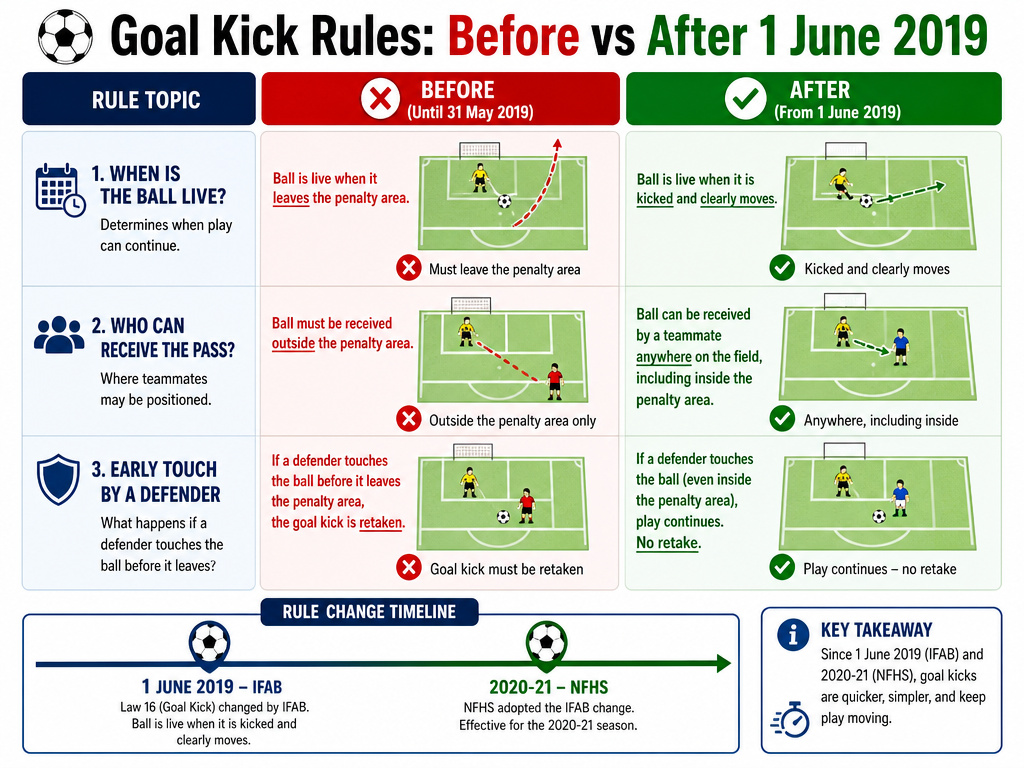
Two dates frame the history: 1 June 2019 for IFAB, and the 2020-21 season for the NFHS, one season later.
IFAB’s change came into force on 1 June 2019. The change removed a time-wasting trick: defenders would touch the ball before it left the area, forcing a retake.
| Question | Before 1 June 2019 | Now (Law 16) |
|---|---|---|
| When is the ball live? | After it left the penalty area | Kicked and clearly moves |
| Who can receive the pass? | Team-mate outside the area | Team-mate inside the area too |
| Early touch by a defender | Forced a retake | Trick no longer works |
The NFHS followed with its NFHS soccer rules changes 2020-21, published on 19 August 2020. Its goal kick wording is “kicked from the ground from any point within the goal area”, and the ball is in play when it’s kicked and moves. The kicker can’t play it again until another player has touched it.
The old rule survives in people’s heads. Some video explainers still teach that the ball must leave the penalty area or the kick is retaken. IFAB’s text says otherwise.
College play needs its own check. I couldn’t find the current NCAA rulebook wording. Look at ncaa.org before assuming it matches.
Short Goal Kicks: 49 Metres of Progress and a 5-to-9 Goal Tally
Short goal kicks look excellent in the progression numbers and worse in the goals column.
I stopped building tactical pieces from highlight packages alone. Highlights show goals but hide the 80 minutes of structure around them, so I watch full matches now. Goal kicks prove the point: a clip can show a goal that grew from a short restart, but it can’t show the traps teams set to stop the next one.
This Premier League and Opta season-trend analysis covers 288 matches in 2019/20. Opta, the data company, counts a goal kick as short when the pass ends less than 40 metres from the team’s own goal. Short kicks progressed the ball 49 m on average and long ones 38 m. Manchester City led at 61.8 m, Arsenal trailed at 40.5 m, and every team did better from short than long.
The goals tell a different story. Moves starting with short kicks produced 5 goals scored and 9 conceded from turnovers. Long kicks produced 0 scored and 2 conceded. The report also shows 36 shots created and 42 conceded after short kicks, against 21 and 34 after long ones. It doesn’t list how many kicks sit in each group, so the raw counts can’t be turned into rates.
A University of Chichester goal kick thesis reached a different conclusion on 292 games. It found 620 short kicks, 77.6% played short-to-short and 22.4% short-to-go-long. Short-to-short reached the final third in 18.10% of possessions against 8.6% for short-to-long.
| Source | What it measured | Finding |
|---|---|---|
| Premier League/Opta, 288 matches | Goals after short vs long | Short 5 for, 9 against; long 0 and 2 |
| Chichester thesis, 292 games | Outcome of short routines | Final third: 18.10% vs 8.6% |
| Brazilian study, one team | Pass type from goal kicks | Short share 22.7% to 37.8% |
These sources measure different things. Chichester tracks what happens next in the possession, while the Premier League piece counts goals conceded from turnovers. Short kicks can progress the ball and still be punished when they go wrong.
IFAB called the 2019 change a faster, more dynamic, more constructive restart. The 9-to-5 count arguably supports coaches who still go long against a press, though it’s a snapshot, not a verdict.
The Brazilian journal study followed one top-flight team across 76 games. The short-pass share from goal kicks rose from 22.7% in 2018 to 37.8% in 2019, a significant change. Short-pass interactions per game rose from 12.88 to 20.77, and the team went short more at home (40.7%) than away (25%). I couldn’t confirm the study’s method, so treat it as one data point.
Placement shifted too. American Soccer Analysis reported that MLS teams took goal kicks from the ends of the six-yard box from 2013 to 2016, then Atlanta and Columbus moved to the centre in 2017. By 2019 only a handful still used the corners. The centre makes the whole field available, whereas a corner “pre-concedes” one half. Goal kicks ending in a team’s own half have doubled since 2013 and made up more than half in 2019.
Making a short restart work asks a lot of the keeper’s feet, and the goalkeeper distribution techniques behind it are a skill set of their own.
I’m an eyes-and-notebook writer, not a spreadsheet one (my old team-mates would agree). So I’d rather you check these figures than trust my gut. Skip any plan built on a slogan like “always play short”. The evidence cuts both ways.
Does a Build-Out Line Change Who Can Touch the Ball?
Yes, but only in leagues that adopt one. A build-out line is a local rule, and Law 16 doesn’t contain it.
EDP Soccer’s US youth policy sets the pattern for 7v7:
- Retreat line. Opponents retreat behind a line halfway between the top of the penalty area and the halfway line.
- Release. Defenders are freed when the ball crosses the build-out line, a team-mate takes a second touch, or the ball comes to a complete stop.
- Banned kicks. Punts and drop kicks aren’t allowed.
- Offside. The line also sets offside in EDP’s version.
- Gone at 9v9. The line is dropped.
At least one club guide says opponents may cross only once the ball has left the penalty area. That’s the pre-2019 standard, so treat it as a separate rule and don’t merge it with EDP’s.
My reading is that the line exists to encourage playing out from the back, though I haven’t seen EDP state its reason in the material I checked. A coach who yells “hoof it” at under-10s to win a match is trading development for a result. That’s my view, not a rule.
Is there offside from a goal kick?
A goal kick is a restart, and a goal can be scored directly from one, but only against the opposing team. If the ball goes straight into the kicker’s own goal, the opponents get a corner kick instead. Many video explainers say there is no offside from a goal kick. The material behind this article does not confirm that as a Law 11 statement, so treat it as common understanding and check the current Laws before relying on it in a dispute.
What the Laws do say is useful. If an attacker in an offside position does not touch the ball or affect an opponent before it crosses the goal line, the restart is still a goal kick. The team taking the kick should focus on placing the ball and playing it, and leave the question of where attackers are standing to the officials.
When is a goal kick retaken?
The ball is in play once it is kicked and clearly moves. Opponents must be outside the penalty area until then. If an opponent deliberately stays in or enters the penalty area before the kick and tries to play the ball, the kick is retaken. An attacker who lingers on purpose is not cautioned unless they keep doing it. If an opponent enters early and fouls a player, the kick is retaken and the offender may be cautioned or sent off.
There is one exception. If an opponent genuinely had no time to leave the area at a quick goal kick, they may play the ball once it is in play and the goal can stand.
The material here gives no specific retake for a misplaced ball. In practice, set it still on the ground inside the goal area. Putting it in an incorrect position can start the five-second countdown, which risks a corner for the opponents. The old idea that the ball must leave the penalty area before anyone touches it is out of date.
Goal kick vs corner kick: what’s the difference?
A goal kick is taken by the defending team from the goal area. A corner kick goes to the attacking side. Which one you get depends on how the ball left play, and a few cases blur the line.
If a goal kick goes directly into the kicker’s own goal, the opponents are awarded a corner kick. A delayed goal kick can also hand the opponents a corner on the side of the field closest to where the kick was to be taken.
The throw-in works differently. A delayed throw-in goes to the opponents, from the same position as the original. The countdown now covers both restarts.
One more case catches people out. A defender’s foul in the penalty area after the ball has wholly crossed the goal line is not a penalty. Play restarts with a goal kick, though a reckless push can still earn a yellow card and serious foul play a red.
Frequently Asked Questions
What is the new goal kick rule in football?
IFAB added a five-second visual countdown for goal kicks the referee thinks are being delayed. If the ball isn’t in play when it ends, the opponents get a corner kick. The wider Laws of the Game 2026/27 took effect on 1 July 2026.
When did the goal kick rule change?
The ball became live on being kicked on 1 June 2019. The countdown was approved on 28 February 2026 and took effect on 1 July 2026. US high school football (NFHS) adopted the “kicked and moves” wording for 2020-21.
Can you take a goal kick from anywhere?
You can take it from any point inside the goal area, from the ground. The ball must be still before you kick it. If you place the ball outside the goal area, the referee can treat it as the wrong position and start the countdown.
Does the ball have to leave the penalty area?
No. Since 2019 the ball is in play once it’s kicked and clearly moves, so a short pass to a team-mate inside the area is legal. Some older videos still teach the pre-2019 rule.
Can you score directly from a goal kick?
Yes, but only against the opposing team. If the ball goes straight into the kicker’s own goal, the opponents get a corner kick.
The Bottom Line
Goal kick rules in football look simple until a quick restart, a late-leaving attacker or a stalling keeper tests them. Most of the grey areas come down to one question: was the ball live yet?
Here’s your first step this week. If your competition started before 1 July 2026, ask the organiser whether it adopted the countdown early or is waiting for its next season. One season can run under different sanctions. In 7v7 youth football, the opponents-stay-out advice above is replaced by your league’s build-out line.
My default for a side that can pass out under pressure: restart short, unless the opponents’ press has already set, and then kick long. That’s my read, not IFAB’s.
So is a goal kick a restart or a pause?
