
How the UEFA Women’s Champions League Works?
This post contains affiliate links. As an Amazon Associate, we earn from qualifying purchases.
The UEFA Women’s Champions League works through a new 18-team league phase where each club plays six matches against six different opponents, with the top four qualifying directly for the quarter-finals. Teams finishing 5th to 12th enter a two-legged knockout phase play-off, while sides ranked 13th to 18th are eliminated. The competition is preceded by a qualifying phase with champions and league paths, and runs parallel to the new UEFA Women’s Europa Cup.
That structure replaces the old group stage. It means every match in the league phase weighs on a single, combined table, so there’s no hiding place and no dead rubbers. The tension carries right through to the final matchday, where all games kick off simultaneously. This is a key part of how the UEFA Women’s Champions League works.
Here’s how the whole machine fits together, from the first qualifying rounds in summer to the final in Oslo the following May, which is central to understanding how the UEFA Women’s Champions League works. We’ll break down the league phase draw, the knockout bracket, the new Europa Cup, and where you can watch it all.
Key Takeaways
- The new 18-team league phase starts in October 2025, with each team playing six matches (three home, three away) against six different opponents.
- Teams ranked 1-4 advance directly to the quarter-finals; sides ranked 5-12 enter a two-legged knockout phase play-off; clubs ranked 13-18 are eliminated.
- Qualification for the league phase is split between a champions path (for domestic title holders) and a league path (for runners-up/third-place teams from top associations).
- The new UEFA Women’s Europa Cup runs in parallel, offering a second chance to clubs eliminated in UWCL qualifying and a route into next season’s Champions League for its winner.
- Broadcasting rights for the 2025/26 season are held by Disney+ in many territories and by CBS/Paramount+ in the United States.
What Is the New League Phase Format?
Forget the old groups of four. From the 2025/26 season, a key part of how the UEFA Women’s Champions League works is that it begins with a single league of 18 teams. The idea is simple: more matches that matter, and no easy calculations about who needs what to finish second.
Each team plays six matches, three at home, three away. You face six different opponents, not the same three teams home and away. The standard three points for a win, one for a draw, applies. All 18 teams are ranked in one table. The last matchday sees all fixtures kick off at the same time, a Wednesday at 21:00 CET, to keep the drama honest.
The league phase features 18 teams. Each team plays 6 matches (3 home, 3 away) against six different opponents, with three points for a win and one for a draw. The fixtures on the final matchday are played simultaneously.
The schedule is tight. For the 2025/26 season, these league phase matches are packed between October and December. That’s a lot of high-stakes football in a short window. The UEFA administration decides the specific match schedule for each round, aiming to balance home and away runs, though they can derogate from the usual rules “if necessary”.
Where this goes sideways: Assuming a slow start is fine because you’ll play the same teams again. You won’t. Every one of those six games is a unique fixture, so a poor opening month leaves you chasing with no direct return match to make up points.
How Does the Rest of the Tournament Work?
Once the league phase table is set, the road splits three ways. This is where the new format’s ruthlessness, and its second chances, becomes clear.
The destinations are fixed by your final league position:
- 1st to 4th: Direct passage to the quarter-finals. Your job is done until the knockout rounds begin in earnest.
- 5th to 12th: You enter the knockout phase play-offs. This is a two-legged tie (home and away) where the winners join the top four in the last eight.
- 13th to 18th: You’re out. Elimination after the league phase.
The play-off draw has its own logic. Clubs are paired as seeded pairs (positions 5 & 6, 7 & 8) and unseeded pairs (positions 9 & 10, 11 & 12). The draw then sets the ties: the 5/6 pair plays the 11/12 pair, and the 7/8 pair plays the 9/10 pair. It’s designed to reward a higher league finish with a theoretically easier route.
From the quarter-finals on, it’s a straight knockout tournament. The top-four finishers are seeded for the quarters, meaning they play the second leg at home. That seeding advantage carries through: the teams ranked 1 and 2 after the league phase are scheduled to play the return leg at home in the semi-finals. Here’s the interesting twist, if the 1st or 2nd ranked team gets knocked out in the quarters, the team that beats them takes over their seeding position in the bracket. The advantage is attached to the spot, not the club.
The 2025/26 final is scheduled for Saturday, 23 May 2026 at Ullevaal Stadion in Oslo. For administrative purposes, the team coming from the silver side of the knockout bracket is considered the nominal home team.
| League Phase Finish | Destination | Format |
|---|---|---|
| 1st – 4th | Quarter-finals | Direct qualification |
| 5th – 12th | Knockout Phase Play-off | Two-legged tie (home & away) |
| 13th – 18th | Eliminated | – |
How Does Qualification Work?
Not all 18 league phase spots are created equal. They are divided between direct entries and teams that come through a qualifying process, which itself has two distinct paths. Understanding this access list is key to knowing who gets to dance.
Sources disagree on the number of direct entries: one UEFA source states nine teams enter the league phase directly for 2025/26, while another describes the 18-team phase being filled by a combination of direct entries and teams from qualifying paths. According to UEFA’s access list, these are:
- The previous season’s UWCL titleholder is guaranteed a place in the league phase.
- The champions and runners-up of France and Germany.
- The champions of Spain, England, Portugal, and Italy.
The other nine spots are filled via a qualifying phase. This is split into:
- Champions Path: For domestic champions from associations without direct league phase entry. Four teams from this path will reach the league phase.
- League Path: For non-champions from the top-ranked associations. Five teams from this path will reach the league phase. This path is now extended to include the runners-up of the association ranked 17 and the third-placed team from the seventh-ranked association.
The qualifying phase itself has multiple rounds. The first and second qualifying rounds are played as single-leg mini-tournaments, hosted by one of the participants. If scores are level after 90 minutes, they go to extra time and then penalties. All third qualifying round ties, however, are two-legged home-and-away knockout matches.
Common mistake: Thinking the “champions path” is only for small nations. The champions of every association that doesn’t have a direct league phase slot enter this path, meaning giants from mid-ranked leagues often start their journey here.
There’s also a safety net for titleholders. The UEFA Women’s Champions League titleholder is guaranteed a place in the league phase. The UEFA Women’s Europa Cup titleholder is guaranteed a place in the third qualifying round of the champions path. If they’ve already qualified via their league, their spot is filled by the next highest-ranked club.
What About the New Women’s Europa Cup?
2025/26 isn’t just about a new Champions League format. UEFA is also launching a second women’s club competition: the UEFA Women’s Europa Cup (UWEC). Think of it as a parallel tournament that offers more clubs European football and a backdoor into next season’s Champions League.
Thirteen teams are entered directly into the Women’s Europa Cup. But its connection to the Champions League is what makes it strategic.
Clubs eliminated from the UWCL qualifying phase drop into the Europa Cup at specific stages:
- UWCL second qualifying round, third-placed team → UWEC first qualifying round.
- UWCL second qualifying round, second-placed team → UWEC second qualifying round.
- UWCL third qualifying round, defeated team → UWEC second qualifying round.
Sources describe the format differently: one states the UEFA Women’s Europa Cup will be played over six rounds, while another specifies all Women’s Europa Cup rounds are played over two legs (home and away). The prize for the winner is significant: automatic qualification for the third qualifying round of the champions path. It’s a genuine second chance with a tangible reward.
How Are Teams Seeded and Ranked?
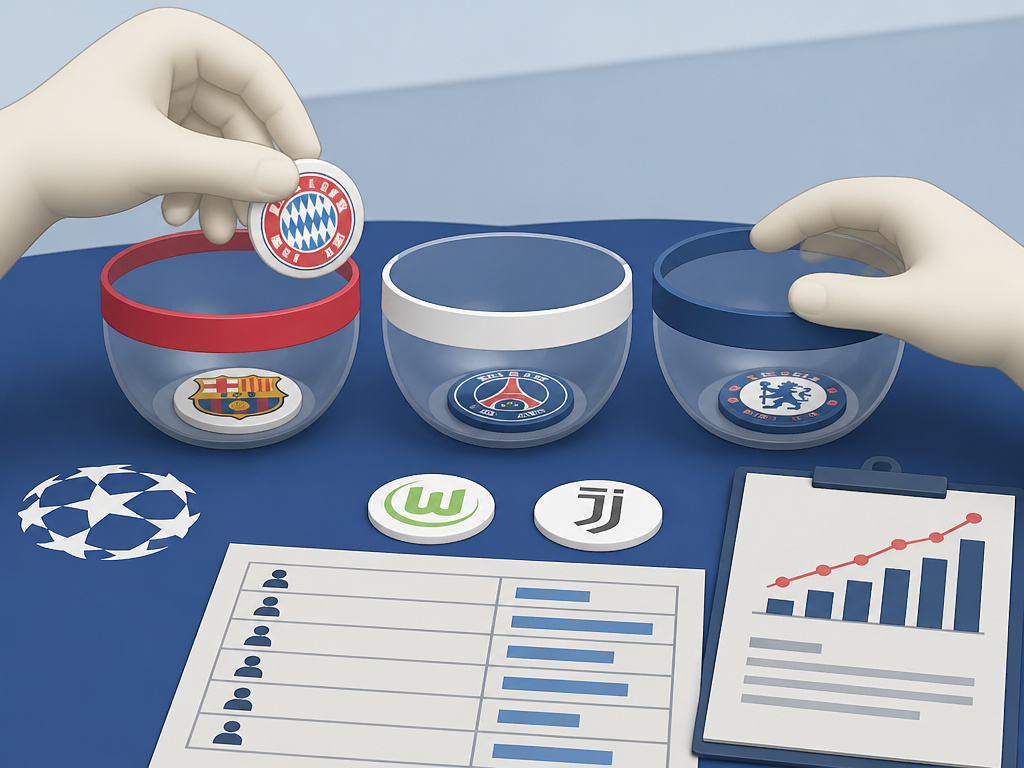
The draw for the league phase isn’t random. It’s based on the club coefficient system, a points-based ranking that reflects a team’s European performance over the previous five seasons. This is the same system used in the men’s Champions League, and it’s crucial for understanding the tournament’s seeding and draws.
For the league phase draw, the 18 clubs are divided into three pots of six. The 18 clubs in the league phase are divided into three pots of six clubs based on club coefficient, with the UEFA Women’s Champions League titleholder as the top seed in pot 1.
Coefficients aren’t just for seeding; they’re also a currency earned during the competition. Clubs earn bonus points based on their final league phase ranking, ranging from 10.000 for 1st to 7.000 for 13th-18th, with specific values for each position in between. You also get extra points for progressing in either European competition: 1 point per round in the UWCL (quarters, semis, final) and 0.5 points per round in the UWEC.
This system, detailed in our guide on the UEFA coefficient system, creates a feedback loop. Success this season gives you a higher coefficient, which leads to better seeding next season, which can make the path to further success slightly easier. It rewards consistency.
How Does This Compare to the Men’s Tournament?
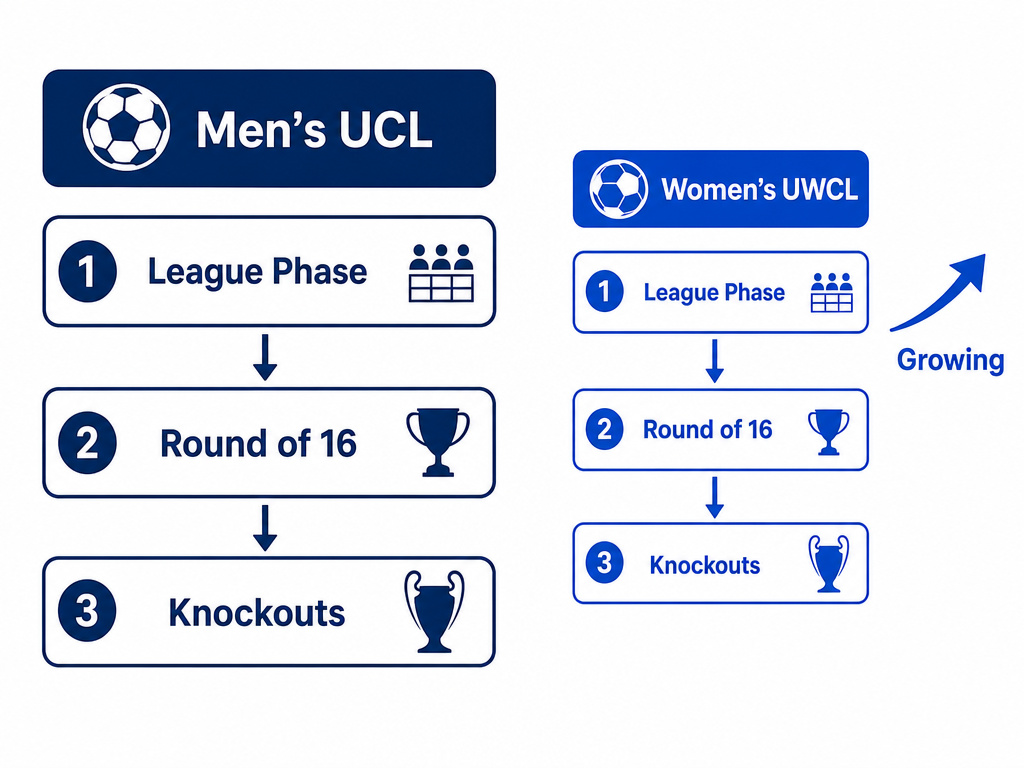
The new Women’s Champions League format is closely modelled on the changes introduced to the men’s competition in 2024/25. The core idea, a single league phase replacing traditional groups, is identical. But the scales are different, reflecting the different stages of development in the club ecosystems.
The women’s version starts at 18 teams with six matches each. The principle of a unified table and the split of outcomes (direct quarters, play-offs, elimination) is the same. Even the introduction of a second competition mirrors the men’s structure, with the UWEC sitting in a similar position to the UEFA Europa League and Europa Conference League.
The major difference lies in qualification. This will likely expand as the women’s game grows.
Key Rules and Tie-Breakers
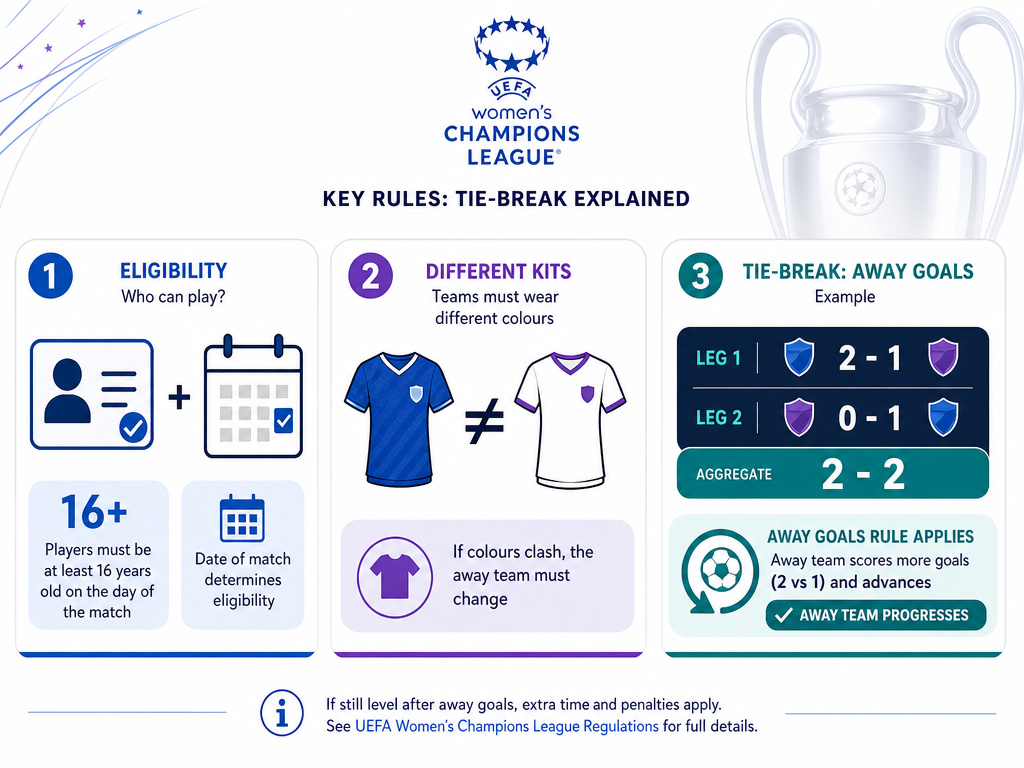
Beyond the format, a few specific rules govern how the competition unfolds. Knowing these can clarify confusing moments.
Player Eligibility: A player must be at least 16 years old by the end of the calendar year when a match is played. Crucially, a player cannot represent more than one club in the UWCL or UWEC in a single season, with a narrow exception for players fielded in the early qualifying rounds.
Match Rules: In the two-legged knockout ties, including the play-offs and the later rounds, the standard aggregate score rule applies. For coefficient calculations, match points are awarded based on final scores ratified by UEFA; penalty shoot-outs do not count.
Administrative Flexibility: The regulations give UEFA the power to adapt. Draw conditions can be changed “to avoid deadlock,” and the knockout phase draw may be adapted or positions assigned to account for constraints. It’s a built-in recognition that a rigid system can sometimes break.
How and Where to Watch
A landmark broadcasting deal means wider access than ever before. According to a report citing a broadcast deal, Disney+ secured a five-year deal with UEFA for the rights to show all 75 games of the 2025/26 season. This is a major shift towards a centralised, streaming-focused presentation.
According to broadcast information, in America, all fixtures will be shown live on CBS and Paramount+.
For fans following specific leagues, like the English Women’s Super League, it means your club’s European matches will likely be on a different platform than their domestic games. It’s worth checking local listings, as other broadcasters may hold rights in different territories, but the Disney+ and CBS deals cover two of the largest markets.
When are the UEFA Women’s Champions League matches played?
For the 2025/26 season, the league phase matches are scheduled between October and December. Each team plays six matches, three at home and three away, against six different opponents. The fixtures on the final league phase matchday are all played simultaneously on a Wednesday evening. After the league phase, the knockout phase play-offs and quarter-finals follow, with matches typically kicking off in the early and late evening slots. The UEFA administration decides the specific schedule for each round from the league phase onwards. The final is set for Saturday 23 May 2026 at Ullevaal Stadion in Oslo.
Is there prize money in the UEFA Women’s Champions League?
The competition offers financial rewards to participating clubs, which are distributed based on performance. These points contribute to a club’s overall coefficient and are linked to the financial distribution system.
Who holds the records in the UEFA Women’s Champions League?
Frequently Asked Questions
What is the UEFA Women’s Champions League?
It is the premier annual club competition in European women’s football, organised by UEFA. It features the top clubs from across the continent competing in a format that includes a qualifying phase, a league phase, and knockout rounds, culminating in a final at a neutral venue.
How many teams are in the Women’s Champions League?
Additional teams participate in the qualifying rounds beforehand, with some dropping into the new UEFA Women’s Europa Cup.
Who qualifies for the Women’s Champions League?
Qualification is based on a club’s performance in its domestic league. The champions and runners-up of the top-ranked associations (like France and Germany) often get direct spots in the league phase, while champions from other nations enter a qualifying path. The exact number of slots per country is determined by UEFA’s association coefficients.
Has the Women’s Champions League format changed?
Yes, significantly. Starting with the 2025/26 season, the traditional group stage has been replaced by an 18-team single league phase. Each team plays six matches against six different opponents. The top four advance directly to the quarter-finals, positions 5-12 enter a play-off round, and the bottom six are eliminated.
What is the UEFA Women’s Europa Cup?
The UEFA Women’s Europa Cup is a new second-tier European club competition launched in 2025/26. It runs parallel to the Champions League and features clubs that either enter directly or are eliminated from the UWCL qualifying rounds. The winner earns a place in the next season’s Champions League qualifying phase.
The Bottom Line
The new format is a bold step. It creates more high-stakes matches from the very beginning, eliminates meaningless final group games, and integrates a second competition that gives more clubs a European platform. The mechanics, from the coefficient-based seeding to the play-off bracket, are designed to reward consistency and a strong league phase finish.
For fans, it means a more intense and engaging autumn of football, where every result shifts a single, massive table. The simultaneous kick-offs on the final matchday will be a spectacle. For clubs, the margin for error is smaller, but the rewards for success, both in silverware and crucial coefficient points, are even greater. It’s a format built for growth, mirroring the men’s game’s evolution while establishing the women’s club game on its own compelling terms.
