
How the Women’s Euros Works: Format, Rules & History
This post contains affiliate links. As an Amazon Associate, we earn from qualifying purchases.
The UEFA Women’s European Championship is a 16-team continental tournament held every four years, with the 2025 edition running from 2 to 27 July in Switzerland. The final tournament features four groups of four, where the top two teams advance to a straight knockout stage of quarter-finals, semi-finals, and a final, with no third-place playoff. Qualification is now directly linked to the preceding UEFA Women’s Nations League.
That link to the Nations League is the single biggest change to the system. It means a team’s performance over a two-year cycle sets their path to the Euros, replacing the old standalone qualifying groups. The result is a more coherent, season-long narrative for women’s international football. Understanding how the Women’s Euros works is key to following this new structure.
What follows is a breakdown of that qualification labyrinth, the simple-but-brutal final tournament format, the eight Swiss host cities, and the specific legacy this 2025 edition is designed to leave behind.
Key Takeaways
- The 2025 tournament in Switzerland runs from 2–27 July, with 16 teams competing across eight host cities.
- Qualification is now tied directly to the UEFA Women’s Nations League, with the top eight League A teams advancing automatically and the rest determined through a two-round playoff system.
- The final tournament format is four groups of four, with the top two from each group advancing to a single-leg knockout stage (quarter-finals, semi-finals, final).
- This edition will use connected ball technology and semi-automated offside (SAOT) for the first time in the Women’s EURO, with all match officials supported from a central hub in Nyon, Switzerland.
- The tournament’s legacy programme aims to double the number of female players and coaches in Switzerland by 2027, using the event as a catalyst for structural growth.
The Road to Switzerland: A Nations League Primer
The old system of drawn qualifying groups is gone. Since the 2023-25 cycle, your ticket to the Women’s EURO is earned through your performance in the UEFA Women’s Nations League.
Here’s how it worked for 2025. After the 2023/24 Nations League concluded, all 51 competing UEFA nations were ranked and split into three leagues for the European Qualifiers phase: League A (16 teams), League B (16 teams), and League C (the remaining teams). Your league placement wasn’t a random draw; it was a direct reflection of where you finished in the Nations League. This creates a true pyramid where success is consistently rewarded.
The eight top teams in League A qualified directly for the final tournament. This rewards excellence in the top flight over a sustained period.
Hosts Switzerland, who were in League B, were guaranteed their spot regardless of their qualifying result, bringing the total confirmed teams to nine. The remaining seven slots were fought over in a two-round playoff system that involved teams from all three leagues. It’s a complex bracket, but the principle is clear: it gives teams in lower leagues a shot, while making the path harder for those who underperformed in the top tier.
| Qualifying Path | Teams Involved | Outcome |
|---|---|---|
| Direct Qualification | Top 8 in League A | 8 teams to finals |
| Host Nation Slot | Switzerland (League B) | 1 team to finals |
| Play-off Round 1 | 3rd/4th in League A vs. Winners/Best runners-up in League C | 8 winners advance |
| Play-off Round 2 | 7 drawn ties from Round 1 winners & League B teams | 7 winners to finals |
The complexity here is a feature, not a bug. It makes every Nations League match matter, because a poor campaign doesn’t just mean relegation—it means a much tougher route to the main event two years later when you consider how the women’s euros works. It’s a format that understands the growth of women’s football needs a competitive structure that engages fans all season.
The Final Tournament Format: Groups & Knockouts
Sixteen teams arrive in Switzerland. The draw on 16 December 2024 in Lausanne sorts them into four groups (A, B, C, D) of four teams each.
The group stage is a round-robin. Each team plays the other three in its group once. You get three points for a win, one for a draw. The top two teams in each group, determined by total points, advance to the quarter-finals. There is no “best third-place team” safety net like in some expanded men’s tournaments. Finish third, you’re on the next flight home.
Where this goes sideways: Assuming goal difference is the first tiebreaker. If two teams are level on points, the head-to-head result between them is the first deciding factor, then goal difference in the matches between them, then overall goal difference.
The schedule is built for recovery. UEFA regulations state each team must have at least three rest days between matches during the tournament, which is a key part of how the women’s euros works. And for competitive integrity, the final two matches in each group kick off simultaneously, so no team has an advantage knowing exactly what result they need.
The knockout stage is mercifully simple: win or go home. Quarter-finals, semi-finals, and the final are all single-leg matches. If a match is level after 90 minutes, it goes to extra time—two 15-minute periods. If it’s still tied, the winner is decided by a penalty shootout. There is no third-place playoff match; the two semi-final losers share that honour equally.
This straight knockout format is what creates the tournament’s iconic moments. There’s no second chance. It’s why the tension in a quarter-final can feel as thick as in the final itself, a pressure cooker environment familiar to fans of the men’s European Championship.
Venues and the Fan Experience
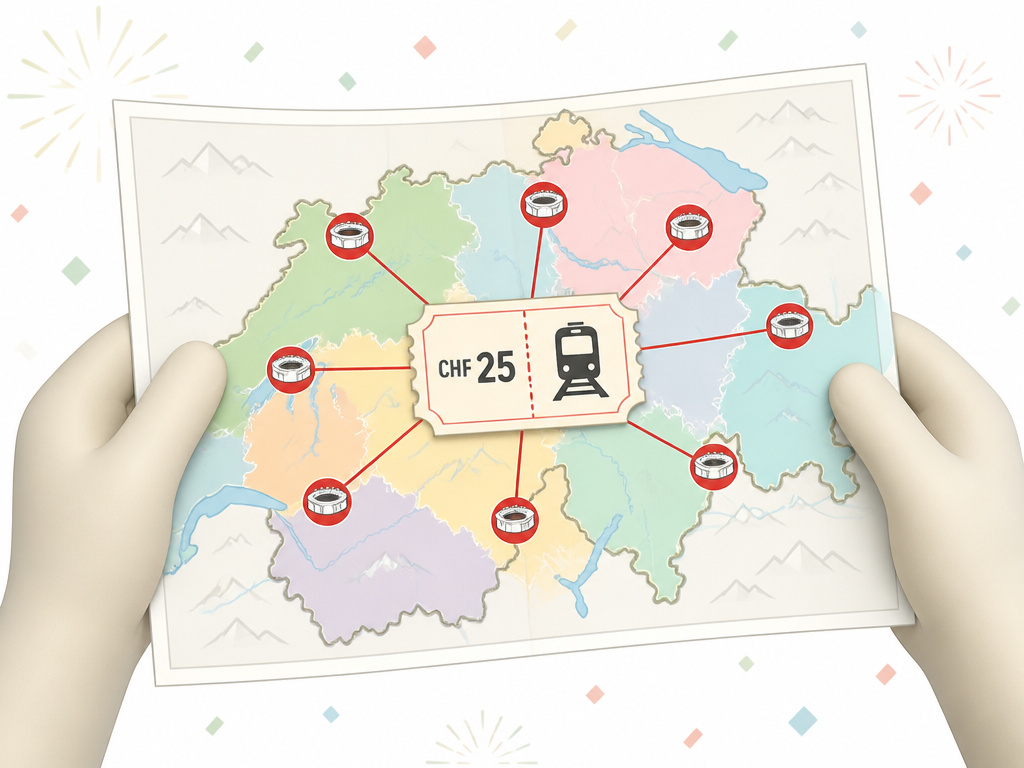
Switzerland is a compact host, and the tournament is using that to its advantage. Eight stadiums across the country will host matches, from Geneva in the west to St. Gallen in the east.
The opening match and the final will both be held at St. Jakob-Park in Basel. The other venues are a mix of modern arenas and more intimate grounds: Stadion Wankdorf (Bern), Stade de Genève, Stadion Letzigrund (Zurich), Arena St. Gallen, Allmend Stadion Luzern, Stade de Tourbillon (Sion), and Arena Thun.
For fans, UEFA has focused on accessibility. More than 720,000 tickets are available for the 31-match tournament. Ticket sales opened on 1 October 2024, with prices starting at CHF 25 for group-stage matches. Crucially, every ticket includes free public transport across Switzerland on the day of the match, making it feasible to stay in one city and travel to games in another.
That last point isn’t just convenient—it’s a deliberate strategy to fill stadiums and create an inclusive atmosphere. Empty seats at a major tournament tell a story, and the organisers are removing as many barriers as possible to make sure the story in Switzerland is about packed, noisy grounds.
Technology and Officiating: A Step Forward
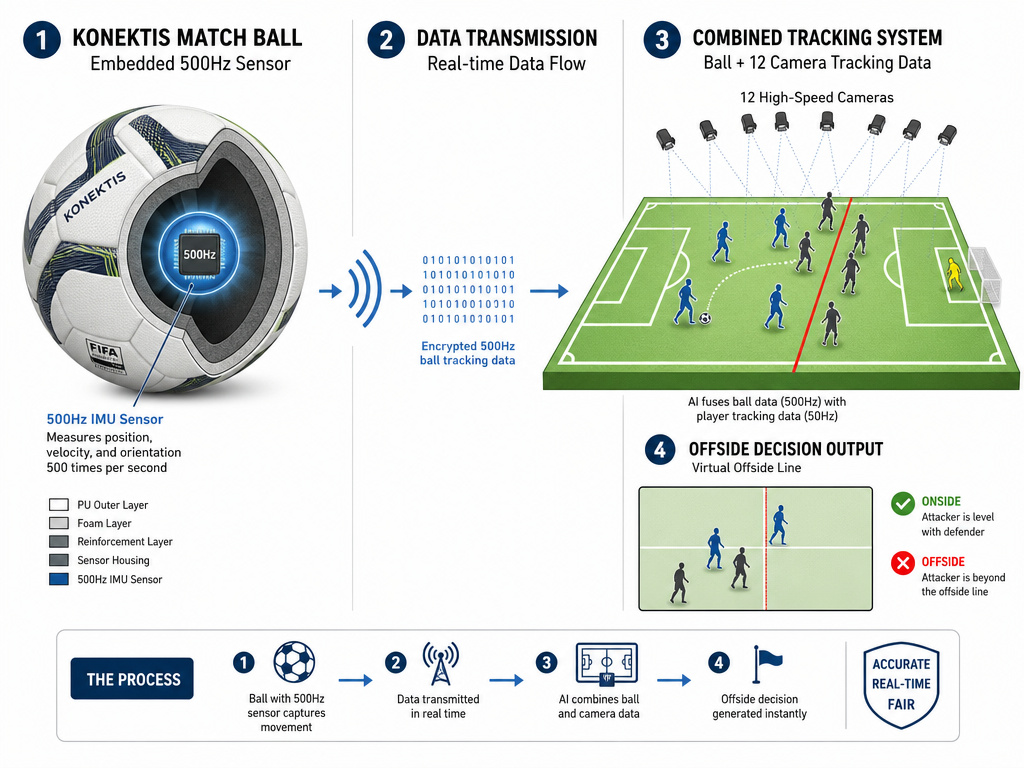
If you watch the 2025 tournament, you’ll see the same suite of technology used at the men’s EURO 2024. Video assistant referee (VAR) and goal-line technology (GLT) are now standard at this level.
The 2025 edition adds two key firsts for the Women’s EURO: connected ball technology and semi-automated offside technology (SAOT).
The official match ball, named KONEKTIS, has a 500Hz sensor embedded inside it. This “connected ball” provides precise data on its position and movement, helping VAR officials determine moments of contact for handballs or penalties with more accuracy than camera angles alone. SAOT uses both dedicated camera tracking and that ball sensor data to create a 3D model of the players’ positions, making offside calls faster and reducing the time spent with lines on a screen.
All this technology is managed from a central VAR/football technologies hub in Nyon, Switzerland. Having a single hub, rather than officials at each stadium, is meant to ensure consistency in decision-making across all eight venues. It’s a significant investment that signals the tournament is being treated with the same technical seriousness as the men’s game.
Tournament History and Legacy
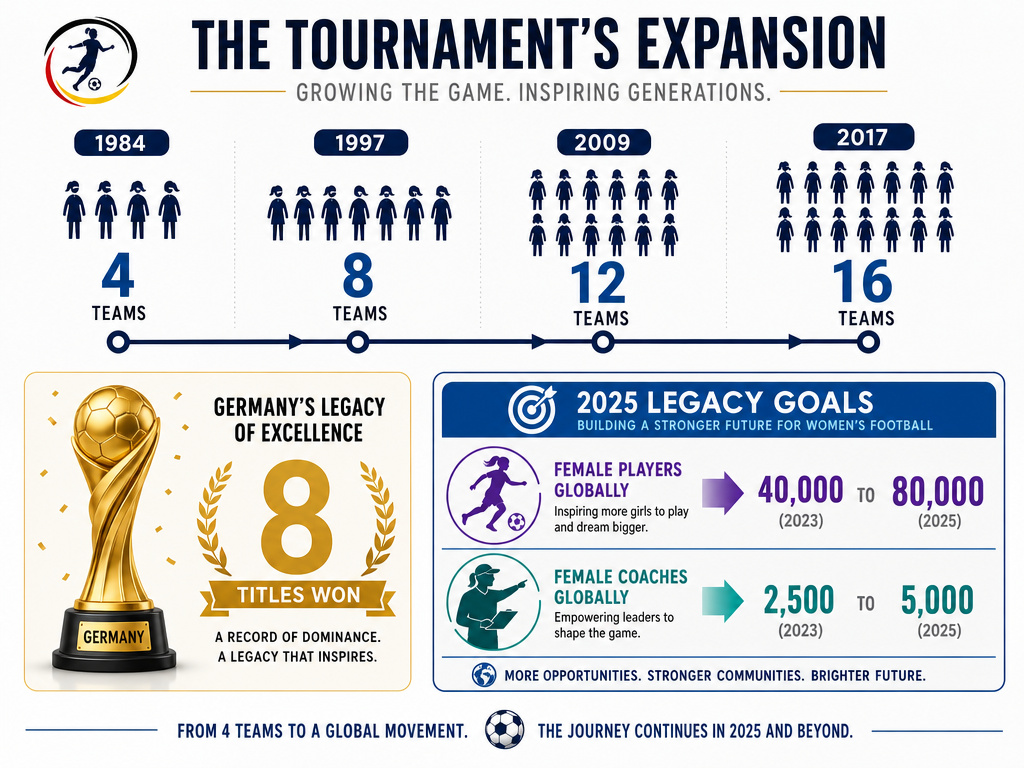
The first official tournament was held in 1984, a two-legged final won by Sweden. It was a four-team event for over a decade. The field expanded to eight teams in 1997, to twelve in 2009, and reached its current 16-team format in 2017.
Germany’s dominance is the defining historical thread. They have won the tournament eight times, including a remarkable run of six consecutive titles between 1995 and 2013. No other nation has more than two wins.
But history isn’t just about trophies. The deeper history of women’s football is one of suppression and resilient regrowth. The 2025 tournament is consciously trying to write a new chapter focused on sustainable development. The legacy programme, led by the Swiss Football Association, has concrete, measurable targets to be achieved by the end of 2027:
- Double the number of girls and women playing football in Switzerland from 40,000 to 80,000.
- Double the number of women working in football as coaches, referees, and officials from 2,500 to 5,000.
This is the “why” beyond the football. The tournament is a catalyst, using the visibility of a major international event to drive structural change at the grassroots level. It’s an approach that could shape how future hosts, of both the women’s and men’s game, plan their own events.
What’s at Stake Beyond the Trophy?
Lifting the trophy is the obvious prize. But for the two finalists in Switzerland, there’s an additional, massive reward: qualification for the 2024 Women’s Olympic Football Tournament.
There’s a catch. The host nation of those Olympics, France, qualifies automatically. If France reaches the Women’s EURO final, then the third-placed team at the Euros gets the second European Olympic slot. This direct pathway elevates the stakes of every knockout match, turning a semi-final into a potential Olympic decider.
Each successive Women’s EURO has seen a significant increase in commercial revenue, prize money, and team compensation.
The international stage simply has a different weight.
Who are the favorites to win the Women’s Euro 2025?
While the full list of 16 finalists won’t be confirmed until after the play-offs conclude in December 2024, the structure of qualification reveals the likely contenders. The eight top teams from League A qualified directly for the tournament, meaning the continent’s highest-ranked nations based on the 2023/24 UEFA Women’s Nations League have already secured their spots. Historically, Germany holds the record with eight European titles and nine final appearances, making them perennial favorites. The host nation, Switzerland, is also guaranteed a place in the final tournament. The remaining slots will be filled through a series of play-offs, but the teams entering from the top league are typically considered the strongest candidates to lift the trophy.
Frequently Asked Questions
How often is the Women’s EURO held?
The UEFA Women’s European Championship is held every four years, in the odd year between the men’s FIFA World Cup and the men’s UEFA European Championship. The 2025 edition follows the 2022 tournament in England.
How does qualification for the Women’s EURO work?
Qualification is now integrated with the UEFA Women’s Nations League. Teams are placed into Leagues A, B, or C based on their Nations League performance. The top eight from League A qualify directly. The host nation qualifies automatically. The remaining spots are decided through a two-round playoff system involving teams from all three leagues.
What is the format of the final tournament?
Sixteen teams are drawn into four groups of four. The top two teams from each group advance to the knockout stage: quarter-finals, semi-finals, and the final. All knockout matches are single-leg, with extra time and penalties if necessary. There is no third-place playoff.
Will VAR be used at Women’s EURO 2025?
Yes. The tournament will use video assistant referee (VAR), goal-line technology (GLT), connected ball technology, and semi-automated offside technology (SAOT). The connected ball tech and SAOT are being used at the Women’s EURO for the first time.
What is the tournament’s legacy goal?
The official legacy programme aims to double the number of female players and the number of women working as coaches, referees, and officials in Switzerland by 2027, using the tournament as a platform for long-term growth in the women’s game.
The Bottom Line
The Women’s EURO is a tournament with a clear, brutal format and a qualification system that now has genuine narrative heft. It’s no longer a standalone event, but the climax of a multi-year cycle built on the Nations League. For a month in the Swiss summer, it becomes the focal point of European sport.
The real test for the 2025 edition won’t just be the quality of football—which, given the rising standards in leagues like the Women’s Super League and across Europe, is a given. The test will be whether it meets its own legacy ambitions. Can it truly double participation in the host nation? If it does, that legacy will be more impactful than any single match result, setting a new benchmark for how a major tournament can be a tool for genuine development, not just a spectacle.
And for the teams, the equation is simple. Navigate the group, survive three knockout rounds, and you’re not just European champions. You’ve earned a place at the summit of the continental game, with a potential ticket to the Olympics as the ultimate bonus. It’s a format that leaves no room for error, and that’s exactly what makes it compelling.
