
History of Women’s Football: The 50-Year Ban and Revival
This post contains affiliate links. As an Amazon Associate, we earn from qualifying purchases.
The history of women’s football is a story of boom, suppression, and a slow, hard-fought revival. It spans from Victorian exhibition matches and record-breaking crowds after World War I to a 50-year ban by England’s Football Association (FA) that smothered the game’s growth. The modern era, marked by professional leagues and global tournaments, only began in earnest after the FA rescinded its ban in 1971.
That 50-year gap is the central fracture in the sport’s timeline. The ban wasn’t just a rule; it was a deliberate suppression that pushed a thriving sport into the shadows, stunting its development for two generations. Understanding why it happened, and how the game rebuilt itself from park pitches, explains the shape of women’s football today.
What follows is the journey from the British Ladies’ Football Club in 1895 to the packed stadiums of the modern Women’s Super League and Women’s World Cup. We’ll look at the pioneers, the political fears that triggered the ban, the key administrative steps to recognition, and why the sport’s growth has been so uneven across the globe.
Key Takeaways
- The FA’s 1921 ban, stating the game was “quite unsuitable for females,” barred women from using affiliated grounds for 50 years, crippling the sport’s finances and visibility.
- Dick, Kerr’s Ladies drew 53,000 fans to Goodison Park in 1920, a domestic attendance record that stood for 92 years, proving the game’s early massive appeal.
- Official recognition came in stages: the FA Council voted to rescind the ban in January 1970, but the formal rule change wasn’t ratified until 24 June 1971.
- Global growth was fractured; while the USA accelerated after Title IX legislation in 1972, many European nations saw “a conspicuous lack of support” for a decade after UEFA’s 1971 directive.
- The modern professional era is built on structures like the FA Women’s Super League (WSL), launched in 2011, which became a two-division fully professional competition in 2017.
The 1921 FA Ban: A 50-Year Suppression
The single most consequential event in the history of women’s football wasn’t a match or a tournament. It was a meeting. On 5 December 1921, the FA Council passed a resolution stating “the game of football is quite unsuitable for females and ought not to be encouraged.” Sources disagree on the nature of the ban: while the FA’s resolution stated the game was ‘quite unsuitable for females’, one source argues the FA did not have the power to ban women from playing outright and instead barred them from using affiliated grounds.
This move financially suffocated the sport. Without stadiums, teams couldn’t charge meaningful admission. Without income, they couldn’t sustain themselves. The FA’s consultative committee also questioned whether the “appropriation of receipts” from charity matches was truly going to charitable objects, casting public doubt on the women’s game’s integrity. The context is everything. The ban came precisely one year after the most successful women’s match in English history.
Where this goes sideways: Assuming the ban was about sport alone. It was a political and economic reaction to the game’s popularity and the causes it supported, which were increasingly seen as a threat to the post-war establishment.
The Boom That Triggered the Ban
To understand the suppression, you have to see what was being suppressed. Women’s football exploded during and after World War I. With men away at the front, women took on factory jobs and formed teams like the legendary Dick, Kerr’s Ladies from a Preston munitions factory. These teams played charity matches, raising enormous sums, the equivalent of millions today, for war veterans and hospitals.
The peak was Boxing Day 1920. Dick, Kerr’s Ladies played St Helens Ladies at Everton’s Goodison Park. Official reports noted 53,000 paying spectators with an estimated 10,000 to 15,000 more turned away. Gate receipts were reported as over £3,000 (about £140,000 today), though sources differ on the exact figure, with another reporting £3,115. The noise from a crowd that size has a specific, dense quality, it’s not just loud, it feels heavy in the air. The match demonstrated the women’s game’s significant drawing power.
The FA and the Football League had just expanded the men’s professional game. A women’s match outdrawing men’s fixtures was a direct commercial threat. The money was raised for charity, though the FA’s consultative committee questioned whether the ‘appropriation of receipts’ was truly going to charitable objects. The establishment’s tolerance had run out.
| Factor | Pre-Ban Reality | Post-Ban Consequence |
|---|---|---|
| Venues | Access to major Football League grounds (Goodison Park, Stamford Bridge). | Restricted to public parks, rugby grounds, and other non-affiliated pitches. |
| Finance | Significant gate receipts enabling charity donations and team sustainability. | No ticketed income, forcing teams to disband or play in obscurity. |
| Visibility | National press coverage and large, engaged crowds. | Removed from public view, becoming a “stigmatised subculture.” |
| Development | The sport had grown significantly by 1921, with teams like Dick, Kerr’s Ladies undertaking international tours. | No competitive structure, pathways, or institutional support for 50 years. |
For two generations, the game survived on sheer willpower in marginal spaces. This isn’t a footnote; it’s the reason the modern game had to start from almost nothing.
Early Origins and the First Pioneers
The story doesn’t start with the munitionettes. Women have been kicking balls for centuries. The first recorded match in Europe dates to 1628 in Carstairs, Scotland, provoking outrage from a local minister. But the codified game’s history for women begins in the Victorian era, tightly intertwined with the fight for women’s rights.
The British Ladies’ Football Club (BLFC) was founded in 1895 by Nettie Honeyball (a pseudonym) and Helen Graham Matthews. Their first match at the Crouch End Athletic Ground in London attracted a crowd of 12,000. Their aim was explicit: to demonstrate that women, freed from restrictive clothing, were capable and athletic.
I once wrote a piece on these pioneers leaning heavily on one romanticised account. A reader emailed with a contemporary newspaper report that was far more sceptical and mocking. I now cross-check every historical anecdote against at least two sources. The past is rarely a simple story.
These early games were exhibitions, not a league. The press coverage was a mix of curiosity and ridicule, focusing on fashion mishaps more than football. Without a formal structure, the BLFC faded, but it planted an idea. Women’s football could draw a crowd. It could be a spectacle. And it was inherently, undeniably political.
The Long Road to Recognition (1967-1993)
Revival didn’t happen overnight. It was a slow, piecemeal process fought by a new generation of organisers. The spark is often traced to the Deal Tournament in Kent, organised by Arthur Hobbs in 1967. This gathering of clubs showed a latent demand. It led directly to the first meeting of the Women’s Football Association (WFA) on 1 November 1969, with 44 clubs represented.
Pressure built on the FA. On 19 January 1970, the FA Council voted to rescind the 1921 resolution. But bureaucracy moved slowly. The formal amendment to FA rules wasn’t ratified until the FA’s Annual General Meeting on 24 June 1971 at the Great Western Royal Hotel in Paddington. Only then could women officially use FA-affiliated pitches and referees.
The administrative grind behind the headline: A vote to rescind in January 1970, a Rules Revision Committee in August, final ratification in June 1971. Real change happens in meeting rooms, not just on pitches.
This period also saw crucial external pressure. At the 1971 Extraordinary UEFA Congress in Monte Carlo, UEFA agreed all national associations should take control of women’s football.
Building a Structure: The WFA Era
With the ban lifted, the WFA began the hard work of building a national structure from scratch.
- The first women’s FA Cup was held in 1971, won by Southampton.
- The first official England women’s international was played versus Scotland in 1972.
- The WFA national league launched in 1991 with 24 clubs, expanding to three regional divisions of ten teams each in 1992.
It was a fragile ecosystem. The WFA operated on a shoestring. In 1993, it voted to pass its activities to the FA, bringing the women’s game under the governing body’s umbrella. The 1993-94 season saw the WFA Cup (with 137 teams) come under FA control. Centralised administration was a double-edged sword, it promised more resources but also meant control was ceded.
A Fractured Global History

England’s story of ban and revival is the most documented, but it’s not unique. Across the world, women’s football faced official suppression and cultural resistance, leading to wildly different timelines for development.
- France banned women’s football in 1932.
- West Germany’s DFB enacted a ban in 1955, declaring the sport “essentially alien to the nature of woman.”
- Brazil banned the game from 1941.
- Norway had a ban in place from 1931.
These bans choked the sport at the national level. Globally, women’s football faced official suppression and cultural resistance, leading to wildly different timelines for development. Conversely, the United States took a different path. The 1972 enactment of Title IX, federal legislation enforcing gender equality in education and sport, created an entire generation of athletic women and a pipeline for soccer. It’s the primary reason the US became and remains a dominant power.
This disparity led to vastly different levels of development and participation across the globe. The global history isn’t one story; it’s a patchwork of repression, neglect, and, in a few cases, deliberate investment.
The “Unofficial” World Cups
Long before FIFA sanctioned a tournament, there were world championships. Independent entrepreneurs, seeing the commercial potential, organised events that looked every bit like a World Cup.
- 1970 in Italy: The first unofficial tournament.
- 1971 in Mexico: The most famous. A “rebel” England side, managed by visionary Harry Batt, competed. The final between Denmark and Mexico drew 110,000 spectators to the Azteca Stadium. England lost to the hosts in front of 80,000 people.
These tournaments were serious. They had sponsors, massive crowds, and global teams. Yet, These unofficial tournaments featured serious competition and massive crowds, predating FIFA’s official event by two decades. FIFA’s first official Women’s World Cup began in 1991, with games lasting 80 minutes.
The Modern Professional Era
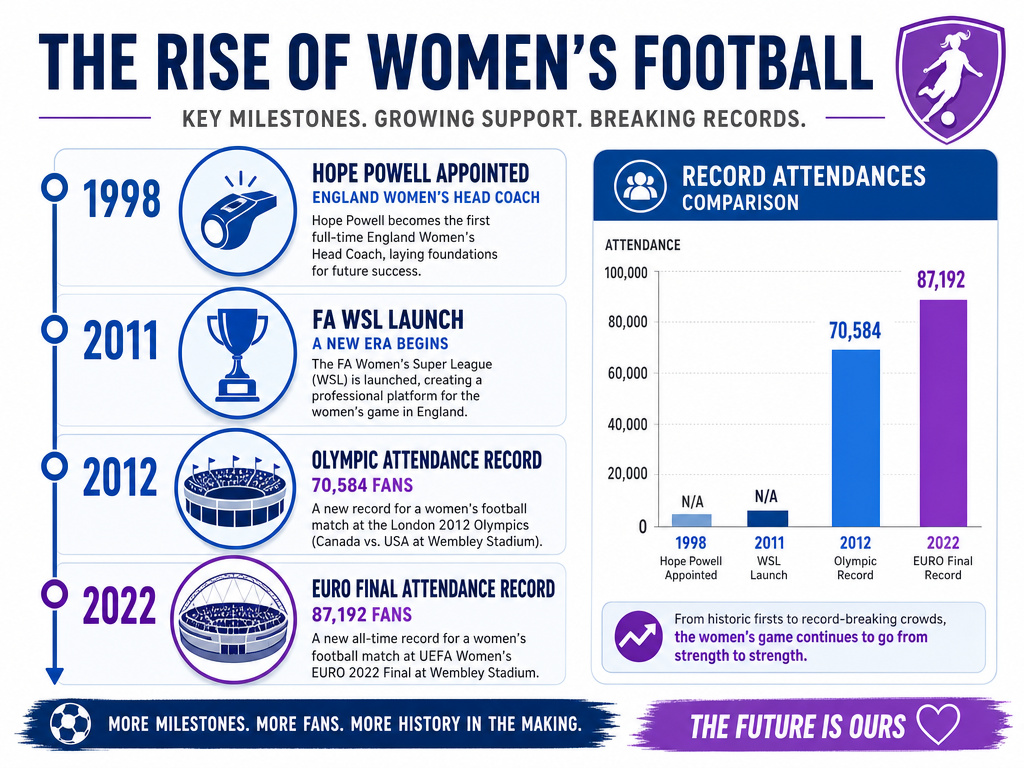
The modern era is defined by professional leagues and institutional investment. The milestones came slowly, then quickly.
- 1998: Hope Powell was appointed as the first full-time England women’s coach.
- 2011: The FA Women’s Super League (WSL) launched as an eight-team summer competition, adopting a “less is more” strategy to prioritise quality.
- 2012: Team GB’s 1-0 win over Brazil at the London Olympics packed 70,584 into Wembley, breaking the 92-year domestic attendance record set at Goodison Park.
- 2013: The FA, Sport England, the Premier League, and the Football League Trust launched the first joint national participation programme for girls’ football.
- 2017: The WSL became a two-division, fully professional game, aligning with the traditional men’s season.
- 2022: The UEFA Women’s Euro 2022 final at Wembley set a tournament record with 87,192 attendees. Barcelona Women broke the world club attendance record with 91,648 fans.
This era is also defined by the fight for equity, mirroring the social battles of the pioneers. In February 2022, the US women’s national team settled an equal-pay lawsuit for a reported £17.7 million. The conversation has shifted from mere existence to fairness and sustainability.
The establishment of professional leagues like the Women’s Super League provides the infrastructure the game lacked for a century. They create career pathways, which in turn raise the technical and tactical level, making tournaments like the Women’s World Cup and the Women’s Euros must-watch events. The history of suppression created a gap; the professional era is about closing it.
What ongoing challenges does women’s football face?
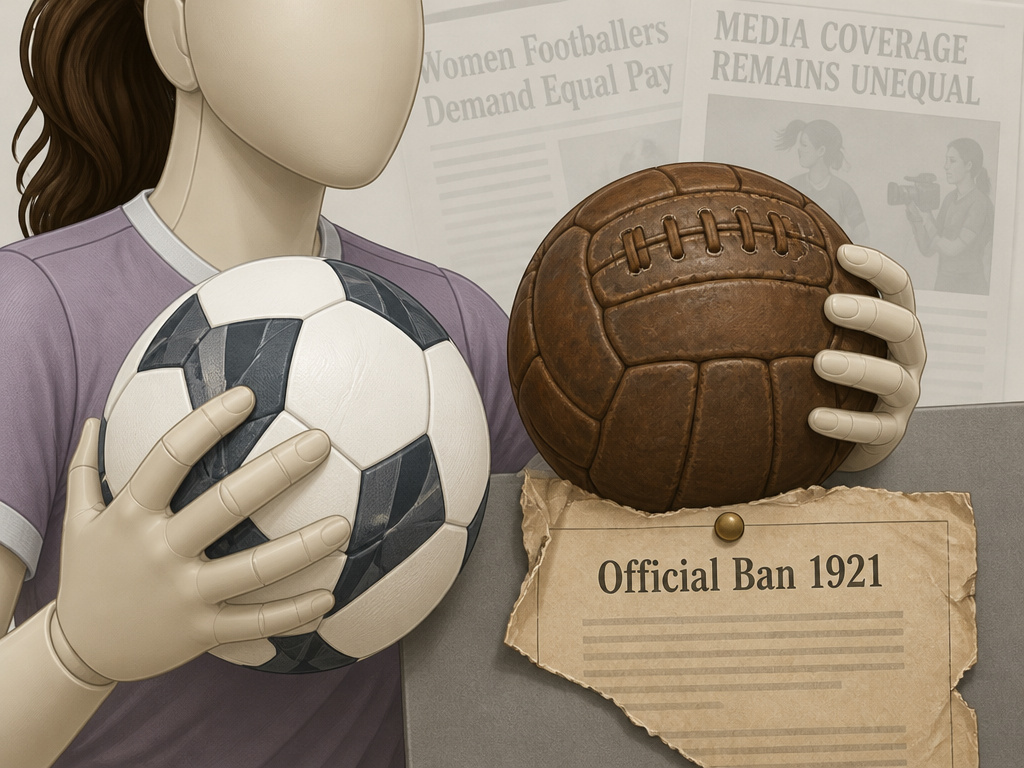
Despite significant progress, women’s football continues to confront systemic challenges. Pay equity remains a central issue, highlighted by high-profile legal battles like the one involving the US women’s national team. Media coverage, while improving, often lags in volume and quality compared to the men’s game, affecting visibility and commercial growth. Underlying these issues are persistent currents of misogyny, which historically manifested in official bans from national associations. These barriers delayed the establishment of proper leagues and international tournaments for generations. The fight for equal investment, consistent and respectful media representation, and the full eradication of discriminatory attitudes are the modern frontiers of a struggle that began over a century ago.
Frequently Asked Questions
Why was women’s football banned for 50 years?
The 1921 FA ban was a reaction to the sport’s surging popularity and independence. After record crowds and significant charity funds were raised, sometimes for causes the establishment disliked, the FA moved to assert control. Using a mix of purported medical concern and financial skepticism, they barred women from using affiliated grounds, cutting off the game’s revenue and visibility. It was a suppression of a cultural and economic threat, not just a sporting one.
When did women’s football become a thing?
Organised women’s football became a public spectacle in the Victorian era, with the founding of the British Ladies’ Football Club in 1895. Its first match drew 12,000 spectators. However, its most significant early growth period was during and after World War I (1914-1918), when factory teams like Dick, Kerr’s Ladies played in front of tens of thousands and raised vast sums for charity.
Who was the first woman to play football?
It’s impossible to name a single “first” due to centuries of informal play. The first prominent organiser was Nettie Honeyball (a pseudonym), who founded the British Ladies’ Football Club in 1895 and placed newspaper ads to recruit players. Key early stars emerged from the WWI factory teams, like Bella Reay, who scored 133 goals in a season for Blyth Spartans Ladies.
What was the first women’s World Cup?
The first FIFA-sanctioned Women’s World Cup was held in China in 1991. However, two major unofficial world championships predated it: one in Italy in 1970 and a larger, more successful tournament in Mexico in 1971, which featured a rebel England side and drew 110,000 fans to the final.
The Bottom Line
The history of women’s football isn’t a linear march of progress. It’s a story of a sport that found massive popularity, was actively and deliberately suppressed for half a century, and then had to rebuild itself almost from zero. The 50-year ban created a developmental chasm that the modern professional era is still working to bridge.
That’s why comparing the men’s and women’s games on simple metrics like speed or power misses the point. The real comparison is in institutional support and time. The men’s professional game has had over 150 years of continuous investment and structure. The women’s game, in its modern form, has had about 30.
The lesson isn’t just about past injustice. It’s a practical guide to the present. The future health of the women’s game won’t be decided solely by sell-out crowds at Wembley for finals. It will be decided by the strength of domestic leagues, the depth of youth pathways, and consistent investment, the very structures the 1921 ban prevented from taking root. The history is a cautionary tale, and the current growth is the long-overdue correction.
