
How the Eredivisie Works: The Dutch League Explained
This post contains affiliate links. As an Amazon Associate, we earn from qualifying purchases.
The Eredivisie is the top professional football league in the Netherlands. It works on an 18-club, double round-robin system where each team plays 34 matches. The bottom two clubs are relegated directly to the Eerste Divisie, while the 16th-placed team enters a promotion/relegation play-off. The champion qualifies for the UEFA Champions League, with additional spots for the Europa League and Conference League awarded based on final league position and the KNVB Cup winner.
That structure is the skeleton, but the muscle and nerve, the things that make this league unique, are in the details. The play-off format, the specific European qualification paths, and even the league’s name have quirks that shape every season.
What follows is a walkthrough of how the Eredivisie works, from the basic fixture list to the high-stakes drama of the play-offs. This explains how teams are promoted and relegated, their European qualification paths, and the history behind the Eredivisie’s consistent production of top players.
Key Takeaways
- The Eredivisie season runs from August to May with a winter break, featuring 18 clubs who play each other twice for a total of 34 matches.
- In football, the bottom two teams go down automatically, but the 16th-placed club must survive a play-off against Eerste Divisie sides to stay up. In basketball, for the 2025-26 season, the teams finishing 10th, 11th, and 12th are relegated.
- European qualification offers multiple routes: the champion goes to the Champions League, while the KNVB Cup winner and league placings secure Europa League and Conference League spots.
- The “Big Three” of Ajax, PSV, and Feyenoord have never been relegated in their current forms.
- Reserve teams (Jong Ajax, etc.) are barred from promotion, meaning if they win the Eerste Divisie, the top senior team below them goes up instead.
The Basic League Structure
The football Eredivisie operates on a straightforward, classic format. Eighteen clubs compete. Each one faces every other club twice, once at home and once away. That simple math gives you the 34-match season that runs from August through May, with a traditional winter break in January.
The Eredivisie consists of 18 clubs playing a double round-robin format, resulting in 34 matches per team. The competition typically starts in August and ends in May, with a scheduled break in January. In seasons preceding a major international tournament like the European Championship, the schedule is condensed, starting and ending one week earlier.
This consistency is its strength. There’s no split into championship and relegation groups like in some other European leagues. The team that finishes with the most points after 34 games is the Dutch champion. This clarity in how the Eredivisie works makes the Eredivisie table easy to follow from week one.
Promotion, Relegation, and the Play-Off Maze
This is where the Dutch system gets interesting. Relegation isn’t just a simple “bottom three go down.” The rules create a specific, and often tense, end-of-season drama.
The two clubs that finish 17th and 18th are relegated directly to the Eerste Divisie. They are replaced automatically by the champion and runner-up from that second division. So far, so standard. The complexity starts with the team in 16th place.
That 16th-placed Eredivisie club does not go down directly. Instead, they enter the promotion/relegation play-offs. According to the official KNVB regulations, this club enters at the semi-final stage, facing a winner from the earlier qualifying rounds of the Eerste Divisie play-offs. The Eredivisie club always has the advantage of playing the second leg of the tie at home.
The play-offs themselves involve six high-placed clubs from the Eerste Divisie (excluding the top two, who are already promoted). They battle through knockout rounds for the right to face that 16th-placed Eredivisie side. One spot in the top flight is on the line. It’s a brutal system that often feels crueler for the second-tier clubs who have to win multiple ties, but it gives the struggling Eredivisie team one final chance to save themselves.
There’s a crucial edge case here, straight from the KNVB’s own rulebook. If a club has its professional license irrevocably revoked during the season, that team is removed from the Eredivisie league standings entirely. In that scenario, the team that would have finished 16th after the regular season is spared direct relegation and instead enters the play-offs. It’s a rare clause, but it shows the level of detail in the promotion and relegation regulations.
| Final League Position | Outcome |
|---|---|
| 1st – 15th | Remain in Eredivisie (subject to European qualification) |
| 16th | Enters promotion/relegation play-offs at semi-final stage |
| 17th & 18th | Relegated directly to Eerste Divisie |
Where this goes sideways: A “Jong” (reserve) team winning the Eerste Divisie. Teams like Jong Ajax or Jong PSV are barred from promotion. If a Jong team finishes first, automatic promotion passes to the highest-placed eligible senior team in the Eerste Divisie. This rule keeps the top flight a competition for independent clubs.
European Qualification: The Road Out of the Netherlands
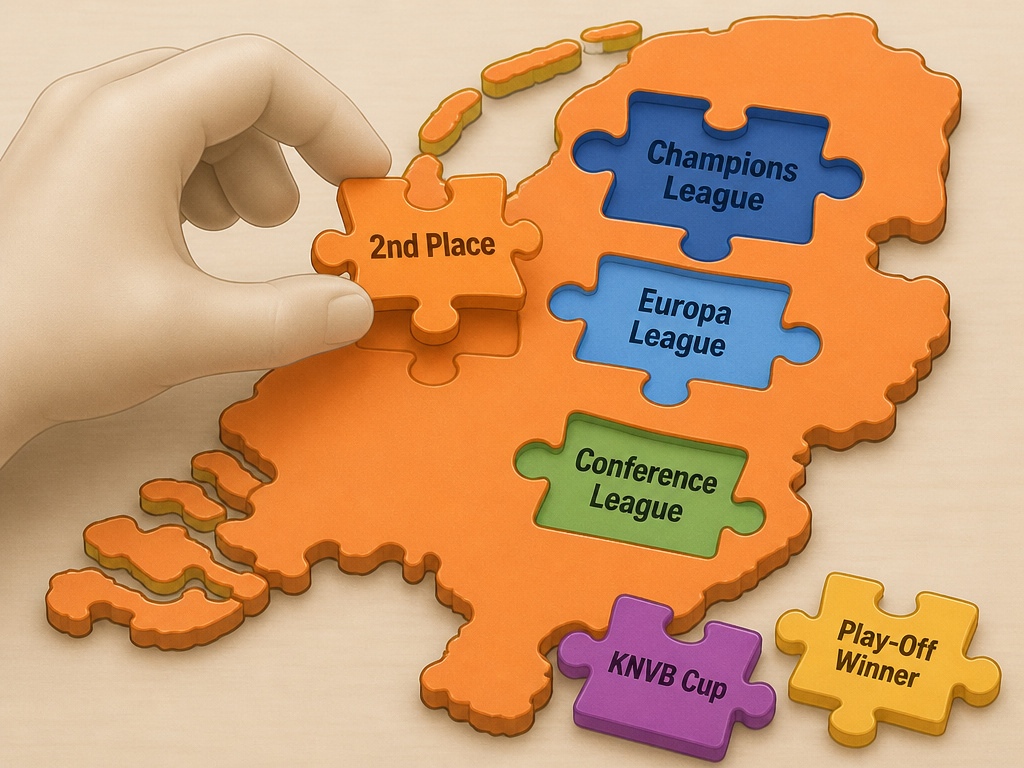
For the top clubs, the real prize isn’t just the domestic title; it’s a ticket to European football. The Eredivisie’s European qualification system is a layered puzzle of league position and cup results.
The champion qualifies directly for the group stage of the UEFA Champions League. The runner-up, for the 2024-25 and 2025-26 seasons, also earned a direct Champions League place due to the Netherlands’ strong UEFA coefficient. However, that extra place was lost starting from the 2026-27 season due to results in the 2025/26 season. Now, the runner-up typically enters a Champions League qualifying round.
The third-placed team earns a spot in the UEFA Europa League. So does the winner of the KNVB Cup, if the cup winner has already qualified for Europe via the league, that Europa League place passes down to the next best-placed team in the league that hasn’t already qualified.
Then there’s the play-off for the final European spot. Teams finishing between 4th and 7th in the Eredivisie enter a separate knockout tournament. The winner of this play-off earns a place in the qualifying rounds for the UEFA Conference League. It’s a backdoor route that keeps the season alive for a handful of clubs just outside the automatic European places.
| Competition | Eredivisie Qualification Path |
|---|---|
| UEFA Champions League | 1st Place (Group Stage) |
| UEFA Champions League (Qualifying) | 2nd Place |
| UEFA Europa League | 3rd Place OR KNVB Cup Winner |
| UEFA Conference League (Qualifying) | Winner of 4th-7th Place Play-Off |
This multi-path system means a club can have a mediocre league campaign but salvage European football by winning the cup. It also means the fight for 7th place can be as intense as the fight for 3rd, because it keeps the door to the Conference League play-offs open. The volatility is part of the charm, and the frustration, for fans.
Tiebreakers, Points, and Settling the Final Standings
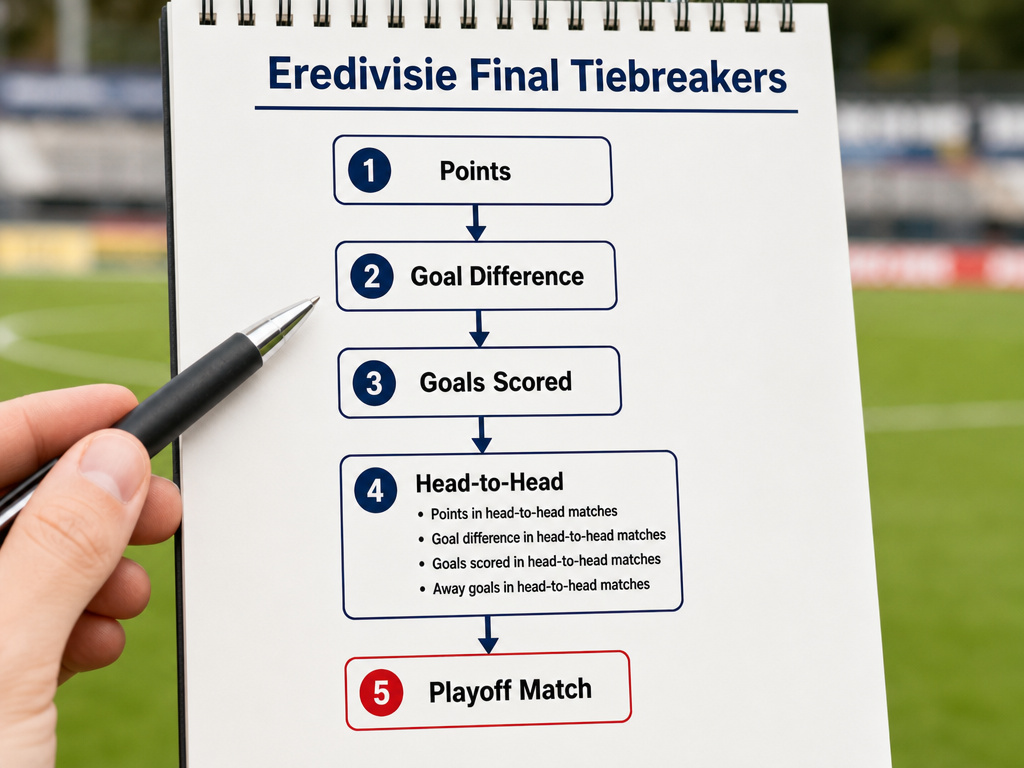
When teams are level on points at the end of the season, how does the league decide who finishes higher? This matters for the title, European spots, and relegation. The Eredivisie uses a specific hierarchy of tiebreakers, but there’s a nuance many sources miss.
During the season, the live league table uses “verliespunten” (points dropped) as the first tiebreaker after total points. This is a quirk of Dutch table presentation. However, for the final, official standings at the end of the season, the rules are different.
According to some sources, the first official tiebreaker for final standings is goal difference, followed by goals scored, and then head-to-head record. Other sources note that ‘points dropped’ is used in the live table during the season but not necessarily in the final standings. The head-to-head is compared first on points in the matches between them, then on goal difference in those matches, then on away goals in those matches.
If a tie still persists for a decisive position, like the championship, a European slot, or a relegation place, the final resort is a single playoff match at a neutral venue. It’s a clean, if dramatic, way to settle it. This clarity is helpful when comparing the Eredivisie’s system to another European league like the Bundesliga, which uses head-to-head as the first tiebreaker.
The Historical Context: More Than Just a League
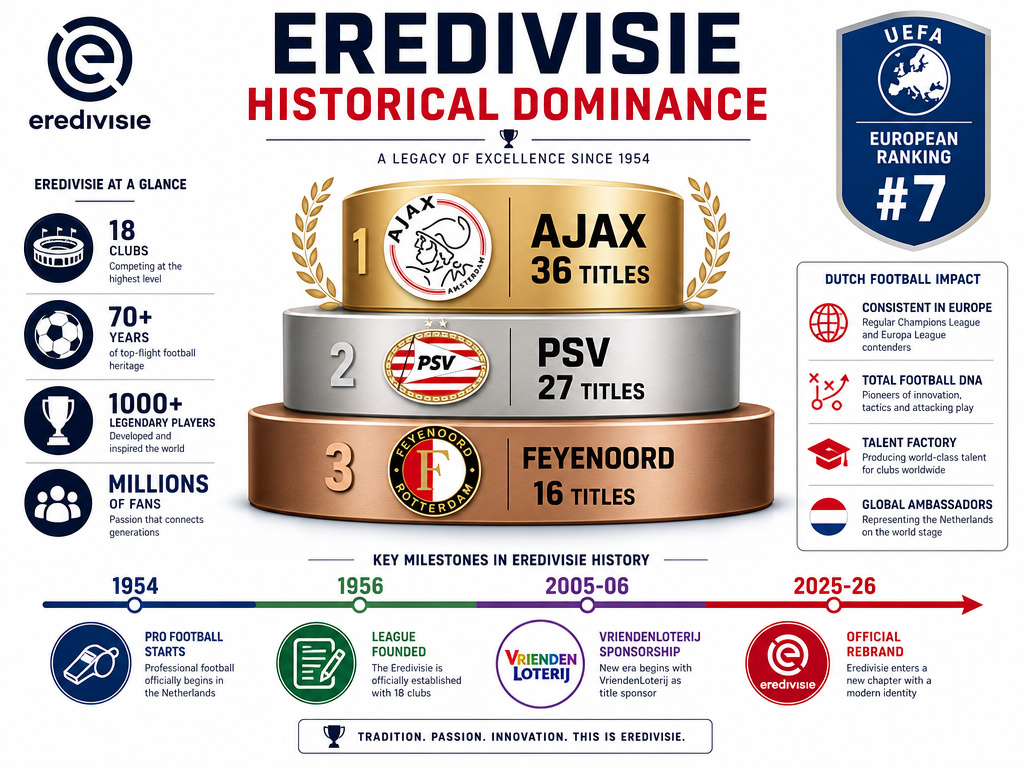
You can’t talk about how the Eredivisie works without mentioning who has always worked it best. The league was founded in 1956, two years after the start of professional football in the Netherlands. Since then, its history has been dominated by the “Big Three”: Ajax (36 titles), PSV Eindhoven (27 titles), and Feyenoord (16 titles).
These three clubs are the only ones in their current forms to have never been relegated from the Eredivisie. This dominance creates a clear hierarchy, but it also fuels the ambition of every other club. Beating one of the big three is a season highlight; breaking their hold on the top spots is the ultimate goal.
The league’s name itself, Eredivisie, translates to “Honour Division.” Since the 2005-06 season, it has been sponsored by the Vriendenloterij, and from the 2025-26 season, it will be officially rebranded as the VriendenLoterij Eredivisie. Despite the corporate names, fans and media almost always refer to it simply as “de Eredivisie.”
Its current status as the 7th-best league in Europe by UEFA’s ranking is a point of pride. It reflects a league that consistently develops world-class talent (often later sold to top European leagues) and plays an attractive, attack-minded brand of football. While the financial difference with the top five leagues is enormous, the Eredivisie’s function as a talent forge is widely accepted.
How do financial realities and player sales affect the Eredivisie?
Operating as a top-tier league that is ranked among the best in Europe, the Eredivisie faces a constant balancing act. Clubs develop world-class talent, but the financial landscape means selling these players to wealthier leagues abroad is a common and often necessary part of the business model. This cycle of talent export defines the league’s character, making it a renowned proving ground. For fans, this means squad turnover is high, and the competitive balance can shift as teams reinvest transfer income. The challenge for clubs is to build a competitive team each season while managing the financial pressures that come with being a talent factory in the global football market.
Frequently Asked Questions
How do the Eredivisie playoffs work?
There are two separate play-off systems. The promotion/relegation play-off involves the 16th-placed Eredivisie team and six high-placed Eerste Divisie clubs (excluding the top two). The Eerste Divisie clubs play qualifying rounds, with the winners facing the Eredivisie club in a two-legged semi-final. The Eredivisie club always hosts the second leg. The winner of that final tie gets the last spot in the top flight. The European play-off involves the teams finishing 4th through 7th, who compete in a knockout tournament for a UEFA Conference League qualifying spot.
How many matches does each team play in the Eredivisie?
Each of the 18 clubs plays 34 regular-season matches. This comes from playing every other team twice (home and away). There is no post-season league format, so the champion is crowned after these 34 games.
Is the Eredivisie a top 7 league?
Yes. As of the 2024–25 season, the Eredivisie is ranked as the seventh-best league in Europe by UEFA’s coefficient system. This ranking determines how many clubs the Netherlands gets in UEFA competitions and in which rounds they enter. It places the league just outside the traditional “top five” but ahead of many other well-known competitions.
What does Eredivisie mean?
Eredivisie is a Dutch word that translates directly to “Honour Division” or “Premier Division.” The “Ere” part means honour or prestige, indicating it is the highest level of competition in Dutch football.
Has the Eredivisie always had 18 teams?
No. The league started with 18 clubs in 1956, but the number has varied over history, including periods with more teams. It has been stable at 18 clubs since the 1966-67 season, which is why the 34-match format is now so entrenched.
Before You Go
The Eredivisie’s mechanics are a blend of simple round-robin fairness and complex, nerve-wracking play-offs. It’s a system designed to keep hope alive, for the 16th-placed team fighting to stay up, for the 7th-placed team dreaming of Europe, and for the clubs chasing the historic giants.
The real test of understanding isn’t just knowing the rules, but seeing how they play out over a full season. Watch where the tension builds in the final weeks. It’s rarely just about the title; it’s in the scramble for that final European play-off spot, or the desperate fight to avoid 16th place and the lottery of the play-offs. That’s where the league’s unique character, part technical excellence, part sheer survival drama, truly comes to life.
