
How the Bundesliga Works: The 18-Team, 34-Match System
This post contains affiliate links. As an Amazon Associate, we earn from qualifying purchases.
The Bundesliga works on an 18-team, double round-robin system where each club plays 34 matches. Since 1995, a win earns 3 points, a draw 1 point, and a loss 0. The bottom two teams are relegated automatically, while 16th place faces a two-legged playoff against the 3rd-place team from the 2. Bundesliga. The top four finishers qualify for the UEFA Champions League.
That 16th-place playoff is the league’s most distinctive pressure valve. It’s not just an extra match; it’s a system with its own scheduling quirks and a recent rule change that flipped the script on away goals. Understanding this playoff is key to understanding how the Bundesliga works.
What follows is a breakdown of how the Bundesliga works, the high-stakes drama of relegation, the path to European glory, and the financial rules that keep the competition grounded. By the end, you’ll see why the Bundesliga’s structure is about more than just scheduling, it’s about sustained tension from August to May.
Key Takeaways
- The league runs on a tight 18-team, 34-match schedule, with each club facing every other home and away.
- Automatic relegation hits 17th and 18th place, with a unique two-legged playoff deciding the fate of 16th place.
- Since the 2021-22 season, away goals do not count in the relegation playoff, with ties going to extra time and penalties.
- The top four teams qualify for the UEFA Champions League under the new 36-team format.
- Clubs must obtain a DFB licence each season, subject to strict financial checks, and are bound by the 50+1 ownership rule.
The Season Format in a Nutshell
Eighteen clubs. That’s the magic number, and it has been for most of the Bundesliga’s modern history. It creates a 34-match season where every team plays each other twice, once at home, once away. The math is simple but relentless: 18 teams x 2 games = 34 matchdays, usually running from August to May with a winter break in December and January.
Each of the 18 clubs plays every opponent twice, once at home and once away, for a total of 34 matches per team. Three points are awarded for a win, one for a draw and none for a defeat.
The points system is a key part of how the Bundesliga works now, but it wasn’t always. Since the 1995–96 season, a win has been worth 3 points, a draw 1 point, and a loss 0 points. That change was meant to incentivize attacking football, to push teams to chase a win rather than settle for a draw. You can argue about how well it worked, but the 3-1-0 system is now baked into the league’s DNA.
A team that starts poorly has time to recover, and a fast starter can never get too comfortable. The winter break acts as a natural season reset. It’s a structural pause that other major leagues, like the relentless Premier League, don’t have.
Promotion, Relegation, and the High-Stakes Playoff
This is where the Bundesliga separates itself from many of its European peers. In England or Italy, three teams go down automatically. In Germany, it’s two, plus one more hanging by a thread.
The bottom two finishers, 17th and 18th place, are automatically relegated to the 2. Bundesliga. No arguments, no second chances. Their places are taken by the top two teams from the second division. That much is straightforward.
The drama is reserved for 16th place. That team enters the relegation play-off, a two-legged tie against the team that finished 3rd in the 2. Bundesliga. It’s a final exam for the struggling top-flight side and a golden ticket for the ambitious second-tier club.
| Position | Bundesliga Team | 2. Bundesliga Team | Outcome |
|---|---|---|---|
| 17th & 18th | Relegated | – | Automatically drop down |
| 1st & 2nd | – | Promoted | Automatically move up |
| 16th | Enters Play-off | 3rd Place Enters Play-off | Winner stays up/goes up |
The playoff isn’t some newfangled idea. It was first used from 1981 until 1991, then shelved for over 15 years. It made its return for the 2008-09 season and has been a fixture ever since, adding a layer of late-season tension that pure automatic promotion can’t match.
Where this goes sideways: Assuming the Bundesliga team always hosts the second leg. The club with fewer days between its most recent match and the first leg hosts the second leg, a rule that can flip the home advantage unexpectedly.
The rules for these two legs have a specific German logic. Since the 2021-22 season, the away goals rule does not apply. If the aggregate score is tied after 180 minutes, the match goes to two 15-minute periods of extra time. If it’s still level, a penalty shoot-out decides it. This change removed a huge strategic element, parking the bus for a 0-0 draw away from home is no longer a masterstroke.
European Qualification: The Bundesliga’s Continental Passport
For clubs at the other end of the table, the prize is a ticket to Europe. The Bundesliga is one of UEFA’s top-ranked leagues, which means it sends a healthy contingent to continental competition every year.
The big change came in 2024/25 with the new UEFA Champions League format. The group stage is gone, replaced by a single 36-team league phase. For the Bundesliga, this means the teams that finish first, second, third and fourth earn automatic qualification to this new Champions League stage. No more tricky playoff rounds for the top four.
But there’s a potential bonus fifth spot. UEFA awards an extra “European Performance Spot” to the association with the highest club coefficient from the previous season. If the Bundesliga finishes in the top two of this coefficient ranking, then fifth place also gets a Champions League berth. It’s a reward for the league’s overall strength.
Below that, the Europa League and Europa Conference League slots are allocated. Europa League and Conference League berths are allocated to Bundesliga teams based on league position, cup results, and the European Performance Spot.
The DFB-Pokal (German Cup) throws a fascinating wrench into this. If a team outside the Bundesliga wins the cup, they qualify for the Europa League. This has happened before, and it means a European spot is essentially reserved for a potential giant-killer, which is a brilliant quirk of the system. It’s a different path to Europe than you’ll find in a league like La Liga, where continental slots are almost exclusively decided by league position.
The Financial and Ownership Framework
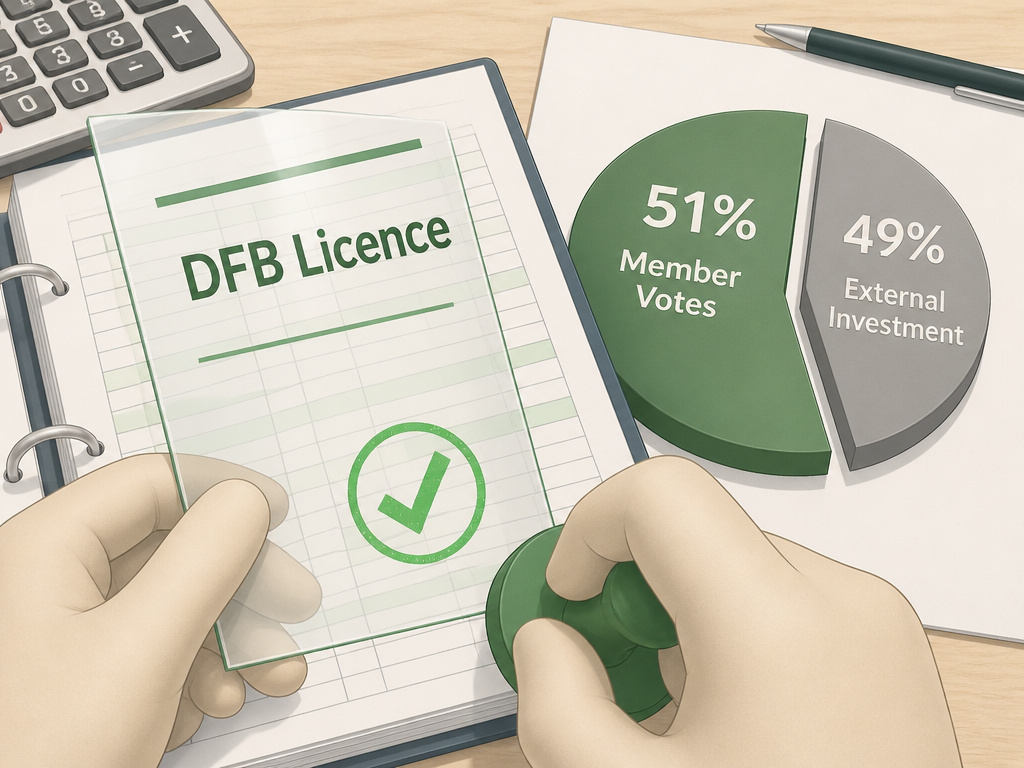
The Bundesliga’s on-field structure is supported by a distinctive off-field framework. Two rules are fundamental: the DFB licence and the 50+1 ownership model.
Before a ball is kicked each season, every club must apply to the German Football Federation (DFB) for a licence to compete. This isn’t a formality. The DFB conducts rigorous financial checks, auditing accounts and transfer dealings. Clubs flirting with insolvency can be denied a licence, fined, or handed points deductions. This system, while not perfect, is a guardrail against the financial recklessness that has plagued other leagues.
Then there’s 50+1. In simple terms, it means that The club’s members, the fans, must retain majority control. This is why you don’t see nation-states or oligarchs buying Bundesliga clubs. The rule exists to protect club identity and prevent external actors from having unchecked power.
There are historical exceptions for clubs founded as factory teams: VfL Wolfsburg (Volkswagen), Bayer Leverkusen (Bayer AG), and FC Carl Zeiss Jena. But for everyone else, 50+1 is the law of the land. It’s a major reason why ticket prices are lower and fan culture is more vibrant than in leagues with different theme park bag policies, wait, that’s a different article. It’s a major reason why the league feels different from those with more permissive ownership rules.
This financial prudence is linked to the league’s impressive stability. The Bundesliga averaged 42,332 spectators per game in the 2025-26 season, the highest average attendance in Europe. That’s not an accident. Affordable tickets and genuine club identity, protected by rules like 50+1, keep stadiums full.
Bundesliga vs. Other Major Leagues
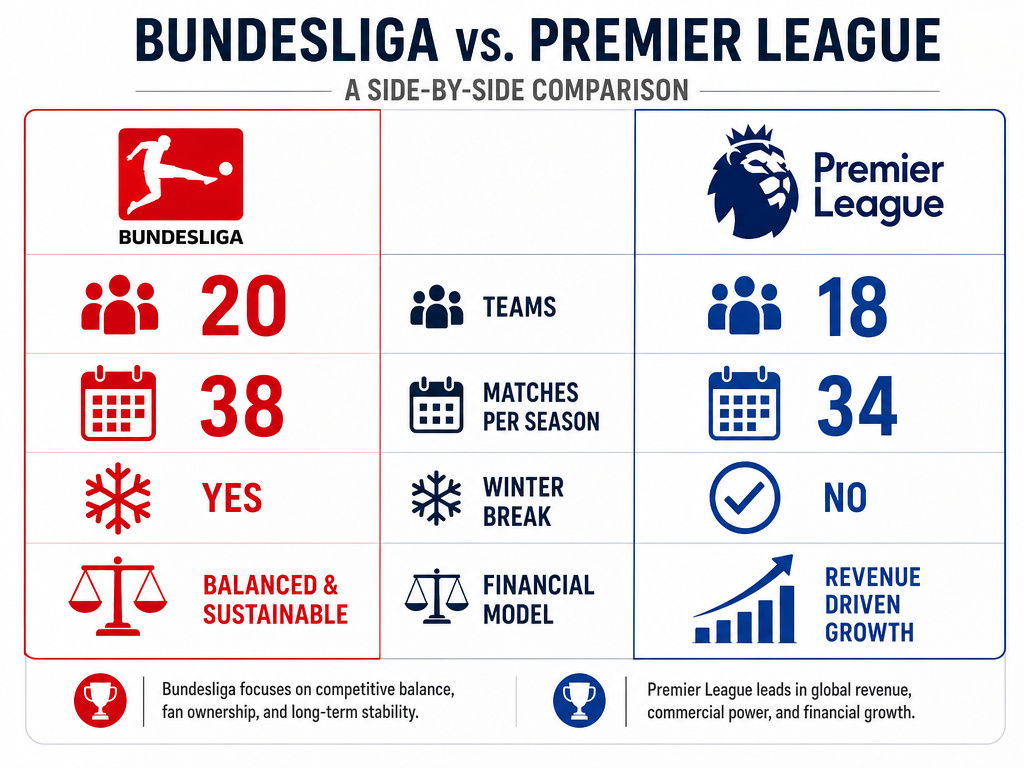
It’s useful to see how the Bundesliga’s structure stacks up against its peers. The differences aren’t just academic; they create entirely different competitive dynamics.
The most obvious comparison is with the Premier League. Both have 20 teams? No. The Premier League has 20 teams, meaning a 38-game season, while the Bundesliga has 18. That’s four more matches, a significantly longer grind with more midweek fixtures and no winter break. The Premier League also relegates three teams automatically, with no playoff safety net for 18th place. Their financial rules are more permissive, leading to vastly higher spending but also greater financial disparity. The Bundesliga’s 18-team, 34-game schedule feels more compact, more intense.
Compare it to Ligue 1, which also has 18 teams and a 34-match format. The structural similarity is there, but the financial power and global appeal differ sharply. Or look at the Brazilian Série A, which often uses a double-round-robin plus playoff knockout stage, a much more convoluted path to a title.
The Bundesliga’s model, with its enforced financial responsibility and fan-centric ownership, arguably produces a more balanced and sustainable competition. It might not generate the same global TV revenue as the Premier League, but it protects what makes the league uniquely compelling: full stadiums, unpredictable results, and clubs that still belong to their communities.
How the Bundesliga was founded
The Bundesliga’s first season began in August 1963, establishing a single, unified top division for German football. It started with 16 teams, a number that has changed over the decades before settling on the current 18. The first champions in that 1963/64 season were Cologne, who finished six points clear of their rivals. This founding created a consistent national competition that replaced the previous regional league system, setting the stage for the modern league structure we see today.
Frequently Asked Questions
What is the 50+1 rule in the Bundesliga?
The 50+1 rule requires that the parent club (usually the members’ association) hold at least 50% plus one share of the voting rights. This prevents a single external investor from taking majority control, ensuring fans retain the decisive voice in club affairs. Exceptions exist for Wolfsburg, Leverkusen, and Carl Zeiss Jena due to their history as factory clubs.
Why are there only 18 Bundesliga teams?
An 18-team league creates a 34-match season, which is seen as the ideal balance between commercial requirements, player workload, and calendar space for cup and European competitions. It has been the standard for most of the league’s modern history, though the first season in 1963 started with 16 teams.
How many teams are relegated from the Bundesliga?
Two teams are relegated automatically (17th and 18th place). A third team (16th place) enters a two-legged relegation play-off against the 3rd-place team from the 2. Bundesliga. The winner of that tie plays in the Bundesliga the following season, the loser goes to the 2. Bundesliga.
Can a team from the 3. Liga reach the Bundesliga?
Yes, but it’s a two-step process. A team must first win promotion from the 3. Liga to the 2. Bundesliga. Then, they must finish in the top two of the 2. Bundesliga (or win the promotion play-off) to reach the top flight. The same playoff system exists between the 2. Bundesliga and 3. Liga.
Before You Go
The Bundesliga’s structure is a carefully crafted engine. The 18-team, 34-game schedule provides clarity. The unique relegation playoff provides a brutal, dramatic finale for one club each year. The financial and ownership rules, while sometimes debated, provide a stability that fuels Europe’s best attendances.
If you want to see the system in action, don’t just watch the title race. Watch the scramble for fourth place in the final weeks. More importantly, watch the desperate fight to avoid 16th place, because that’s where the Bundesliga’s unique brand of tension truly lives, in a two-legged tie where everything is on the line. For a deeper look at the league’s foundational rules, the Wikipedia Bundesliga football article remains an excellent reference.
