
How La Liga Works: Competition Format, Rules & Governance
This post contains affiliate links. As an Amazon Associate, we earn from qualifying purchases.
La Liga works as a 38-match, double round-robin competition for 20 teams in its top division, LALIGA EA SPORTS, where three points are awarded for a win. It is organized by the private sports association LALIGA in coordination with the Royal Spanish Football Federation (RFEF), with the bottom three teams relegated to the second division, LALIGA HYPERMOTION.
That coordination clause is the entire story. It’s not a simple “league runs itself” model. The RFEF holds the official state-level title, sets the binding competition rules, and must approve any calendar changes LALIGA proposes. LALIGA handles the day-to-day operations, marketing, and commercial side. This split creates a system with checks, balances, and the occasional public disagreement over how la liga works.
What follows is a walk through the mechanics: the matchday math, the high-stakes promotion playoffs most guides gloss over, the precise path to European football, and the financial controls that reshaped the league from a debt-ridden mess into a €24 billion enterprise.
Key Takeaways
- The competition is a 38-match double round-robin for 20 clubs, with three points for a win.
- Governance is a shared model: LALIGA organizes and markets, but the RFEF owns the competition and sets the rules.
- Relegation sends the bottom three teams to LALIGA HYPERMOTION, with a complex six-team playoff deciding the third promotion spot.
- European qualification is dynamic, with up to five Champions League spots possible based on UEFA’s coefficient ranking.
- Financial stability is enforced by LALIGA’s Squad Cost Limit, a domestic rule separate from UEFA’s Financial Fair Play.
The Core Competition Format in 5 Steps
Forget the branding for a second. The Primera División, now called LALIGA EA SPORTS, runs on a simple, brutal arithmetic.
The 2025/26 RFEF competition rules set it in stone: twenty clubs, one group, 38 matchdays. Each team plays every other team twice, once at home, once away. You get three points for a win, one for a draw, and zero for a loss. Add it all up after 38 games, and the team at the top is champion.
The Campeonato Nacional de Liga de Primera División is configured in a total of 38 matchdays in which the participating clubs will face each other in a double round-robin system using the points system, establishing the final classification according to the points obtained by each of the contending clubs, at the rate of three points per match won, one for a draw and zero for a loss.. RFEF Competition Rules, Article 7.
The format is so standard it feels invisible, which is a core part of how la liga works. But that 38-game schedule is the product of that LALIGA-RFEF coordination. LALIGA proposes the calendar, but the RFEF publishes the final, binding version. The rules even state the calendar can be modified by agreement between the two bodies. This isn’t theoretical. During the COVID-19 pandemic, this “force majeure” clause was the legal basis for suspending and later rescheduling matches. The system is rigid until it absolutely cannot be.
When the final whistle blows on matchday 38, the league table is your ultimate truth. But what if two teams finish level on points?
Tie-breakers work in this order:
- Head-to-head record between the tied teams. This is the first decider, a rule that makes every direct clash doubly important.
- Overall goal difference across the entire season.
- Most goals scored. This order differs from some other major leagues and can dramatically change European qualification or relegation fates. A single goal in a 1-1 draw in October could be the difference between 7th and 8th place in May.
Who Actually Runs La Liga? (It’s Two Groups)
If you think one boss runs the show, you’re missing the tension that defines Spanish football. The organization is a permanent negotiation.
On one side is LALIGA (Liga Nacional de Fútbol Profesional). It’s a private sports association, not a government body. Its members are the 20 clubs in LALIGA EA SPORTS and the 22 in LALIGA HYPERMOTION. Think of it as the operators and sales team. Per its statutes, its core jobs are organizing the professional competitions and marketing the audiovisual rights. It sets kick-off times for TV, runs the global offices, and deploys the anti-piracy team.
On the other side is the RFEF (Real Federación Española de Fútbol), the national federation. It’s the governing body. The RFEF’s competition rules are explicit: the Primera and Segunda Divisions are “official state-level professional competitions… Organized by LALIGA in coordination with the RFEF.” The RFEF retains the titular ownership and its rules have “obligatory compliance for all participating clubs, players, coaches, delegates, referees.”
| Responsibility | LALIGA’s Role | RFEF’s Role |
|---|---|---|
| Competition Organization | Day-to-day operations, logistics, fixture scheduling. | Owns the official competition, sets and publishes binding rules. |
| Commercial Rights | Exclusive marketing of audiovisual rights globally. | No direct role, but must be consulted on calendar affecting other competitions. |
| Rulemaking & Discipline | Proposes regulations (e.g., financial controls). | Enacts final competition rules, oversees disciplinary committees. |
| Calendar Approval | Proposes match schedule and kick-off times. | Must approve the final calendar; can mandate changes. |
This duality explains the occasional public spats. LALIGA might want a Monday night game for Asian TV audiences; the RFEF might refuse because it clashes with a lower-league cup fixture. It’s a built-in friction that prevents any single entity from having absolute power.
Promotion, Relegation & The Pyramid Below
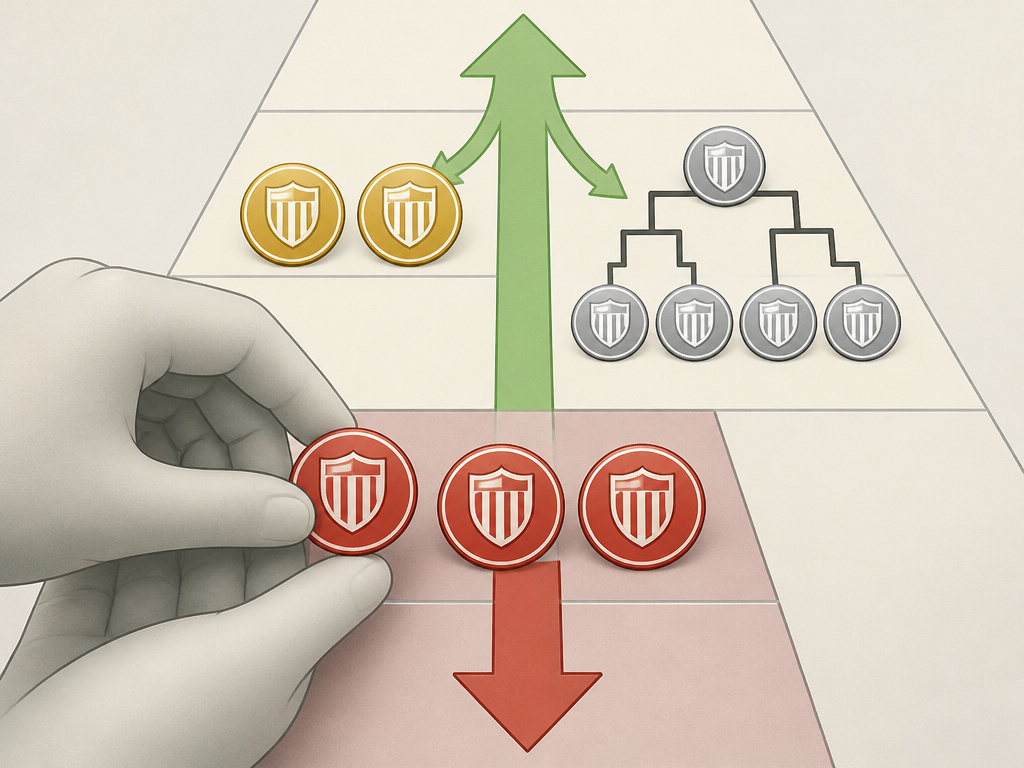
The drop is simple. The climb back up is a gauntlet.
In LALIGA EA SPORTS, the teams finishing 18th, 19th, and 20th are relegated directly to LALIGA HYPERMOTION (the Segunda División). No playoffs, no second chances. Their place in the top flight is gone.
Promotion from HYPERMOTION is where the drama unfolds. The top two teams earn automatic promotion. The third promotion spot is decided by a six-team playoff (play-off de ascenso). It works like this:
- The teams finishing 3rd, 4th, 5th, and 6th in Segunda enter the playoff.
- 3rd plays 6th, and 4th plays 5th in two-legged semi-finals.
- The winners of those ties meet in a two-legged final.
- The winner of that final gets the third promotion ticket.
It’s a brutal system that rewards consistency over the full season, the top two avoid it entirely, while giving a thrilling, high-stakes chance to the chasing pack.
But what’s below HYPERMOTION? That’s the Primera Federación. This is a critical distinction. The Primera Federación is a non-professional competition, and its exclusive sporting ownership belongs to the RFEF, not LALIGA. It’s the top of the “non-league” pyramid. The winner of each of its two groups gets automatic promotion to HYPERMOTION. Teams finishing 2nd through 5th in each group then enter another complex playoff for two more promotion spots. This is the pipeline for historic clubs and ambitious projects trying to reach the professional tiers.
How Teams Qualify for Europe (It’s Not Just the Top 4)
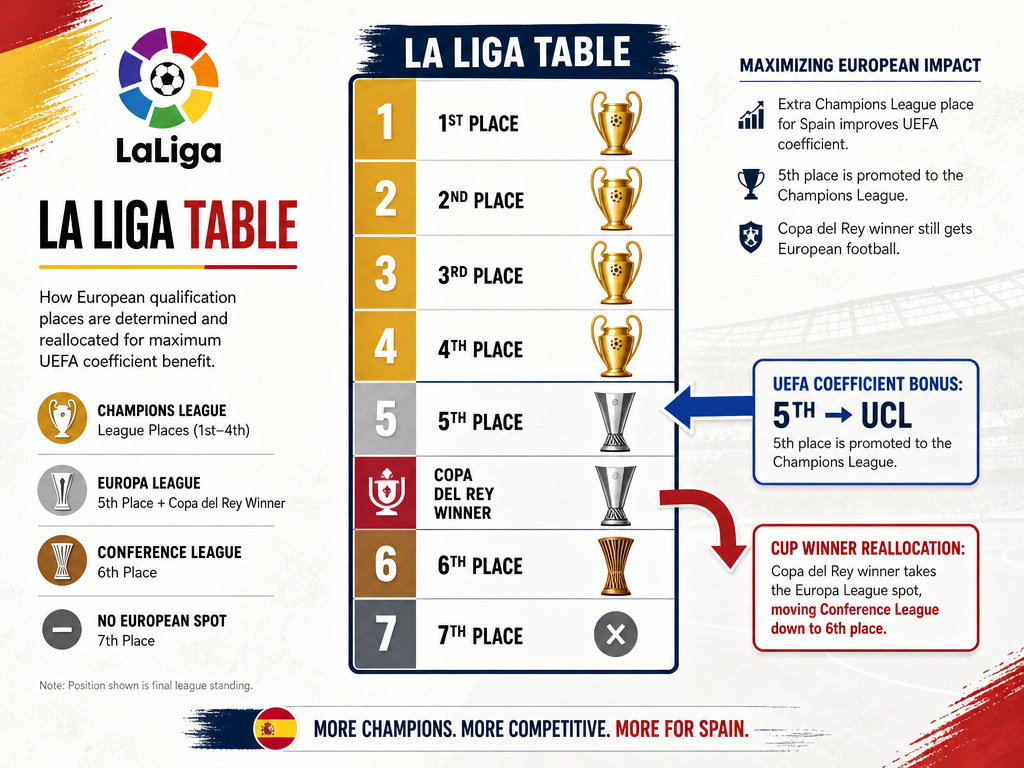
European qualification is the season’s other major prize, and the slots have expanded. The Champions League is the big target, but the Europa League and Conference League offer vital continental revenue and prestige.
The standard allocation for La Liga is:
- Champions League (4 spots): 1st, 2nd, 3rd, and 4th place.
- Europa League (2 spots): 5th place, and the winner of the Copa del Rey.
- Europa Conference League (1 spot): 6th place.
However, there’s a major twist: the UEFA coefficient. If Spain finishes as one of the top two performing nations in European competitions that season, it earns a fifth Champions League spot. This goes to the team that finished 5th in the league. In that scenario, 6th place would get the Europa League spot, and 7th place would enter the Conference League.
The Copa del Rey winner also throws a wrench in the works. If the cup winner has already qualified for Europe via their league position (e.g., they finish in the top six), their Europa League spot defaults to the next-best league finisher not already in Europe. This is why the race for 6th and 7th can suddenly become so important in the final weeks.
Where this goes sideways: Assuming 4th place is the only goal for the Champions League. In a season where Spain’s coefficient is high, 5th place gets you in too. Clubs that shut down after securing 5th could miss a historic opportunity.
The Financial Engine: From Crisis to Control
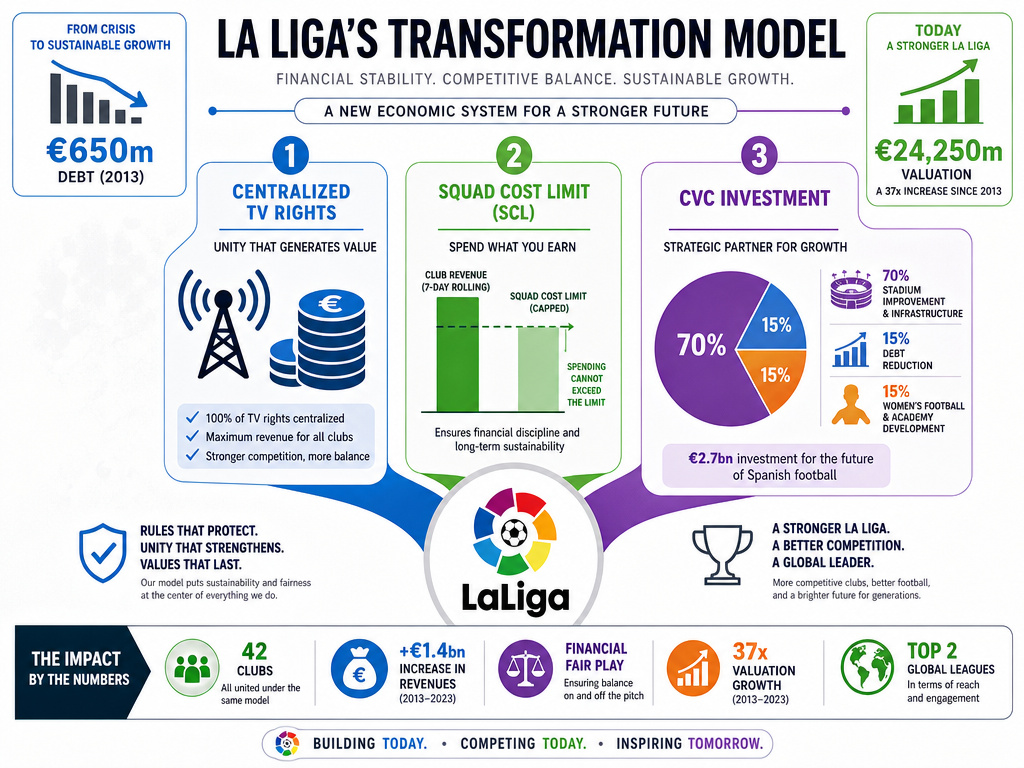
In the early 2010s, La Liga was financially chaotic. The fact sheet lays it out starkly: in 2013, debts with the Spanish tax authorities stood at €650 million. Two years prior to 2013, complaints over non-payment of wages amounted to 341 and involved €84m.
The turnaround came from three pillars of financial control instituted by LALIGA:
- Centralized Audiovisual Rights Sales: LALIGA markets TV rights collectively, not club-by-club.
- The Squad Cost Limit (SCL): This is LALIGA’s domestic version of Financial Fair Play, but more immediate. Before each season, LALIGA calculates a spending limit for each club based on its revenues, expenses, debt, and projected income. This limit covers player and coach wages, amortization costs, and agent fees. A club cannot register new players if a signing would breach its SCL. It’s a hard cap.
- The CVC Investment: In 2021, LALIGA’s assembly approved a strategic deal with CVC Capital Partners, which valued LALIGA at €24,250 million. The injected funds come with strings: clubs must spend 70% on infrastructure (stadiums, training grounds), 15% on debt restructuring, and 15% on player registration. This is a long-term play to modernize assets.
These controls are enforced by LALIGA’s Economic Control Committee, five independent members, most of whom must be economists or auditors.
When does the La Liga season start and end?
The La Liga season runs across multiple months. The twenty clubs in the top division, LALIGA EA SPORTS, compete across 38 matchdays. The competition calendar can be modified by agreement between the RFEF and LALIGA. For the 2024/25 season, the player registration periods for Primera and Segunda División are from 1 July 2024 to 30 August 2024 and from 2 January 2025 to 3 February 2025. On days designated for official matches, LALIGA sets the kick-off times and must communicate the schedule to the RFEF with sufficient advance notice for referee assignments. The season concludes with the crowning of the champion and the relegation of the bottom three teams.
When was La Liga founded?
La Liga is Spain’s premier football competition. LALIGA’s statutes define its purpose as organizing professional competitions and marketing audiovisual rights. Its governance includes a General Assembly composed of the President and a representative from each registered team. Today, LALIGA is valued at €24,250 million and has a global reach, with rules that are binding for all participating clubs, players, coaches, delegates, referees, and any person involved.
How does La Liga compare to other top leagues?
La Liga operates a system of promotion and relegation and awards three points for a win. Its top division features twenty clubs playing each other twice across 38 matchdays. A key distinction is its governance, being organized by LALIGA in coordination with the Spanish football federation (RFEF). The league has its own financial regulations and controls, including an Economic Control Committee. Its global audience is immense; in the 2019/2020 season, LALIGA reached more than 2.8 billion people globally.
Frequently Asked Questions
What is the difference between LALIGA EA SPORTS and LALIGA HYPERMOTION?
They are the branded names for the first and second divisions of Spanish professional football. LALIGA EA SPORTS is the top tier (Primera División) with 20 clubs. LALIGA HYPERMOTION is the second tier (Segunda División) with 22 clubs. Both are organized by LALIGA.
How many games are in a La Liga season?
Each team plays 38 games in a full LALIGA EA SPORTS season, 19 home and 19 away. This is because 20 teams play a double round-robin format (playing each other twice).
Who has won La Liga the most?
Can a Segunda División team be promoted if it doesn’t finish in the top two?
Yes. While the top two teams in LALIGA HYPERMOTION are promoted automatically, the teams finishing 3rd, 4th, 5th, and 6th enter a multi-round playoff. The winner of this playoff earns the third and final promotion spot.
Does the Copa del Rey winner qualify for Europe?
Yes. The winner of the Copa del Rey (Spain’s domestic cup) qualifies for the following season’s UEFA Europa League group stage. If the winner has already qualified for the Champions League via their league position, the Europa League spot goes to the next-highest ranked team in the league not already in Europe.
The Bottom Line
Understanding how La Liga works means seeing past the 90 minutes on the pitch. It’s a league governed by a dual-power structure, stabilized by aggressive financial policing, and connected to a deeper pyramid where promotion is a brutal fight. The 38-game marathon decides the champion, but the real story is in the boardrooms and rulebooks where LALIGA and the RFEF negotiate the league’s future every single day.
For any fan, the first step to deeper appreciation is to stop just watching the ball. Next time you see a fixture list, remember it was a joint agreement. When a mid-table club makes a sensible signing instead of a splashy one, the Squad Cost Limit is working. The game is the show, but this is the machinery that makes the show possible.
