
How the Premier League Works: The 20-Club System Explained
This post contains affiliate links. As an Amazon Associate, we earn from qualifying purchases.
The Premier League is a 20-club competition where each club plays 38 matches in a season running from August to May. It uses a promotion and relegation system linked to the EFL Championship, with points awarded as three for a win and one for a draw. The bottom three clubs are relegated each season, replaced by the top two from the Championship and a third via playoffs.
That 20-club count is the single most important number in the whole system. It dictates the 380-match calendar, the revenue each club gets, and the two-thirds voting majority needed for any major change. Every other rule, from the tie-breakers to the share transfers at the Annual General Meeting, exists to serve that fixed, elite membership, which is a core part of how the Premier League works.
What follows is a walkthrough of the format, the drama of promotion and relegation, the scramble for European football, and the surprisingly corporate rulebook that keeps it all running. By the end, you’ll know exactly what it takes to win, survive, or fall out of the world’s most watched league.
Key Takeaways
- The league’s 20-club structure creates a 38-game season for each team and a total of 380 matches, a format unchanged since 1995.
- Promotion and relegation sees the bottom three PL clubs drop to the Championship, replaced by the top two from that league plus a playoff winner.
- European qualification is a ladder: the top four (sometimes five) go to the Champions League, with Europa League and Conference League spots going to cup winners and the next highest league finishers.
- The Premier League Handbook is a binding contract between the clubs and the league, with rule breaches punishable by fines, points deductions, or even expulsion.
- Tie-breakers after points are goal difference, then goals scored, then head-to-head records, a system that has decided the title on the final day.
The Premier League’s Basic Format: 20 Clubs, 380 Matches
The whole competition is built on a double round-robin. Each of the 20 clubs plays every other club twice, once at home, once away. That simple math gives you 38 matches per club and 380 matches in total across the season, which runs from August through May.
Three points for a win, one for a draw, none for a loss. The club with the most points after matchday 38 wins the title. It’s a brutally simple scoring system that creates a clear hierarchy over ten months. The fixture list is a marathon, not a sprint, and the table rarely lies after that many games.
The Premier League competition format involves 20 clubs playing a double round-robin, resulting in 380 total matches per season. Points are awarded as three for a win, one for a draw, and zero for a loss, with the title awarded to the club with the most points after all matches are completed.
The 20-club size wasn’t always the case. The league started with 22 clubs in 1992 but was trimmed down to 20 in 1995. The current number strikes a balance between a packed calendar and player welfare, though fixture congestion is a constant debate.
This structure is the engine of the league’s global appeal and a key part of how the Premier League works. The consistency allows fans in 189 different countries to follow a predictable schedule, and the sheer number of games, 380, provides a relentless stream of content. It’s a commercial machine as much as a sporting one.
The Points System and How the League Table is Decided
Points are the only currency that matters in how the Premier League works. Win, and you get three. Draw, and you get one. The team that finishes with the most points wins the league. It doesn’t matter how you get them. A 1-0 grind counts the same as a 5-0 rout.
But what happens when teams finish level on points? This is where the drama often lies, and the tie-breaking rules are a precise sequence.
- Goal Difference (GD). This is goals scored minus goals conceded. A positive GD is a sign of a dominant team. It’s the first separator and often the decider for European spots or the title itself.
- Goals Scored (GF). If GD is identical, the team that scored more goals finishes higher. This rewards attacking play.
- Points in Head-to-Head Matches. If still tied, the league looks at the results between the two tied clubs. Whoever took more points in their two meetings gets the higher place.
- Away Goals in Head-to-Head. If the head-to-head points are also level, the club that scored more away goals in those specific matches finishes higher.
| Tie-Breaker Step | What It Means | Example Scenario |
|---|---|---|
| 1. Goal Difference (GD) | Goals For minus Goals Against | Team A: +35 GD, Team B: +30 GD → Team A wins |
| 2. Goals Scored (GF) | Total number of goals scored | Team A & B both have +35 GD, but Team A scored 75 goals vs Team B’s 70 → Team A wins |
| 3. Head-to-Head Points | Points taken from the two league matches between the tied clubs | Teams are identical on GD & GF; Team A took 4 points from Team B (win & draw) → Team A wins |
| 4. Head-to-Head Away Goals | Goals scored away in those two head-to-head matches | Head-to-head points are level (e.g., two draws); Team A scored 2 away goals to Team B’s 1 → Team A wins |
This system has produced unforgettable moments. The 2011/12 title was decided on goal difference alone, +64 for Manchester City to +56 for Manchester United. Sergio Agüero’s 93rd-minute winner wasn’t just a goal; it was a +1 swing that etched the rule into folklore.
The Promotion and Relegation System
This is the heartbeat of the competition and what separates it from closed-shop leagues in the United States. Every season ends with three clubs being relegated from the Premier League and three new ones arriving from the English football pyramid. The fear of the drop and the dream of promotion create a unique pressure.
The process is a direct exchange with the EFL Championship, the second tier. Here’s how the swap works:
- Down Go the Bottom Three. The clubs that finish 18th, 19th, and 20th in the Premier League table are relegated. They lose their share of Premier League broadcasting revenue, a significant financial blow.
- Up Come the Top Two. The clubs that finish 1st and 2nd in the Championship are automatically promoted. Their season ends in celebration, with planning for the top flight beginning immediately.
- The Playoff Winner Takes the Third Spot. The clubs finishing 3rd, 4th, 5th, and 6th in the Championship enter a knockout playoff. It’s a mini-tournament often called the “richest game in football,” with the winner securing the final promotion place. The drama is immense, and the financial reward is huge.
This promotion and relegation process is formalized at the league’s Annual General Meeting (AGM) after the season. Relegated clubs literally transfer their Premier League shares to the promoted clubs. It’s a corporate handover that matches the sporting one.
Where this goes sideways: Assuming survival is guaranteed with a few games left. The scramble to avoid 18th place is often more frantic than the race for the title. A single loss in the final weeks can condemn a club to the Championship.
The system ensures a constant renewal of the league. Since 1992, 51 different clubs have played in the Premier League. Only six are “ever-present”: Arsenal, Chelsea, Everton, Liverpool, Manchester United, and Tottenham Hotspur. Everyone else has felt the chill of the trapdoor at some point.
European Qualification: The Race for More Than Just Pride
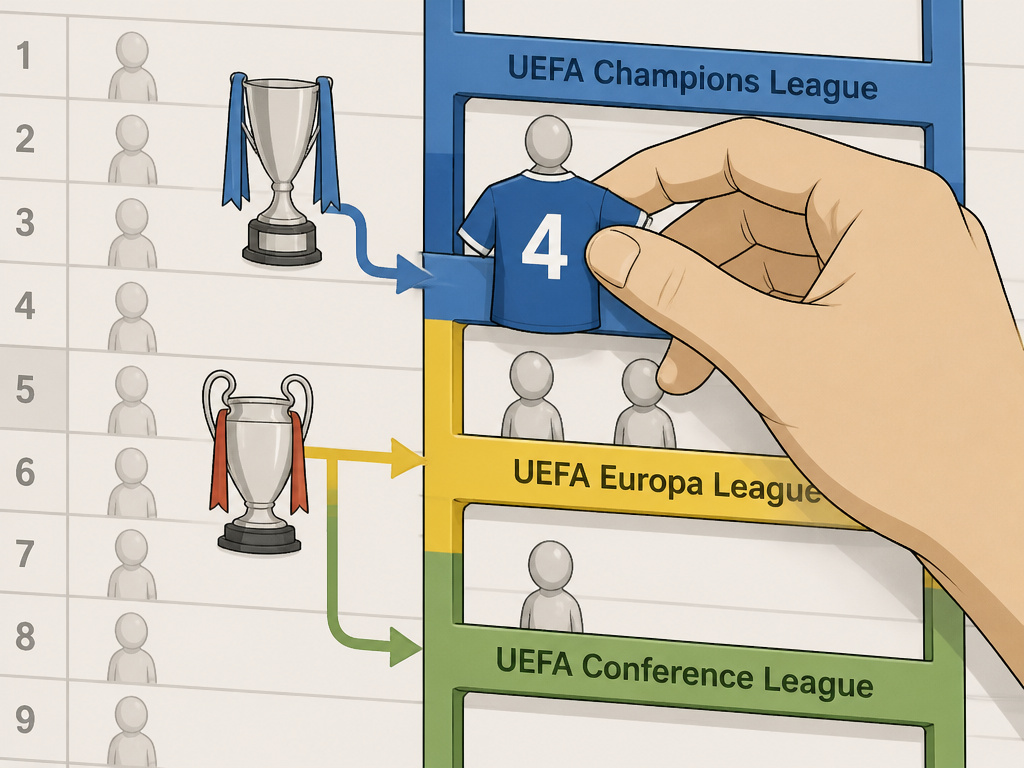
For clubs outside the title race, qualifying for European competitions is the primary goal. It brings prestige, more revenue, and helps attract better players. The Premier League sends clubs into UEFA competitions: the Champions League, Europa League, and Europa Conference League.
The slots are allocated based on league finish and domestic cup wins. Here’s how it worked for the 2025/26 season, which is the standard template:
| Competition | Who Qualifies | 2025/26 Example |
|---|---|---|
| UEFA Champions League | 1st – 4th (or 5th) in Premier League | Man City, Liverpool, Arsenal, Aston Villa + (5th: Chelsea via UEFA coefficient) |
| UEFA Europa League | 5th (or 6th) in PL + FA Cup winner | 6th-place Newcastle + (FA Cup winner Man City, spot passed to 7th-place Sunderland) |
| UEFA Conference League | EFL Cup winner | (EFL Cup winner Man City, spot passed to 8th-place Brighton) |
The “or” is crucial. England earned a fifth Champions League qualification spot for 2025/26 via UEFA’s coefficient system, which rewards a league’s collective performance in Europe. This extra spot went to the next-highest league finisher not already qualified.
The cup winners’ spots can also cascade. If the FA Cup or EFL Cup winner finishes in a Champions League place, their Europa or Conference League spot goes to the next highest-ranked Premier League club. This is why finishing 7th or 8th can still mean European football.
It’s a complex ladder, and fans often need a calculator on the final day. Securing a top four finish remains the ultimate guarantee for the biggest stage.
Governance and Rules: It’s a Private Company
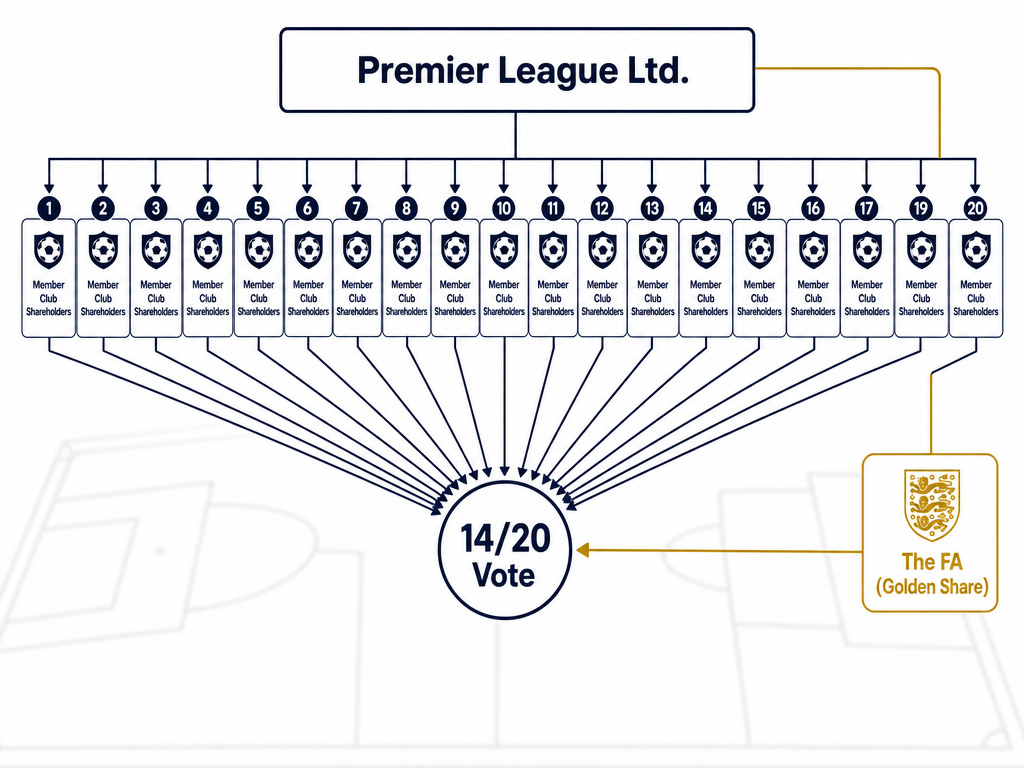
At this level, the game is a business. The Premier League is a private company limited by shares. The shareholders are the 20 member clubs, each holding one share and getting one equal vote. The Football Association (The FA) also holds a special “golden share” with veto power over certain fundamental changes.
Major decisions, like changing major rules or approving huge commercial contracts, require a two-thirds majority (14 out of 20 clubs). This gives the majority substantial power but protects smaller clubs from being railroaded.
The rulebook is not a set of guidelines. It’s a contract. The Premier League Handbook is updated each summer and binds every club to its terms. Breaches can be punished severely.
- Fines: The Premier League Board can issue fines of up to £100,000 for certain breaches before escalating the matter.
- Points Deductions: For more serious financial or regulatory breaches, independent commissions can dock points. This punishment directly alters the league standings and has decided relegation battles.
- Expulsion: The rules allow for it in extreme cases, though it has never happened.
This corporate structure, with its financial regulations and shareholder meetings, is the scaffolding that holds the sporting spectacle up. The drama on the pitch is governed by a boardroom in London.
A Global League: Scale and Diversity
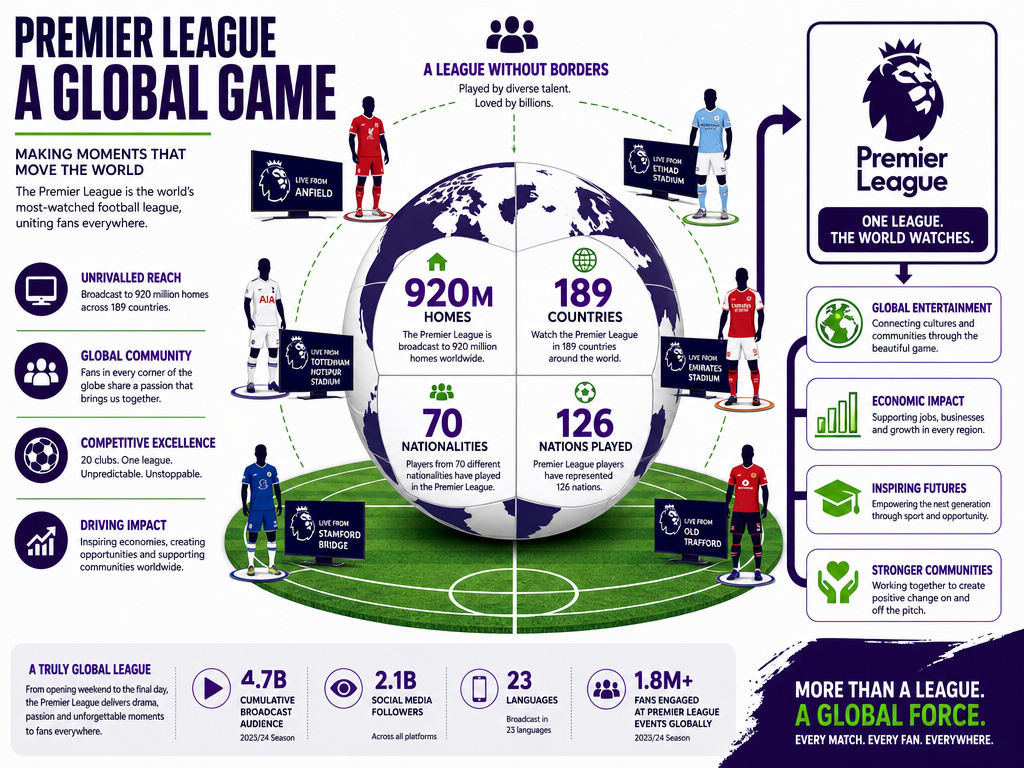
The Premier League’s reach is staggering. Its matches are broadcast in 920 million homes across 189 countries. That global audience is the foundation of its multi-billion pound television deals, which are then distributed among the clubs.
This global appeal is mirrored on the pitch. While the league is fiercely proud of developing English talent, over 95% of academy players are British, the first-team squads are melting pots. On average, about 70 different nationalities are represented in any given season, with 126 having played in the league to date.
That mix of local identity and global stars is a key part of the product. You can watch a lad from Manchester academy play alongside a superstar from Brazil, managed by a Spaniard, in a stadium owned by an American consortium. It’s a uniquely modern football ecosystem.
History and Legacy
The league’s history is relatively short but packed. It broke away from the old Football League in 1992, driven by a desire for clubs to control their own broadcasting rights. Since its inception in 1992, there have been only seven different winners.
Manchester United has been the most successful with 13 titles. The landscape has shifted, though, with Manchester City and Chelsea becoming dominant forces in the 21st century thanks to significant investment. The competition has seen invincible seasons (Arsenal 2003/04), miraculous champions (Leicester City 2015/16), and title races decided in the dying seconds.
The league’s evolution is ongoing. The introduction of Video Assistant Referee (VAR) technology, the tightening of Profit and Sustainability Rules, and the expansion of the Champions League continue to shape how the game is played and governed at the highest level.
How to Watch/Follow the League
Following the Premier League is a global pastime, with matches broadcast in millions of homes across numerous countries. To watch games live, you typically need a subscription to a broadcaster that holds the rights in your region. These broadcasters provide full match coverage, highlights, and analysis. Many clubs also offer their own streaming services and content. To stay updated on news, transfers, and table movements, a combination of official sources, dedicated sports news outlets, and club social media channels will provide full coverage throughout the season.
Frequently Asked Questions
How does promotion from the Championship work?
The top two teams in the EFL Championship are automatically promoted. Teams finishing 3rd, 4th, 5th, and 6th enter a two-legged playoff semifinal, with the winners meeting in a one-off final at Wembley Stadium. The winner of that final gets the third and final promotion spot.
Can only English teams play in the Premier League?
While the clubs are based in England (and one in Wales), there is no nationality restriction on club ownership or players. Players from anywhere in the world can play, provided they have a work permit and the club has the required visa. The diversity of nationalities is a defining feature.
What decides who wins the Premier League?
The club with the most points after each team has played 38 matches wins the title. Points are three for a win, one for a draw. If teams are level on points, the winner is decided by goal difference, then goals scored, then head-to-head record.
How hard is it to play in the Premier League?
Extremely. With only 20 clubs and global recruitment, the level is incredibly high. Even established internationals can struggle with the pace and physicality. The league is a magnet for the world’s best talent, making it arguably the most competitive top-flight in the world.
What is the Premier League Handbook?
It’s the official rulebook, published before each season. It covers everything from player registrations and fixture rules to financial regulations and disciplinary procedures. It serves as a legal contract between the league and its member clubs.
Is the Premier League the same as the English Football League?
No. The Premier League is the top tier. The English Football League (EFL) is the governing body for the three professional divisions below it: the Championship, League One, and League Two. Together, they form the English football pyramid.
The Bottom Line
The Premier League works because of a simple, brutal formula: 20 clubs fighting over 380 games, with three points for a win and a trapdoor waiting for the bottom three. Its global success is built on this perfect storm of sporting meritocracy, financial might, and relentless drama.
Everything else, the European ladder, the corporate rulebook, the global audience, is a consequence of that core competition. The rules are designed to maintain the intensity and the value of that membership. Whether you’re playing Fantasy Premier League or watching a relegation scrap, you’re engaging with a system that has turned football into a year-round, high-stakes narrative. That’s the real magic of how it works.
