
History of the Premier League: How It Works and Evolved
This post contains affiliate links. As an Amazon Associate, we earn from qualifying purchases.
The Premier League is a football competition that began in 1992 when the top 22 clubs in England broke away from the Football League to gain commercial independence and control their own television rights. Its founding principles, established in the 1991 Founder Members Agreement, created a new governance model where every club had an equal vote and broadcast revenue was shared in a specific 50-25-25 split.
That last sentence is the whole game. A new voting structure and a new way of sharing money didn’t just create a league, they created a financial and competitive engine that would dominate world football. The story isn’t just about dates and deals in the history of the premier league; it’s about how a handful of club chairmen, a determined FA executive, and a satellite broadcaster rewrote the rules of an entire sport.
What follows is the full timeline of the history of the premier league, from secret meetings in 1991 to the global phenomenon it is today. We’ll look at the first goal, the first title, the records, and the teams that have defined its three decades. By the end, you’ll see the Premier League not as a list of champions, but as a case study in how ambition, television, and a simple voting rule changed football forever.
Key Takeaways
- The Founder Members Agreement on 17 July 1991 established the league’s core principles, but it was not legally binding, its power came from the collective will of the clubs.
- The inaugural 1992/93 season featured 22 clubs, a compromise after some plans for an 18-team league were dropped, and was reduced to the current 20 clubs by the end of the 1994/95 season.
- The first television deal with BSkyB, passed by a 14-6 club vote, was worth £42m more over five years than ITV’s bid and fundamentally linked the league’s growth to subscription television.
- Six clubs, Arsenal, Chelsea, Everton, Liverpool, Manchester United, and Tottenham Hotspur, have been ever-present, while a total of 51 different clubs have competed.
- The league’s internal governance runs on a one club, one vote, two-thirds majority system, a radical departure from the Football League’s committee structure.
The Breakaway: How and Why It Happened
The Football Association announced plans for a breakaway league on 5 April 1991. The immediate, tangible motive was television money. Top clubs wanted to stop sharing broadcast revenue with the lower divisions of the Football League and negotiate their own deals.
Top clubs wanted to stop sharing broadcast revenue with the lower divisions of the Football League and negotiate their own deals. Dyke told them a deal as lucrative as the last one wasn’t coming. Arsenal’s David Dein reportedly said, “It’s time to break away.” They knew they needed the FA’s backing to make it stick, and they found a willing partner in FA chief executive Graham Kelly, who was concerned about the Football League’s growing power.
The Founder Members Agreement, signed on 17 July 1991, is not legally binding but it has acquired a kind of sanctity. It contained two profound changes: one club, one vote requiring a two-thirds majority, and a 50-25-25 split of all TV revenue.
This agreement was the blueprint. The “one club, one vote” rule gave even the smallest member a voice, ensuring buy-in. The 50-25-25 revenue split (50% shared equally, 25% based on league finish, 25% on TV appearances) was a masterstroke. It kept the big clubs rich enough to compete in Europe while giving everyone a stable financial floor. International TV money, negligible at the time, was to be divided equally, a clause that would later be worth billions.
The 22 First Division clubs resigned from the Football League en masse on 20 February 1992. The Premier League was then established as a limited company on 27 May 1992, formally beginning its life separate from both the FA and the Football League.
| Key Date | Event | Significance |
|---|---|---|
| 17 July 1991 | Founder Members Agreement signed | Established voting and revenue principles. |
| 20 Feb 1992 | 22 clubs resign from Football League | Formal breakaway action. |
| 27 May 1992 | Premier League incorporated as limited company | Legal birth of the new entity. |
| 15 Aug 1992 | Inaugural season kicks off | The new competition begins. |
The Inaugural Season: 1992/93
The first Premier League campaign started on Saturday 15 August 1992. It wasn’t called the Premier League yet, it was the FA Premier League. Twenty-two teams ran out, a number that was itself a compromise. The FA’s original “Blueprint for the Future” had imagined an 18-club top flight, but by the time of the launch, that idea was dropped. The focus had shifted entirely from restructuring the game to securing commercial control.
The first goal was scored early in the new era. Sheffield United’s Brian Deane headed past Manchester United’s Peter Schmeichel at Bramall Lane. The season would see 1,222 goals in total.
Manchester United won that first title, their first league championship in 26 years, finishing 10 points clear of Aston Villa. The signing of Eric Cantona from Leeds United in November proved the catalyst. The season also recorded its lowest attendance: just over 3,000 fans watched Wimbledon host Everton at Selhurst Park in January 1993.
Here are the defining numbers from that first campaign:
- Champions: Manchester United
- Top Scorer: Teddy Sheringham (22 goals for Nottingham Forest & Tottenham)
- Total Goals: 1,222
- Ever-Present Clubs: 6 (Arsenal, Chelsea, Everton, Liverpool, Manchester United, Tottenham)
Where this goes sideways: Focusing only on the 22 clubs that started. The breakaway created an instant, hard border between the new Premier League and the Football League. The breakaway created an instant, hard border.
Founding Principles: Governance and The Sky Deal
The league’s internal structure was its secret weapon. Gone were the Football League’s labyrinthine committees. The Premier League was run by a two-man board, chief executive Rick Parry and chairman Sir John Quinton, and all major decisions were put to a vote of the member clubs. Each club had one vote, and a two-thirds majority (14 out of 22) was needed to pass anything. This made the league agile and democratic.
The first test of this system was the choice of a broadcast partner. ITV, with its established audience, was the favourite. But BSkyB, a fledgling satellite pay-TV service, saw the league as the killer content it needed to sell dishes. The vote on 18 May 1992 is legendary in sports business.
ITV’s Trevor East arrived late to the bid meeting at the Royal Lancaster Hotel with an offer. Spurs chairman Alan Sugar, who had a deal to manufacture Sky dishes, famously stormed into the lobby, phoned Sky’s Sam Chisholm, and told him to “get your fucking arse round here and blow them out of the water.” Sky returned with a bid worth £42m more than ITV’s over five years. The vote passed 14 to 6.
The deal with Sky and the BBC (for highlights) was a gamble on both sides. Sky was deeply in debt. Most UK households didn’t have satellite TV. But it worked. It created a virtuous cycle: exclusive, high-quality coverage funded by subscriptions, which in turn funded ever-higher rights fees and player wages.
| Aspect | Football League (Pre-1992) | Premier League (Post-1992) |
|---|---|---|
| Governance | Committee-based, slower. | One club, one vote, two-thirds majority. |
| TV Rights | Negotiated for all 4 divisions, revenue shared. | Negotiated independently, revenue kept in top division. |
| Revenue Split | Varied, with larger shares to top clubs. | Fixed 50-25-25 formula for domestic TV money. |
| Commercial Control | Held by Football League central body. | Held by Premier League clubs collectively. |
Evolution of a Global Brand
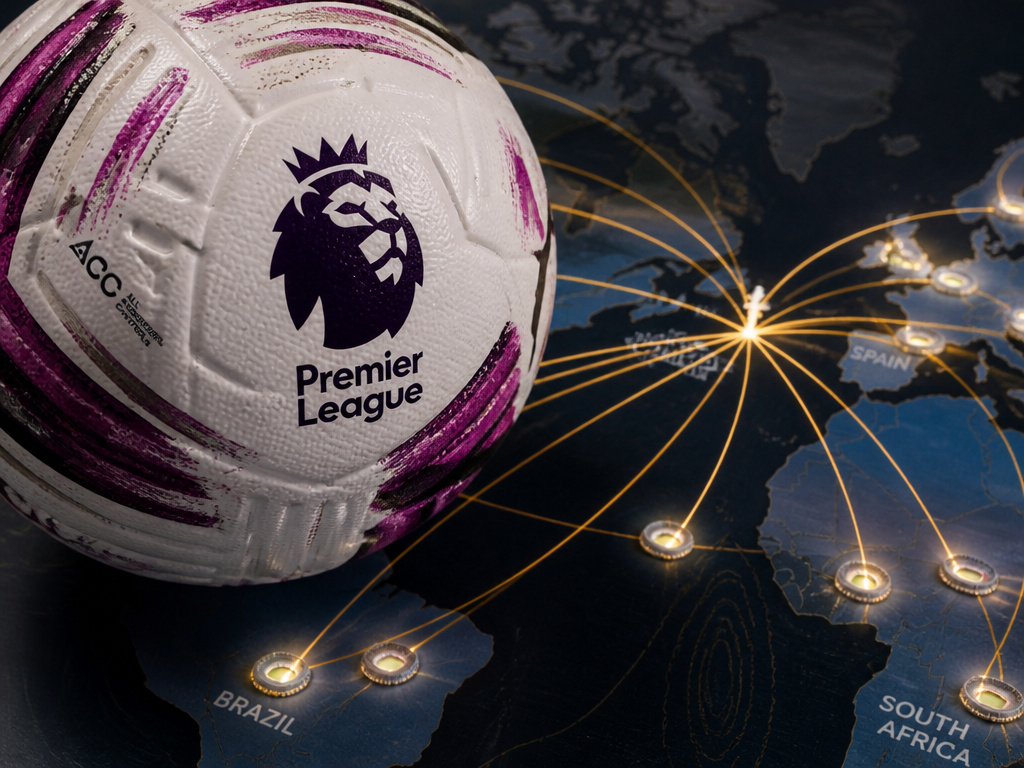
The league didn’t stand still. It immediately acted on its founding intention to reduce from 22 to 20 clubs, which it achieved at the end of the 1994/95 season by relegating four teams and promoting only two. The competition also had title sponsors for many seasons, changing names from the FA Carling Premiership (from 1993/94) to the Barclaycard Premiership (2001 to 2004) and finally the Barclays Premier League (from 2007/08). Since the 2015/16 season, it has gone without a title sponsor, confident enough in its own brand.
Its global reach is the ultimate measure of its success. The Premier League is now the most-watched league on the planet, broadcast in 920 million homes across 189 countries. That international appeal is underpinned by a simple, compelling product: fast-paced, unpredictable football in iconic, often modern, stadiums.
European qualification has also evolved dramatically. In the first season, only the champions qualified for the UEFA Champions League. Now, the top four or five teams enter the Champions League, with further spots for the UEFA Europa League and UEFA Conference League. This expansion has increased the importance of final league positions.
The Premier League has become the definitive model for commercial sports leagues worldwide, but its roots remain in that unique English football pyramid with its fierce promotion and relegation system.
Records, Reigns, and The Invincibles
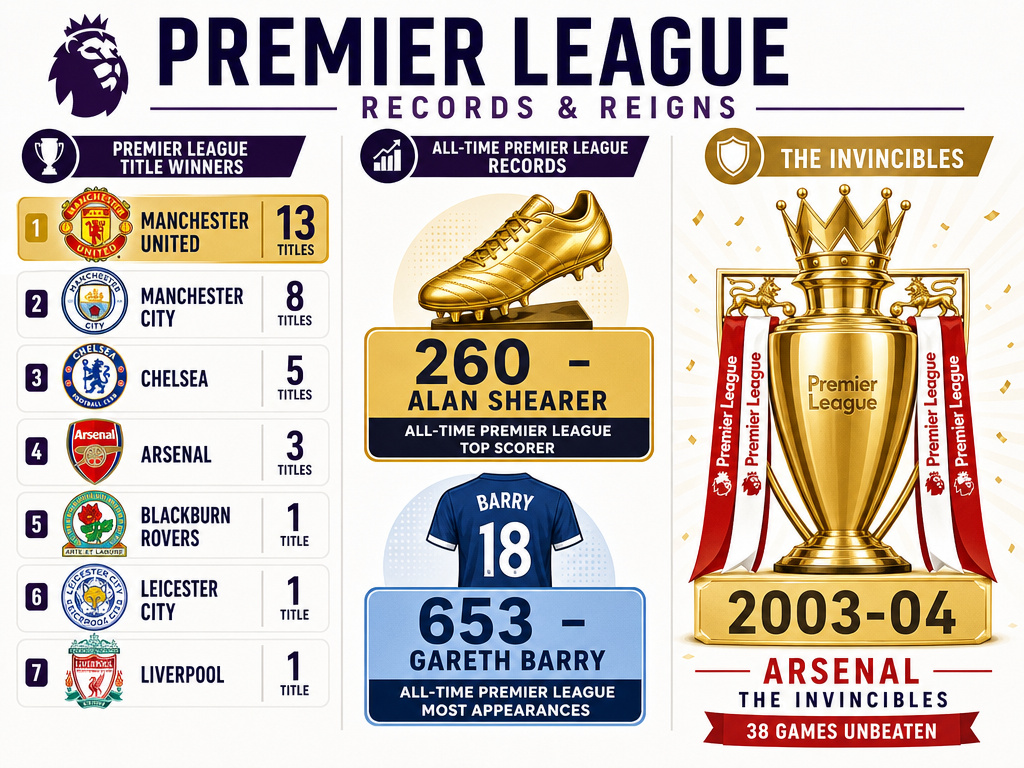
Seven different clubs have won the Premier League title. Manchester United dominate the history books with 13 titles, all won under Sir Alex Ferguson, the league’s longest-serving manager (21 years at United). The other winners are Blackburn Rovers, Arsenal, Chelsea, Manchester City, Leicester City, and Liverpool.
Individual records tell their own stories. Alan Shearer remains the all-time top scorer with 260 goals. Gareth Barry holds the appearance record with 653 games. But team achievements resonate louder. Manchester City hold the record for the biggest title-winning margin (19 points in 2017/18), while the narrowest winning margin of +8 goal difference came in 2011/12.
Then there is the pinnacle: Arsenal’s “Invincibles.” In the 2003/04 season, Arsène Wenger’s side went the entire 38-match campaign unbeaten. It is a feat of consistency that no other club has matched in the modern era. The story of The Invincibles is a perfect snapshot of tactical mastery meeting relentless will.
The history is also shaped by great rivalries, like the North West derby between Manchester United and Liverpool, which has often doubled as a title battle. These clashes are the fixtures that define seasons and eras.
Premier League winners list
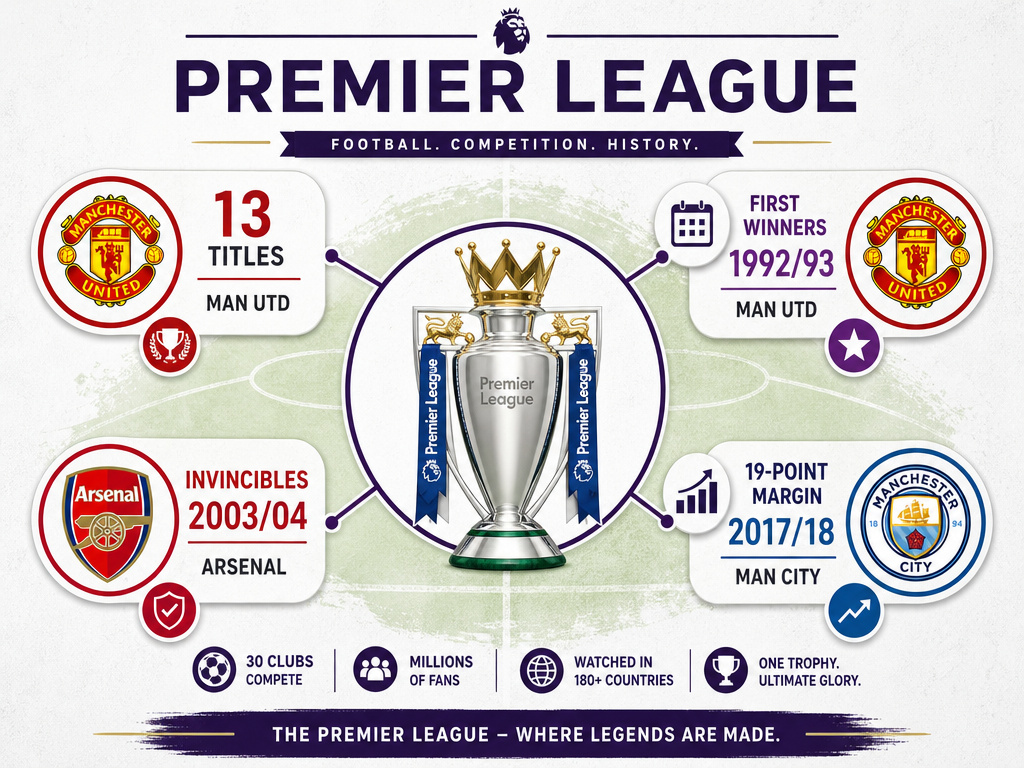
Manchester United have had the most success, with 13 titles in the 34 seasons so far. The first Premier League title went to Manchester United, the club’s first title in 26 years, achieved with a 10-point lead over runners-up Aston Villa. Other winners include Arsenal, who went the entire 2003/04 season without losing a match. Manchester City hold the record for the biggest winning margin, 19 points ahead in 2017/18, while the narrowest winning margin of +8 goal difference came in 2011/12.
How the Premier League works
The Premier League involves the teams playing each other home and away across the season, a total of 380 matches. Three points are awarded for a win, one point for a draw and none for a defeat. The team with the most points at the end of the season is crowned champion. Teams who finish in the top four of the Premier League qualify for the next season’s UEFA Champions League, a rule that started from the 2001/02 season. In the opening season, only the champions qualified for the UEFA Champions League. From the 2025/26 season, the Premier League will have a fifth Champions League spot.
Premier League promotion and relegation explained
The Premier League is connected to the English football pyramid through promotion and relegation. At the end of each season, the bottom three clubs are relegated to the division below. Their places are taken by clubs promoted from the EFL Championship. This system was adjusted in the early years to achieve a smaller league size. The inaugural Premier League had 22 clubs, but the intention was always to reduce the number. This reduction to 20 clubs was achieved at the end of the 1994/95 season, when four clubs were relegated and just two were promoted.
Frequently Asked Questions
How many clubs have played in the Premier League?
The higher figure includes the most recent promoted sides. What’s certain is that only six have been there for every single season.
What was the Premier League called before 1992?
There was no “Premier League” before 1992. The top division of English football was simply the First Division of the Football League. The new league was a clean break from that structure, not a renaming of an existing competition.
Which team has won the most Premier League titles?
Manchester United have won 13 Premier League titles, more than any other club. All of their triumphs came under manager Sir Alex Ferguson between 1993 and 2013.
Why did the top clubs break away in 1992?
The primary motive was commercial control, specifically over television rights money. Club chairmen believed they were subsidizing the lower leagues and wanted to negotiate their own TV deals, keep more of the revenue, and have greater autonomy over their own affairs. The FA supported the move to regain authority from the Football League.
Before You Go
The history of the Premier League is often told as a triumph of business. And it is. But it’s also the history of a simple, brilliant governing idea: one club, one vote. That rule prevented a cabal of big clubs from dominating completely and gave every member a stake in the collective project. It’s why the league could make bold decisions, like the Sky deal, and why its financial model has proven so resilient.
The story isn’t finished. New challenges like the Profit and Sustainability Rules (PSR) and the ever-increasing global competition for talent are writing the next chapters. But to understand where it’s going, you have to start in a hotel room in 1991, with a handwritten agreement that wasn’t even legally binding. Everything since, the goals, the titles, the global fan in a pub at 7:30 a.m., flows from that moment. It’s a history worth knowing, not just for the scores, but for the sheer scale of the ambition.
