
How the Copa America Works?
This post contains affiliate links. As an Amazon Associate, we earn from qualifying purchases.
The Copa América works as a 16-team tournament featuring 10 South American nations and 6 invited guests from North and Central America. The competition runs over 25 days, starting with a group stage where four groups of four teams play a round-robin. The top two teams from each group advance to a knockout bracket, culminating in a final. A win earns 3 points, a draw earns 1, and tie-breakers start with points.
That 16-team number is the key to the whole thing. It’s not a neat number for a confederation with only ten members. The entire structure, the guest invites, the four-group setup, the 32-match schedule, flows from that simple, awkward math. To understand this, you need to know how the Copa America works.
What follows is a walk through the mechanics of how the Copa America works: how teams get in, how the group stage sorts them, and the specific, sometimes quirky rules that decide who moves on when things are dead even. We’ll also look at where this tournament fits in the wider football calendar, especially against the backdrop of South America’s other great competition, the marathon of World Cup qualifying.
Key Takeaways
- The tournament format is built around 16 total teams: 10 from CONMEBOL (South America) and 6 guests from CONCACAF (North/Central America).
- In the knockout phase, no extra time is played in the quarterfinals, semifinals, or third-place match, ties go straight to penalties. Only the final uses extra time.
- Group stage ties are broken by a nine-step criteria list, starting with points, then goal difference, and ending with a random draw conducted by CONMEBOL.
- This is the oldest continental national team tournament in the world, first played in 1916, but it has only settled into a regular four-year cycle recently.
- South America runs two parallel competitions: the Copa América and a separate, stable round-robin league for World Cup qualification involving all 10 CONMEBOL nations.
The 2024 Tournament Format: A 25-Day Sprint
The modern Copa América is a compact, high-stakes event. The 2024 edition in the United States packaged the entire competition into 25 days, from the opening match on June 20 to the final on July 14.
The 2024 Copa América featured 16 teams divided into four groups of four. The 32 total matches progressed from a round-robin group stage to a straight knockout bracket, with the top two teams from each group advancing to the quarterfinals.
Sixteen teams mean four groups. Each team plays the other three in its group once. The top two finishers from each of the four groups, eight teams in total, move into the knockout quarterfinals. From there, it’s a single-elimination bracket: quarterfinals, semifinals, a third-place match, and the final.
The schedule is relentless. With only a few days between matchdays, squad depth and recovery become as important as tactical brilliance in the context of how the Copa America works. It’s tournament football in its purest, most pressurized form.
How Teams are Chosen: 10 Automatic, 6 Invited
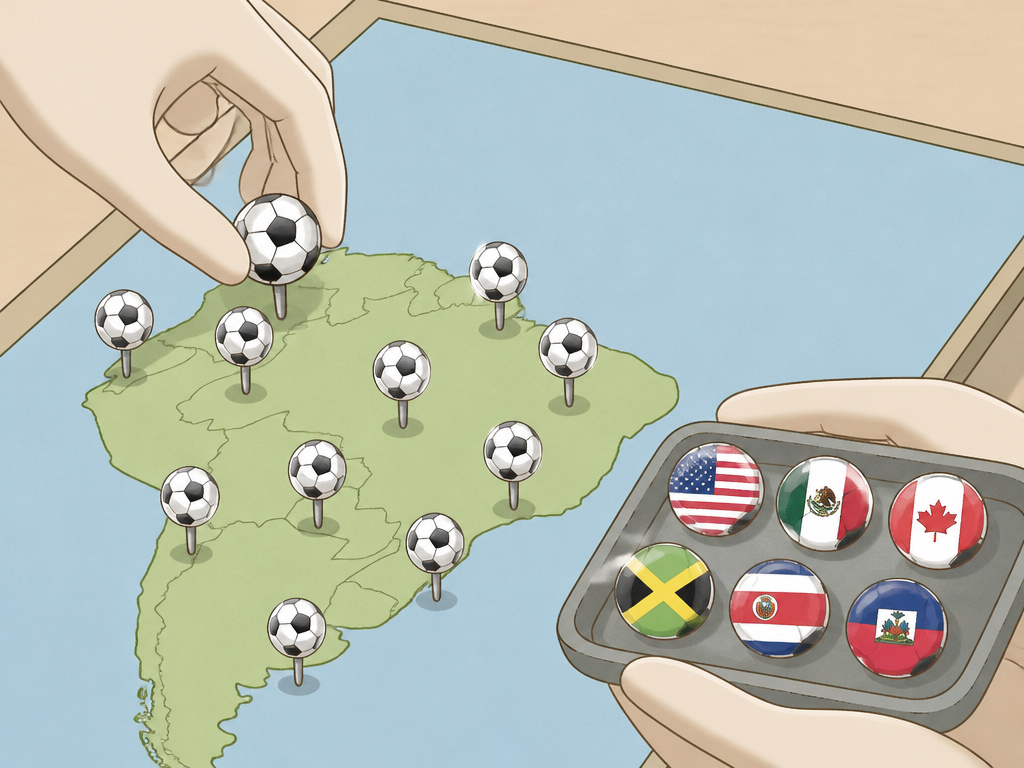
This is where the Copa América’s unique character starts. CONMEBOL has only ten member nations: Argentina, Bolivia, Brazil, Chile, Colombia, Ecuador, Paraguay, Peru, Uruguay, and Venezuela. All ten qualify automatically for every edition. They are the tournament’s core.
To reach a workable bracket size, CONMEBOL invites guests, almost always from neighboring CONCACAF. For 2024, the six guests qualified through their own confederation’s competition. The four semifinalists of the 2023/24 CONCACAF Nations League, the United States, Jamaica, Panama, and Mexico, earned their spots. Two more teams, Canada and Costa Rica, won special play-in matches in March 2024.
A guest competes on equal footing and can win the whole thing, as the CONMEBOL Copa América historical winners list shows Mexico nearly did in 1993 and 2001. But their participation ends with the tournament; they don’t become CONMEBOL members or enter the South American World Cup qualifying process.
| Team Type | How They Qualify | Number (2024) |
|---|---|---|
| CONMEBOL Members | Automatic entry | 10 |
| CONCACAF Guests | Via CONCACAF Nations League performance | 6 |
Navigating the Group Stage: Points, Tie-Breakers, and Fine Print
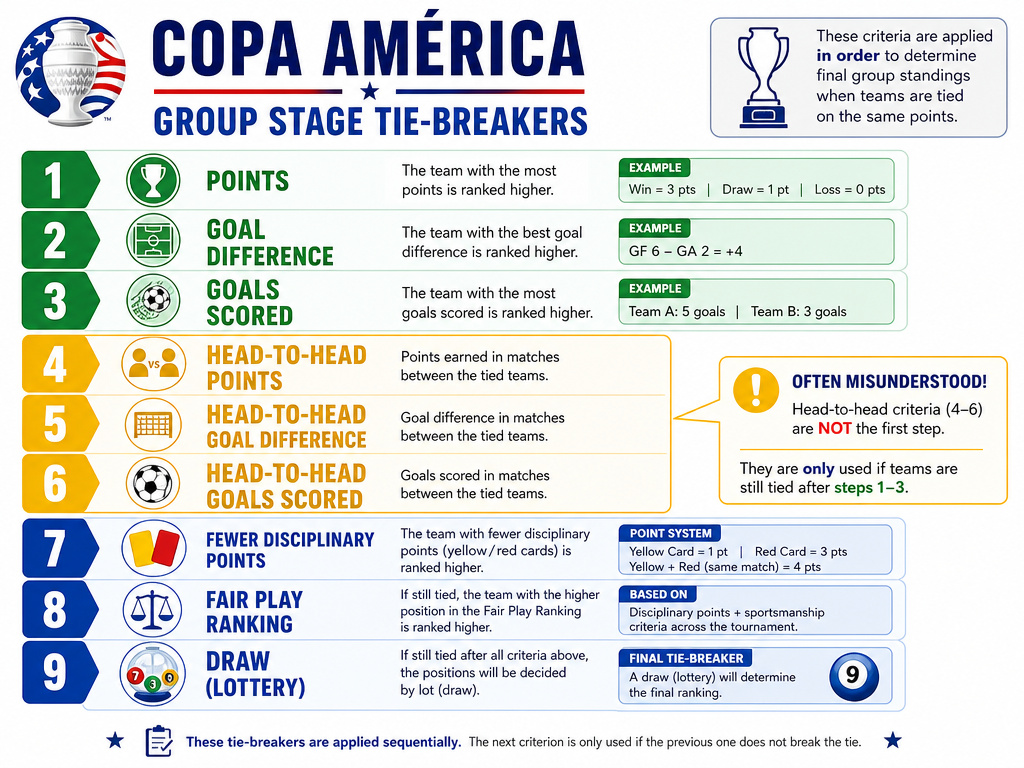
The group stage is a three-match mini-league for each team. The stakes are simple: finish first or second. The mechanics of how that order is determined, however, have layers.
Teams earn 3 points for a win, 1 for a draw, and 0 for a loss. This has been the standard since 1995; before that, wins were worth only 2 points, which shifted the tactical calculus significantly toward avoiding defeat.
When teams finish level on points, CONMEBOL uses a detailed, sequential set of tie-breakers. This isn’t a vague “goal difference maybe” situation. It’s a formal nine-step checklist.
- Goal difference in all group matches.
- Goals scored in all group matches.
- Head-to-head points earned in the match(es) between the tied teams.
- Head-to-head goal difference in those matches.
- Head-to-head goals scored in those matches.
- Fewest red cards received across the group stage.
- Fewest yellow cards received.
- Random draw conducted by CONMEBOL.
Where this goes sideways: Assuming head-to-head record is the first tie-breaker. For final group standings, it’s actually the fourth criterion, after overall goal difference and goals scored. This can produce a counterintuitive result where a team that beat a rival still finishes below them.
For ranking teams from 5th to 8th place, all criteria (points, goal difference, cards) accumulated throughout the competition, including the Quarterfinals, are considered. For the teams eliminated in the quarterfinals, their group stage and knockout stage results are combined to determine 5th through 8th place.
The Knockout Phase: Where the Rules Change
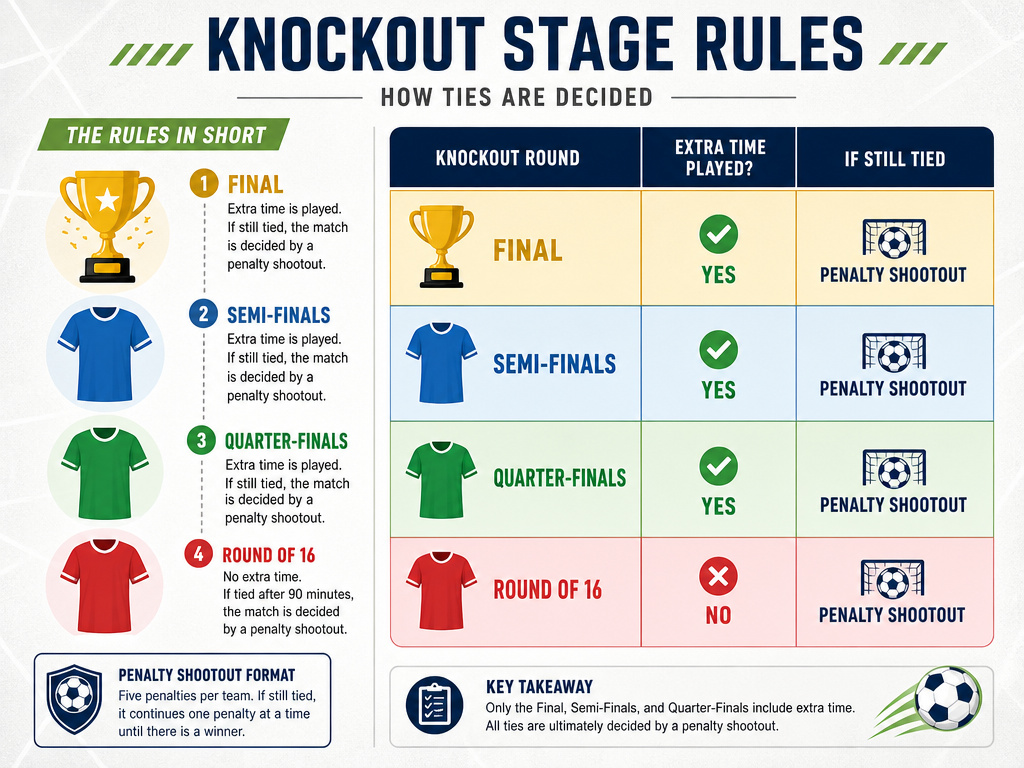
The knockout stage is a different beast. The margin for error disappears, and so, notably, does extra time for most matches.
In the 2024 tournament, a specific rule applied: if a quarterfinal, semifinal, or the third-place match was tied after 90 minutes, it went directly to a penalty shootout. No extra time. This places a huge premium on closing out games in regulation and changes a manager’s late-game substitution strategy.
The exception is the final. If the championship match is tied after 90 minutes, two 15-minute halves of extra time are played. If the deadlock remains, penalties decide the champion. This distinction makes the final a unique physical and tactical test. The drama of the 2024 Copa América knockout bracket, from quarterfinal upsets to a tense final, is built on these rules.
| Knockout Round | Extra Time Played? | If Still Tied After 90 Min (or 120 Min) |
|---|---|---|
| Quarterfinal | No | Penalty shootout |
| Semifinal | No | Penalty shootout |
| Third-Place Match | No | Penalty shootout |
| Final | Yes (two 15-min halves) | Penalty shootout |
A Tournament With Two Rhythms: Copa América vs. World Cup Qualifying
To understand the Copa América, you have to see its contrast with South America’s other major competition. While the Copa América is a concentrated tournament, the continent’s World Cup qualification is a years-long league.
All ten CONMEBOL teams play each other home and away in a single, round-robin table. That’s 18 matchdays and 90 total matches. It’s a brutal, home-and-away marathon where every point matters in the long grind. The top six teams from this league qualify directly for the expanded 2026 World Cup.
The Copa América is the sprint. It’s volatile, shaped by invites and short-term form. The qualifiers are the grueling test of consistency. This dual-competition reality is unique to South America and defines the international calendar for its nations.
A Brief History: From 1916 to the Modern Era
The Copa América is the oldest continental national team tournament in the world. It began in 1916 as the South American Championship of Nations, celebrating Argentina’s centennial. Only four teams played: Argentina, Brazil, Chile, and Uruguay, with Uruguay winning that first title.
The tournament’s history is marked by irregular scheduling. For decades, it was held almost yearly, then every two years, with occasional long gaps. The name changed to Copa América in 1975. The 1975, 1979, and 1983 editions didn’t even have a single host country; matches were played in home-and-away series across the continent.
It has only recently stabilized into a roughly four-year cycle, slotting between World Cups. The United States has hosted twice (2016 and 2024), the only non-South American country to do so. Argentina leads the all-time title count with 16, followed by Uruguay with 15 and Brazil with 9. This rich South American football history is the tournament’s backbone.
I’ve always been fascinated by the 1975-83 era with no fixed host. It must have felt less like a tournament and more like a continental cup tie that lasted months. It speaks to a different, more logistical view of competition that’s hard to imagine today.
How It Compares to Other Continental Championships
The Copa América sits alongside the UEFA European Championship, the Africa Cup of Nations (AFCON), the AFC Asian Cup, and the CONCACAF Gold Cup as one of football’s premier continental tournaments. Its defining feature is its use of guest teams.
Unlike the Africa Cup of Nations or the Asian Cup, which have fixed qualification paths for their own confederation’s members, the Copa América requires outsiders to fill its bracket. This creates a unique cross-continental flavor. Similarly, while the Gold Cup is CONCACAF’s championship, its top teams often use the Copa América as a higher-stakes proving ground.
Historically, its prestige is considered second only to the FIFA World Cup for senior men’s national teams. The depth of talent, particularly from nations like Argentina, Brazil, and Uruguay, ensures its matches are fiercely contested. The winner earns the right to play in the Finalissima against the champion of Europe, cementing its global standing.
Frequently Asked Questions
Is the Copa América every 2 years or 4 years?
It is now on a four-year cycle, but this is a recent stability. Historically, the schedule was highly irregular, with tournaments sometimes held in consecutive years. Since 2007, it has generally been held every four years, aligning with the cycle between World Cups.
What is the difference between Copa América and Copa Libertadores?
The Copa América is a tournament for national teams. The Copa Libertadores is South America’s premier club competition, equivalent to the UEFA Champions League in Europe. They are completely different competitions run by the same confederation, CONMEBOL.
Can a guest nation win the Copa América?
Yes, a guest nation can win. They compete on fully equal terms. Mexico has come closest, finishing as runner-up in 1993 and 2001. No guest has won it yet, but the possibility is built into the rules.
How does the group stage work?
The group stage divides the 16 teams into four groups of four. Each team plays every other team in its group once. The top two teams from each group, based on points and tie-breakers, advance to the knockout quarterfinals.
Who decides the tournament draw and seeding?
CONMEBOL conducts the tournament draw, typically seeding teams based on FIFA rankings or previous tournament performance to create balanced groups. The exact seeding criteria can vary by edition.
The Bottom Line
The Copa América works because it embraces a unique constraint: ten core members and a need for more. That simple fact explains the guest teams, the 16-team format, and the tournament’s special place in the football world. It’s a tournament where history weighs on every match, where the knockout rules have a deliberate twist, and where a tie can be broken by something as minute as a yellow card.
For a fan, the joy is in that specificity. It’s not just another continental championship; it’s the one that solved its math problem by opening the door to its neighbors. Watch for the group stage tie-breaker drama, remember there’s no extra time until the final, and appreciate the sprint for what it is, a brilliant, chaotic contrast to South America’s marathon World Cup qualifiers. That’s the shape of it.
