
How the Copa Libertadores Works: Format, Rules and History
This post contains affiliate links. As an Amazon Associate, we earn from qualifying purchases.
The Copa Libertadores is South America’s premier annual club football tournament, organized by CONMEBOL. It works through a multi-stage format: domestic qualification for 47 clubs, a group stage of 32 teams in 8 groups, and a knockout final stage where matches are two-legged ties except for a single-match final. The winner qualifies for the FIFA Intercontinental Cup, the FIFA Club World Cup, the Recopa Sudamericana, and the next edition’s group stage.
The group stage is where the continental map gets drawn, with intricate seeding rules and a country protection clause that keeps domestic rivals apart until the knockouts. It’s a system designed for drama, where a bad night in the high altitude of La Paz or a humid evening in Manaus can upend an entire campaign, and it’s a key part of how the Copa Libertadores works.
Here’s how it all fits together: the qualification spots per country, the draw that builds the groups, the unique knockout rules, and the rich history that shapes every match, which is essential to understanding how the Copa Libertadores works. We’ll also look at the current 2026 edition, its key dates, and what makes this tournament different from its European counterpart.
Key Takeaways
- Qualification is based on domestic league performance, with Brazil getting 7 spots and Argentina 6, while other CONMEBOL nations receive 4 each.
- The Group Stage draw uses a four-pot seeding system based on the CONMEBOL Club Ranking, with a rule preventing teams from the same country being drawn together (with one specific exception).
- Knockout stage matches (Round of 16, quarter-finals, semi-finals) are two-legged ties with no extra time; if aggregate score is level, it goes straight to penalties.
- The tournament winner earns a place in the FIFA Club World Cup, the Recopa Sudamericana against the Copa Sudamericana winner, and automatic qualification for the next Libertadores group stage.
- The third-placed teams from each group enter the Copa Sudamericana knockout stage, creating a direct link between South America’s two major club competitions.
The Basic Format: From Qualifying to the Final
The Copa Libertadores isn’t a single knockout bracket. It’s a marathon that begins with domestic fixtures and ends with one team lifting the trophy in a neutral final, a core part of how the Copa Libertadores works. The structure has evolved, but the current format is a blend of a league phase and a cup competition.
Forty-seven clubs enter the fray. They don’t all start at the same point. The journey begins with domestic qualification. Each of CONMEBOL’s ten member associations receives a set number of berths, distributed according to their federation’s ranking and historical performance. For the 2026 edition, Brazil gets 7 spots and Argentina gets 6. Bolivia, Chile, Colombia, Ecuador, Paraguay, Peru, Uruguay, and Venezuela each receive 4 spots.
The tournament involves 47 clubs and a total of 155 matches. The competition began on 3 February 2026 and is scheduled to end on 28 November 2026, awarding the winner qualification for three other major international tournaments.
Once qualified, teams enter one of three phases:
- Preliminary Stages: Lower-ranked qualifiers face off in early knockout ties to win a place in the group stage.
- Group Stage: 32 teams are drawn into 8 groups of 4. They play a double round-robin (home and away), with the top two teams advancing.
- Final Stage: A straight knockout bracket from the Round of 16 to the final.
The link with the Copa Sudamericana, CONMEBOL’s secondary club competition, is crucial. The third-placed teams from each Libertadores group don’t go home; they drop into the Copa Sudamericana Round of 16 playoffs. This safety net adds a strategic layer to the group stage and ensures more continental football for more clubs.
Qualification: How Clubs Earn Their Spot
You don’t win your way into the Libertadores by winning the Libertadores. Well, except that you do, the defending champion gets an automatic group-stage spot. For everyone else, the path runs through their domestic league and cup.
The specific method varies by country, reflecting the diverse league structures across the continent. Most nations use a combination of their annual league champion(s) and the winners of half-year tournaments called the Apertura and Clausura. For example, in Paraguay or Uruguay, winning the Apertura or Clausura tournament typically secures a Libertadores berth.
In contrast, larger nations like Brazil and Argentina use a European-style single-table league format (like the Brazilian Série A). Here, the top finishers in the Campeonato Brasileiro or the Argentine Primera División earn qualification, often with domestic cup winners also securing a place.
This system creates a fascinating dynamic. A club like Barcelona S.C. Of Ecuador might qualify by winning the second-stage (Clausura) title, while a club like Flamengo qualifies by finishing in the top four of the sprawling Brasileirão. It ties the prestige of the continental competition directly to the weekly grind and drama of domestic football, making every league match from Buenos Aires to Barranquilla matter that much more.
The 2026 Group Stage Draw: Pots, Rules, and Drama
The draw is where theory becomes reality. For the 2026 edition, it was held on Thursday, March 19, 2026, at 20:00 Paraguay time and broadcast live. This isn’t a random lottery; it’s a meticulously engineered event designed to balance competitiveness.
The 32 teams are divided into four pots of eight teams each. Seeding is based on the CONMEBOL Club Ranking as of December 15, 2025, which considers a club’s performance over the past decade and its historical coefficient. The defending Libertadores champion is automatically placed in Group A, and the defending Copa Sudamericana champion is seeded in Pot 2.
| Pot | Seeded Based On | Draws Into Group Position |
|---|---|---|
| Pot 1 | Top-ranked teams (incl. Defending champion) | Position 1 in Groups B-H |
| Pot 2 | Next-highest ranked teams | Position 2 in Groups A-H |
| Pot 3 | Third tier of ranked teams | Position 3 in Groups A-H |
| Pot 4 | Lowest-ranked teams & qualifiers | Position 4 in Groups A-H |
The draw proceeds pot by pot, from Pot 1 to Pot 4, filling each group with one team from each pot. The key rule is country protection: no two teams from the same national association can be drawn into the same group. There’s one notable exception: the four winners of the Third Qualifying Stage (who go into Pot 4) are exempt from this rule and can be drawn with a compatriot.
Where this goes sideways: Misunderstanding the draw order. Pot 1 fills the top spot in Groups B through H, not Group A. Group A’s top spot (A1) is reserved for the defending champion before the draw even begins.
Once drawn, the schedule is set. The 2026 Group Stage runs from April 7 to May 28, 2026, with each team playing six matches. The top two from each group advance to the Libertadores Round of 16. The third-place team gets a consolation prize: a ticket to the Copa Sudamericana knockout rounds.
Knockout Stage Rules: Two Legs, No Extra Time, One Final
The knockout phase is where the Copa Libertadores earns its reputation for nerve-shredding tension. The rules here are distinct, especially for a global audience used to the European model.
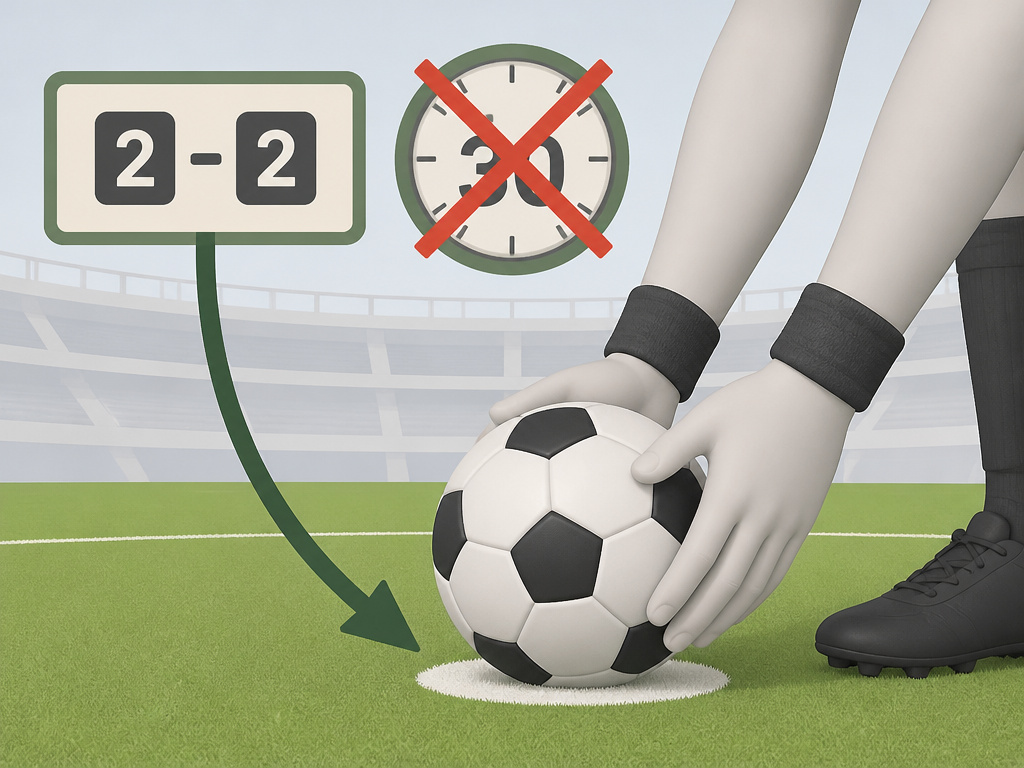
From the Round of 16 through the semi-finals, every tie is played over two legs (home and away). The away goals rule has been abolished. Here’s the critical difference: if the aggregate score is tied after the second leg, there is no extra time. The match proceeds directly to a penalty shootout. This rule, straight from the CONMEBOL regulations, places a huge premium on scoring over the two games and eliminates the grueling 30-minute period that can favor the home team in the second leg.
The final, however, switches to a different script. Since 2019, the final has been a single match at a neutral venue. For 2026, that venue is the Estadio Centenario in Montevideo, Uruguay. If the final is tied after 90 minutes, then extra time is played, followed by penalties if needed.
| Stage | Format | Tiebreaker if Aggregate Tied |
|---|---|---|
| Round of 16 | Two-legged tie | Penalty shootout (NO extra time) |
| Quarter-finals | Two-legged tie | Penalty shootout (NO extra time) |
| Semi-finals | Two-legged tie | Penalty shootout (NO extra time) |
| Final | Single match | Extra time, then penalties |
This creates a fascinating tactical shift. Coaches can’t plan for an extra-time contingency in the quarter-finals; their strategy must be to win in regulation over 180 minutes. It leads to more aggressive, decisive football in the closing stages of the second leg. The contrast with the history of the competition is stark. Decades ago, ties were decided on a points system (2 for a win, 1 for a draw), and if still level, a third match at a neutral venue was required. The modern system is streamlined for maximum drama.
Prize & Global Qualification: What the Winner Gets
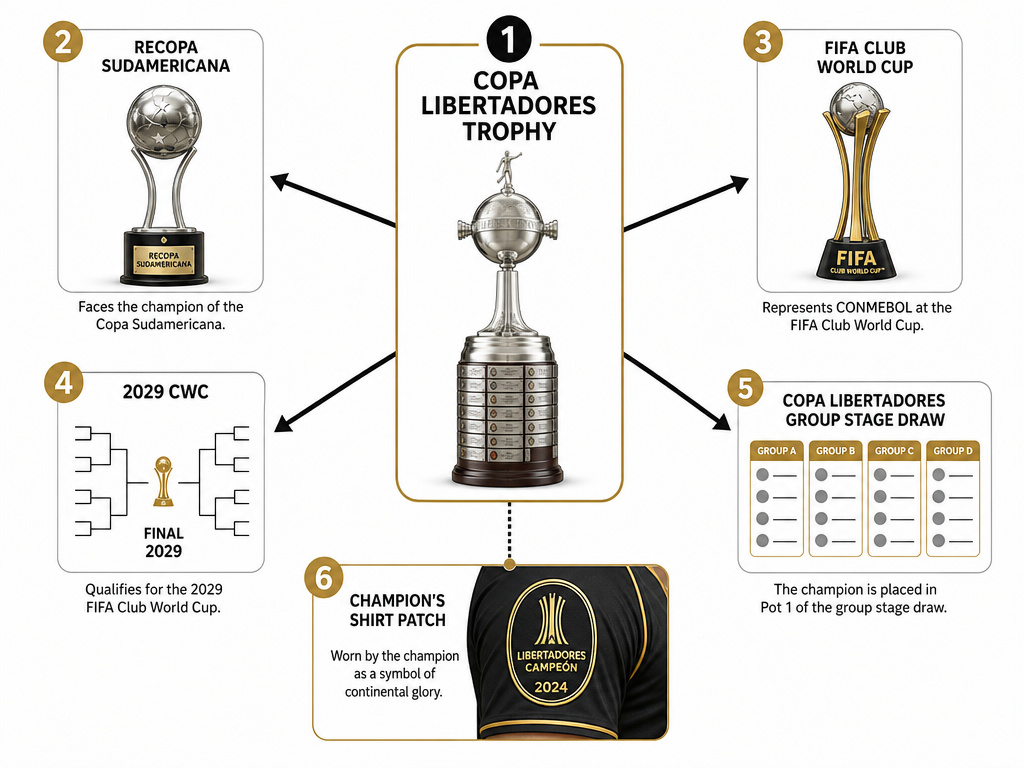
Lifting the Copa Libertadores trophy is about more than continental glory; it’s a key that provides access to the global stage. The champion secures entry into four prestigious tournaments, cementing its place among the world’s elite.
First, the winner earns the right to face the champion of the Copa Sudamericana in the following year’s Recopa Sudamericana. This two-legged super cup is CONMEBOL’s version of a continental curtain-raiser, with the Libertadores champion hosting the decisive second leg.
A major prize is automatic qualification for the FIFA Club World Cup. For the 2026 Libertadores winner, this means a place in the 2026 FIFA Intercontinental Cup and, looking further ahead, a berth in the expanded 2029 FIFA Club World Cup. This guarantees matches against the champions of Europe, Asia, Africa, and other confederations on a global stage.
Finally, the champion receives the ultimate security: automatic qualification for the group stage of the next Copa Libertadores. This means even if the club has a disastrous domestic season the following year, its title defense is assured. This rule underscores the tournament’s prestige, winning it once guarantees another shot the next year, a cycle that can define eras for clubs like Boca Juniors or River Plate.
The champion must wear a special champion patch on the front of their shirt during the Recopa Sudamericana matches, a small but proud symbol of their achievement.
History & Evolution: From 1960 to the Modern Era
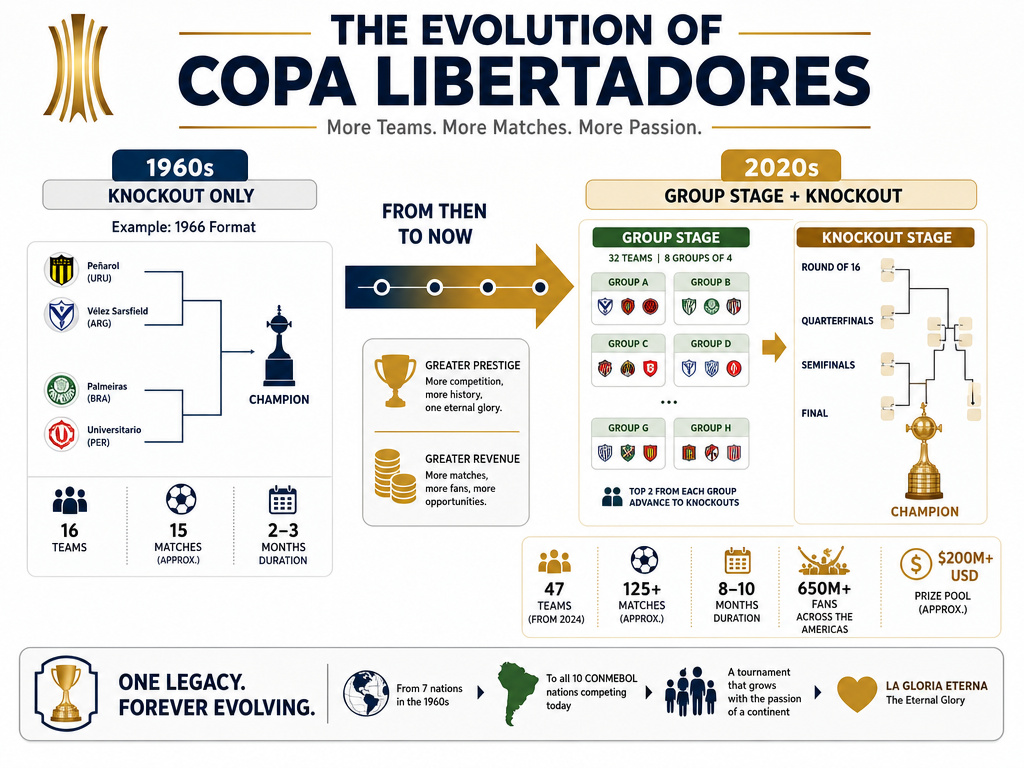
The tournament’s soul is in its history. First played in 1960 as the “Copa de Campeones de América,” it was rebranded in 1965 as the Copa Libertadores de América, honoring the leaders of South America’s independence wars. Its creation was inspired by the European Cup, but its character is uniquely South American.
For its first few decades, it was a pure knockout competition, often involving just the champions of each country. The format we recognize today, with a group stage introduced in the 1980s and steadily expanded, evolved to include more teams and generate more revenue, mirroring changes in the global game. The historical tie-breaking methods, like the points system and third matches, feel like relics from a different sporting world compared to today’s streamlined penalty shootouts.
The competition’s prestige was forged by legendary clubs and rivalries. The dominance of Argentine sides like Independiente (7 titles) in the 60s and 70s, the rise of Brazilian powerhouses, and the indelible moments from clubs like Uruguay’s Peñarol have built its mythology. Understanding this history is key to understanding the pressure and passion that accompanies every match. It’s more than a tournament; it’s a central pillar of the continent’s football identity.
The Libertadores vs. Other Continental Championships
It’s impossible to talk about the Libertadores without comparing it to the UEFA Champions League. They are often spoken of in the same breath as the world’s top two club competitions, but they operate on different logics.
The Champions League is a financial and technical behemoth, with a massive group stage and a focus on commercial consistency. The Libertadores is a tournament of extreme contrasts and logistical warfare. The travel distances are vast, the climatic swings, from the altitude of La Paz (3,600m) to the humidity of the Amazon basin, are brutal, and the fan intensity is arguably unmatched. A trip to play Always Ready in El Alto is a different kind of test than a visit to the Allianz Arena.
The format differences are structural. The Champions League uses away goals (in two-legged ties) and has extra time before penalties. The Libertadores’ direct-to-penalties rule in knockouts (except the final) creates a different kind of tension. The Libertadores’ direct link to the Copa Sudamericana for third-place finishers has no direct equivalent in UEFA’s ecosystem.
While the CAF Champions League and AFC Champions League share similar continental formats, the Libertadores’ unique blend of historical weight, stylistic diversity, and raw passion sets it apart. Its winner gets to test itself against all of them at the FIFA Club World Cup, the ultimate proving ground for confederation champions.
Frequently Asked Questions
Why don’t Mexican teams play in the Copa Libertadores?
Mexican clubs participated from 1998 to 2016 as invited guests. They left to focus on Concacaf competitions like the Champions Cup, which offered a more direct path to the FIFA Club World Cup and aligned better with their geographic and commercial interests. Their absence is now a permanent fixture of the tournament.
Is the Copa Libertadores final 2 legs?
No. Since the 2019 edition, the final has been a single match at a predetermined neutral venue. All knockout rounds before the final (Round of 16, quarter-finals, semi-finals) are two-legged ties.
Which teams will participate in the 2026 Copa Libertadores?
Forty-seven clubs from the ten CONMEBOL nations will participate. The specific teams are determined by their 2025 domestic league and cup results. The draw for the 2026 group stage, which includes teams like Flamengo, Boca Juniors, and Palmeiras, was held in March 2026.
Is the Copa Libertadores better than the Champions League?
“Better” is subjective. The Champions League generally features higher technical quality and financial power. The Libertadores offers unmatched passion, intense rivalries, and a unique, often chaotic, competitive environment shaped by extreme travel and climate. Most fans agree they are the two most prestigious club competitions in the world, just different in character.
Before You Go
The real test of understanding the Copa Libertadores isn’t memorizing the rules, it’s watching a match with context. Next time you tune in, don’t just watch the ball. Look at the setting. Is the game at altitude in Bolivia? Is it a derby between Argentine rivals in a knock-out tie? That context is everything.
Remember the stakes: beyond the trophy, it’s about a spot in the Club World Cup and eternal bragging rights on a football-mad continent. The format, with its sudden-death penalties and Copa Sudamericana lifeline, is designed to produce stories. The history of the Copa America is about national pride; the Libertadores is about the deep, often fierce, pride of the club. That’s what makes it work.
