
How the FIFA Club World Cup Works: The New 32-Team Format
This post contains affiliate links. As an Amazon Associate, we earn from qualifying purchases.
The FIFA Club World Cup now works as a 32-team tournament held every four years, with teams qualifying via a combination of winning their continent’s premier club competition or through a four-year ranking system within their confederation. The 2025 edition in the USA features eight groups of four, with the top two from each advancing to a knockout stage of 16 teams, culminating in a final with no third-place playoff.
The shift from a compact seven-team annual event to this expansive summer spectacle changes everything from the financial stakes for clubs to the physical demands on players. It’s a format designed to mirror the global appeal and structure of the men’s World Cup, but built entirely around club football’s elite, which is a key part of how the FIFA Club World Cup works.
What follows is a breakdown of the new tournament’s engine: the confederation slot allocations, the two distinct qualification paths that decided the 2025 field, the significant prize money at stake, and the very real scheduling controversies that have players and managers speaking out about how the FIFA Club World Cup works.
Key Takeaways
- Teams qualify for the FIFA Club World Cup through two pathways: by winning their confederation’s premier club competition (e.g., Champions League, Copa Libertadores) or via a four-year ranking within their continent.
- A maximum of two clubs per country can qualify, with an exception if more clubs from that nation win their continental title during the four-year cycle.
- According to FIFA regulations, the 2025 tournament in the USA will feature 63 matches across 12 stadiums, with clubs guaranteed a minimum 72-hour rest between games.
- The total prize fund is £775 million, with the winner earning £30.0 million in prize money for winning the final.
- The schedule is contentious, with just five weeks between the final and the next Premier League season, leading to legal threats from player unions over fixture congestion.
The New Format vs. The Old Format
For years, the Club World Cup was a brief, almost ceremonial event, a stark contrast to the modern reality of how the FIFA Club World Cup works. Seven teams—the six continental champions plus the host nation’s champion—played a short knockout tournament over about ten days. It felt like an afterthought, crammed into the December calendar. The champion was usually the European or South American entry, and the whole thing was over before most fans had tuned in.
The 2025 edition is a different beast. It’s a 32-team tournament staged over several weeks in the summer of 2025, designed to be a centerpiece event. The expansion to eight groups of four creates a genuine tournament narrative, similar to the international FIFA World Cup or a massive tournament group stage. It demands squad depth, tactical flexibility across multiple opponents, and a huge commitment of time from the world’s biggest clubs.
Here’s the direct comparison:
| Aspect | Old Format (Pre-2025) | New Format (2025 Onwards) |
|---|---|---|
| Frequency | Annual | Every four years |
| Teams | 7 (6 continental champions + host champion) | 32 |
| Duration | ~10 days | ~5 weeks (June-July) |
| Matches | 7 | 63 |
| Qualification | Win your continental cup in the preceding year | Four-year performance cycle (2021-2024) via two pathways |
| Group Stage | None (straight knockout) | 8 groups of 4, round-robin |
| Third-Place Playoff | Yes | No |
The removal of the third-place playoff is a small but telling detail. FIFA’s regulations state it explicitly. This isn’t a consolation tournament anymore; it’s a pure knockout race to the final at MetLife Stadium.
How the FIFA Club World Cup qualification mechanism works
Figuring out who gets one of the 32 golden tickets is where things get intricate. It’s not just about being the current champion of Europe or South America. Qualification for the 2025 edition was based on performances across the four-year period from 2021 to 2024.
There are two parallel roads to qualification, and they apply differently across the six confederations (UEFA, CONMEBOL, AFC, CAF, Concacaf, OFC).
The Champion Pathway: Win your confederation’s premier club competition during the four-year cycle, and you’re in. This is the most straightforward route—be the best in your continent in any of those four seasons.
The Ranking Pathway: For slots not filled by champions, the remaining places go to the highest-ranked clubs in each confederation based on their performances in that continent’s premier competition over the same four years.
This dual system is why a club like FC Salzburg qualified. They didn’t win the UEFA Champions League, but they were the highest-ranked club from a country (Austria) that did not already have its two allocated spots taken.
The slots themselves are fixed by confederation, as decided by the FIFA Council in March 2023. The breakdown is non-negotiable and forms the tournament’s geographic skeleton:
| Confederation | Slots | Example Qualified Teams (2025) |
|---|---|---|
| UEFA (Europe) | 12 | Chelsea, Manchester City, Real Madrid, Bayern Munich, Paris Saint-Germain, FC Porto, Benfica |
| CONMEBOL (S.A.) | 6 | Palmeiras, Flamengo, River Plate, Boca Juniors |
| AFC (Asia) | 4 | Al Hilal (KSA), Urawa Red Diamonds (JPN), Ulsan HD (KOR) |
| CAF (Africa) | 4 | Al Ahly (EGY), Wydad AC (MAR), Mamelodi Sundowns (RSA) |
| Concacaf (N.A.) | 4 | Seattle Sounders, Monterrey, Pachuca |
| OFC (Oceania) | 1 | Auckland City (NZL) |
| Host Nation | 1 | Inter Miami (USA) |
The host slot adds a fascinating wrinkle. For 2025, the host nation (USA) receives one slot.
The “Two Clubs Per Country” Rule and Its Exceptions
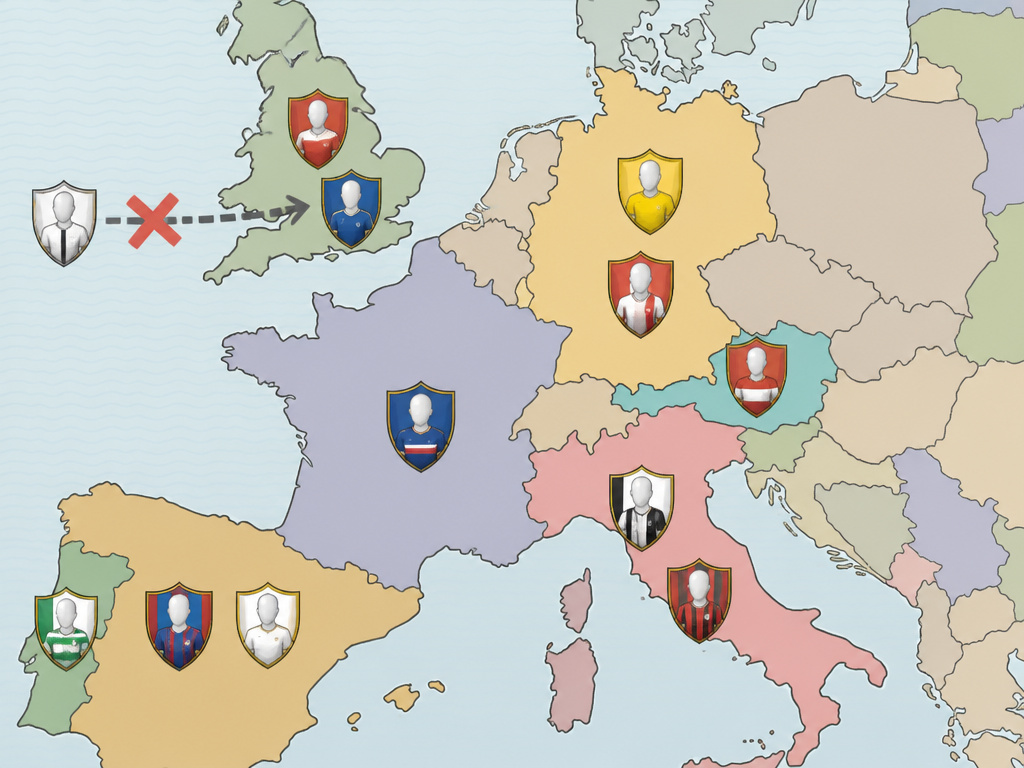
This rule is the reason Liverpool isn’t in the 2025 tournament, despite their consistent excellence in the Champions League during the qualifying period. Simply put, a maximum of two clubs from any single country can qualify.
The mechanism is simple: the champion pathway takes priority. If, say, English clubs won the Champions League in three of the four qualifying seasons, three different English clubs would earn a spot via the champion pathway, overriding the two-club limit. The ranking pathway then fills any remaining slots from that confederation, but once two clubs from a country are in (via any combination of pathways), the door closes for others from that nation.
In Europe’s case, England, Spain, Germany, Italy, and Portugal all have two representatives. France has one (Paris Saint-Germain as 2024 Champions League winner), and Austria has one (Salzburg via ranking). This rule ensures a more diverse field from across the continent, rather than simply taking the top 12 clubs from a European coefficient list, which would be overwhelmingly dominated by a few leagues.
The Tournament Path: From Group Draw to Final
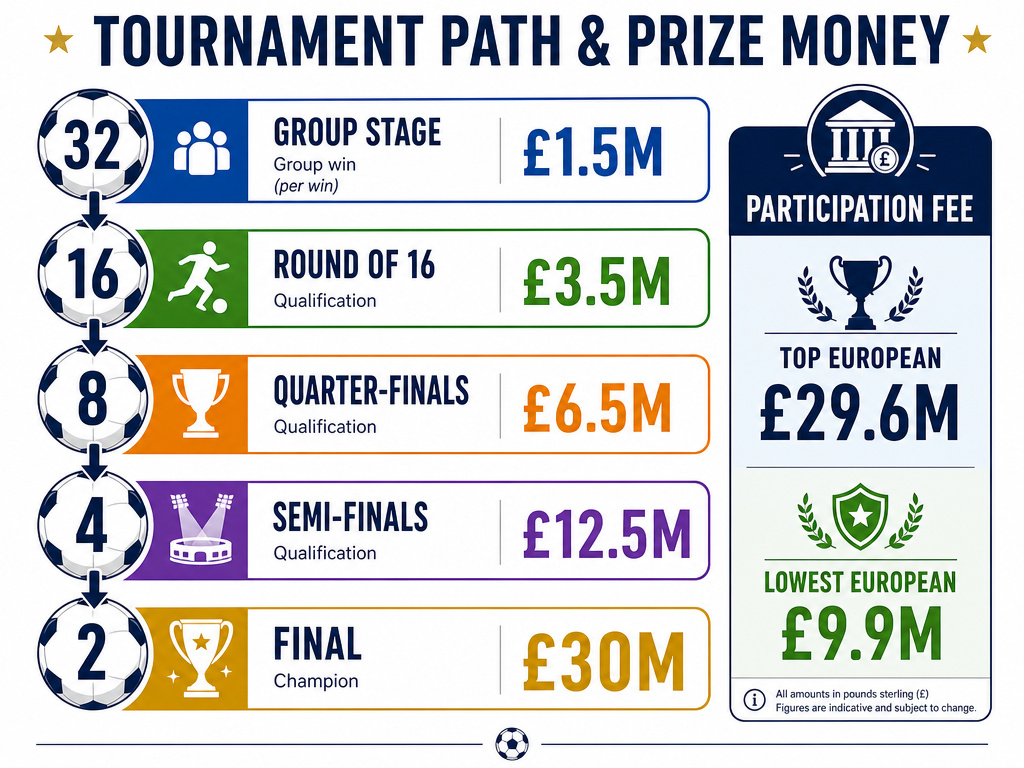
Once the 32 teams are set, the tournament follows a familiar and logical progression. It starts with a draw to sort the teams into eight groups of four. From there, the path to the final is a straight line, but it’s a marathon of up to seven matches for the two finalists.
The structure is clean:
- Group Stage (48 matches): Each team plays the other three in its group once. A win earns £1.5 million, a draw £800,000. The top two teams advance.
- Round of 16 (8 matches): The group winners face the runners-up from other groups. Qualification for this round alone nets a club £5.8 million.
- Quarter-finals (4 matches): Win and you bank £10.1 million.
- Semi-finals (2 matches): The penultimate step is worth £16.2 million.
- Final (1 match): The winner takes £30 million, and the runner-up gets £23.2 million.
Where this goes sideways: Assuming the group stage is a formality. With only two teams advancing from each group of four, a single surprise result or a tight draw can eliminate a heavyweight before the knockout rounds even begin. There’s no margin for a slow start.
Clubs also receive a substantial participation fee on top of this prize money, which varies by confederation and sporting criteria. The highest-ranked European clubs get £29.6 million just for showing up, while the lowest-ranked European participants still receive £9.9 million. This financial incentive is a major reason clubs have agreed to the expanded schedule, despite the strain.
Rules, Regulations, and Real-World Complications
The official FIFA Club World Cup 2025 Regulations document is a dense read, but a few clauses have real teeth. They show FIFA attempting to legislate for professionalism and unforeseen chaos.
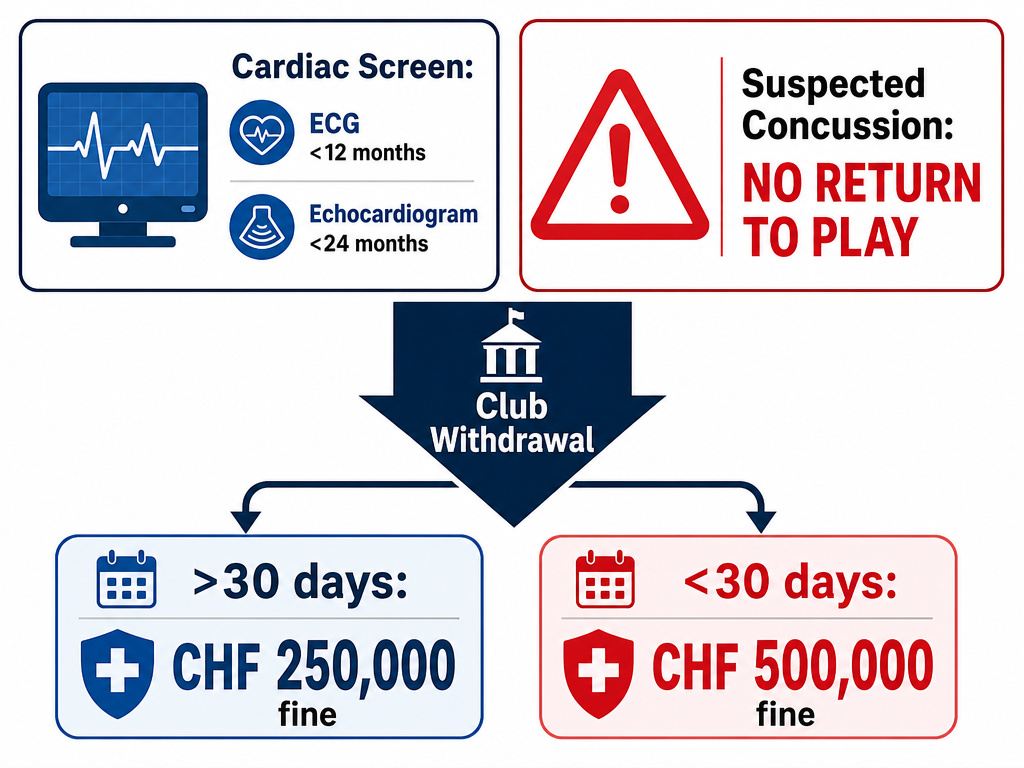
The medical protocols are particularly stringent. Each club must have at least one team doctor (two are recommended) who has passed specific FIFA concussion and cardiac arrest training modules. Every player must have undergone a cardiac screening (ECG) within 12 months and an echocardiogram within 24 months of the tournament start. The concussion protocol is absolute: under no circumstances should a player with suspected concussion return to play.
Then there are the withdrawal penalties, which highlight how seriously FIFA is treating commitment. If a club pulls out after signing the participation agreement, it faces a fine of at least CHF 250,000 if the withdrawal is more than 30 days before the first match, and at least CHF 500,000 if it’s within 30 days.
The regulations also cover a nightmare scenario: a club withdrawing or being disqualified during the group stage. In that case, all its matches are declared null and void. The group standings are recalculated without them. It’s a clean slate, which is fairer than awarding walkover wins but could dramatically alter the qualification math for the other three teams.
Why the New Club World Cup Is So Controversial
You can’t talk about how this tournament works without addressing the elephant in the room: the football calendar is bursting. The new Club World Cup is the flashpoint for a long-simmering conflict between FIFA, clubs, leagues, and players.
The numbers tell the story. The final is on July 13, 2025. The next Premier League season is scheduled to start five weeks after the Club World Cup final. That’s a five-week turnaround. For players going deep in this tournament, it effectively eliminates a summer break. Global players’ union FIFPro and the World Leagues Association have threatened legal action, calling the calendar “oversaturated” and warning of risks to “player safety and wellbeing.”
High-profile players like Manchester City’s Rodri have been vocal about the physical toll. Managers like Pep Guardiola have requested later starts to their domestic seasons.
There’s another clash, too. The tournament will partially overlap with Women’s Euro 2025, which runs from 2-27 July.
How to Watch the 2025 Tournament
For fans, the viewing landscape has shifted dramatically. Streaming service DAZN has secured exclusive global rights to the tournament in a deal worth $1 billion. They have secured exclusive global rights to the tournament.
In the United Kingdom, however, a sub-licensing deal means 23 matches will be broadcast live on free-to-air television via Channel 5. This includes key group games, knockout rounds, and the final. It’s a significant compromise that ensures the tournament reaches a broad audience in a major football market, even as the broader trend moves towards paid streaming.
What trophy and prize money do teams get?
The ultimate prize is the FIFA Club World Cup trophy, awarded to the tournament winner. Beyond the physical trophy, a significant prize pot is shared among all 32 participating clubs. Prize money increases with each stage a team reaches. Teams earn money for group stage wins and draws. Further financial rewards are given for advancing to the knockout rounds, with the largest sums reserved for the finalists and the champion. In addition to this performance-based prize money, each participating club receives a participation fee, with the amount varying based on their ranking and confederation.
Frequently Asked Questions
How do teams get chosen for the FIFA Club World Cup?
Teams qualify based on their performance in their confederation’s premier club competition (like the UEFA Champions League or Copa Libertadores) over a four-year period (2021-2024 for the 2025 edition). They can qualify either by winning that competition (champion pathway) or by having a high ranking in it over the four years (ranking pathway). A maximum of two clubs from any country can qualify, with an exception for multiple champion winners.
Is the FIFA Club World Cup every 4 years now?
Yes. Starting in 2025, the revamped FIFA Club World Cup is a quadrennial (every four years) event. It replaced the previous format, which was an annual seven-team tournament. The 2025 edition is the first of this new four-year cycle.
What is the format of the 2025 FIFA Club World Cup?
The format mirrors a FIFA World Cup. Thirty-two teams are drawn into eight groups of four. Each team plays the others in its group once. The top two teams from each of the eight groups advance to the knockout stage: a Round of 16, followed by quarter-finals, semi-finals, and a final. There is no third-place playoff.
Why are Chelsea in the Club World Cup, but not Liverpool?
Chelsea qualified by winning the UEFA Champions League in 2021, securing a spot via the “champion pathway.” Liverpool, despite strong performances, did not win the Champions League during the 2021-2024 qualifying window. England’s two slots were filled by Chelsea (2021 champion) and Manchester City (2023 champion and via ranking), triggering the “two clubs per country” rule that excluded Liverpool.
Where is the 2025 FIFA Club World Cup?
The 2025 tournament is hosted by the United States. Matches will be played across 12 stadiums in the United States. The final will be held in the USA.
The Bottom Line
The new FIFA Club World Cup is built to be a heavyweight event. It has the scale (32 teams), the structure (a group and knockout stage), and the financial incentives (£775 million prize pot) to command attention. It’s designed to crown a true world club champion through a rigorous, month-long competition.
But its success hinges on a fragile equilibrium. The massive prize money placates clubs, but the congested calendar enrages players. The expanded format promises more meaningful games, but it risks diluting the prestige of the continental championships that serve as its qualifying gateways.
The 2025 edition in the USA is the experiment. Whether this new format becomes a celebrated pillar of the football world or remains a contentious flashpoint will depend on what happens on the pitch—and how the sport’s stakeholders manage the fallout off it.
