
How the Africa Cup of Nations Works?
This post contains affiliate links. As an Amazon Associate, we earn from qualifying purchases.
The Africa Cup of Nations (AFCON) works as a continental championship organized every other year by the Confederation of African Football (CAF). It features a qualifying phase where 48 national teams compete for 24 spots in the final tournament, which uses a group stage (six groups of four) followed by a knockout bracket where the top two from each group and the four best third-placed teams advance to the Round of 16. The 2027 edition will be hosted by Kenya, Tanzania, and Uganda from 19 June to 17 July.
That structure is the skeleton, but understanding how the Africa Cup of Nations works means grasping its specifics. The rules for who advances from the groups, how hosts are treated in qualifying, and even the tie-breaking order are where the drama, and the confusion, often lives. A simple guide can tell you it’s 24 teams in a knockout; a useful one shows you the mechanics that decide which 24 get there and how they’re whittled down.
What follows: a walk through the qualifying labyrinth, the final tournament’s knockout calculus, the three physical trophies that have crowned champions, and the common mix-ups every new fan should skip. By the end, you’ll read an AFCON draw sheet or group table not as a list of names, but as a set of live, ticking scenarios that reveal how the Africa Cup of Nations works.
Key Takeaways
- The final tournament format puts 24 teams into six groups; the top two from each, plus the four best third-placed teams, advance to the knockout Round of 16.
- In qualifying groups containing a host nation, the host qualifies automatically, altering which other team from that group can progress.
- The official tie-breaking procedure for the final tournament group stage uses head-to-head results first (points, then goal difference, then goals scored among tied teams), not overall goal difference.
- The competition is currently biennial (every two years), with the 2025 edition in Morocco (Dec 2025–Jan 2026) and the 2027 edition in Kenya, Tanzania, and Uganda (June–July 2027).
- It is often confused with the African Nations Championship (CHAN), a separate tournament for domestic-based players only.
How Does AFCON Qualification Work?
The road to the finals is a sprawling, 48-team puzzle. For the 2027 cycle, the Confederation of African Football (CAF) will split the entrants into 12 groups of four teams each. They play each other home and away across six matchdays. On paper, the top two teams from each group qualify. But the script has a crucial footnote for host nations.
Where this goes sideways: In a qualifying group containing a tournament host, the host qualifies automatically. If that host finishes first, second place also goes through. If the host finishes outside the top two, only the group winner qualifies. This reshuffles the math for every other team in that group.
For the 2027 edition, the three host nations. Kenya, Tanzania, and Uganda, add another layer. CAF’s draw rules state they cannot be drawn into the same qualifying group. So you’ll have three separate groups each with a built-in qualifier, each with that altered qualification path. The seeding for this draw uses the FIFA rankings as of a fixed date, with the continent’s top 12 sides in Pot 1. The entire process, from pot allocation to the draw ceremony itself, is documented in official publications like the AFCON 2023 qualifier draw procedures.
The logistical scale is immense. National associations must formally request to participate by 31 December of the year before the qualifying phase begins. Each team must also submit a list of 25 players before every qualifying match. It’s a two-year cycle of travel, negotiation, and, sometimes, controversy over match organization.
| Qualifying Phase Element | Specification | Notes |
|---|---|---|
| Total Participating Teams | 48 | Divided for the 2025 and 2027 cycles. |
| Group Format | 12 groups of 4 teams | Round-robin, home-and-away. |
| Standard Qualification Spots | Top 2 from each group (24 teams) | The default rule for groups without a host. |
| Qualification with a Host Nation | Host qualifies automatically; 2nd spot depends on host’s position. | A key edge case that changes group dynamics. |
| Draw Seeding Basis | FIFA World Rankings | As of a specific date (e.g., April 1, 2026 for 2027). |
The Final Tournament Format: From Groups to the Final
Once the 24 qualifiers are set, the final tournament begins. The teams are drawn into six groups of four. This initial group stage is a whirlwind of three matches per team, where the primary goal is simply to survive and advance.
The advancement rule is specific: the top two teams from each of the six groups move on. They are joined by the four best third-placed teams from across all groups. This “best third-place” system rewards consistency and often leads to frantic calculations during the final group matches. A team with three or four points can often sneak through.
If two or more teams are level on points at the end of the group stage, CAF does not use overall goal difference as the first tie-breaker. The official regulations state the order is: 1) points in head-to-head matches among the tied teams, 2) goal difference in those head-to-head matches, 3) goals scored in those head-to-head matches.
This head-to-head emphasis makes every direct duel within the group doubly critical. A 1-0 win against a rival is more valuable than a 4-0 win against a minnow if you end up tied on points. It turns the group stage into a series of nested mini-tournaments.
From the Round of 16 onward, it’s straight knockout football. No second chances. Matches tied after 90 minutes go to extra time and, if needed, penalty kicks. The tournament condenses into a pure, single-elimination bracket through the quarter-finals and semi-finals until only two remain for the final.
The match schedule itself is tightly controlled. Official regulations state matches cannot start before 14:00 or after 22:00 local time without special approval. There’s even a stark rule for extreme failure: if a referee stops a match due to darkness caused by a delayed kick-off, the host association’s team forfeits and is eliminated.
When and Where Is AFCON Held? (And Why It Changes)
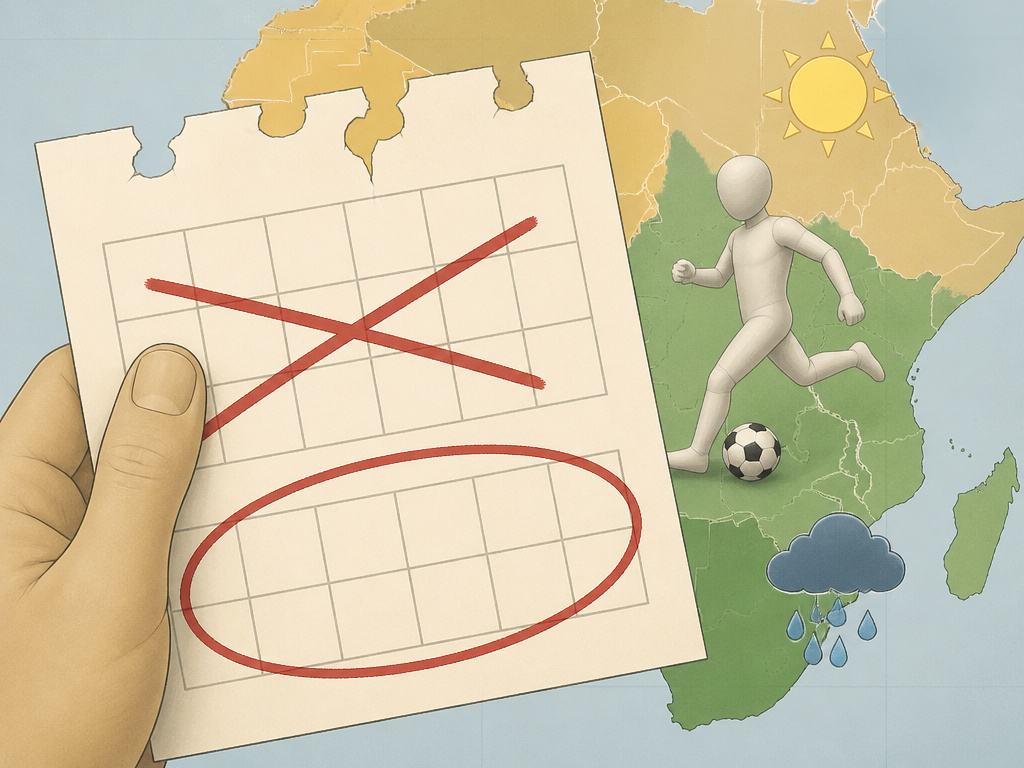
Pinpointing the tournament’s timing requires a calendar and a history book. While a core rule from CAF’s regulations states the “opening of the final phase… Must be held during the months of June and July of each odd year,” the 2025 edition in Morocco is scheduled for December 2025 to January 2026. The 2027 tournament in East Africa follows this, set for 19 June to 17 July.
But look at the very next edition. The 2025 Africa Cup of Nations in Morocco runs from 21 December 2025 to 18 January 2026. That’s a winter tournament, not a summer one. This conflict highlights a central tension in AFCON’s history: the clash between the European club season and weather patterns in Africa.
- The Historical Shift: For decades, AFCON was held in January-February, causing club-vs-country disputes as European clubs lost key players mid-season.
- The Weather Compromise: The move to June-July aligns with the international calendar but coincides with the wet season in central and west Africa, limiting potential hosts.
- The Future Change: According to multiple sources, the tournament is expected to shift to a quadrennial cycle (every four years) in leap years starting from 2028. This would be a fundamental change from its century-long identity as a biennial event.
So, the simple answer is it’s held every two years. The real answer is it’s been January, it’s moving to June-July, it sometimes isn’t (like 2025), and it may soon be every four years. The hosting pattern is also evolving, with the 2027 edition will be jointly hosted by Kenya, Tanzania, and Uganda. Hosting is a massive undertaking, requiring hosts to secure civil liability insurance and provide the policy to CAF three months before kick-off.
A Tournament of Three Trophies
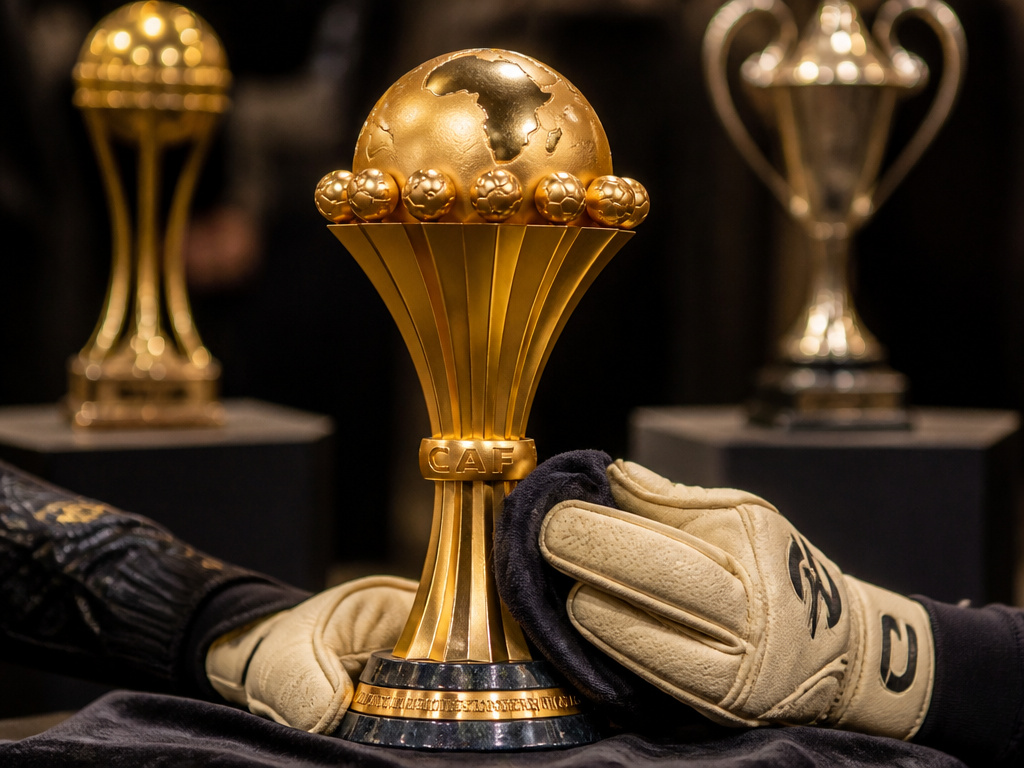
The reward for winning is a piece of history, literally. Three different trophies have been awarded throughout the AFCON’s life, each with its own story. Lifting one is about more than a title; it’s about connecting to a lineage.
The trophy we see today was introduced for the 2002 edition. It’s a gold-plated cup that remains CAF’s property, held aloft by the current champion until the next tournament.
Beyond the winner’s cup, there’s a Fair-Play trophy awarded for the best conduct during the finals. CAF’s regulations are strict about any other awards: any person or group wishing to present an additional prize must get approval from the CAF Executive Committee and make the request at least three months before the competition. This control keeps the focus on the football.
Common AFCON Confusions and Clarifications
First-time viewers often trip over a few recurring points. Clearing these up saves you from talking about the wrong tournament.
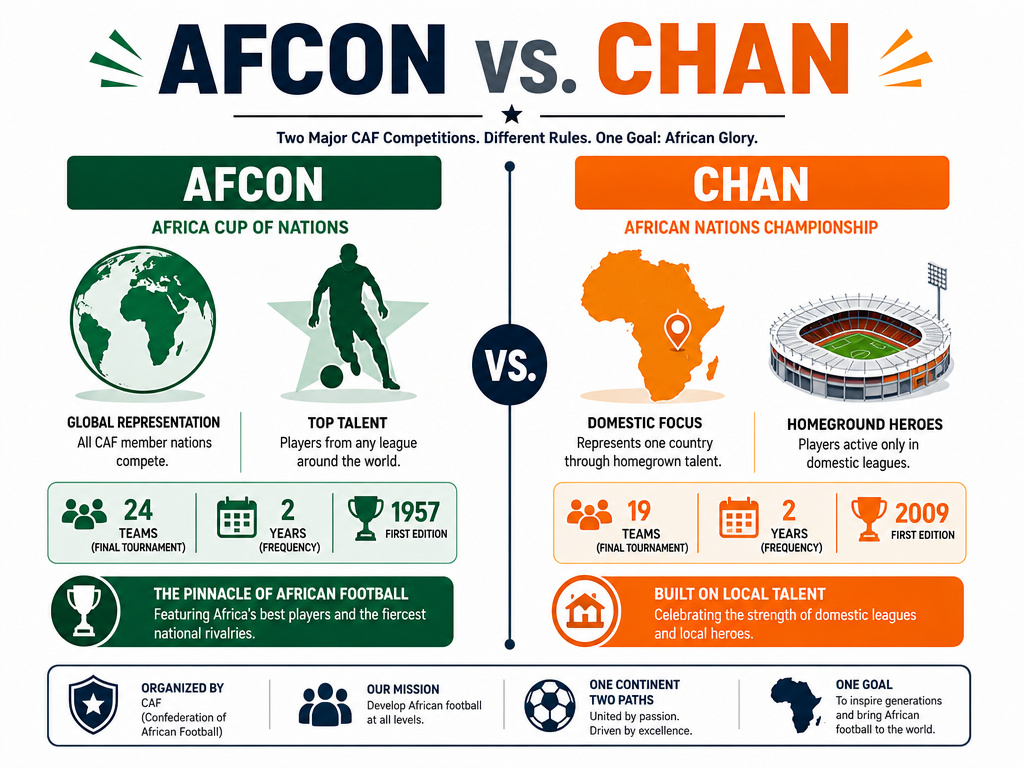
AFCON vs. CHAN: This is the big one. AFCON is the main continental championship for full national teams, featuring stars who play anywhere in the world. The African Nations Championship (CHAN) is a separate CAF tournament exclusively for players who are active in their own domestic leagues. They are not the same.
The Name Game: You’ll see “Africa Cup of Nations,” “African Cup of Nations,” “AFCON,” and the French “CAN” (Coupe d’Afrique des Nations). They all refer to this tournament. Don’t get bogged down; they’re interchangeable.
Qualifying vs. The Finals: The multi-year qualifying process involving dozens of teams is often conflated with the final month-long tournament. When people say “AFCON is on,” they mean the final 24-team event, not the qualifiers.
Player Release Headaches: The tournament’s timing, especially when it was in January, famously clashed with the European season. Clubs were obligated to release players, but it created tension. The regulations have a strict injury-replacement rule: a player on the final list can only be replaced if seriously injured at least 24 hours before his team’s first match, and only with medical committee approval.
How AFCON Connects to the Wider Football World
AFCON doesn’t exist in a vacuum. It’s a key part of the global football ecosystem. Its qualifying results and final standings influence the all-important FIFA rankings, which in turn affect seeding for future tournaments like the FIFA World Cup.
For African club football, success in AFCON can elevate a player’s profile, impacting transfers and the prestige of continental club competitions like the CAF Champions League. The tournament is also a major commercial and broadcasting entity.
The rules themselves are interlinked with global standards. CAF regulations explicitly state that FIFA’s doping control regulations and disciplinary code apply to AFCON matches. Even the method for knockout match penalty shootouts follows the FIFA Laws of the Game. This vertical integration, from local qualifying match to global governing law, is what makes it a professional, standardized competition.
Prize Money & Rewards
While the champion’s trophy is the ultimate prize, the Africa Cup of Nations also recognizes other achievements. The Confederation of African Football (CAF) awards a Fair-Play trophy to the team that shows the best fair-play spirit during the final tournament. Any other trophies, prizes, or awards beyond this require the formal agreement of the CAF Executive Committee. Organizations wishing to present an additional prize must submit their request to the CAF General Secretariat well in advance of the competition, following the specified deadlines.
Where to Watch / Broadcast
Finding a broadcast for the Africa Cup of Nations depends on your location and the agreements CAF has with television networks and streaming services in each region. These rights are sold to broadcasters who cover the host country and international markets. To watch the matches, you should check with major sports channels and streaming platforms in your area closer to the tournament dates. Advertising for the tournament and its broadcast partners is permitted, including for specific products, provided the laws of the host nation allow it.
Frequently Asked Questions
What is the format of the AFCON tournament?
The final tournament format features 24 teams drawn into six groups of four. After a round-robin group stage, the top two teams from each group, plus the four best third-placed teams overall, advance to a knockout Round of 16. The tournament then proceeds through quarter-finals, semi-finals, and a final.
How does the AFCON round of 16 work?
The Round of 16 is the first knockout round. It is composed of the 12 teams that finished first and second in their groups, plus the four best third-placed teams. The matchups are determined by a pre-set bracket in the tournament draw, typically pairing group winners against third-place teams or runners-up from other groups.
Why is the tournament sometimes in January and sometimes in June?
The schedule has shifted due to conflicts with the European club season and African weather patterns. While CAF rules prefer a June-July window in odd-numbered years, practical exceptions are made. The 2025 edition is in December-January to avoid Morocco’s summer heat, while the 2027 edition is scheduled for June-July in East Africa.
How are the best third-placed teams determined?
The four best third-placed teams are selected by ranking all six third-place finishers across the groups. It rewards the most competitive third-place teams.
Is AFCON held every year?
No. The Africa Cup of Nations is a biennial competition, meaning it is held every two years. There are indications it may shift to a quadrennial cycle (every four years) starting in 2028, but as of the 2025 and 2027 editions, the two-year cycle remains.
The Bottom Line
Understanding how the Africa Cup of Nations works means looking past the 24-team bracket. It’s about the two-year qualifying grind where a host nation’s automatic spot changes a group’s entire equation. It’s about the group stage where head-to-head results trump total goal difference, and where finishing third with four points might still be enough. The tournament’s rhythm is set by a push-and-pull between tradition, climate, and the global football calendar.
Watch for those details. When the group tables are tight, check the head-to-head column before goal difference. When a host nation is struggling in qualifying, remember they’re already through, playing for pride and their group rival’s fate. That’s where the tournament’s unique story is written, not just in who lifts the trophy, but in the intricate, often unforgiving mechanics that get them there.
