
How the World Cup Qualifying Works: A Global Guide
This post contains affiliate links. As an Amazon Associate, we earn from qualifying purchases.
The World Cup qualifying process works by dividing FIFA’s 211 member nations into six continental confederations, each given a set number of spots for the final tournament. Each confederation runs its own multi-stage qualifying competition, using group stages, knockout rounds, or league formats, to decide which nations earn those spots. For the 48-team 2026 World Cup, 45 spots are contested: 3 are reserved for the hosts (USA, Canada, Mexico), 43 via direct confederation qualification, and 2 through a final intercontinental playoff tournament.
The beauty of it is the sheer variety. A team in South America plays every other nation home and away in a marathon league, while a European side’s fate can hinge on a single-leg playoff match in March. The process isn’t uniform, and that’s by design, it respects the geographical and competitive realities of each continent. This variety is a key part of how the World Cup qualifying works.
What follows is a walk through the global map, a breakdown of each confederation’s unique path, and the specific rules, from tie-breakers to playoff formats, that decide which nations get to dance on the world’s biggest stage.
Key Takeaways
- The 48-team 2026 World Cup allocates 45 competitive spots: 3 to the hosts (USA, Canada, Mexico), 43 via direct confederation qualification, and 2 through an intercontinental playoff.
- Europe (UEFA) gets 16 spots, the most of any confederation, decided through a group stage (12 winners qualify) and a complex playoff involving 16 teams.
- South America (CONMEBOL) uses a simple 10-team league where all nations play each other twice; the top six qualify directly.
- The final chance is the intercontinental playoff tournament in March 2026, where six teams compete for the last two spots. BBC Sport states they come from four confederations, while AP News details a knockout format involving the four lowest-ranked teams in semifinals.
- Qualifying started as early as September 2023 and runs through March 2026, with each confederation on its own schedule.
The Global Roadmap: How Spots Are Won
For the 2026 edition, the math is set. FIFA has allocated the 48 spots as follows, according to its official announcements and confederation press materials.
| Confederation | Direct Spots | Play-off Spot(s) | Total Contested Spots |
|---|---|---|---|
| UEFA (Europe) | 16 | 0 | 16 |
| CAF (Africa) | 9 | 1 | 10 |
| AFC (Asia) | 8 | 1 | 9 |
| CONMEBOL (S. America) | 6 | 1 | 7 |
| CONCACAF (N. America) | 3 (plus 3 hosts) | 2 | 8* |
| OFC (Oceania) | 1 | 1 | 2 |
*Includes the three automatic host spots for USA, Canada, and Mexico.
The 53 CAF nations compete in eight groups of six teams and one group of five. Each of the nine group winners qualifies automatically for the FIFA World Cup 26.. FIFA
The three host nations, the United States, Canada, and Mexico, occupy spots that would normally be contested within CONCACAF. This means the confederation’s other members are actually competing for the remaining three direct berths and two playoff places. It’s a unique dynamic that changes the calculus for every team in the region.
The way World Cup qualifying works is this. It’s fragmented by design. FIFA sets the allocation, but the confederations are given the freedom to design their own paths within a framework of approved formats. This can lead to what looks like inconsistency, but it’s actually a pragmatic solution for a planet-sized sport.
How UEFA’s 16 Spots Are Decided (The Most Complex Path)
Europe’s pathway is a masterclass in layered competition. With 16 spots up for grabs, more than any other continent, the process is a two-phase system blending traditional qualifying with the newer UEFA Nations League.
The first phase is the European Qualifiers group stage. Drawn in December 2024, 54 nations were split into 12 groups (six groups of four teams, six groups of five). The group stage runs from March to November 2025. The rule is simple: win your group, you’re going to the World Cup. That accounts for 12 of the 16 spots.
The remaining four spots are decided by a playoff in March 2026. This is where it gets intricate. The playoff is not just for the 12 group runners-up. It’s a 16-team tournament, and filling those slots is a specific formula:
- The 12 group runners-up from the qualifiers.
- The four best-ranked UEFA Nations League group winners that did not finish first or second in their World Cup qualifying group.
These 16 teams are then drawn into four separate playoff “paths,” each containing four teams. Each path is a mini-tournament: two single-leg semi-finals, followed by a single-leg final. The four path winners grab the last four European tickets.
The playoff dates are locked in: 26 and 31 March 2026. Two matches, one chance.
The Marathon: CONMEBOL’s 10-Team League
If Europe’s system is a complex bracket, South America’s is a brutal marathon. CONMEBOL’s format is the simplest and most storied in world football: every one of its 10 member nations plays each other twice, home and away. That’s 18 matches per team, a round-robin league that started in September 2023 and wrapped up in late 2025.
The stakes are clear from the first kickoff. After 18 rounds, the top six teams in the final table qualify directly for the World Cup. The team that finishes seventh gets one more life, entering the intercontinental playoff tournament. The bottom three are out.
This format is a purist’s dream. It creates a relentless, years-long narrative where every match matters, and traditional powerhouses can’t afford a single off-day against supposedly smaller nations. The pressure is constant, the travel is immense, and it produces a qualification order that often feels like the continent’s true footballing hierarchy.
Where this goes sideways: Assuming a top-5 nation is safe with three games left. The condensed schedule and altitude of venues like La Paz or Quito have undone more than one campaign in the final stretch.
Confederation Shortcuts: AFC, CAF, CONCACAF & OFC
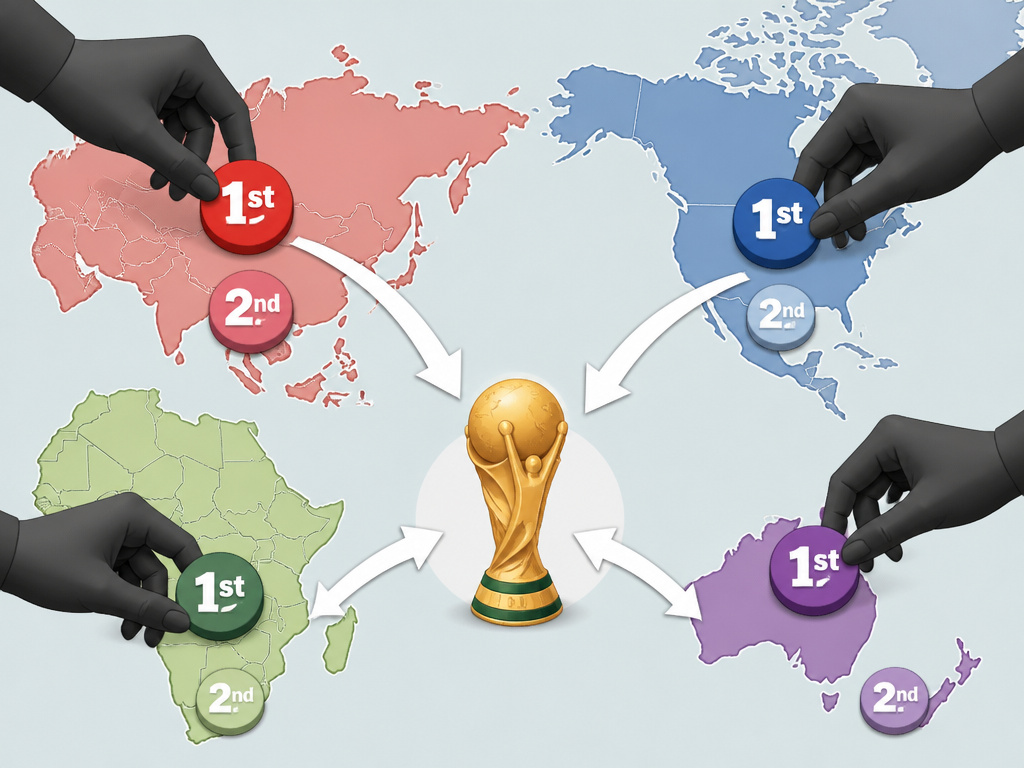
Outside Europe and South America, confederations use multi-round systems to whittle down large numbers of teams to their allotted qualifiers. Each has its own rhythm.
Asia (AFC) began its long road in October 2023. For 2026, the process was designed to fill eight direct spots. In the decisive third round, 18 teams were divided into three groups of six. The top two teams from each of these three groups qualified automatically, securing six of the eight direct spots, with the remaining two spots determined by further criteria. The next-best team enters the intercontinental playoff.
Africa (CAF) has the most teams vying for its nine direct spots. Its qualifying, which started in November 2023, featured groups: according to FIFA, eight groups of six and one group of five; BBC Sport reported nine groups of six. Each group winner qualified directly for the World Cup. The four best runners-up then enter play-offs to determine which team earns Africa’s single slot in the intercontinental playoff.
North America (CONCACAF) had a unique cycle for 2026. With the USA, Canada, and Mexico qualified as hosts, the remaining nations competed for three direct spots and two playoff places. The final round featured 12 teams in three groups. The winner of each group qualified directly, while the two best-ranked runners-up advanced to the intercontinental playoff.
Oceania (OFC) made history for the 2026 cycle. For the first time, the confederation was awarded a guaranteed direct spot, not just a playoff chance. Its qualifying ended early, in March 2024, with New Zealand beating New Caledonia in the final to claim that direct place. New Caledonia, as the runner-up, took Oceania’s slot in the intercontinental playoff.
The Final Chance: The Intercontinental Play-off Tournament
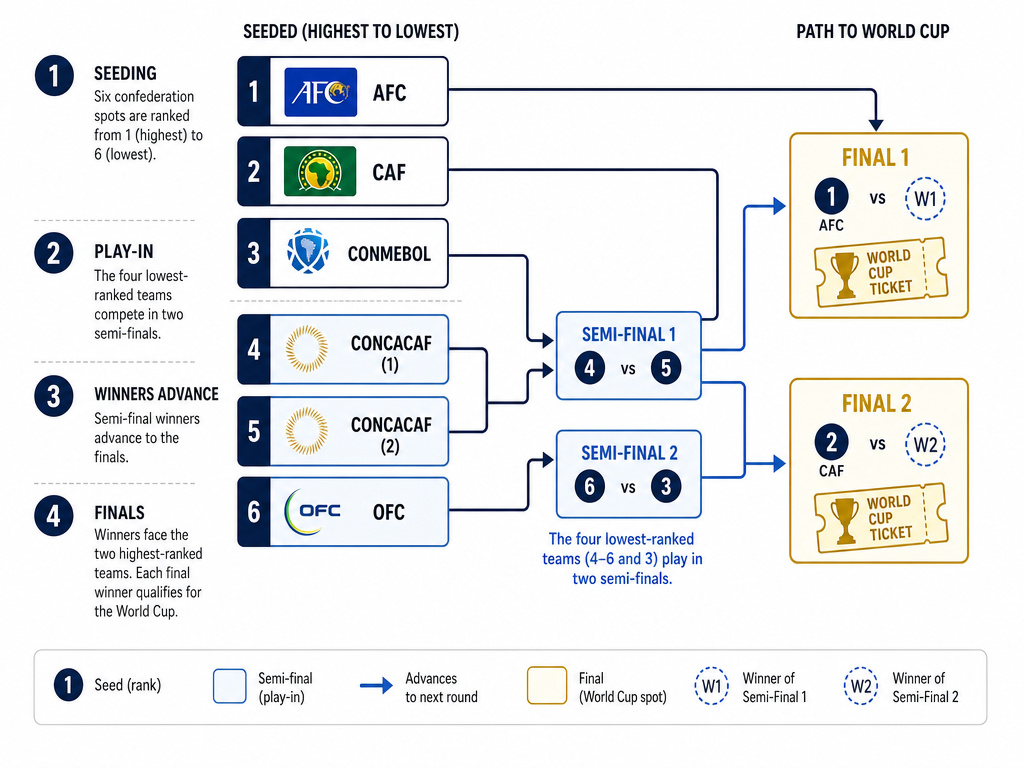
When the confederation pathways end, one last door remains open. The intercontinental play-off tournament is a final, global shootout for the last two spots in the 48-team field. It’s scheduled for March 2026.
Six teams qualify for this tournament:
- 1 from Asia (AFC)
- 1 from Africa (CAF)
- 1 from South America (CONMEBOL)
- 2 from North America (CONCACAF)
- 1 from Oceania (OFC)
The format is a knockout. According to the AP News World Cup qualifying guide, the four lowest-ranked of these six teams will play in two single-leg semi-finals. The winners of those semis then face the two highest-ranked teams in single-leg finals. The two winners of those finals claim the last two World Cup tickets.
It’s a brutal, high-stakes format where a team’s entire four-year journey can hinge on one match on neutral ground. The drama is absolute, often pitting teams with radically different styles against each other in a winner-takes-all clash.
Rules, Tie-Breakers & FIFA’s Framework
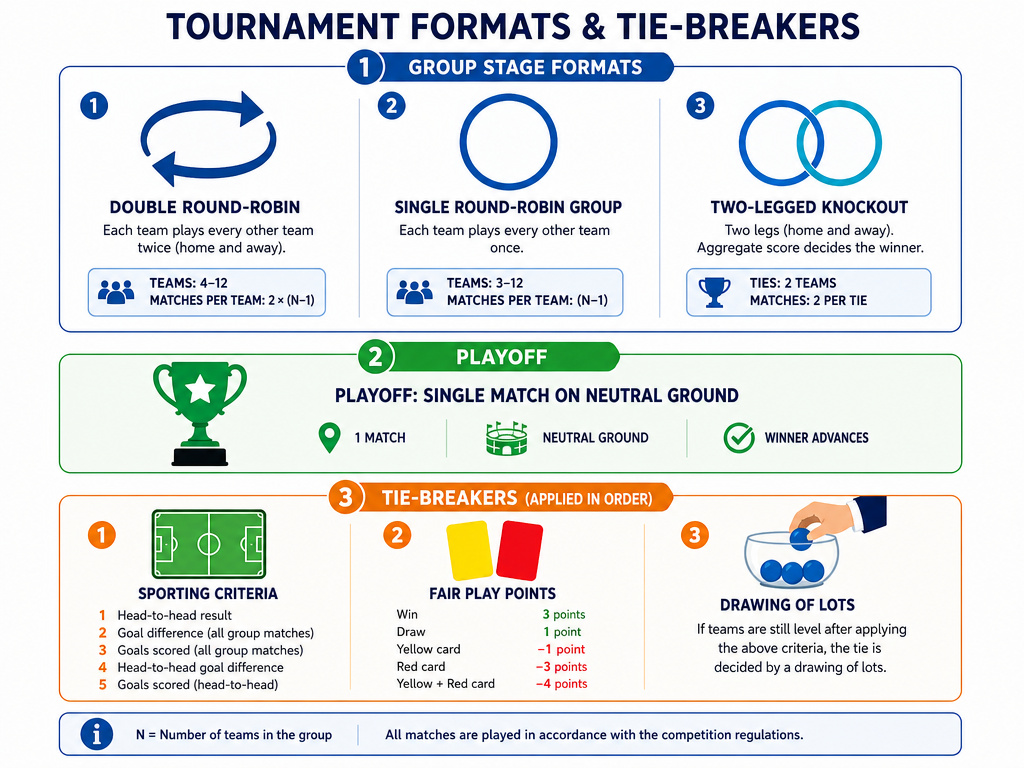
While confederations control their formats, FIFA’s regulations provide the underlying rulebook. The governing body permits several competition structures, as outlined in its guidelines and reported by sporting news outlets.
According to reports on FIFA’s framework, approved qualifying formats can include: * Double round-robin leagues (home and away). * Single round-robin groups. * Two-legged knockout ties. With special permission, confederations can also use: * A single-leg knockout format. * A tournament held in one participating nation or on neutral territory.
This flexibility in how the World Cup qualifying works explains the variety we see. It also extends to playoff matches. FIFA’s official regulations state that with committee permission, playoff matches can be played as a single match (cup system) in one of the participating countries or on neutral territory.
When teams finish level on points in a group, tie-breakers are applied according to confederation and FIFA regulations. FIFA’s regulations state that if teams remain tied after all on-field sporting criteria and a play-off is unfeasible, the tie will be broken by fair play points, then by drawing of lots.
The last two are true last resorts. If all sporting criteria are equal and a playoff isn’t feasible, the team with the better fair play record advances. If they’re still tied, names are drawn from a bowl. It’s rare, but it’s the final, arbitrary line in the rulebook.
How World Cup qualifying has changed over time
The format for reaching the World Cup has evolved significantly as the tournament itself has grown. Early editions featured far fewer teams, with qualification often a simple knockout round or even invitation. As football’s global footprint expanded, FIFA introduced a confederation-based system to manage the increasing number of nations vying for a place. This structure allows each continent to run its own qualifying process, tailoring the format to its geographical and competitive realities. The constant adjustments, from adding more slots to introducing intercontinental playoffs, reflect the ongoing effort to balance global representation with sporting merit across an ever-widening field of competitors.
Frequently Asked Questions
Do World Cup hosts automatically qualify?
Yes. For the 2026 World Cup, the three host nations, the United States, Canada, and Mexico, qualified automatically. Their spots are separate from their confederation’s (CONCACAF) allocated qualifying places.
Does the defending champion automatically qualify?
No. This rule was abolished after the 2002 World Cup. The defending champion, like all other nations, must now qualify through its confederation’s process. Argentina, the 2022 champion, had to qualify for 2026 via CONMEBOL.
How does the UEFA Nations League help in World Cup qualifying?
The UEFA Nations League provides a secondary route for European teams. The four best Nations League group winners that do not finish in the top two of their World Cup qualifying group earn a place in the European playoffs. It’s a safety net for nations that perform well in the Nations League but have a poor World Cup qualifying campaign.
How long does World Cup qualifying take?
The entire process spans about two and a half years. For the 2026 cycle, the first match (in CONMEBOL) was in September 2023. The final qualifiers (the intercontinental playoffs) are in March 2026, just three months before the tournament begins.
Can a confederation change its qualifying format?
Yes, but within FIFA’s guidelines. Confederations approve their own formats for each World Cup cycle. Changes are common, often to accommodate an expanded number of teams or to streamline the process.
The Bottom Line
Understanding World Cup qualifying is understanding football’s global ecosystem. It’s a puzzle where the pieces are continents, each with its own shape. The system isn’t meant to be perfectly symmetrical; it’s meant to be globally representative and competitively viable.
For a fan, the real joy is tracing your nation’s path through this labyrinth. It’s about knowing that a draw in a chilly October match in Asia can be as consequential as a last-minute winner in a South American clásico. The qualifying process is a tournament in its own right, a sprawling, multi-year drama that sets the stage for the main event. Every spot is earned, and every journey there is a story.
