
How the FIFA World Cup Works: The Format Explained
This post contains affiliate links. As an Amazon Associate, we earn from qualifying purchases.
The FIFA World Cup works as a four-year cycle, culminating in a month-long final tournament. For the 2026 edition, 45 teams qualify through their continental confederations, the three hosts qualify automatically, and all 48 are drawn into 12 groups of four. The top two from each group, plus the eight best third-placed teams, advance to a 32-team knockout stage, which is single-elimination until a champion is crowned.
That 48-team structure is the biggest shift in a generation. It adds a new round, more matches, and a fresh layer of strategy for navigating the groups. This change is a key part of how the FIFA World Cup works.
What follows is a breakdown of the entire machine: the two-year qualification slog across six continents, the precise draw mechanics that build the groups, the seven-step tie-breaker list that decides who advances, and the single-elimination drama of the knockout rounds, which is the core of how the FIFA World Cup works. By the end, you’ll know exactly how a team goes from a qualifying match in Asia or Africa to lifting the trophy in July.
Key Takeaways
- The 2026 World Cup features 48 teams in 12 groups of four, with the top two plus eight best third-placed teams advancing to a new, 32-team knockout bracket.
- 45 teams qualify via continental tournaments (AFC, CAF, CONCACAF, CONMEBOL, OFC, UEFA), while the three hosts (Canada, Mexico, USA) qualify automatically.
- The official group stage tie-breaker order starts with head-to-head results, not overall goal difference—a crucial detail that changes team strategy in the final group matches.
- A final 6-team intercontinental play-off tournament awards the last two spots, involving one team from each confederation except UEFA, plus an extra CONCACAF side.
- The tournament runs from 11 June to 19 July, with 104 matches across 16 host cities in Canada, Mexico, and the United States.
The 2026 Format: 12 Groups, 32 Knockout Teams
The old 32-team World Cup is gone. The new model, launching in 2026, is built for more games, more nations, and more complexity in the group stage.
You now have 48 finalists. They are split into 12 groups of four teams (labeled A through L). Each group plays a round-robin, so every team has three matches. The stakes for each game shift because advancing isn’t as simple as finishing in the top two.
The top two teams from each of the 12 groups (24 teams) qualify automatically for the knockout stage. They are joined by the eight best third-placed teams across all groups, creating a 32-team knockout bracket.
That last clause changes everything. Finishing third in your group no longer guarantees a flight home. It triggers a massive, tournament-wide comparison where your points, goal difference, and goals scored are stacked against every other third-place team. It encourages attacking play in the final group games, because a cautious 0-0 draw that gets you third with 4 points might not be enough if other groups produce third-place teams with 5 or 6 points.
The math of this new 48-team format means more football—104 total matches, up from 64. It also creates a longer tournament path, with the addition of a Round of 32 before the traditional Round of 16.
The Long Road: How Teams Qualify
Before any team dreams of the group draw, they must survive a two-year gauntlet within their own continent. The World Cup qualifying process is decentralized, with each of FIFA’s six confederations running its own tournament under a framework set by world football’s governing body.
FIFA allocates a set number of slots to each confederation. For 2026, the breakdown is: 45 slots for the confederations, plus 3 slots for the automatic host qualifiers (Canada, Mexico, USA).
| Confederation | Region | Qualifying Slots (2026) |
|---|---|---|
The process isn’t uniform. Confederations have authority, subject to FIFA approval, to design their own qualification process, a fundamental part of how the FIFA World Cup works. CONMEBOL typically uses a single, league-style home-and-away round-robin with all 10 members. UEFA employs a multi-stage system with group phases and play-offs. The formats can include knockout ties, single-match leagues, or even single-venue tournaments if requested and approved.
Where this goes sideways: Assuming the host’s automatic spot comes from their confederation’s allocation. It doesn’t. The three host slots are additional. CONCACAF gets its full 6 direct slots plus its three members host automatically. This decision, approved by the FIFA Council on 14 February 2023, reshaped the entire qualification math for the region.
The last two spots are decided by a centralized 6-team play-off tournament. It involves one team from each confederation (except UEFA), plus one additional team from the host confederation, CONCACAF. Those six battle it out in a short tournament for the final two places in the 48-team field.
Building the Tournament: The Final Draw
Once 45 teams have qualified through their confederations and the play-off tournament winners are known, the final tournament draw takes place. This isn’t random. It’s a carefully seeded event designed to create balanced groups and avoid early clashes between the strongest sides.
The three hosts (Canada, Mexico, USA) are automatically placed in Pot 1. The remaining 39 qualified teams are allocated to Pots 1 through 4 based on the FIFA rankings. The highest-ranked teams go into Pot 1 with the hosts, the next batch into Pot 2, and so on.
The mechanics of the tournament draw ensure no group has more than one team from the same confederation, with the exception of UEFA, which can have up to two European teams in a single group given its large number of qualifiers.
There’s one notable quirk for 2026: the draw will include four placeholder slots for UEFA teams that qualify via European play-offs, which occur after the final draw. Those placeholders are drawn with a specific pot allocation, and the actual teams that later win the play-offs will slot into those pre-drawn positions.
Navigating the Group Stage
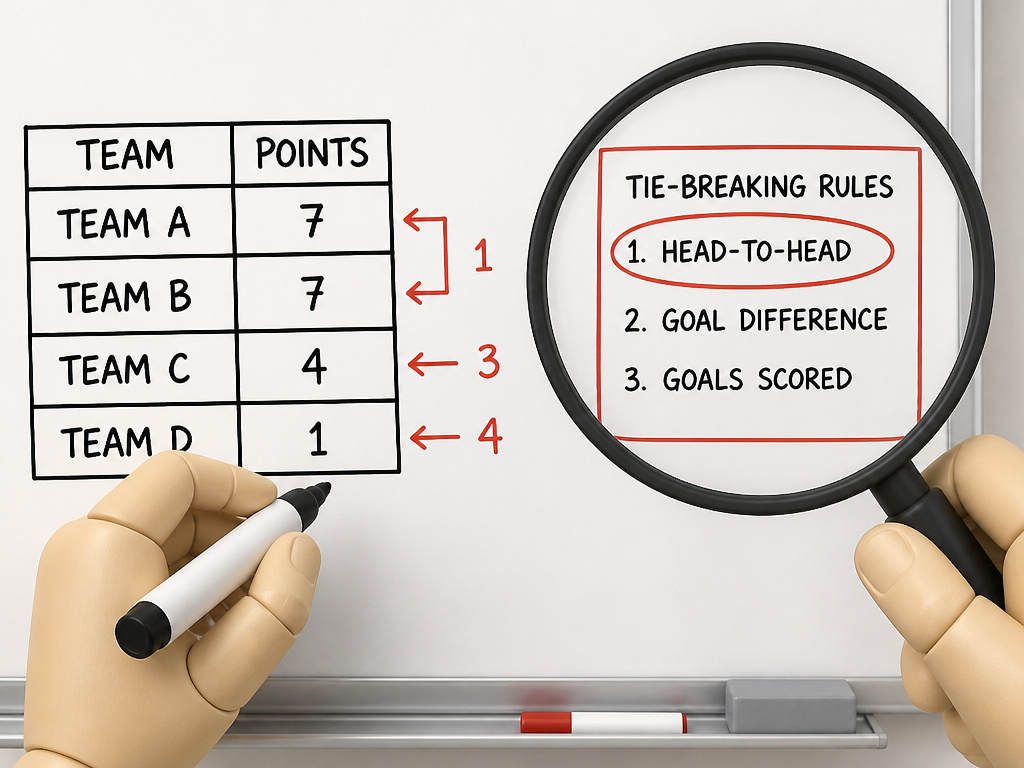
The group stage is a three-match mini-league for each team. A win is worth 3 points, a draw 1 point, and a loss 0. The teams are ranked from 1st to 4th based on total points. Simple, until two or more teams finish level on points.
This is where most fan confusion lives. The tie-breaking order is not guesswork. It’s a seven-step list defined in FIFA’s official regulations, and it prioritizes direct results over everything else.
Here is the official order, verbatim from the FIFA World Cup 2026 Preliminary Competition regulations:
- Points in head-to-head matches between the tied teams.
- Goal difference in head-to-head matches between the tied teams.
- Goals scored in head-to-head matches between the tied teams.
- If still tied, overall goal difference in all group matches.
- Overall goals scored in all group matches.
- Fair play conduct score (points deductions for yellow/red cards).
- Drawing of lots.
Notice that steps 1 through 3 are all about the head-to-head record before the tournament even looks at overall goal difference. This order can produce surprising outcomes. A team that scores 10 goals and concedes 9 (a +1 difference) can finish below a team that scores 3 and concedes 1 (+2) if they lost the direct match between them. It makes every group match a potential tie-breaker.
The group stage runs for about two weeks. At its conclusion, the top two from each of the 12 groups are known. Then, a separate table is built ranking all 12 third-place teams by points, then goal difference, then goals scored, then fair play points. The top eight from that table fill out the 32-team knockout bracket.
The Knockout Stage: Win or Go Home
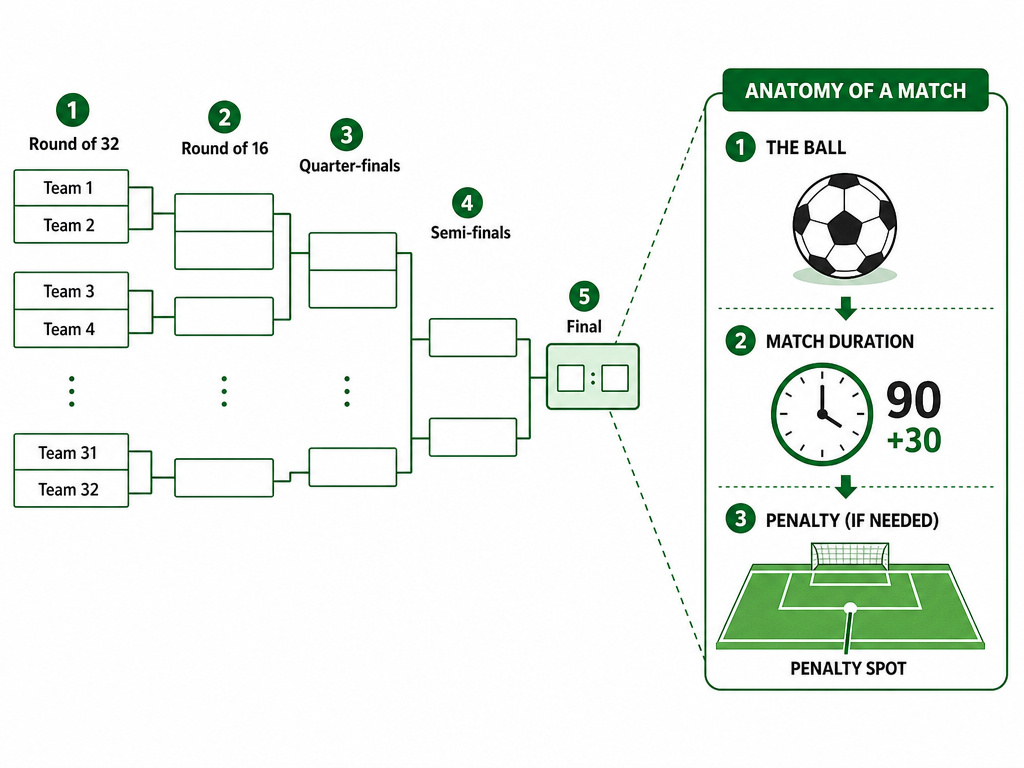
The knockout stage is pure, single-elimination drama. There are no second chances. If the match is tied after 90 minutes, it goes to 30 minutes of extra time (two periods of 15 minutes). If still tied, a penalty shootout decides the winner.
The bracket is pre-determined. The 12 group winners and 12 runners-up are seeded, and the eight best third-placed teams are drawn into specific slots to complete the 32-team field. The bracket is split into two halves, with the aim of keeping the strongest teams from meeting until the latter stages.
The knockout rounds proceed in sequence:
- Round of 32: 32 teams → 16 winners.
- Round of 16: 16 teams → 8 winners.
- Quarter-finals: 8 teams → 4 winners.
- Semi-finals: 4 teams → 2 finalists.
- Bronze Final: The two losing semi-finalists play for third place.
- Final: The last two teams play for the trophy.
This straight knockout format is why tournament football feels different from a league season. A single moment of brilliance, a costly error, or the tension of a penalty shootout can define a team’s entire campaign. Tactical flexibility becomes paramount, as teams must adapt to a new, often very different, opponent every few days.
Tournament History & Host Selection
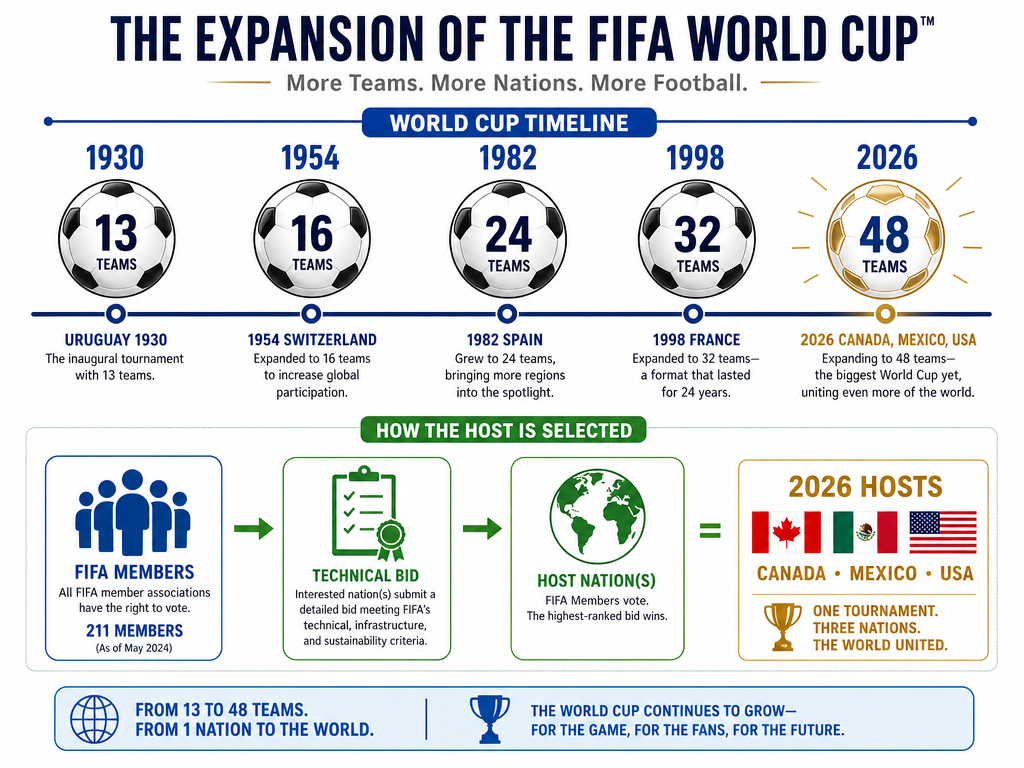
The World Cup’s history is a story of expansion and globalization. The first tournament in 1930 featured just 13 teams. It grew to 16, then 24 in 1982, and settled at 32 from 1998 through 2022. The jump to 48 teams in 2026 is the latest step.
The event is held every four years, a rhythm that builds anticipation and allows for the lengthy qualification process. The process for choosing World Cup hosts has evolved dramatically. Historically, FIFA’s Executive Committee voted on bids. Now, all FIFA member associations vote on a host or joint-host proposal, following a detailed evaluation of technical bids. The 2026 edition, jointly hosted by Canada, Mexico, and the USA, is the first to feature 48 teams and the first with three host nations.
Past Winners & Records
The FIFA World Cup’s history is defined by a small group of elite nations. A handful of countries have won the tournament multiple times, creating dynasties that span decades. These teams have set records for most titles, most appearances in finals, and longest unbeaten runs in the tournament. Individual records also stand, such as the most goals scored by a single player in World Cup history and the most appearances by a player across multiple tournaments. Tracking these records adds context to each new edition, as modern teams aim to match or surpass the legends of the past.
Frequently Asked Questions
How many teams advance from the World Cup group stage in 2026?
In the new 48-team format, 32 teams advance from the group stage. This includes the top two teams from each of the 12 groups (24 teams) plus the eight best third-placed teams from across all groups.
What happens if a knockout match is tied?
If a knockout stage match is tied after 90 minutes, two 15-minute periods of extra time are played. If the score is still level after extra time, the match proceeds to a penalty shootout to determine the winner.
Can a team win the World Cup if they lose a group match?
Absolutely. The group stage is about accumulation of points to advance, not about being undefeated. Many past champions, including Spain in 2010, lost a group match. The knockout stage is a fresh start.
How are the “best third-placed teams” determined?
After all group matches, a table is created ranking all 12 third-placed teams. They are compared first by total points, then by overall goal difference, then by overall goals scored, then by fair play points. The top eight teams in that ranking advance.
Why do some continents get more World Cup spots than others?
FIFA allocates slots based on the relative strength and number of member associations in each confederation. Stronger, deeper confederations like UEFA (Europe) and CONMEBOL (South America) receive more spots. The allocation is reviewed before each tournament cycle.
The Bottom Line
Understanding the World Cup means seeing it as two distinct tournaments. The first is a sprawling, global qualification saga that lasts years. The second is a condensed, high-stakes final event where the new 48-team format rewards depth and resilience as much as star power.
The real shift for 2026 is in the group stage math. Finishing third might be enough, but you’ll be scoreboard-watching every other group to see if your total stacks up. It turns the final group matches into a tactical puzzle where a 2-1 win might be safer than a 0-0 draw. That’s the new calculus. Every goal, every point, and every yellow card in the group stage could be the difference between a Round of 32 berth and an early trip home.
