
How World Cup Hosts Are Chosen: The Process Explained
This post contains affiliate links. As an Amazon Associate, we earn from qualifying purchases.
FIFA chooses World Cup hosts through a formal, multi-stage process. First, eligible national associations submit bids that are technically evaluated against minimum requirements. A FIFA Council then shortlists up to three qualified bids. Finally, all 211 member associations vote in a FIFA Congress, with the winner decided by an absolute or simple majority. Recent tournaments like 2030 and 2034, however, have used a streamlined, single-candidate selection.
The key is that the Council proposes, but the Congress decides. That separation is the core of the modern process, a direct response to past scandals. The process for how World Cup hosts are chosen is designed to be objective, but the 2030 and 2034 appointments show how the rules can adapt, or be set aside entirely, when the governing body’s strategic goals align.
What follows is a walkthrough of the standard competitive bid, the specific voting math, and the notable exceptions that have rewritten the playbook for the next decade. We’ll look at the 2026 vote as a textbook example, and then at why 2030 and 2034 were different.
Key Takeaways
- The FIFA Council can designate a maximum of three bids for the final Congress vote, acting as a quality-control filter.
- In a Congress vote, an absolute majority (>50% of eligible members) is needed in the first ballot; if not reached, a simple majority decides the second ballot.
- A bid deemed to have a “material failure” against minimum hosting requirements can be excluded entirely before reaching the Council.
- For the 2030 and 2034 tournaments, the process was a single-candidate, confederation-rotated selection approved by acclamation, not a competitive vote.
- The FIFA Congress can reject all bids presented by the Council, triggering a new bidding phase.
The Two-Tiered System: Council vs. Congress
Forget the old image of shadowy backroom deals. The current framework, solidified after the 2015 reforms, splits power clearly between two bodies. The FIFA Council sets the table; the FIFA Congress eats the meal.
The FIFA Council, a strategic body, manages the process for how World Cup hosts are chosen. It issues the regulations, receives the evaluation reports, and most importantly, designates which bids are fit for a final decision, though for the 2026 process, the FIFA general secretariat also had the power to exclude bidders not meeting minimum technical requirements after consultation with the Competitions Committee. According to the 2026 Bidding Regulations, the Council can send a maximum of three bids to the Congress. Its role is to filter out proposals that don’t meet the grade, based on a technical report. This isn’t a vote for a winner, it’s a check based on the technical report.
The FIFA Congress, comprising all member associations, holds the ultimate authority. As per the FIFA Statutes, it selects the hosts. The Council can propose, but the Congress disposes. This was showcased in the 2026 vote, where the Council presented two bids, and the Congress chose one. It’s a system built for transparency, but also for control. The Council controls what the Congress gets to choose from.
Where this goes sideways: A common public perception is that the Council’s shortlisting is the real decision. It’s not, but it is a veto. A bid that fails to impress the Council’s evaluation never gets a chance to charm the wider membership.
The Bid Evaluation: More Than Just Stadiums
Once a country declares its intent to bid, the real work begins. FIFA administers a detailed technical evaluation. For the 2026 process, this was handled by a dedicated 2026 Bid Evaluation Task Force, a group of experts from FIFA’s administration and standing committees.
Their job is to appraise every bid against clear, objective criteria with attributed scores. The evaluation covers everything from stadium capacities and transport links to hotel room inventory and commercial potential. Think of it as a due-diligence report for the world’s biggest party.
The stakes are concrete. The bidding documents state that a bid failing the minimum hosting requirements in the technical evaluation can be excluded from consideration, with some documents specifying that a ‘material failure’ leads to ineligibility. The language is sharp: for the 2034 cycle, FIFA reserves the right to determine a bid has “materially failed” and is thus ineligible. This isn’t about being the best; it’s about clearing a minimum viable bar. A bid can be dazzling but still fail if it can’t guarantee, say, the required minimum of fourteen suitable stadiums or the necessary government financial guarantees.
| Evaluation Area | What’s Assessed | Consequence of Failure |
|---|---|---|
| Infrastructure | Stadium suitability, training sites, accommodation | Immediate risk of exclusion for “material failure” |
| Commercial | Revenue projections, marketing plans, ticketing | Lower score reduces overall bid attractiveness |
| Legal & Compliance | Government guarantees, tax exemptions, visa waivers | Bid cannot proceed without signed commitments |
| Sustainability & Human Rights | Environmental plans, human rights policies | Public scrutiny and potential downgrade in evaluation |
The resulting Bid Evaluation Report is published. For 2026, both the United States/Canada/Mexico and Morocco reports were made public before the vote. This transparency is meant to arm Congress voters with facts, not just politics.
Confederation Rotation: The Unwritten Rule
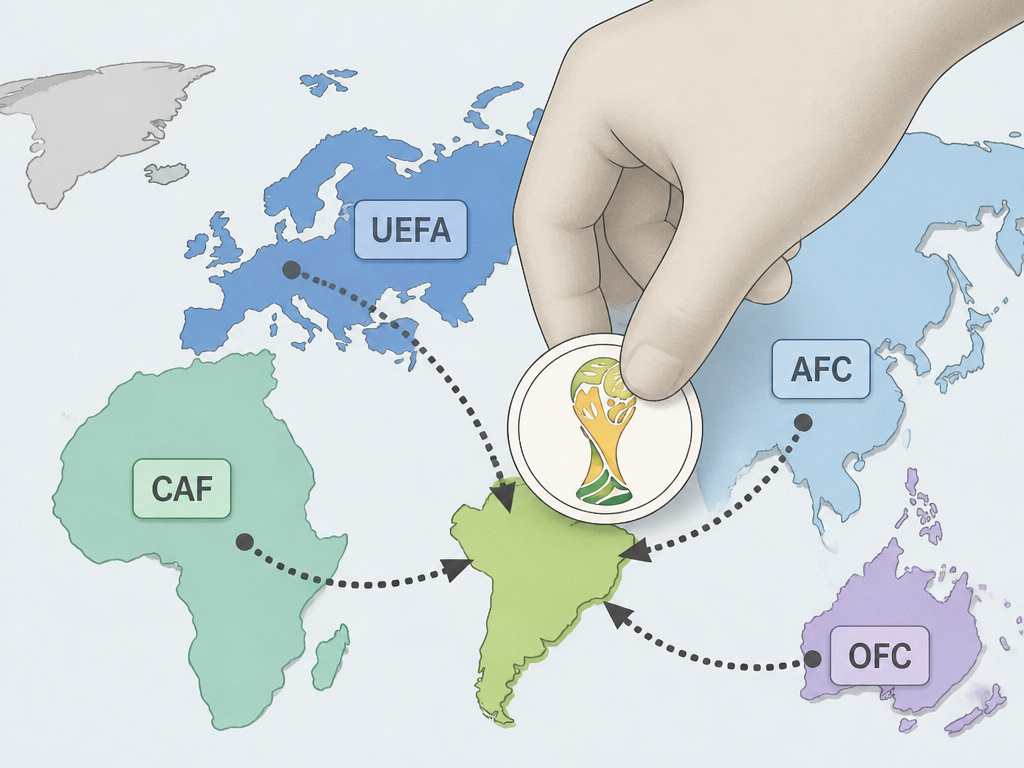
There’s no formal statute that says the World Cup must rotate continents, but a powerful gentlemen’s agreement guides the process. The principle is simple: after a confederation hosts, it should wait its turn. This “two-tournament gap” rule aims to spread the event globally.
This principle directly shaped eligibility for recent bids. For the 2026 tournament, the initial invitation went only to member associations from CONCACAF, CAF, CONMEBOL, and the OFC.
The 2030 and 2034 cycles took this further, pre-determining the eligible confederations. FIFA’s overview document stated only member associations from CAF and UEFA were eligible for 2030, and only those from the AFC and OFC for 2034. This wasn’t a suggestion; it was a rule of the bidding process. It effectively limited the field from the start, a move FIFA said provided “harmony and rotation.”
I’ve always been skeptical of rigid rotation. It can prioritize geography over merit. But commercially, it makes sense for FIFA to plant its flag in new markets regularly. The risk is that you end up with a single viable candidate in a pre-chosen region, which is exactly what happened for 2034.
The FIFA Congress Vote: How the Final Decision is Made
This is the public climax. The designated bids are put before the 211-member FIFA Congress for a vote. The procedure is meticulous, designed to leave no ambiguity.
For the 2026 vote, the 68th FIFA Congress in Moscow chose between the Moroccan bid and the United States/Canada/Mexico bid, with an option to reject all bids and reopen the process.
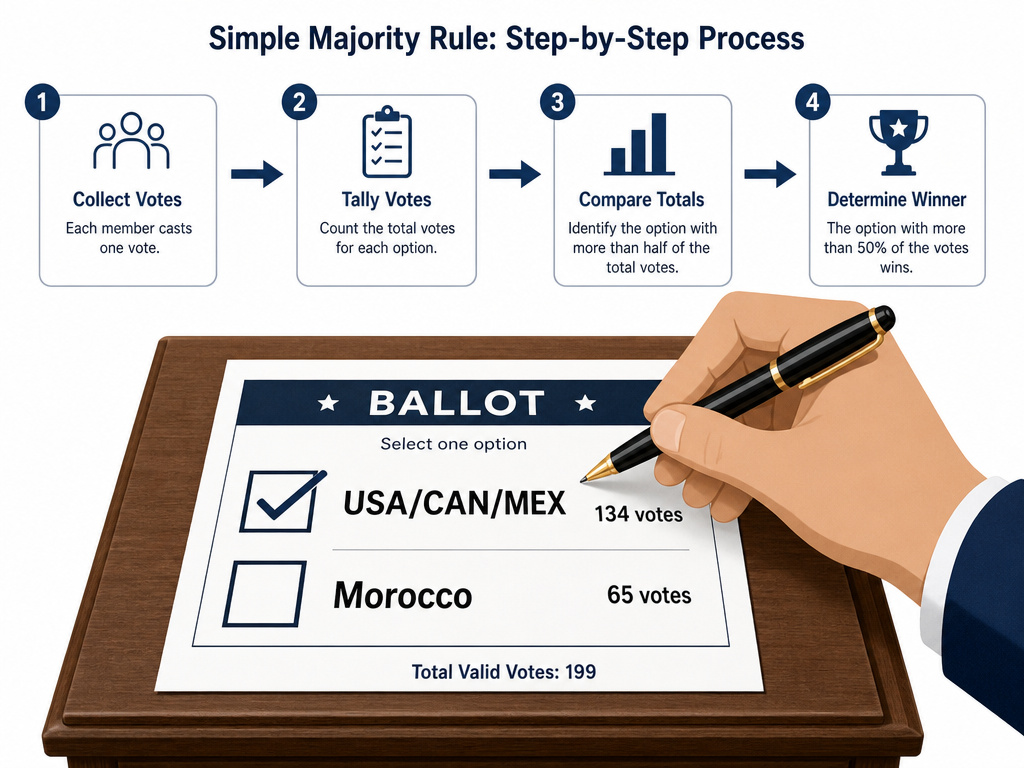
The voting thresholds are precise. If three or more bids are presented, the first ballot requires an absolute majority, more than 50% of the members present and eligible. If no bid achieves that, the lowest-voted bid is eliminated, and a second ballot is held requiring only a simple majority (more than 50% of valid votes cast).
However, if fewer than three bids are on the ballot, a simple majority in the first ballot is enough to win. This was the rule that decided 2026. The United States/Canada/Mexico bid received 134 votes, defeating Morocco’s 65 votes.
“In accordance with art. 69 par. 2 (d) of the FIFA Statutes, if fewer than three bids are presented to the Congress, a simple majority (more than 50%) of the valid votes cast is required for a decision on the host.”
The Congress also holds a nuclear option. If the “None of the Bids” option gets a simple majority, both bids are rejected, and the entire process reopens. It’s a rarely used but powerful check on the Council’s shortlisting power.
The 2030 & 2034 Exception: Selection by Acclamation
The process described above is the standard competitive model. For the 2030 and 2034 World Cups, FIFA threw that model out the window.
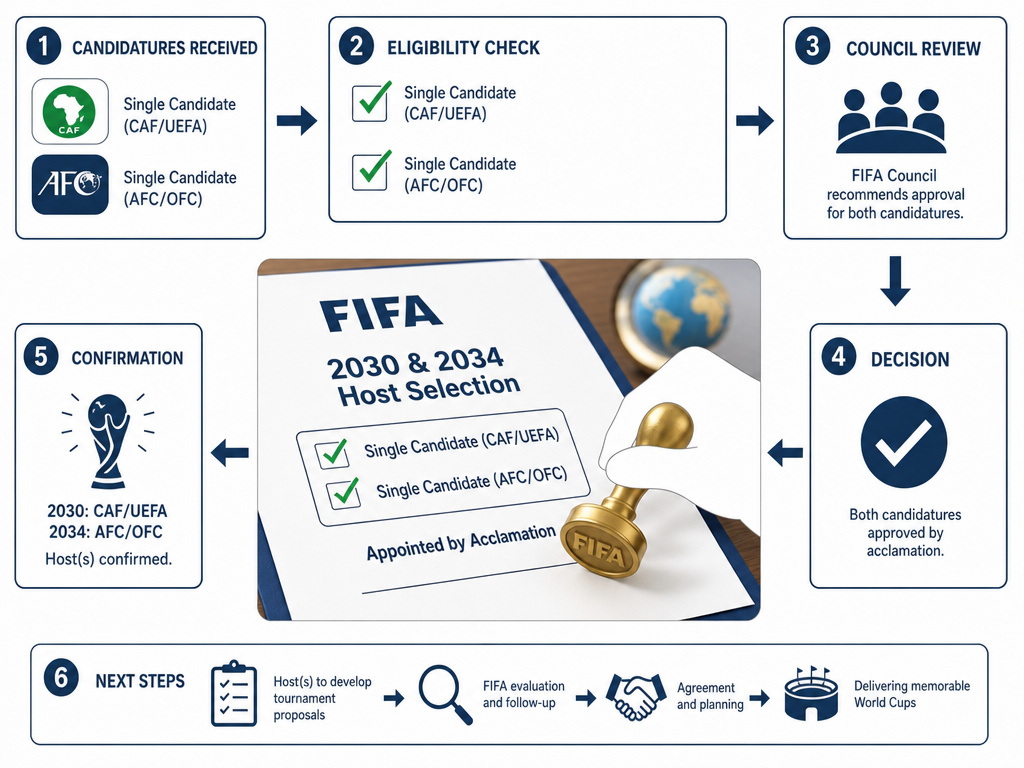
Here, a consolidated proposal from the FIFA Council, supported by all confederations, established a single-candidate, confederation-rotated process. For 2030, only a joint bid from Morocco, Portugal, and Spain (spanning CAF and UEFA) was eligible, with a nod to the tournament’s centenary via three opening matches in Argentina, Paraguay, and Uruguay. For 2034, only bids from the AFC and OFC were invited, with Saudi Arabia emerging as the sole candidate.
On 11 December 2024, a virtual Extraordinary FIFA Congress was held. The hosts for both tournaments were appointed en bloc by acclamation, concluding a single-candidate, confederation-rotated selection process.
This was efficiency over competition in how World Cup hosts are chosen. FIFA argued it provided certainty and rotation. Critics saw it as a return to a less transparent era, where deal-making between confederation presidents and FIFA leadership superseded a contested vote. The technical evaluation still happened, but with only one candidate in each race, it became a compliance check rather than a comparative assessment.
Financial and Legacy Commitments: The Fine Print
Winning the bid is just the start. The hosting requirements documents are essentially a massive contract. A successful bidder must provide a slew of government guarantees: tax exemptions for FIFA and its commercial partners, relaxed visa and work-permit regimes, and commitments to cover security costs.
The financial model has also shifted. Modern bids are less about a host nation turning a direct profit and more about FIFA securing its revenue. The 2026 tournament, with its 48 teams, is a commercial beast. Hosts provide the stage; FIFA sells the global TV and sponsorship rights.
There’s also an increasing emphasis on legacy and sustainability. For 2034, the hosting overview requires the host association to use “best efforts” to engage with the UNFCCC Sports for Climate Action Framework. These soft obligations are becoming hard expectations, reflecting broader societal pressures on mega-events.
Frequently Asked Questions
Do World Cup hosts automatically qualify?
Yes, the host nation(s) receive an automatic berth in the final tournament. For multi-host tournaments like 2026 (USA, Canada, Mexico) and 2030 (Morocco, Portugal, Spain), all host countries qualify automatically.
How far in advance are hosts chosen?
Hosts are selected years in advance. The 2026 hosts were chosen in 2018. The 2030 and 2034 hosts were appointed in late 2024.
Can a country be stripped of hosting rights?
Yes, though it’s extremely rare. Hosting agreements contain strict obligations. A “material breach” of these commitments, such as failing to deliver key infrastructure or provide legally guaranteed conditions, could give FIFA grounds to terminate the hosting rights. The political and financial fallout makes this a last resort.
Why was the 2034 bid limited to Asia and Oceania?
This was a deliberate confederation rotation decision by the FIFA Council. With Europe hosting 2030 (via the Spain/Portugal part of the bid) and Asia having hosted in 2022 (Qatar), the 2034 edition was earmarked for the AFC and OFC to continue FIFA’s goal of global rotation, leading to Saudi Arabia’s uncontested bid.
The Bottom Line
The textbook process for choosing a World Cup host is a robust, two-stage filter of technical merit and democratic vote. But the 2030 and 2034 selections reveal that the textbook can be rewritten when FIFA’s strategic vision, be it centenary celebrations, geopolitical outreach, or commercial certainty, demands it.
For future cycles, watch the Council’s first move: which confederations are invited to bid tells you more about the likely outcome than any stadium inspection report. The real choice is often framed long before the Congress gavel falls. The process is transparent, but its boundaries are set by the very body that benefits from the result.
