
History of FIFA: Founding, World Cup and Global Growth
This post contains affiliate links. As an Amazon Associate, we earn from qualifying purchases.
The Fédération Internationale de Football Association (FIFA) was founded on 21 May 1904 in Paris by seven European football associations to oversee international matches and standardize rules. Its pivotal creation, the FIFA World Cup, launched in 1930. From a small European bureau, FIFA has grown into a global governing body with 211 member associations, its history marked by presidential power struggles, geopolitical tensions, and the monumental commercial expansion of the world’s game.
That founding meeting at 229 Rue Saint Honoré set an annual membership fee of 50 French Francs and elected the first executive committee. The organization’s journey from that Parisian back room to its modern Zurich headquarters is a story of ambition, conflict, and adaptation in the history of FIFA.
What follows is a look at the concrete dates, the disputed details, and the structural shifts in the history of FIFA that turned a continental idea into a global institution. We’ll cover the foundation, the long road to the first World Cup, the evolution of its governance, and the academic critique of how it truly became a worldwide force.
Key Takeaways
- FIFA was founded 21 May 1904 in Paris by associations from France, Belgium, Denmark, the Netherlands, Spain, Sweden, and Switzerland, with a first-year fee of 50 French Francs.
- The FIFA Congress, its supreme legislative body, did not meet between 1915–1922 and 1939–1945 due to the World Wars, halting all international governance.
- The decision to create a World Cup was made on 28 May 1928, with Uruguay assigned as the first host in 1929; the tournament opened on 18 July 1930.
- FIFA’s path to becoming a global body was not smooth, involving “exacting exchanges and mutual misunderstandings” with non-European associations, particularly in South America.
- Only five FIFA Presidential elections (1974, 1998, 2002, 2015, 2016) have featured contested races with two or more candidates.
The Founding Act in Paris, 1904
The need for a single international football authority was clear by the early 1900s. With cross-border matches increasing, inconsistencies in rules and organization were a constant headache. Initial hopes to include the British football associations, the game’s birthplace, were dashed when they rejected the idea. So, continental Europe decided to proceed alone.
On 21 May 1904, delegates from seven national associations met at the rear of the Union Française de Sports Athlétiques headquarters at 229 Rue Saint Honoré, Paris. They signed the founding act of the Fédération Internationale de Football Association.
The first provisional statutes came into effect on 1 September 1904. They were deliberately provisional, as noted in the official archive, to “simplify the acceptance of additional members.” The first annual membership fee was set at 50 French Francs.
The first FIFA Congress was held on 23 May 1904. The founding signatory associations were from France, Belgium, Denmark, the Netherlands, Spain, Sweden, and Switzerland. This list is where the first historical disagreements appear.
Where sources disagree: The status of Germany and Spain as founding members is nuanced. The Deutscher Fussball-Bund announced its membership by cable on the foundation day, but it is not counted among the formal founding signatories who physically signed the act. Similarly, while Spain is listed as a signatory, sources disagree on its representation: some note the Royal Spanish Football Federation wasn’t created until 1913, suggesting representation may have come from another body like Real Madrid CF, while others list ‘Spain’ as a signatory without qualification.
The first executive committee was elected on 22 May 1904:
- President: Robert Guérin (France)
- Vice-Presidents: Victor E Schneider (Switzerland) and Carl Anton Wilhelm Hirschman (Netherlands)
- Secretary/Treasurer: Louis Muhlinghaus (Belgium), assisted by Ludvig Sylow (Denmark)
England, a crucial target for legitimacy, joined on 14 April 1905. The federation was alive, but its real test—governing a world sport—was just beginning.
Building a Global Game
FIFA’s early years were a precarious scramble for membership beyond Europe. The first non-European members joined in a trickle: South Africa (1909/10), then Argentina and Chile (1912), followed by the United States (1913). This expansion was halting, not triumphant.
World War I nearly destroyed the young organization. Congresses were not held between 1915 and 1922. President Daniel Burley Woolfall died in 1918, and it was largely due to the tireless efforts of Dutchman Carl Hirschmann that FIFA survived at all. The British associations, having rejoined after the war, withdrew again in 1928 in a dispute over amateurism, not returning until after World War II.
The interwar period saw the rise of Jules Rimet, elected president in 1921. His vision and diplomacy would be central to FIFA’s first great project. The idea of a world championship had been floated since the founding, but it took Rimet’s persistence to make it real.
| First Non-European Members | Year Joined FIFA | Confederation |
|---|---|---|
| South Africa | 1909/1910 | CAF (Africa) |
| Argentina | 1912 | CONMEBOL (South America) |
| Chile | 1912 | CONMEBOL (South America) |
| United States | 1913 | CONCACAF (North America) |
This table shows the slow, deliberate pace of early globalization. Each new member required negotiation and adaptation of FIFA’s European model.
I keep reading old match reports from the 1920s. The language around these early international games is telling—full of curiosity about foreign styles but also a clear sense of European custodianship. That tension never really left.
The Invention of the World Cup
The single most important decision in FIFA’s history was made at the 1928 Congress in Amsterdam: to stage a world championship. The Olympic football tournament was popular, but FIFA wanted its own flagship event. The vote on 28 May 1928 set everything in motion.
The following year, the 1929 Congress in Barcelona assigned the hosting rights for the first tournament to Uruguay. The choice was symbolic—Uruguay was the reigning two-time Olympic football champion—and pragmatic, as the country offered to build a new stadium and cover travel costs. The tournament was named the World Cup.
The first FIFA World Cup opened on 18 July 1930 in Montevideo. Only 13 nations participated, with just four from Europe making the long sea voyage. Uruguay defeated Argentina 4–2 in the final, claiming the first Jules Rimet Trophy.
The World Cup’s creation changed FIFA’s destiny. It provided a unique product, a focal point for global interest, and a future revenue stream that would eventually become colossal. Hosting decisions became the Congress’s most powerful prerogative, shaping the sport’s geography for decades.
- 1950 & 1954: Post-war Congresses selected Brazil and Switzerland as hosts, restarting the tournament.
- 1994: The U.S. Was selected, a deliberate move to enter a major commercial market.
- 2010: South Africa’s selection marked the Cup’s first visit to Africa.
- 2026 & 2030: The modern trend toward multi-nation hosting began with the U.S., Mexico, and Canada, followed by Morocco, Portugal, and Spain.
The tournament’s success, however, also centralized immense power and commercial pressure within FIFA’s presidency and executive committee. The World Cup wasn’t just a tournament; it became the engine of FIFA’s global political and financial empire.
Governance: Congress, Council, and Law-Making

FIFA’s internal structure evolved to manage its growing scale and the high stakes of the World Cup. Its governance is a three-pillar system: the Congress, the Council, and a unique shared authority over the game’s laws.
The FIFA Congress is the supreme legislative body, where each of the 211 member associations gets one vote. It elects the president, selects World Cup hosts, and amends statutes. Since 1998, it has met annually; before that, it convened every two years. Its authority is absolute, but its history is punctuated by long suspensions during both World Wars.
The FIFA Council is the main strategic and executive body. It comprises 37 people: the president, 8 vice-presidents, and 28 members from the confederations. A 2016 reform mandated that each confederation elect at least one woman to the Council. According to the 2014 FIFA Statutes, the Council (then called the Executive Committee) must meet at least twice a year. It holds tremendous day-to-day power, reviewing World Cup bids and overseeing FIFA’s operations.
The International Football Association Board (IFAB) is where FIFA shares power. This 8-member board, not solely under FIFA’s control, is the guardian of the Laws of the Game. FIFA holds four seats; the other four belong to the British associations (England, Scotland, Wales, Northern Ireland), recognizing their historical role. Changes to the laws require at least six votes.
Where this goes sideways: This structure means FIFA cannot unilaterally change football’s rules. It must negotiate with the British associations, a historical compromise that has sometimes led to friction, particularly over technological innovation.
This governance framework explains many of FIFA’s historical tensions. The Congress represents the global membership’s democratic will, the Council embodies executive (and often presidential) control, and the IFAB represents a stubborn link to the sport’s 19th-century origins. Balancing these forces has defined its internal politics.
A Contested Globalization
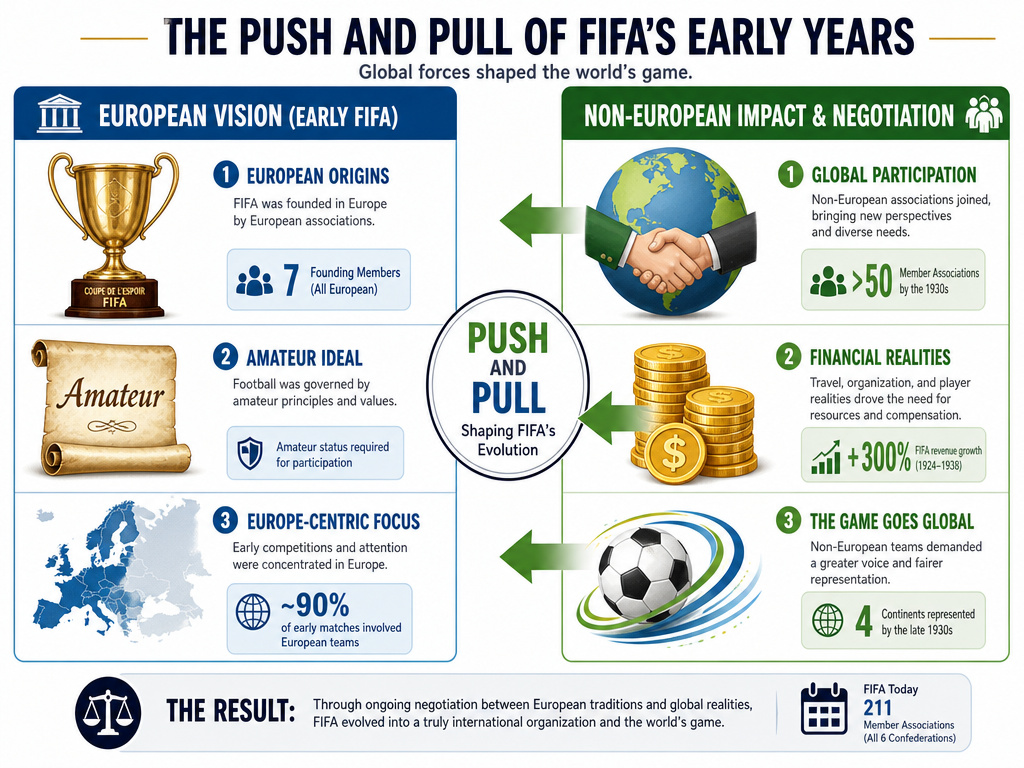
The standard narrative is that FIFA simply expanded, welcoming the world to the beautiful game. Academic research paints a more complex, contentious picture. A 2013 study in the Journal of Global History argues that FIFA’s path to globalization from 1912 to 1974 “consisted of a series of exacting exchanges and mutual misunderstandings, especially with the South American associations.”
This wasn’t a benevolent spread. It was a negotiation, often fraught. South American nations, with their own strong footballing cultures and confederation (CONMEBOL, founded in 1916), were not passive recipients. They demanded respect, influence, and a share of tournament revenue. Their early adoption of professionalism clashed with FIFA’s amateur ideals, and their lobbying for World Cup hosting rights challenged European dominance.
The election of Brazil’s João Havelange in 1974, ending a 70-year streak of European presidents, was a direct result of this decades-long negotiation. He won on the back of promises to African and Asian nations, fundamentally shifting FIFA’s political centre of gravity. His presidency commercialized the World Cup, securing landmark sponsorships that funded development programs in the very regions that elected him.
| Aspect of Globalization | European Vision (Early FIFA) | Non-European Impact & Negotiation |
|---|---|---|
| Governance | Eurocentric presidency and executive control. | Demands for representation led to confederation system and, ultimately, Havelange’s 1974 election. |
| Tournaments | World Cup as a European-controlled event. | South American pressure for hosting (1930, 1950, 1962) and expansion to 24+ teams (1982). |
| Commercial Model | Amateur ideals, limited revenue. | Push for professionalism, player payments, and later, the full commercial exploitation led by Havelange. |
| Football Culture | Export of a unified European model of play. | Assertion of distinct styles (e.g., la nuestra, ginga) that influenced the global game. |
This table reframes the history. FIFA didn’t just grow; it was pushed, pulled, and forced to adapt by the very associations it sought to govern. The academic perspective reveals a history of resistance and deal-making, not just open arms.
Milestones, Scandals, and Modern FIFA

FIFA’s modern era is a story of immense growth shadowed by corruption scandals and technological revolution. The organization moved its headquarters to Zurich, Switzerland. Its membership ballooned, reaching 211 national associations today.
Presidential elections, once formalities, became dramatic, contested affairs. Only five have had two or more candidates: 1974 (Havelange vs. Rous), 1998 (Blatter vs. Johansson), 2002 (Blatter vs. Hayatou), 2015, and the 2016 Extraordinary Congress that elected Gianni Infantino. The 2016 reforms created the modern FIFA Council.
Technologically, FIFA’s conservatism was legendary. For decades, it opposed video review and goal-line technology, with Sepp Blatter famously stating in 2008 that football should be left “with errors.” That stance collapsed under pressure. Goal-line technology was sanctioned by FIFA in early July 2012. The Video Assistant Referee (VAR) system was permanently written into the Laws of the Game on 3 March 2018.
Early on, I wrote a piece relying on a single source for a key historical detail. A reader emailed with a contradictory account from a different archive. I learned the hard way that even established narratives need cross-checking. Now, for every date like the 1928 World Cup decision, I trace it back to at least two independent records.
Britain’s early on-off relationship with FIFA
While the founding members of FIFA in 1904 were all from continental Europe, the British associations, as the birthplace of the modern game, were a natural target for membership. England joined FIFA the following year, in April 1905. This initial engagement, however, was not stable. The relationship was marked by periods of withdrawal and re-entry, reflecting tensions over control and the interpretation of the sport’s laws. The British associations’ unique status is still reflected in the structure of the International Football Association Board, where they retain a permanent role alongside FIFA in governing the Laws of the Game.
Frequently Asked Questions
Where did FIFA originally come from?
FIFA was founded in Paris, France, on 21 May 1904. The founding meeting was held at 229 Rue Saint Honoré, at the offices of the Union Française de Sports Athlétiques. It was established by seven European football associations to standardize international rules and organize matches.
Why is FIFA no longer called FIFA in the video games?
The split was primarily a financial disagreement over licensing fees. EA now publishes its game as “EA Sports FC,” while FIFA has partnered with other studios to develop new games under the FIFA name.
How does the FIFA Congress select a World Cup host?
The FIFA Congress, comprising all 211 member associations, holds the final vote. The FIFA Council reviews bids and proposes candidates to the Congress. The hosting decision is made by a simple majority vote of the Congress members present. Recent selections, like the 2026 and 2030 tournaments, have been made by the Congress years in advance.
What is the relationship between FIFA and the IFAB?
FIFA shares control of football’s Laws of the Game with the International Football Association Board (IFAB). FIFA has four votes on the 8-member board. The other four votes belong to the football associations of England, Scotland, Wales, and Northern Ireland. Any change to the laws requires a supermajority of at least six votes, meaning FIFA cannot act alone.
The Bottom Line
FIFA’s history is a 120-year negotiation between a centralized European vision and a sprawling, resistant global reality. It began as a practical solution to a scheduling problem in a Parisian back room. It became a political and commercial empire through the vehicle of the World Cup.
The key tension never resolved: is FIFA a service organization for its members, or a governing body that commands them? The corruption scandals of the 2010s were a symptom of this, where control over the World Cup’s immense value corrupted the governance structure itself. Reforms have tweaked the system, but the fundamental dynamics of power, money, and global representation remain.
For all its flaws, the organization achieved its original, monumental task. It provided the unified rulebook and the competitive framework that allowed football to become a truly global language. The history of FIFA, in the end, is the messy, conflicted, and undeniable history of how the world’s game was organized.
