
History of UEFA: From Basel to a Football Superpower
This post contains affiliate links. As an Amazon Associate, we earn from qualifying purchases.
The history of UEFA began on 15 June 1954 at the Hotel Euler in Basel, Switzerland, when 28 national football associations formed a continental confederation. From a body with limited authority and a 250 Swiss franc membership fee, UEFA evolved into the regulatory and commercial superpower behind competitions like the Champions League and European Championship, now headquartered in Nyon with 55 member associations.
That foundational meeting was less a grand declaration and more a practical solution. European football needed a unified voice within FIFA and a structure to manage its own affairs. The minutes from that day reveal a focus on drafting statutes, not destiny.
What follows is the story in the history of UEFA of how a modest administrative group became the engine of modern European football. We’ll look at the political quirks of its birth, its deliberate growth across the Cold War divide, the creation of its iconic tournaments, and the pivotal moments that shifted its power from recommendation to regulation.
Key Takeaways
- UEFA was officially born on 15 June 1954 in Basel, with an initial Executive Committee of eight members.
- The original statutes stated UEFA’s decisions were not binding on national associations, except for FIFA and UEFA elections, a stark contrast to its current regulatory monopoly.
- The body’s first headquarters were in Paris, before moves to Bern (1960) and finally its permanent home in Nyon, Switzerland (1999).
- Critical early competitions included the European Cup (1955), the European Nations’ Cup (1960), and the UEFA Cup Winners’ Cup (first staged in the 1960/61 season).
- A major shift occurred in 1972, when standard regulations were adopted for all UEFA club competitions and its legal bodies were granted independent status.
The 1954 Birth in Basel: A Modest Start
The defining meeting took place in a Swiss hotel, not a grand hall. On 15 June 1954, representatives from 28 European football associations gathered at the Hotel Euler in Basel. The context changes everything. This wasn’t a spontaneous birth but a response to FIFA’s 1953 authorisation for continental confederations. Europe needed its own house in order.
The attendance sheet itself tells a story of post-war Europe. Czechoslovakia represented Romania, whose delegates couldn’t get visas. England stood in for Wales. Greece’s representatives arrived after proceedings had begun. It was a patchwork assembly, focused on a single motion to form a “group of the said associations” and draft a constitution.
The draft statutes fixed the annual membership fee at 250 Swiss francs and stipulated that the Executive Committee should comprise eight members. Crucially, it was deemed that “the decisions taken by UEFA would not be binding on the national associations, but that they would take the form of recommendations, excepting matters concerning FIFA and UEFA elections.”
That clause is the part the scoreline hides. The UEFA of 1954 was a collaborative forum, not a governing powerhouse. Its power was persuasive, not legal. The name itself was finalized months later in Copenhagen on 29-30 October 1954: Union of European Football Associations (UEFA) in English, Union des Associations Européennes de Football in French.
The inaugural UEFA Congress was held in Vienna on 2 March 1955. Snow blanketed the city. The first UEFA Congress had representatives from 29 European national football associations, and the Turkish Football Federation was welcomed, bringing the number of represented associations to 30. They adopted the first official statutes and began discussing fixture lists, television, and, most importantly, competitions. The history of the European Cup was about to begin, though UEFA initially embraced a tournament created by the French sports paper L’Équipe rather than inventing it themselves.
Building the European Football Calendar
UEFA’s first task was to give Europe its own fixtures. The ideas were already in the air; the organization’s role was to sanction, standardize, and scale them. The European Champion Clubs’ Cup (the European Cup) was first competed for in the 1955–56 season. It was a straight knockout tournament for domestic champions, a simple format that immediately captured the continent’s imagination.
The idea for a national team competition was older. Henri Delaunay, UEFA’s first general secretary, had first proposed it to FIFA alongside Austrian administrator Hugo Meisl back in 1927. Delaunay’s dream finally became the European Nations’ Cup, first staged over a 22-month period between 1958 and 1960. The Soviet Union won that first final, lifting the trophy named in Delaunay’s honour. His son Pierre, who succeeded him as general secretary, watched 29 associations enter the second edition, proof the concept had taken root.
The tournament portfolio expanded to capture different kinds of glory. The European Cup Winners’ Cup was first staged in the 1960/61 season, creating a European path for domestic cup winners. The old Inter-Cities’ Fairs Cup, a competition for cities hosting trade fairs, came under UEFA’s full control and was rebranded as the UEFA Cup in 1971. Finally, the UEFA Super Cup, pitting the champions of the European Cup and the Cup Winners’ Cup, was created in 1973.
| Competition | First Season | Initial Purpose | Evolution |
|---|---|---|---|
| European Cup | 1955–56 | Champions of domestic leagues | Rebranded as UEFA Champions League (1992) |
| European Nations’ Cup | 1958–60 | Continental championship for national teams | Became European Championship (1968), expanded to 8 (1980) then 24 teams |
| Cup Winners’ Cup | 1960–61 | Winners of domestic cup competitions | Discontinued in 1999, merged into UEFA Cup |
| UEFA Cup | 1971–72 (under UEFA) | Successor to Inter-Cities’ Fairs Cup | Rebranded as Europa League (2009) |
| UEFA Super Cup | 1973 | Winner of European Cup vs. Winner of Cup Winners’ Cup | Still contested annually |
This framework, a champions’ path, a cup winners’ path, and a broader league path, defined European club football for decades. Understanding how the UEFA Champions League works today requires seeing it as the direct descendant of that original 1955 tournament, just as the modern UEFA Europa League works as an evolution of the UEFA Cup.
A Pan-European Bridge During the Cold War
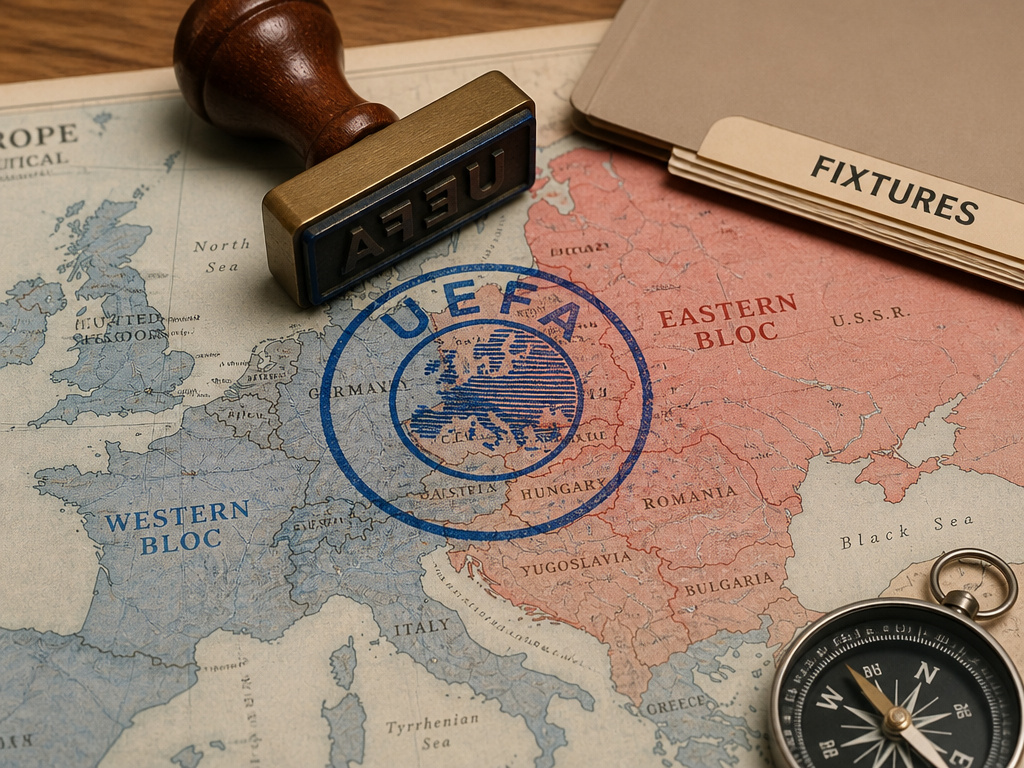
Post-war Europe was split by an Iron Curtain. Yet, UEFA’s membership included associations from both East and West from day one. This wasn’t an accident. As explored in the academic study “United Europe football formation“, football administrators deliberately sought to limit the impact of international politics on the sport. UEFA became a rare paneuropean organization where Hungary, the Soviet Union, and Yugoslavia competed directly with England, Italy, and West Germany.
The organization’s early stability was symbolic. Its first president was Ebbe Schwartz of Denmark (1954-1962). Its second was Gustav Wiederkehr of Switzerland (1962-1972). The general secretary for nearly three decades was Hans Bangerter, also Swiss. Bangerter succeeded Pierre Delaunay in 1960, the same year UEFA moved its headquarters from Paris to Bern, Switzerland, a neutral ground.
UEFA had 33 member nations by the early 1960s. This growth across the East-West divide was a conscious achievement, making its competitions a genuine continental spectacle when other cultural exchanges were fraught.
The football field became a sanctioned space for Cold War rivalry and, occasionally, diplomacy. The 1960 European Nations’ Cup final was contested between the Soviet Union and Yugoslavia. The 1972 European Cup final saw the Dutch Ajax of the West face Italy’s Inter Milan. UEFA managed the fixtures, the referees, and the broadcasting agreements with both the Western European Broadcasting Union (EBU) and the Eastern International Broadcasting Organization (IBO). It was a logistical and political tightrope walk, performed successfully for decades.
This unique position meant that when geopolitical upheaval came, UEFA was already the established home for European football. The collapse of the USSR, Yugoslavia, and Czechoslovakia in the early 1990s didn’t create new football nations; it simply turned their existing football associations into independent UEFA members overnight, swelling the ranks.
From Administrator to Regulator: The Power Shift
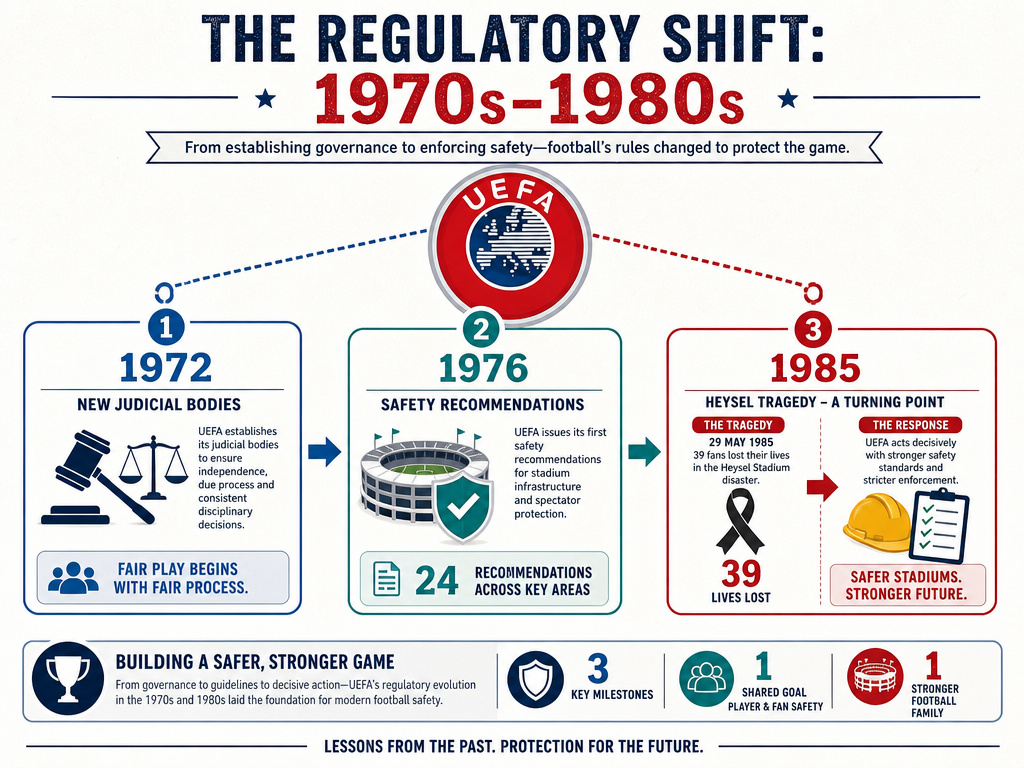
For its first two decades, UEFA’s authority was largely based on consensus. That began to change in the early 1970s, a period of formalization and legal assertion. A series of decisions in 1972 marked a turning point.
First, standard regulations were adopted for all UEFA club competitions. No more ad-hoc agreements. Second, the Control and Disciplinary Committee and the Board of Appeal were separated from UEFA’s administrative machinery and granted independent status. This created a formal judicial system within the organization. Third, subsidies were paid for the first time to clubs suffering deficits after early elimination, a financial lever that created dependency and goodwill.
The shift from advisor to governor continued throughout the decade:
- 1971: The Inter-Cities’ Fairs Cup is renamed the UEFA Cup, bringing it under full UEFA control.
- 1976: Binding recommendations are issued on maintaining order in stadiums, a direct response to growing fan violence.
- 1980: The European Championship final tournament expands to eight teams, increasing its commercial and sporting footprint.
The tragic catalyst for a harder regulatory stance was the Heysel Stadium disaster in 1985. Thirty-nine fans died when a wall collapsed after crowd trouble before the European Cup final in Brussels. A Belgian civil court later found UEFA partially responsible for organizational failures. The aftermath forced UEFA to take a lead on stadium safety, security protocols, and sanctions, areas where it could no longer just recommend.
This era transformed UEFA’s role. It was no longer just the organizer of a calendar; it was the rule-maker, judge, and financial distributor for European football. This consolidated authority would be vital for the next major phase: the commercial revolution.
The Commercial Revolution and the Modern Era
The single biggest symbol of UEFA’s evolution is the rebranding of the European Cup. In the 1991-1992 season, it became the UEFA Champions League. This wasn’t just a name change. It was a new format with a group stage, guaranteeing more matches for top clubs, and a new business model built on selling exclusive television rights to the highest bidder, often private broadcasters rather than public networks.
The Champions League became a financial supernova. It created a virtuous (or vicious, depending on your perspective) cycle for elite clubs: more TV money, better squads, deeper runs in the competition, even more TV money. This commercial power fundamentally altered the balance within European football, concentrating wealth and influence. The anthem, the starball logo, the Saturday final, all part of a meticulously branded product.
UEFA’s physical home mirrored this new stature. In 1995, it moved from Bern to Nyon, on the shores of Lake Geneva. A sleek, modern “House of European Football” opened there in 1999, a far cry from the borrowed offices in Paris. It was the headquarters of a global sports business.
The competition landscape continued to evolve. The UEFA Cup Winners’ Cup was discontinued in 1999. The UEFA Cup was revamped into the UEFA Europa League in 2009. In 2021, the UEFA Europa Conference League was launched, creating a third tier and a European path for even more domestic leagues. Each change was designed to manage the competing demands of elite clubs, emerging nations, and commercial partners.
Where this goes sideways: Concentrating commercial wealth in the Champions League has dramatically widened the financial gap between Europe’s elite clubs and the rest. Domestic leagues now often feel like qualifying tournaments for UEFA’s cash-rich competition, distorting sporting priorities.
The governance challenges also became more complex. The presidency of Michel Platini (2006-2015) ended in a FIFA ethics scandal. The organization has faced constant pressure from elite clubs threatening breakaway leagues, leading to repeated reforms of the Champions League format to placate them. Recent sanctions over multi-club ownership, like the 2025 case involving Crystal Palace and Lyon, show UEFA actively wielding its regulatory power in an increasingly complex football ecosystem.
Today, UEFA is a behemoth. It runs the men’s and women’s Champions Leagues, the European Championship (which expanded to 24 teams), the Nations League, and a vast array of youth and futsal competitions. It dictates financial fair play rules, oversees refereeing standards, and generates billions in revenue. From that meeting of 28 associations in a Basel hotel, it now governs 55 members, including non-sovereign entities like Gibraltar and Kosovo, detailed in the Wikipedia UEFA history entry.
The provided fact sheet contains no specific information about UEFA’s historical role in developing women’s football. To understand this aspect of UEFA’s history, you should consult official UEFA archives or historical summaries that focus specifically on women’s football. Look for documents detailing the founding dates of UEFA’s women’s competitions, the evolution of the Women’s European Championship, and key policy decisions that promoted the women’s game across the continent. These sources will provide the necessary timeline and context for UEFA’s work in this area.
Frequently Asked Questions
How many countries are members of UEFA?
UEFA currently consists of 55 national associations. This number has grown from the 28 involved in the founding meeting, through the fragmentation of states like the Soviet Union and Yugoslavia. Membership includes sovereign nations, UK constituent countries (England, Scotland, etc.), and territories like Gibraltar and the Faroe Islands.
Who is bigger, FIFA or UEFA?
FIFA is the global body with 211 national associations. UEFA is arguably more powerful in financial power and concentration of elite clubs. It generates the majority of world football’s revenue through its club competitions and the European Championship. FIFA governs the World Cup, but UEFA’s Champions League is the sport’s richest annual club tournament.
Which country won the first UEFA Nations League?
Why is it called UEFA?
The name is an acronym for the Union of European Football Associations (Union des Associations Européennes de Football in French). The name was formally adopted in Copenhagen on 29-30 October 1954, replacing an earlier proposal of “Entente européenne.” The common pronunciation on the continent is “you-ay-fa,” like the English word “wafer.”
What was UEFA’s first major competition?
The first major competition under UEFA’s umbrella was the European Champion Clubs’ Cup (now the Champions League), first played in the 1955–56 season. The tournament was originally proposed by the newspaper L’Équipe; UEFA adopted and organized it. The first competition UEFA itself created was the European Nations’ Cup (now the European Championship), which began in 1958.
The Bottom Line
The history of UEFA is the story of football mirroring the history of Europe itself: post-war collaboration, Cold War division managed through sport, commercial integration, and finally, the tensions of a vastly unequal continent. It started as a modest administrative group with no binding power and became the regulator of the world’s most popular sport in its richest region.
The key transition happened when it stopped merely organizing competitions and started governing them, writing the rules, dispensing justice, and controlling the money. That shift, solidified in the 1970s and supercharged by the Champions League rebrand, created the UEFA we know today: a body whose decisions on formats, finances, and sanctions shape the destiny of clubs and nations.
Watch the space, not just the ball. The next chapters will be defined by how UEFA balances the insatiable financial demands of its biggest clubs with the need for competitive balance across 55 member associations. The threat of breakaway leagues hasn’t vanished; it’s merely changed shape. From a hotel in Basel to a glass headquarters in Nyon, UEFA’s history suggests it will adapt, consolidate, and fight to remain the primary architect of European football’s future.
