
Football Player Diet Plan Explained: The Practical Numbers
This post contains affiliate links. As an Amazon Associate, we earn from qualifying purchases.
A football player’s diet plan is built on three specific, timed targets: carbohydrate intake of 6–8 g/kg/day (or 8–10 g/kg/day for a dedicated load) before a match to fill muscle glycogen, daily protein between 1.2–2 g/kg/day for repair, and hydration of 5–7 mL/kg at least 4 hours before kick-off. The numbers come from FIFA, UEFA, and national federation consensus documents, but a 2022 systematic review found most players don’t hit them.
The gap between the official recommendations and what players actually eat is where performance gets left on the table. A clear football player diet plan explained would show it’s not about exotic supplements. It’s about hitting those gram-per-kilo numbers with real food, at the right time, consistently.
What follows walks you through each number, why it matters, and where the research shows players consistently fall short. You’ll get the official targets, the on-the-ground reality from recent studies, and a practical framework to build your own plan without overcomplicating it.
Key Takeaways
- Most players eat less than 4 g/kg/day on matchday+1.
- Protein supports repair, not match-day fuel. Daily needs range from 1.2–2.4 g/kg/day, with higher ends for youth players or during weight loss. Observed intake is around 1.8 g/kg/day for adults.
- Hydrate early. The Nutrients review recommends 5–7 mL/kg of fluid at least 4 hours before playing. Your body needs time to absorb it.
- Your metabolism stays elevated for days. A 2024 study found Resting Metabolic Rate was still +179 kcal/day higher at 48 hours post-match, you need to eat to recover, not just to refuel.
- Food first, always. Regular diet recalls by a practitioner are the most useful tool to adjust intake. Supplements fill gaps; they don’t build the foundation.
The Core Macronutrient Framework
Forget vague advice about “eating clean.” The football player diet plan explained is a fuel-and-repair equation with published numbers. The Portuguese Football Federation consensus and the UEFA expert group statement break it down into measurable daily targets. The hard part isn’t understanding them; it’s actually hitting them day after day.
The foundational macronutrient recommendations for football players are: carbohydrates at 6–8 g/kg/day for glycogen loading pre-match, daily protein between 1.2–2.0 g/kg/day for muscle repair, and a focus on timed hydration of 5–7 mL/kg at least 4 hours prior to exercise. Fibre intake should meet the EFSA daily reference value of 25 g for adults.
Carbohydrates: The Non-Negotiable Fuel
Your muscles run on glycogen, which comes from carbohydrates. The size of your tank dictates how long you can sustain high-intensity actions before fatigue sets in. This practical reality explains the precision of the pre-match numbers.
The Portuguese Football Federation consensus states carbohydrate intake in the 24-48 hours before a match should be 6–8 g/kg/day to optimise glycogen storage. The FIFA Nutrition booklet, however, recommends 8–10 g/kg/day for carbohydrate-loading before a big game, illustrating a point where expert sources disagree on the optimal range. The higher FIFA range is for a dedicated “load,” while the 6–8 g/kg range is for stimulating storage when training load is already tapering.
Hitting even 6 g/kg is harder than it sounds. For a 75 kg player, that’s 450 grams of carbohydrates. That’s roughly two large bowls of pasta, six slices of bread, and three bananas, spaced across a day. The federation’s own document notes that achieving this “may be difficult for several players.” A 2024 study in the journal Nutrients found that even first-division players only averaged 4.6 g/kg of carbs on the day after a match. They were already in a deficit.
Where this goes sideways: Skipping the carb load because you “feel fine.” Glycogen depletion doesn’t feel like hunger; it feels like heavy legs and lost sprints in the final twenty minutes. The deficit builds silently.
Protein: The Repair Crew, Not the Fuel
Protein gets the marketing, but its job is structural. It repairs the muscle micro-tears from training and matches. The Portuguese consensus states daily protein intake recommendations for football players range between 1.2–2 g/kg/day. Observed intake among adult players is about 1.8 g/kg/day, and slightly higher (~1.9 g/kg/day) in youth players who are still growing.
The number climbs when body composition is a goal. During weight loss phases, the recommendation jumps to 1.6–2.4 g protein/kg/day to preserve muscle mass while losing fat. This is where attention is needed, especially for vegan athletes or those cutting calories, as the consensus notes total protein requirements may not be achieved.
| Protein Scenario | Recommended Intake | Notes |
|---|---|---|
| General Maintenance | 1.2 – 2.0 g/kg/day | Covers daily repair and adaptation. |
| Observed Adult Intake | ~1.8 g/kg/day | What players actually eat (per Portuguese data). |
| Weight Loss Phase | 1.6 – 2.4 g/kg/day | Higher end to protect muscle mass. |
| Youth Players | ~1.9 g/kg/day | Slightly higher for growth and development. |
Fats and Fibre: The Support Cast
Fats are essential for hormone function and long-term energy, but they’re not a primary match-day fuel. The advice is simple: include healthy sources like avocados, nuts, and olive oil, but don’t let them displace your carbohydrate targets on high-intensity days.
Fibre is trickier. While a 25 g/day intake (per European Food Safety Authority guidelines) is ideal for gut health, it can cause digestive discomfort if eaten too close to exertion. The Portuguese consensus pragmatically suggests a reduction of fibre ingestion could be limited to match day, depending on individual tolerance. Don’t cut it out entirely, just time it wisely.
The 24-Hour Matchday Clock
Nutrition is a periodized schedule that shifts with your proximity to kick-off. We break the cycle into three phases: loading, match-day execution, and the critical recovery window. Each has a different macro focus.
The Pre-Match Load (48 to 4 Hours Out)
This phase is about topping up the glycogen tank and ensuring you start hydrated. As training load decreases, your carbohydrate intake should increase or remain high. That’s the “carbohydrate periodisation” you’ll hear experts talk about.
- 48-24 Hours Before: Center your meals on carbohydrate-rich foods, pasta, rice, potatoes, bread. Use the 6–8 g/kg/day target as your guide. This is also the time to ensure you’re hitting that 25 g of fibre, as you’ll likely reduce it closer to the game.
- The Pre-Match Meal (3-4 Hours Before): This meal should be familiar, easily digested, and substantial. The Portuguese consensus recommends a carbohydrate content of 2–3 g/kg body mass. For our 75 kg player, that’s 150-225 grams of carbs, a large plate of spaghetti with a simple sauce fits the bill. This is also your hydration window: the Nutrients review recommends 5–7 mL/kg of fluid at least 4 hours prior.
Match-Day Execution (Kick-Off to Final Whistle)
Your work is done. Now it’s about not making mistakes. The goal is to maintain blood sugar and hydration without upsetting your stomach.
- 60-30 Minutes Before: A small, fast-acting carb snack can be useful if you feel hungry, a banana, an applesauce pouch, or a few crackers. Avoid anything high in fat, fibre, or protein here.
- Halftime: This is for quick fuel and fluid. Sports drinks or carbohydrate gels are designed for this: they deliver carbs and electrolytes fast. Aim for 30-60 grams of carbohydrates if it suits your gut. Don’t try new foods here.
- Fluid During Play: Drink to thirst. Over-drinking can be as problematic as under-drinking. If it’s hot or humid, you’ll need more. A good hydration strategy is built in training, not invented on match day.
The Golden Recovery Window (0 to 4 Hours After)
The final whistle isn’t the finish line. Your muscles are primed to replenish glycogen and start repair. This window is essential for players with another match or hard session within 48 hours.
The FIFA Nutrition booklet is specific: post-exercise carbohydrate intake in the 0-4 hour window should be 1 g/kg/hour, consumed at frequent intervals. So, our 75 kg player needs about 75 grams of carbs per hour for those first four hours. That’s aggressive, and it highlights why a proper post-match meal is a planned part of the job, not an afterthought.
Pair those carbs with a source of protein to kickstart muscle protein synthesis. A chicken and rice bowl, a protein shake with a banana, or a tuna sandwich all work. The point is to have it ready, not to figure it out ninety minutes later when you’re home.
Why “Just Eat Healthy” Isn’t Enough: The Data Gap
If the targets are clear, why is performance nutrition still a challenge? Because the data shows a persistent gap between recommendation and reality. A 2022 systematic review in the International Journal of Environmental Research and Public Health concluded that a majority of studies show football players fail to meet UEFA expert group recommendations, with insufficient energy, carbohydrate, and micronutrient intake prevalent.
This isn’t a guess. A 2024 intervention study published in the Journal of the International Society of Sports Nutrition provided a stark example. Their control group of professional academy players, who received no targeted nutrition education, consistently consumed <4 g/kg/day of carbohydrates on matchday-1, matchday, and matchday+1. They were operating at a chronic fuel deficit.
The same study revealed another critical, often-missed factor: the metabolic cost of a match lingers. They found a significant increase in Resting Metabolic Rate (RMR) of +243 kcal/day at 24h post-match and +179 kcal/day at 48h post-match. Your body is still burning extra calories to repair itself two days later. If your recovery nutrition doesn’t account for this, you’re trying to rebuild a house without enough bricks.
| Competition Level | Avg. Carbs (MD+1) | Avg. Protein (MD+1) | Source |
|---|---|---|---|
| 1st Division Players | 4.6 ± 1.2 g/kg | 1.9 ± 0.4 g/kg | Nutrients (2024) |
| 4th Division Players | 4.2 ± 1.2 g/kg | 1.6 ± 0.4 g/kg | Nutrients (2024) |
This table, drawn from a 2024 dietary intake of soccer players study, shows two things. First, even elite players aren’t hitting pre-match loading targets the day after a game. Second, there’s a measurable drop in intake between first and fourth division players. The “elite” guidelines assume a support system that lower-level players simply don’t have.
Building Your Practical Plan
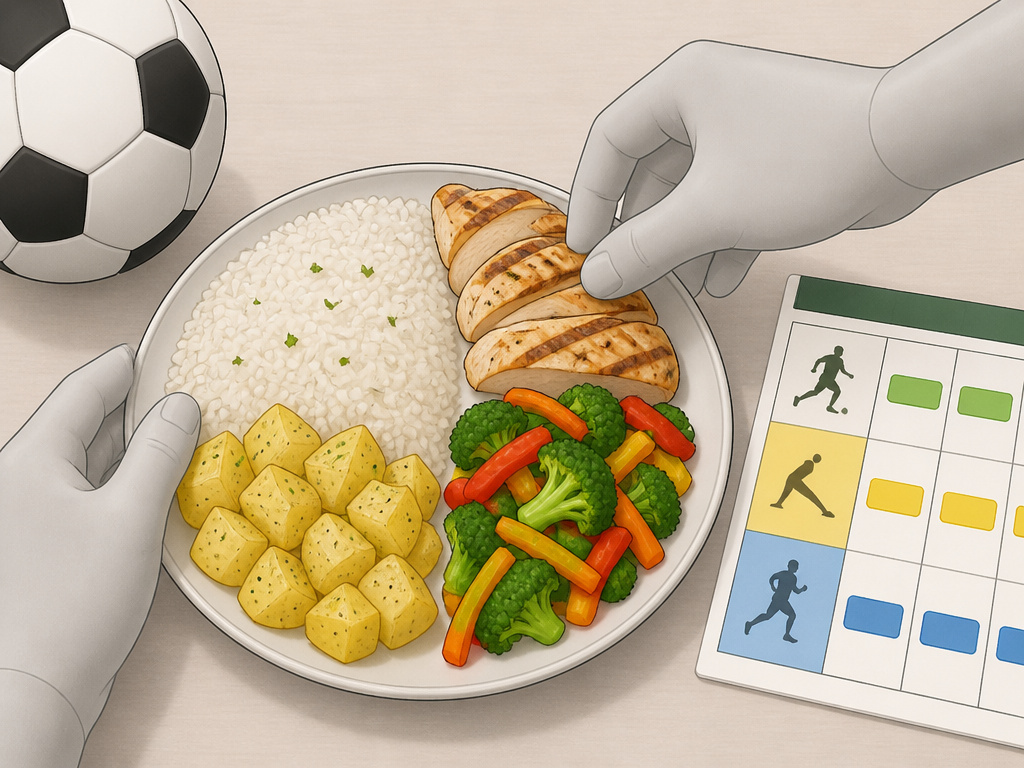
Theory is one thing. Making it work with your schedule, budget, and appetite is another. This is where a food-first, habit-based approach beats a complex, supplement-heavy regime.
Step 1: Find Your Baseline (The “Diet Recall”)
You can’t adjust what you don’t measure. The Portuguese experts agree: regular diet recalls or food frequency questionnaires conducted by trained practitioners are useful and easy-to-use tools to adjust nutrient intake. For a week, write down everything you eat and drink. Don’t judge it, just record it. Then, use a nutrition app to estimate your average daily carbs, protein, and calories. This shows your starting point.
Step 2: Apply the Plate Method for Daily Meals
Forget weighing everything forever. Use this visual guide for your main meals:
- 1/2 Plate = Carbohydrates (rice, pasta, potatoes, quinoa)
- 1/4 Plate = Protein (chicken, fish, eggs, tofu, lentils)
- 1/4 Plate = Vegetables (mixed colors for micronutrients) This naturally pushes you toward the right macro balance for a training day. On a rest day, you might shrink the carb portion slightly.
Step 3: Periodize Your Week
Map your week against your training load. Here’s a simple framework:
- Hard Training / Match Day -1: High carb day. Hit the upper end of your range. This is when carb loading is most effective.
- Match Day: Focus on timing. Big meal 3-4 hours out, light snack if needed, execute your in-match plan.
- Match Day +1 (Recovery Day): Don’t stop eating. This is a moderate-to-high carb and protein day to feed that elevated metabolism. This is as important as your pre-match meal.
- Light Training Days: Moderate carb, maintain protein. Let your intake match your output.
Step 4: Smart Supplementation (If Needed)
Supplements fill gaps; they don’t replace meals. If you struggle with post-match nutrition, a recovery shake with carbs and protein is a valid tool. But as detailed in our guide on football supplement pros and cons, they are the last piece of the puzzle, not the first. Your foundation is real food.
What are good food sources for carbs, protein, and fats?
For carbohydrates, focus on whole grains like rice, oats, and pasta, as well as potatoes and fruits. These are your primary fuel source. Protein should come from lean meats, fish, eggs, dairy, and plant-based options like lentils and beans for muscle repair. Healthy fats are found in foods like avocados, nuts, seeds, and olive oil. Vegan athletes and those trying to reduce energy intake for body composition need special attention to ensure total protein needs are met through careful food selection.
What does a daily football meal plan look like?
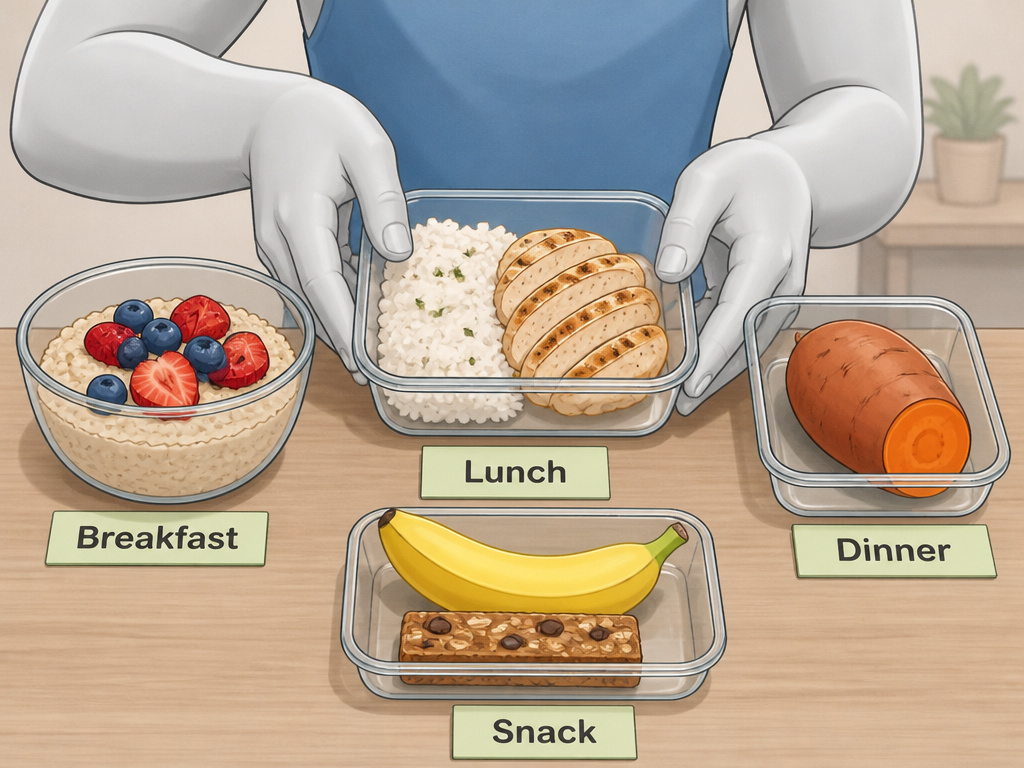
A practical daily plan centers on consistent fuel. Start with a breakfast rich in carbohydrates and protein, like oatmeal with fruit. Lunch and dinner should feature a lean protein source alongside a substantial portion of carbs like rice or sweet potato, with vegetables. Around training, include smaller carb-based snacks. On match day, the pre-match meal itself should be high in carbohydrates, and some players may reduce high-fibre foods depending on individual tolerance to avoid digestive discomfort during the game.
What foods should football players limit?
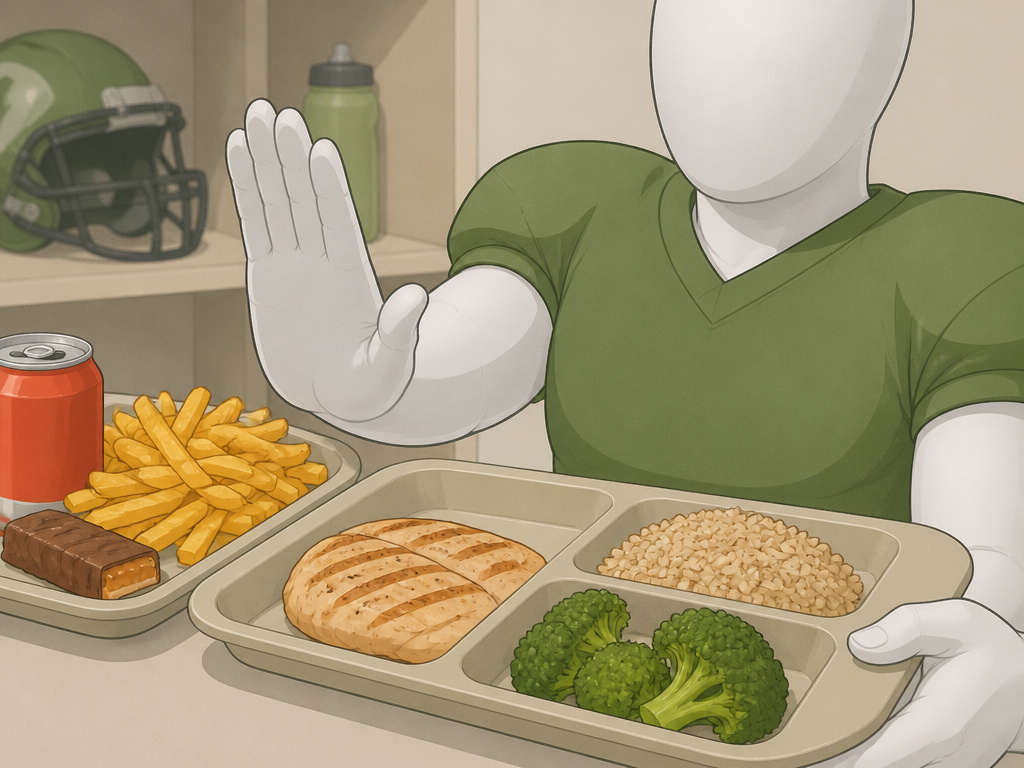
Players should limit foods that offer poor nutritional value and can hinder performance or recovery. This includes heavily fried foods, sugary snacks and beverages, and highly processed items. These foods can displace the necessary intake of quality carbohydrates, proteins, and healthy fats needed to meet daily targets. Many studies show players already fail to meet energy and carbohydrate recommendations, so prioritizing nutrient-dense foods over empty calories is a key part of the dietary strategy.
Frequently Asked Questions
An elite player’s plan is built on precision timing and gram-targets, not just “healthy food.” It involves consuming 6-8 g/kg/day (or 8-10 g/kg/day) of carbs in the two days before a match, a specific 2-3 g/kg pre-match meal 3-4 hours out, and a strict 1 g/kg/hour carb refuel in the first 4 hours after the match, all while maintaining a daily protein intake within the recommended 1.2–2 g/kg/day range. This is supported by a full-time nutritionist and chef, which is the main difference from an amateur plan.
What is the 4-2-1 rule for athletes?
The “4-2-1” rule is a simple, visual portion guide for a recovery meal: 4 fists of carbohydrates, 2 palms of protein, and 1 fist of vegetables. It’s not a scientific gram target, but it’s a useful, no-scale way to build a plate that aligns with the higher-end recovery needs after intense exercise.
Should amateur players follow the same plan as professionals?
Amateur players should follow the same principles (carb-load before games, prioritize recovery nutrition) but will have different calorie and absolute gram needs due to lower training volumes and often less muscle mass. The bigger difference is practicality: a pro has meals prepared; an amateur must plan and prep. Focus on hitting the relative targets (g/kg) that match your own training load.
Is protein powder necessary for football players?
No, protein powder is not necessary if you can meet your daily protein target (1.2-2.4 g/kg) through whole foods like chicken, fish, eggs, dairy, beans, and lentils. It is, however, a convenient and fast way to get a high-quality protein dose immediately after training when you might not have an appetite for a full meal.
How important is hydration compared to food?
Critically important, but for different reasons. Dehydration can significantly impair performance, concentration, and decision-making. While food provides the energy and building blocks, hydration is the medium that allows all those processes to happen. They are essential partners. A dedicated hydration strategy is as essential as your meal plan.
The Bottom Line
A football diet plan works when you trade vague notions of “eating well” for the specific, timed gram targets the sport’s governing bodies have already published. The Portuguese Federation says 6-8 g/kg of carbs pre-match. FIFA says 8-10 g/kg for a full load. Your job is to find where in that range your body performs best.
The hardest truth from the research is the simplicity of the failure. Most players, as a 2022 review confirmed, don’t eat enough to meet the demands they’re under. The gap isn’t knowledge; it’s consistent execution.
So start with one number. If you do nothing else, nail your pre-match meal at 2-3 g/kg of carbs, 3-4 hours out. That single habit will do more for your second-half performance than any supplement on the shelf. Everything else, the loading, the recovery, the periodization, builds from that foundation. The plan is just a map. You still have to make the journey.
